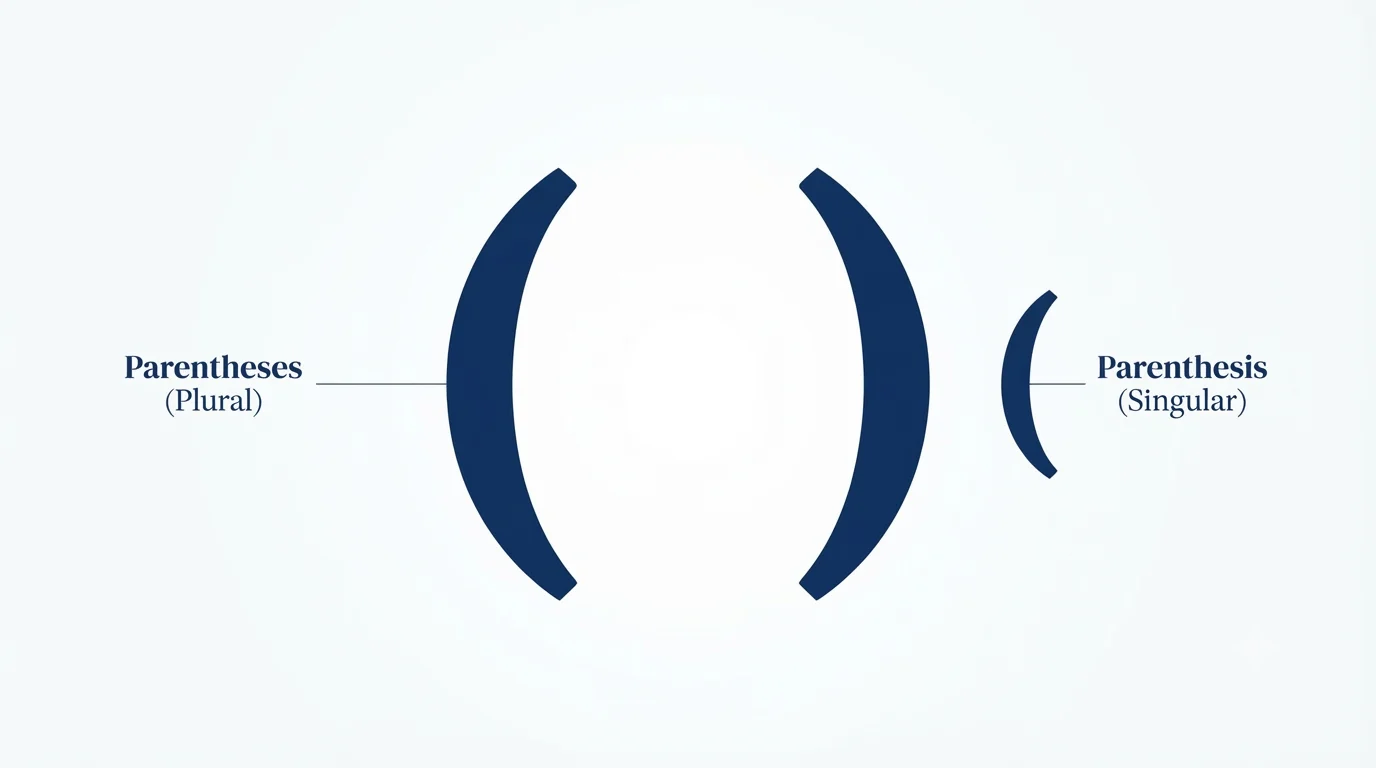
A parenthesis refers to a single curved mark, while parentheses refer to the pair of marks used to set off extra information. You use these punctuation marks to insert supplementary, clarifying, or incidental details into a sentence without disrupting the main flow of your writing.
Many writers feel confused when they try to choose between the words parenthesis and parentheses. This simple guide will help you understand how to use these marks correctly every time you write. You will learn the exact difference between the singular form and the plural form. Furthermore, you will discover why these marks matter for your daily communication.
Using the right term makes your writing look professional and polished. Whether you are typing an email, writing a report, or crafting an essay, correct punctuation shows that you care about your work. People often mix these terms up because they look very similar. However, once you learn the rule, you will never struggle with this choice again. In the sections below, we will explore clear definitions, common mistakes, and helpful tips. By the end of this article, you will feel confident using parentheses to improve the clarity of your sentences. Let us begin our journey into the world of punctuation.
To simplify your understanding, remember that parenthesis is the singular term, and parentheses is the plural. Think of a single curved mark as a parenthesis. When you enclose text using both the opening and closing marks, you are using parentheses. These marks function as a way to include extra information without breaking the primary thought of the sentence. Mastering this small detail significantly enhances your writing precision and readability.
Definition and Explanation
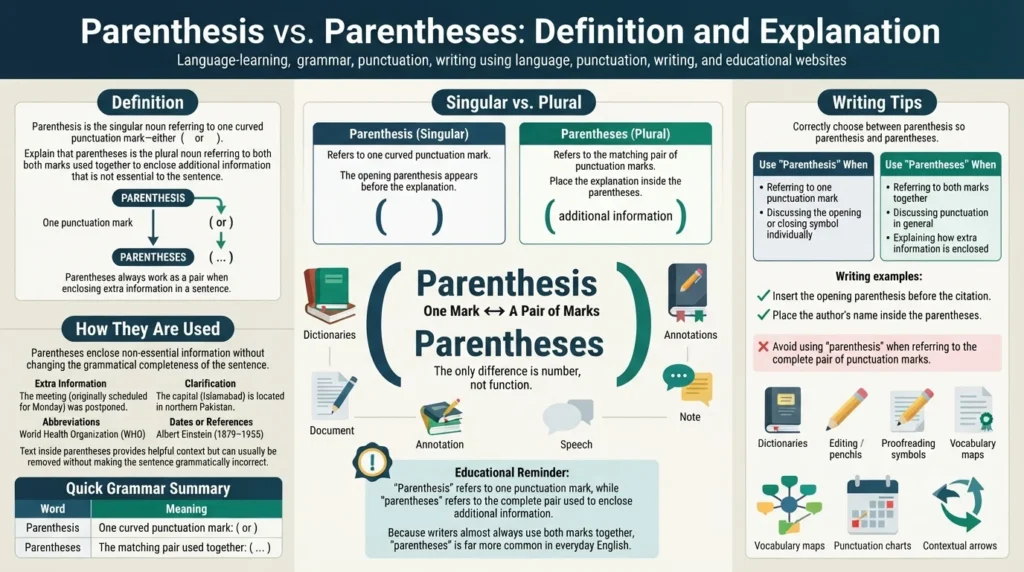
The term parenthesis (singular) describes one curved mark, either ( or ). Conversely, the term parentheses (plural) refers to the pair of marks used to enclose non-essential text. Writers utilize these marks to add comments, explanations, or side notes that provide context but are not strictly necessary for the sentence to remain grammatically complete.
Understanding the Singular versus Plural
If you only need to reference one specific mark, you use the singular noun. If you are discussing the pair as a whole, the plural noun is the correct choice. Most of the time, you will find yourself using the plural form because you almost always need both the opening and closing marks to set off your text properly.
Advantages and Disadvantages
Using these punctuation marks correctly offers several benefits, but it also carries potential pitfalls if you rely on them too heavily.
| Feature | Advantage | Disadvantage |
| Clarity | Allows for quick side notes without confusing the reader. | Excessive use can make a paragraph look cluttered. |
| Efficiency | Provides context quickly without needing a new sentence. | May distract the reader if the content is too long. |
| Structure | Helps organize complex lists or technical data. | Can disrupt the natural rhythm of your writing style. |
By balancing these pros and cons, you ensure your writing remains professional while utilizing the tools available to you.
Real-World Examples
Writers use these marks in many different settings. Below are a few scenarios to illustrate their function in real-world communication.
Technical Writing
In technical manuals, authors often include model numbers or alternative names for clarity.
- “Connect the power cable to the primary port (Port A) to ensure stable operation.”
Business Correspondence
In emails or reports, you might add a brief note to provide immediate background information.
- “We expect the final report to arrive by next Tuesday (October 24).”
Academic Writing
Students frequently use these marks for citations or to define abbreviations upon their first mention.
- “The World Health Organization (WHO) released a new set of guidelines regarding public safety.”
Regional and Global Usage
English speakers across the globe use these marks in the same way, but terminology preferences sometimes shift. In some regions, particularly in British English, people often use the term “brackets” to describe what Americans call parentheses. While they are functionally the same, recognizing this difference helps when you read international documents or work with global teams.
Terminology Comparison
- American English: Parentheses
( ) - British English: Round Brackets
( )
Regardless of the regional name, the grammatical rules for inserting extra information remain consistent across all forms of English.
Common Mistakes
Even experienced writers occasionally struggle with these marks. Avoiding these frequent errors will make your writing much cleaner.
Punctuation Placement
A common mistake involves placing the period outside the closing mark when the parentheses contain a full, independent sentence.
- Incorrect: This is an important rule (do not forget it).
- Correct: This is an important rule. (Do not forget it.)
Overloading Sentences
Another frequent error is stuffing too much information inside the marks. If the content within is too long, consider turning that information into a separate sentence or a footnote. Keep the enclosed text brief so the reader does not lose track of the main point.
Exercises with Answers
Test your knowledge with these short exercises to see how well you understand the usage.
Question 1: Which word is the singular form of the punctuation mark?
Question 2: True or False: Parentheses should be used to enclose essential information that changes the meaning of the sentence if removed.
Question 3: Correct the following sentence: “The meeting is at noon (but please arrive early.)”
Answer Key
Answer 1: The singular form is parenthesis.
Answer 2: False. You should only use them for non-essential or supplementary information.
Answer 3: “The meeting is at noon (but please arrive early).” Note that the period should be outside the closing parenthesis.
Related Concepts or Comparisons
People often confuse these marks with other types of brackets. Understanding these related concepts helps you select the right tool for the job.
- Square Brackets
[ ]: These typically denote editorial changes or additions within a direct quote. - Curly Brackets
{ }: These usually appear in mathematical sets or coding logic. - Angle Brackets
< >: These often indicate tags in programming languages like HTML or XML.
While parentheses are for general side notes, these other types of brackets serve specific technical or scholarly functions.
FAQs
What is the main difference between parenthesis and parentheses?
The main difference is quantity. Parenthesis refers to one individual curved mark, while parentheses refers to the pair used to enclose text.
When should I use parentheses in my writing?
Use them whenever you need to add extra, non-essential information, such as dates, definitions, or asides, without breaking the flow of your main sentence.
Can I use parentheses for essential information?
No, you should not use them for essential information. If the sentence loses its meaning when you remove the content inside, you should rewrite the sentence to incorporate that information naturally.
How do I punctuate a sentence containing parentheses?
If the parenthetical text is part of a larger sentence, the terminal punctuation (like a period) goes after the closing mark. If the entire sentence is in parentheses, the period stays inside.
Is it acceptable to use brackets instead of parentheses?
In British English, they are often called round brackets, which is perfectly acceptable. However, avoid using square or curly brackets as they have specific, different meanings.
How many parentheses can I use in one sentence?
While there is no hard limit, using them more than once in a single sentence creates confusion. It is better to rewrite the sentence for better readability.
Should I capitalize the first word inside parentheses?
Only capitalize the first word if the parenthetical statement is a complete, independent sentence. If it is just a phrase, do not use a capital letter.
Do parentheses help with SEO?
While they do not directly boost SEO, clear and well-punctuated writing improves user experience. Better readability encourages users to stay on your page longer, which indirectly supports your ranking.
Are parentheses considered formal or informal?
They are acceptable in both formal and informal writing. However, in strictly formal academic writing, you should use them sparingly to maintain a professional tone.
How do I check if my use of parentheses is correct?
Read your sentence aloud without the text inside the parentheses. If the sentence still makes complete sense, your usage is likely correct.
Conclusion
Mastering the difference between parenthesis and parentheses is a quick win for anyone looking to improve their writing skills. Remember that the singular form represents one mark, while the plural form represents the pair used to add supplementary context. By following the simple rules outlined in this guide—such as keeping your enclosed text brief and ensuring your terminal punctuation is correctly placed—you will produce cleaner, more professional content.
Do not let these small marks intimidate you. Instead, view them as helpful tools that provide flexibility in your writing. If you ever feel uncertain, perform the “read aloud” test to see if your main sentence maintains its integrity without the extra information. Apply these professional recommendations, practice with the provided exercises, and you will soon use these punctuation marks with complete confidence. Clear communication is the foundation of effective writing, and your commitment to mastering these small details will not go unnoticed by your readers.

Jack Murphy is a language writer with a passion for word meanings, synonyms, and effective communication. He creates informative and easy to understand content to help readers enhance their vocabulary and language skills.




10 thoughts on “Parentheses or Parenthesis| A Comprehensive Guide to Usage”