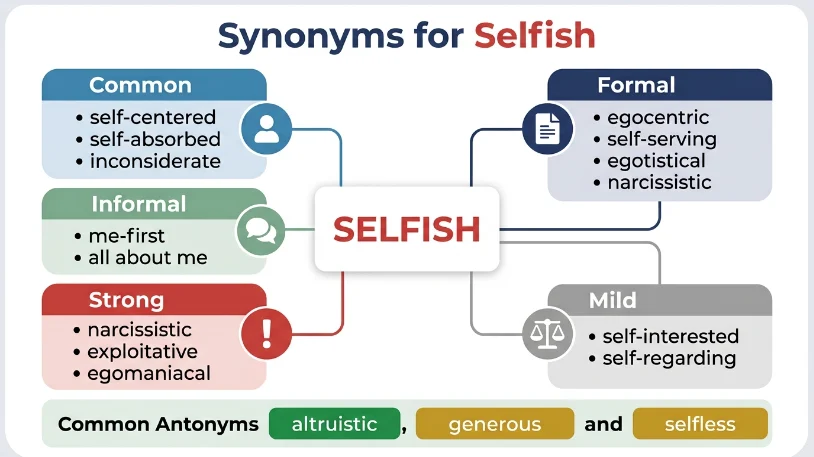
The best synonyms for selfish are self-centered, egocentric, self-serving, and self-absorbed. The right choice depends on tone, context, and intensity. For formal writing, try egotistical or narcissistic. For casual conversation, selfish itself or inconsiderate works well. For strong criticism, narcissistic or exploitative packs more punch. And for milder descriptions, self-interested or self-regarding softens the judgment.
Finding the right selfish synonym can make your writing more precise and help you express personality traits clearly. The word “selfish” describes someone who mainly cares about their own needs, interests, or advantages. However, different alternatives carry different meanings and levels of intensity. If you need another word for selfish, options such as self-centered, egocentric, self-serving, and inconsiderate may fit different situations. This guide explores useful selfish synonyms, synonyms for selfish, and synonyms of selfish with clear explanations and examples. You will also discover the best another word for selfish person and selfish person synonym depending on the context. For a broader understanding, we explain selfish synonym and antonym, including words that express the opposite quality. Whether you are writing an essay, improving your vocabulary, or searching for a synonym for selfish, this guide will help you choose the most accurate word confidently.
What Does Selfish Mean?
Selfish is an adjective that describes someone who prioritizes their own needs, desires, or well-being above those of others. It often implies a lack of concern for how one’s actions affect other people.
Simple definition: Concerned primarily with one’s own advantage, pleasure, or well-being, often at the expense of others.
Part of speech: Adjective
Common usage:
- Describing a person’s character: “He’s a selfish person who never shares.”
- Describing an action or behavior: “That was a selfish thing to do.”
- Describing a motive: “Her decision was purely selfish.”
Example sentences:
- “His selfish behavior alienated everyone who cared about him.”
- “She made the selfish choice to leave the team without warning.”
Core Meaning of Selfish
At its heart, selfish points to a focus on oneself that comes at the expense of others. It’s not simply about having preferences or taking care of your own needs it’s about doing so in a way that disregards or harms others.
Excessive self-concern. The person centers their own wants and needs, often ignoring the impact on others. This isn’t about healthy self-care; it’s about a pattern of putting yourself first even when it hurts others.
A lack of consideration. Selfishness often reveals itself in thoughtlessness forgetting to ask how others are doing, failing to consider other people’s feelings, or making decisions that benefit yourself while inconveniencing others.
A value judgment. Calling someone selfish isn’t neutral. It’s a criticism that implies they should have behaved differently. The word carries moral weight and suggests the person falls short of expected social standards.
A spectrum of behavior. Selfishness isn’t binary. It ranges from mild self-interest (which can be normal and even healthy) to pathological egocentrism (which can damage relationships and communities). The right synonym depends on where the behavior falls on that spectrum.
Grammar and Usage Notes
Understanding how selfish works grammatically helps you replace it correctly.
Part of speech: Adjective
Common sentence patterns:
- Subject + linking verb + selfish: “She is selfish.”
- Selfish + noun: “He made a selfish decision.”
- Selfish + prepositional phrase: “She was selfish with her time.”
Common collocations and phrases:
- selfish behavior
- selfish motives
- a selfish act
- selfish person
- selfish reasons
- purely selfish
When selfish sounds natural:
- In everyday conversation when describing someone’s character
- When criticizing a specific action or decision
- In informal and neutral writing
- When you want to make a clear moral judgment
When a synonym may work better:
- When you need more precision (use self-centered for self-focus, exploitative for harmful behavior)
- When you want to sound more formal or academic (use egocentric or narcissistic)
- When you want to soften the criticism (use self-interested)
- When you want to intensify the criticism (use egomaniacal or narcissistic)
- When you’re writing professionally and need to avoid harsh moral language
Best Synonyms for Selfish
| Synonym | Meaning | Tone | Best Use Case | Example Sentence |
|---|---|---|---|---|
| Self-centered | Focused on oneself; unconcerned with others | Neutral to critical | General description of self-focus | She’s too self-centered to notice anyone else’s problems. |
| Egocentric | Seeing everything from one’s own perspective | Formal, psychological | Academic or clinical contexts | His egocentric worldview left no room for others’ needs. |
| Self-serving | Acting to benefit oneself, often at others’ expense | Formal, critical | Professional and business contexts | The CEO’s self-serving policies hurt the company’s culture. |
| Self-absorbed | Wrapped up in one’s own thoughts and concerns | Neutral to critical | Describing someone who ignores others | He was too self-absorbed to realize his friends were struggling. |
| Egotistical | Excessively self-important; vain | Formal, critical | Describing arrogance and self-importance | Her egotistical attitude made her difficult to work with. |
| Inconsiderate | Not thinking about others’ feelings or needs | Neutral to critical | Everyday situations, thoughtlessness | It was inconsiderate of him to leave without telling anyone. |
| Narcissistic | Having an inflated sense of self-importance; lacking empathy | Strong, clinical | Severe cases, psychological descriptions | His narcissistic behavior drove away everyone close to him. |
| Exploitative | Using others for personal gain | Strong, formal | Describing harmful, manipulative behavior | The exploitative contract took advantage of vulnerable workers. |
Common Synonyms for Selfish
These are the everyday alternatives you’ll hear in conversation and see in regular writing.
Self-centered
Meaning: Focused primarily on one’s own interests, feelings, and needs, often to the exclusion of others.
Best context: General descriptions of someone who doesn’t consider others.
Example: “Her self-centered attitude made her hard to be around.”
Self-absorbed
Meaning: So wrapped up in one’s own thoughts, problems, or concerns that others are ignored.
Best context: Describing someone who seems oblivious to others because they’re consumed by their own world.
Example: “He’s so self-absorbed that he didn’t even notice I was upset.”
Inconsiderate
Meaning: Not showing concern for the feelings or needs of others.
Best context: Everyday situations where someone has been thoughtless or rude.
Example: “It was inconsiderate to play loud music so late at night.”
Selfish
Meaning: The original word concerned primarily with one’s own advantage at the expense of others.
Best context: General use; clear, direct, and widely understood.
Example: “She made a selfish choice that hurt the entire team.”
Greedy
Meaning: Wanting more than one needs, especially when it deprives others.
Best context: Describing someone who hoards resources or always wants more.
Example: “He was too greedy to share his winnings with the others.”
Self-indulgent
Meaning: Giving in to one’s own desires and pleasures without restraint or regard for consequences.
Best context: Describing excessive or indulgent behavior.
Example: “Her self-indulgent spending put the household in debt.”
Formal Synonyms for Selfish
When you’re writing academic papers, business reports, or professional correspondence, these formal alternatives will serve you well.
Egocentric
This term comes from psychology and describes someone who perceives the world primarily from their own viewpoint. It’s clinical and precise, avoiding the harsh moral judgment of selfish.
Example: “The study examined the relationship between egocentric behavior and social adjustment in adolescents.
When to use: Academic writing, psychology, discussions of cognitive development.
Self-serving
This phrase describes actions or policies that benefit the person making them, often at the expense of others. It’s commonly used in business, politics, and organizational contexts.
Example: “The board rejected the self-serving proposal as detrimental to the company’s long-term interests.”
When to use: Professional settings, business writing, political analysis.
Egotistical
This word emphasizes excessive self-importance and vanity. It suggests someone who not only puts themselves first but also believes they deserve to.
Example: “His egotistical management style demoralized the entire department.”
When to use: Formal descriptions of arrogant or self-important behavior.
Narcissistic
A clinical term from psychology describing a pattern of grandiosity, a need for admiration, and a lack of empathy. It’s the strongest formal synonym.
Example: “The study explored the link between narcissistic traits and leadership effectiveness.”
When to use: Academic or clinical writing about personality disorders or extreme self-focus.
Self-interested
This is the mildest formal option. It simply means acting in one’s own interest, without necessarily implying harm to others. It’s descriptive rather than judgmental.
Example: “Voters are often motivated by self-interested concerns rather than altruistic ideals.”
When to use: Economics, political science, policy discussions where selfishness is analyzed as rational behavior.
Exploitative
This describes behavior that takes unfair advantage of others for personal gain. It implies a power imbalance and harm to the exploited party.
Example: “The labor practices were widely condemned as exploitative.”
When to use: Discussions of labor, business ethics, social justice.
Informal Synonyms for Selfish
For everyday conversation, text messages, social media, and casual writing, these alternatives feel natural and relaxed.
Me-first
Meaning: A playful or blunt way to say someone always puts themselves ahead of others.
Best context: Lighthearted criticism among friends.
Example: “He’s got a me-first attitude that really gets old.”
All about me
Meaning: Someone who makes everything revolve around themselves.
Best context: Casual complaints about self-absorbed people.
Example: “She’s always been all about me and never asks how I’m doing.”
It’s all about number one
Meaning: The person prioritizes themselves above everyone else.
Best context: Conversation about someone’s selfish lifestyle.
Example: “For him, it’s all about number one nobody else matters.”
Selfish jerk
Meaning: A blunt, unflattering description of someone who is selfish in an offensive way.
Best context: Venting frustrations.
Example: “He was a selfish jerk for not even saying thank you.”
Self-centered
This also works in informal contexts and is one of the most natural alternatives for everyday speech.
Example: “My roommate is so self-centered he never asks how my day was.”
Greedy guts
Meaning: A childish or playful insult for someone who takes more than their share.
Best context: Very casual, often humorous.
Example: “Leave some for the rest of us, you greedy guts.”
Strong Synonyms for Selfish
Sometimes you need a word that carries more weight, criticism, or psychological depth. These stronger alternatives add punch to your writing.
Narcissistic
This word suggests a level of self-focus that goes beyond ordinary selfishness into a personality pattern characterized by grandiosity and lack of empathy.
Example: “His narcissistic behavior destroyed every relationship he had.”
When to use: When you want to emphasize extreme self-absorption and a lack of empathy.
When it’s too strong: When the behavior is mild or occasional; using it casually can sound exaggerated.
Egomaniacal
This intense word describes someone who is obsessively self-centered and consumed with their own importance.
Example: “The egomaniacal CEO refused to listen to any criticism.”
When to use: When you want to emphasize extreme self-importance and an almost obsessive focus on oneself.
When it’s too strong: For describing someone who is merely self-interested but not pathologically obsessed.
Exploitative
This word emphasizes the harm selfish behavior causes to others. It goes beyond mere thoughtlessness to active use of others.
Example: “His exploitative business practices left a trail of ruined lives.”
When to use: When you want to highlight the harmful effects of selfish behavior on others.
When it’s too strong: When the person is just thoughtless rather than actively taking advantage.
Self-serving
Though formal, this word carries strong criticism when used in the right context. It suggests that someone’s actions are motivated entirely by personal gain.
Example: “The politician’s self-serving policies enriched his donors while hurting constituents.”
When to use: Professional and political contexts where you want to expose hidden motives.
When it’s too strong: In personal, non-political situations where the stakes are lower.
Conscienceless
This rare but powerful word suggests a complete lack of moral awareness someone who feels no guilt about their selfish choices.
Example: “His conscienceless decisions showed he cared about no one but himself.”
When to use: When you want to emphasize a total lack of guilt or moral compunction.
When it’s too strong: For everyday selfishness that involves at least some awareness of others.
Mild Synonyms for Selfish
When you want to soften your language, downplay the criticism, or describe self-interest without judgment, these milder alternatives work well.
Self-interested
This neutral phrase simply means acting in one’s own interest. It doesn’t inherently imply harm to others or a lack of empathy.
Example: “Her self-interested decision was understandable given the circumstances.”
When to use: When you want to describe someone’s motivation without moral judgment.
When it’s too mild: When the behavior clearly harms others and deserves stronger criticism.
Self-regarding
A more formal, less common synonym that suggests concern with oneself, but not necessarily to the exclusion of others.
Example: “His self-regarding nature made it difficult for him to see other people’s perspectives.”
When to use: Academic or formal writing where you want to avoid harsh judgment.
When it’s too mild: When you need to criticize clearly harmful behavior.
Self-focused
This describes someone who is oriented toward themselves, but it doesn’t carry the same negative weight as selfish. It’s almost descriptive.
Example: “Young children tend to be self-focused until they develop empathy.”
When to use: Developmental or psychological descriptions where selfishness is expected or temporary.
When it’s too mild: When you want to make a clear moral criticism.
Independent
Sometimes what looks like selfishness is just self-reliance or not wanting to depend on others. Independent frames it positively.
Example: “She’s very independent and prefers to handle things on her own.”
When to use: When you want to describe self-sufficiency without negative judgment.
When it’s too mild: When the behavior actually harms others or disregards their needs.
Synonyms for Selfish by Context
The best synonym for selfish depends heavily on where and how you’re writing. Here’s how to choose based on context.
Everyday Conversation
In casual speech, direct and simple words work best. Self-centered, inconsiderate, and selfish itself are clear, natural, and widely understood. Reserve stronger words like narcissistic for truly extreme behavior.
Example: “He’s so self-centered he never asks how anyone else is doing.”
Professional Writing
Business emails, reports, and professional communication call for language that’s critical but not inflammatory. Self-serving and self-interested strike the right tone formal enough to be taken seriously but not so harsh that you sound unprofessional.
Example: “The manager’s self-serving decisions have negatively impacted team morale.”
Academic Writing
In research papers, essays, and scholarly articles, precision and neutrality are paramount. Egocentric, narcissistic (when clinically appropriate), and self-interested are your best choices. Avoid casual alternatives.
Example: “The study examined whether egocentric tendencies correlate with reduced prosocial behavior.”
Creative Writing
Fiction and creative nonfiction give you more freedom. Self-absorbed, narcissistic, egomaniacal, and self-indulgent can add color and psychological depth to your characters.
Example: “Marcus was a self-absorbed artist who believed the world revolved around his inspiration.”
Marketing Copy
When you’re writing to persuade, you rarely want to call anyone selfish directly. Instead, use gentler terms like self-focused or self-interested to describe customer motivations, or avoid negative language entirely.
Example: “We understand that you have self-interested reasons for wanting the best deal and we respect that.”
Emotional Expression
When you’re describing personal feelings about someone’s behavior, choose words that match your emotional weight. Inconsiderate for mild frustration, selfish for clear criticism, narcissistic for deep hurt.
Example: “I felt so hurt by her inconsiderate comments.”
Personal Communication
Messages to friends and family allow for a relaxed tone. Self-centered, self-absorbed, or even playful phrases like me-first feel natural and warm rather than harsh.
Example: “My brother’s being so self-absorbed lately he didn’t even ask about my new job.”
Another Word for Selfish in a Sentence
Here are 15 natural example sentences using different synonyms for selfish in realistic contexts.
- His self-centered behavior pushed away everyone who tried to get close to him.
- The CEO’s self-serving decisions prioritized quarterly profits over employee well-being.
- She was so self-absorbed that she didn’t notice her friend was crying.
- His inconsiderate habit of interrupting others made meetings unbearable.
- The study explored how egocentric thinking develops in early childhood.
- Her egotistical attitude made it impossible for her to accept constructive feedback.
- His narcissistic traits made him incapable of genuine empathy.
- The contract was exploitative, taking advantage of workers who had no other options.
- Her self-indulgent spending left the family struggling to pay bills.
- His me-first approach to life alienated even his closest friends.
- The politician’s self-interested motives were obvious to everyone.
- Her self-regarding nature made it hard for her to see anyone else’s perspective.
- The greedy landlord raised rents without making any improvements to the building.
- His conscienceless actions showed he had no regard for anyone but himself.
- The manager’s exploitative policies caused a mass exodus of talented employees.
Selfish Synonyms Compared
Not all synonyms for selfish are created equal. Here’s how closely related alternatives differ in meaning, tone, and use.
Self-centered vs. Self-absorbed vs. Egocentric
All three describe a focus on oneself, but with different nuances.
- Self-centered suggests someone who puts themselves at the center of their world and doesn’t consider others. It’s the most direct and neutral alternative to selfish.
- Self-absorbed implies being so consumed by one’s own thoughts or problems that others are simply invisible. It’s more about obliviousness than active disregard.
- Egocentric is the most formal and psychological. It describes a cognitive orientation seeing everything from one’s own perspective, often without realizing others have different viewpoints.
Verdict: Choose self-centered for general use, self-absorbed for obliviousness, and egocentric for formal or clinical writing.
Self-serving vs. Exploitative
These synonyms emphasize the harmful impact of selfish behavior.
- Self-serving describes actions motivated by personal gain. It’s critical but not necessarily devastating someone can be self-serving without being cruel.
- Exploitative describes actions that actively take advantage of others. It implies a power imbalance and harm to the exploited person or group. It’s much stronger and more damaging.
Verdict: Use self-serving for motivated self-interest, exploitative for harmful taking advantage.
Egotistical vs. Narcissistic
These synonyms emphasize self-importance and lack of empathy.
- Egotistical describes someone with an excessive sense of self-importance. They believe they’re better than others and want others to acknowledge it.
- Narcissistic is a clinical term that implies a deeper pattern of grandiosity, need for admiration, and lack of empathy. It’s a personality trait, not just a behavior.
Verdict: Use egotistical for arrogance and self-importance, narcissistic for extreme, pathological self-focus.
Inconsiderate vs. Thoughtless
These are the milder, everyday alternatives.
- Inconsiderate describes a lack of concern for others’ feelings or needs. It’s a behavior you can criticize without calling someone wholly selfish.
- Thoughtless describes someone who acts without thinking about consequences for others. It’s even milder it might be absent-mindedness rather than malice.
Verdict: Use inconsiderate for lack of concern, thoughtless for lack of awareness.
Words Similar to Selfish
These words belong to the same semantic field as selfish but aren’t always direct replacements. Understanding the differences helps you use them correctly.
Self-indulgent
This describes someone who gives in to their own desires and pleasures without restraint. It’s similar to selfish because it involves focusing on oneself, but it doesn’t necessarily imply harming others it’s more about excess and lack of discipline.
When it’s useful: When you want to describe excessive personal pleasure-seeking rather than disregard for others.
Arrogant
Arrogance is about an inflated sense of one’s own importance. While selfish people can be arrogant, selfishness is about action and motivation; arrogance is about attitude and self-perception.
When it’s useful: When you want to emphasize superiority rather than self-interest.
Greedy
Greed specifically refers to wanting more than one needs, especially in terms of money, food, or resources. Selfishness is broader it can be about time, attention, or emotional energy.
When it’s useful: When the focus is on hoarding resources or possessions.
Entitled
An entitled person believes they deserve special treatment or privileges. This can look like selfishness, but the core is a sense of deservingness rather than simple self-focus.
When it’s useful: When you want to emphasize someone’s expectations rather than their actions.
Vain
Vanity is excessive pride in one’s appearance, achievements, or qualities. While selfishness can include vanity, the core of selfishness is putting oneself first, not self-admiration.
When it’s useful: When the focus is on appearance or self-image rather than behavior.
Solitary
A solitary person prefers being alone. This isn’t necessarily selfish they might be kind and considerate when they’re with others, but they just don’t want company.
When it’s useful: When you want to describe introversion or preference for solitude, not selfish behavior.
Individualistic
This describes someone who values independence and self-reliance. It’s often positive and shouldn’t be confused with selfishness, which implies disregard for others.
When it’s useful: When you want to celebrate self-sufficiency rather than criticize self-focus.
Antonyms of Selfish
Understanding what selfish isn’t helps clarify what it is. Here are the main antonyms.
| Antonym | Meaning | Example Sentence |
|---|---|---|
| Altruistic | Concerned for the well-being of others; unselfish | Her altruistic work with homeless veterans earned her widespread respect. |
| Selfless | Putting others’ needs before one’s own | His selfless dedication to his family was inspiring. |
| Generous | Willing to give and share freely | She was generous with both her time and her money. |
| Considerate | Showing concern for the feelings and needs of others | It was considerate of him to offer his seat to the elderly woman. |
| Charitable | Kind and generous, especially to those in need | The charitable organization helped thousands of families. |
| Empathetic | Able to understand and share others’ feelings | Her empathetic nature made her an excellent counselor. |
| Giving | Willing to give to others without expecting anything in return | He was a giving person who always put others first. |
| Benevolent | Well-meaning and kind; desiring to do good | The benevolent CEO donated millions to education programs. |
| Magnanimous | Generous and forgiving, especially toward a rival or less powerful person | In a magnanimous gesture, she shared the credit with her team. |
| Unselfish | Not selfish; putting others’ interests first | Her unselfish actions saved the project from failure. |
How to Choose the Right Synonym for Selfish
Choosing the right synonym isn’t complicated, but it does require you to think about a few key factors.
Match the context. Where are you writing? Academic papers demand formality; text messages don’t. Choose a synonym that fits the setting. Narcissistic belongs in a psychology paper; selfish jerk belongs in a frustrated text to a friend.
Match the tone. Think about how you want to sound. Critical? Neutral? Formal? Casual? Each synonym carries its own emotional weight. Self-serving sounds professional; me-first sounds conversational.
Check the intensity. Are you describing mild self-interest or pathological self-focus? Choose a synonym that matches the severity. Self-interested is mild; narcissistic is strong.
Think about your reader. Will they understand the word? Will it sound natural to them? Avoid overly formal words in casual contexts and overly casual words in formal ones. Your reader’s expectations matter.
Check whether the synonym is exact or only related. Not every word in this guide is a perfect replacement for selfish in every use. Self-indulgent emphasizes pleasure-seeking, not disregard for others. Arrogant emphasizes attitude, not behavior. Make sure the synonym actually means what you want to say.
Keep the sentence natural. Read your sentence aloud with the new word. Does it flow? Does it sound like something a real person would say? If it feels forced or awkward, try a different synonym.
Use simple words when clarity matters. When in doubt, choose the simplest, clearest word. Selfish, self-centered, and inconsiderate are almost always safe choices that readers will understand instantly.
Common Mistakes When Using Synonyms for Selfish
Even experienced writers make mistakes when replacing selfish. Here are the most common pitfalls and how to avoid them.
Choosing a word with the wrong tone. Using narcissistic in casual conversation about someone who’s just a bit self-absorbed sounds exaggerated and dramatic. Using selfish in a clinical psychology paper sounds too blunt. Match the tone to the context.
Using a synonym that is too strong. Narcissistic implies a personality pattern, not just occasional selfish behavior. If you use it lightly, you risk sounding like you’re diagnosing someone.
Using a formal word in casual writing. “My roommate’s egocentric tendencies are frustrating” sounds stiff in conversation. “My roommate’s so self-centered” sounds natural.
Using a casual word in professional writing. “The board rejected the CEO’s me-first proposal” might be too informal for a business report. “The board rejected the CEO’s self-serving proposal” sounds more professional.
Replacing selfish without checking meaning. Self-indulgent doesn’t mean the same as selfish. Someone can be self-indulgent without being selfish they might treat themselves well but still care about others.
Treating related words as exact synonyms. Arrogant and selfish overlap but aren’t the same. Arrogance is about self-importance; selfishness is about prioritizing oneself over others. They often go together, but not always.
Making the sentence sound unnatural. Forcing a synonym into a sentence where it doesn’t belong creates awkward phrasing. If the sentence sounds better with selfish, leave it.
Overusing synonyms. Replacing every instance of selfish with a different word can make your writing feel forced. Sometimes selfish is simply the right word. Use synonyms when they improve clarity or tone, not just for the sake of variety.
Quick Synonym List for Selfish
Common Synonyms
- Self-centered
- Self-absorbed
- Inconsiderate
- Selfish
- Greedy
Formal Synonyms
- Egocentric
- Self-serving
- Egotistical
- Narcissistic
- Self-interested
- Exploitative
Informal Synonyms
- Me-first
- All about me
- It’s all about number one
- Selfish jerk
- Self-centered
Strong Synonyms
- Narcissistic
- Egomaniacal
- Exploitative
- Self-serving
- Conscienceless
Mild Synonyms
- Self-interested
- Self-regarding
- Self-focused
- Independent
Related Words
- Self-indulgent
- Arrogant
- Greedy
- Entitled
- Vain
- Solitary
- Individualistic
FAQs
What is the best synonym for selfish?
The best synonym depends on your context. For general use, self-centered and self-absorbed are excellent alternatives. For formal writing, egocentric or self-serving work well. For strong criticism, narcissistic or exploitative are more powerful. Choose based on your tone and what you’re trying to say.
What is another word for selfish?
Common alternatives include self-centered, self-absorbed, inconsiderate, egocentric, self-serving, egotistical, and narcissistic. The right one depends on whether you’re describing self-focus, thoughtlessness, arrogance, or harmful behavior.
What is a formal synonym for selfish?
Formal synonyms include egocentric (psychological), self-serving (business and politics), egotistical (arrogance), narcissistic (clinical), self-interested (neutral), and exploitative (harmful). These work well in academic, business, and professional writing.
What is an informal synonym for selfish?
Informal synonyms include me-first, all about me, it’s all about number one, selfish jerk, and self-centered. These are perfect for conversation, text messages, social media, and casual writing.
What is a stronger word for selfish?
Stronger alternatives include narcissistic, egomaniacal, exploitative, and conscienceless. These words emphasize extreme self-focus, lack of empathy, or harm to others.
What is a milder word for selfish?
Milder alternatives include self-interested, self-regarding, self-focused, and independent. These words downplay the criticism, describing self-focus without the harsh moral judgment.
What words are similar to selfish?
Related words include self-indulgent, arrogant, greedy, entitled, vain, solitary, and individualistic. These belong to the same semantic field but aren’t always direct replacements. Self-indulgent emphasizes pleasure-seeking; arrogant emphasizes self-importance.
What is the opposite of selfish?
The main antonyms are altruistic, selfless, generous, considerate, charitable, empathetic, giving, benevolent, magnanimous, and unselfish. These words describe putting others first, being concerned for others’ well-being, and acting with generosity.
How do I choose the right synonym for selfish?
Consider your context, tone, intensity, and reader. Match the formality level formal for academic and professional writing, informal for conversation. Think about whether you’re emphasizing self-focus, thoughtlessness, arrogance, or harm to others. Read your sentence aloud with the new word to make sure it sounds natural.
Conclusion
Selfish is a word with real weight. It’s not just descriptive it’s judgmental. That’s why choosing the right synonym matters so much. Whether you’re writing casually or professionally, formally or informally, the word you pick shapes how your reader understands the person or behavior you’re describing. For mild criticism, self-interested or inconsiderate can soften the blow. For strong criticism, narcissistic or exploitative packs more punch. For formal contexts, egocentric or self-serving provides precision without harshness.
The key is to match your word to your context, tone, and intended intensity. Don’t force a synonym where it doesn’t belong, and don’t be afraid to stick with selfish when it’s the most natural choice. With the options in this guide, you have the tools to write more precisely, sound more professional, and communicate more effectively every single time.