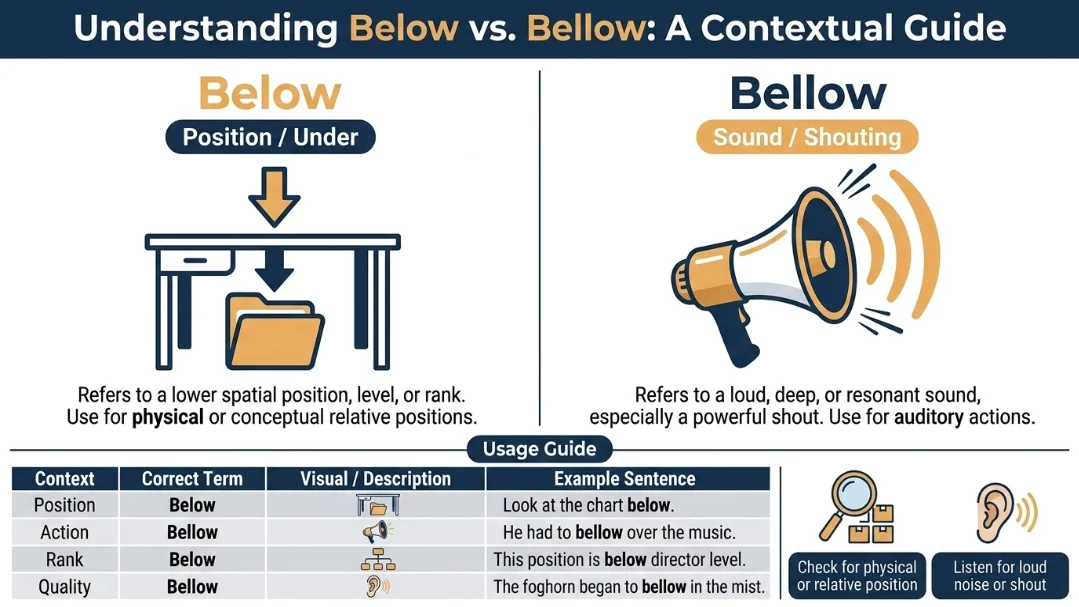
The word “below” is a preposition or adverb used to describe a lower position or rank, such as being underneath something. Conversely, “bellow” is a verb that refers to the act of shouting in a deep, loud voice, often when someone is angry or in pain.
Language often contains pairs of words that look similar but have entirely different meanings. The choice between “below” or “bellow” frequently confuses writers because of their shared starting letters and similar sounds. Understanding which one to pick requires looking at the role the word plays in your sentence. One word describes where an object is located, while the other describes a specific type of sound. Getting these right is essential for clear communication in both professional emails and casual writing. This guide simplifies the confusion by breaking down the definitions, providing context, and offering practice exercises. Once you master the difference, you will never struggle with this choice again. Let us explore the nuances of these words to improve your writing skills today.
Definition and Explanation
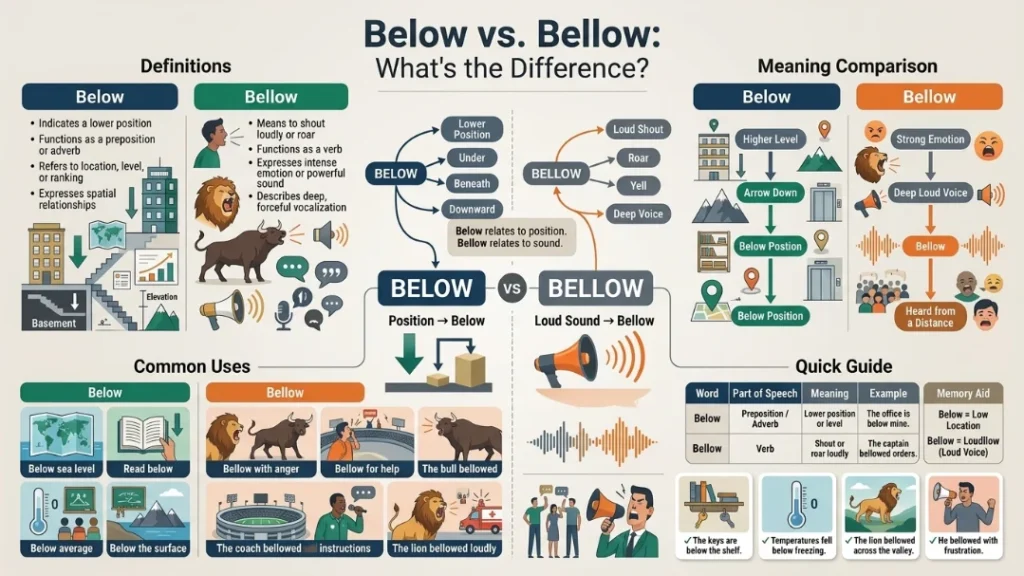
“Below” acts primarily as a preposition or an adverb indicating a lower position than something else. You use it when you describe objects, physical levels, or abstract rankings. For instance, you might say the basement is located below the main floor. It remains one of the most common ways to express spatial relationships in English.
“Bellow,” on the other hand, functions as a verb. It describes a deep, loud roar or a forceful shout. People often bellow when they express intense emotions like fury, agony, or extreme excitement. Think of a large animal or an angry person raising their voice to be heard from a distance. The word captures both the volume and the low-pitched quality of the sound.
Comparison Table
| Feature | Below | Bellow |
| Part of Speech | Preposition or Adverb | Verb |
| Primary Meaning | Lower than or underneath | To shout loudly and deeply |
| Usage Context | Position, rank, or level | Sound, volume, or emotion |
| Common Suffix | None | -ed, -ing, -s |
Advantages and Disadvantages
Using “below” offers the advantage of precision when describing physical layouts. It provides a clear, objective sense of place. However, writers sometimes overuse it when more descriptive words like “underneath” or “beneath” would add flavor to the text. It serves a functional purpose but lacks emotional impact.
“Bellow” provides a powerful advantage because it creates an immediate auditory experience for the reader. It paints a picture of intense action and sound. The disadvantage lies in its specificity; you cannot use it to describe quiet or normal speaking. Using it when someone is just talking normally would make your writing sound exaggerated or confusing.
Real-World Examples
To master the difference between below or bellow, observe these distinct scenarios.
- Spatial Usage: The temperature dropped significantly below freezing during the night.
- Vocal Usage: The frustrated coach began to bellow instructions at the team from the sidelines.
- Ranking Usage: His performance was well below expectations for this quarter.
- Emotional Usage: She started to bellow with laughter after hearing the hilarious joke.
Regional and Global Usage
English speakers across the globe use “below” consistently in formal and informal settings. It appears in navigation, mathematics, and everyday directions without any regional variations.
“Bellow” also enjoys universal recognition in the English-speaking world. You might hear it more often in literature or storytelling than in daily conversation. While specific accents might pronounce the two words differently, the spelling and usage remain uniform across American, British, and Australian English.
Common Mistakes and Corrections
The most frequent error occurs when writers confuse the spelling, often adding the extra ‘w’ to the sound-based verb. Another common mistake involves using “bellow” to describe a low physical position, which is entirely incorrect.
- Incorrect: The boat sank bellow the water level.
- Correct: The boat sank below the water level.
- Incorrect: The captain stood on the deck and started to below orders.
- Correct: The captain stood on the deck and started to bellow orders.
Exercises with Answers
Practice your understanding of below or bellow with these quick questions. Fill in the blank with the correct word.
- Please write your name ________ the dotted line.
- The wounded soldier began to ________ in pain.
- Our office is located two floors ________ the marketing department.
- The giant creature let out a massive ________.
- Do not ________ at your coworkers when you feel stressed.
Answers:
- below
- bellow
- below
- bellow
- bellow
Related Concepts or Comparisons
Concepts related to “below” include words like beneath, under, and underneath. These synonyms describe the same spatial relationship but carry different levels of formality. Beneath often feels more literary, while below is neutral.
Concepts related to “bellow” include words like roar, yell, scream, and shout. Roar implies a sound often associated with animals or fire. Yell and shout remain broader terms that cover various volumes. Bellow specifically highlights the low, deep, and resonant nature of the sound.
FAQs
What is the simplest way to remember below or bellow?
Think of “below” as having a ‘w’ for “way down,” while “bellow” ends in a double ‘l’ which helps you remember “loud.”
Can I use bellow to describe a person speaking normally?
No, using bellow to describe normal speech is incorrect because it implies an intense, loud, and deep-pitched vocalization.
Is below ever used as a verb?
No, “below” is strictly a preposition or an adverb and never functions as a verb in standard English grammar.
Does bellow always imply anger?
Not always, though it frequently does. People also bellow out of pure joy, excitement, or extreme pain.
Can below describe abstract concepts?
Yes, you can use it for ranks, temperatures, or grades, such as “his score was below average.”
Is bellow the same as a scream?
While both are loud, a scream is typically high-pitched, whereas a bellow is deep, resonant, and low-pitched.
Are these words homophones?
No, they are not true homophones because they have distinct pronunciations and are used in completely different grammatical contexts.
Which word is more common in professional writing?
“Below” is much more common in professional settings, as it is used to describe charts, data, and office locations.
Do I need a hyphen between below or bellow?
No, these are two separate words with different definitions and should never be hyphenated or joined.
Conclusion
Distinguishing between below or bellow comes down to identifying the function of the word in your sentence. If you describe a location, a rank, or a measurement, “below” is your correct choice. If you describe a deep, booming shout or an animal-like roar, “bellow” serves your needs perfectly. Mastering these terms will prevent spelling errors and ensure your intent remains clear to your reader.
Actionable advice involves proofreading your work specifically for these two words whenever you describe a physical position or a loud sound. If you find yourself writing about volume, ensure you have that double ‘l’ at the end. Conversely, if you are writing about placement, ensure you keep the ‘w’ to signify the location. Consistent practice helps these rules become second nature. You now possess the knowledge to use these words with total confidence in your writing.

Jack Murphy is a language writer with a passion for word meanings, synonyms, and effective communication. He creates informative and easy to understand content to help readers enhance their vocabulary and language skills.








7 thoughts on “Below or Bellow| Meaning, Examples and Better Word Choices”