Finding accurate synonyms for normal allows you to describe standard, expected, or natural situations with greater precision. Because “normal” is a versatile adjective, your choice of substitute should depend on whether you are describing behavior, quality, or frequency. If you need a quick replacement, words like “typical,” “standard,” or “regular” often serve as excellent alternatives depending on your intended tone.
Best Synonyms for Normal
| Context | Best Synonyms |
| Common/Frequent | Typical, Regular, Usual |
| Standard/Accepted | Conventional, Standard, Established |
| Natural/Unforced | Natural, Routine, Average |
| Formal/Technical | Orthodox, Canonical, Habitual |
What Does Normal Mean?
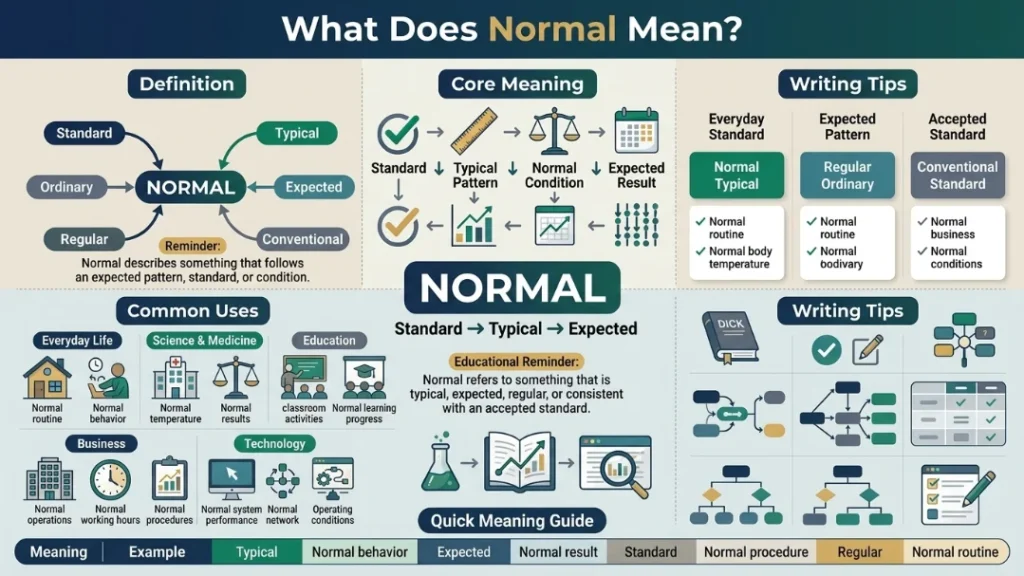
At its core, “normal” describes something that conforms to a standard, rule, or typical pattern. It is the baseline against which we measure deviations. When something is normal, it is predictable, expected, and aligned with what is generally accepted by a group or a system.
Core Meaning and Grammar of Normal
As a descriptive adjective, “normal” functions to categorize things based on their adherence to a norm. You can use it to describe physical states (e.g., “normal temperature”) or behavioral patterns (e.g., “normal routine”). Because it denotes a state of being rather than an action, it often appears as a predicate adjective following linking verbs like “is” or “becomes.”
Best Synonyms for Normal in Context
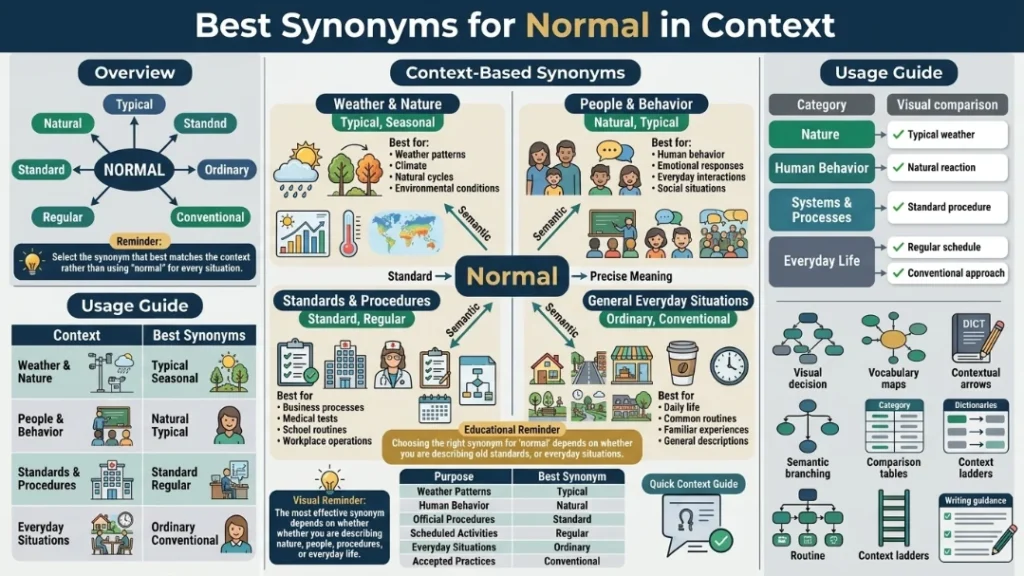
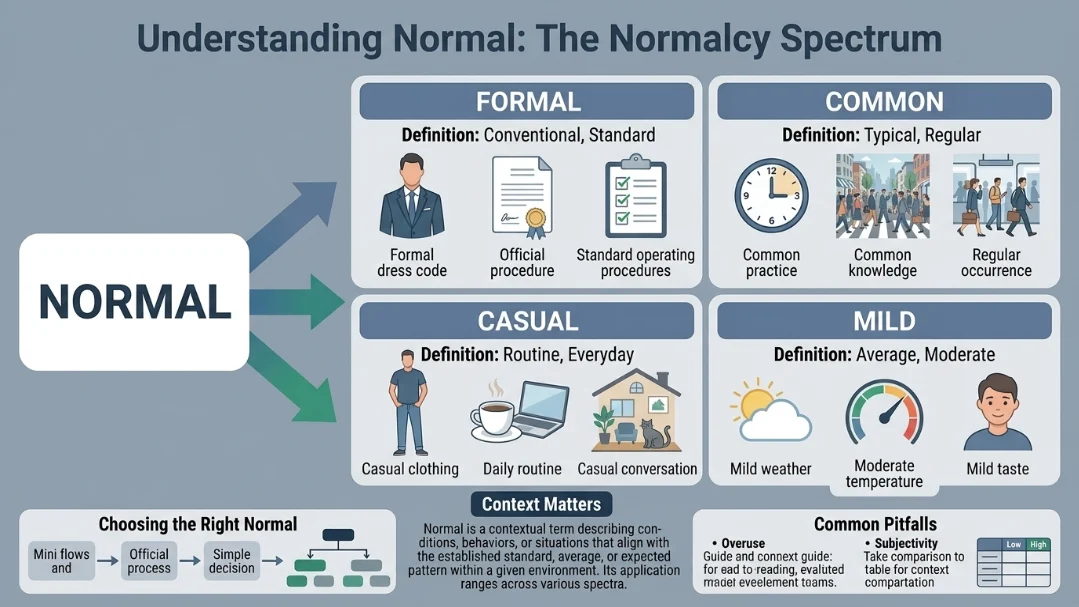
Selecting the right synonym helps you clarify your point. Describing a weather pattern as “normal” is correct, but calling it “typical” suggests a seasonal expectation. Describing a person’s behavior as “normal” might sound clinical, whereas “natural” sounds more human and relatable.
Common Synonyms for Normal
When you want to avoid using the same word repeatedly, these general-purpose alternatives work in most daily scenarios:
- Typical: Suggests that the person or thing embodies the usual characteristics of their group.
- Regular: Implies that something happens according to a schedule or consistent pattern.
- Usual: Refers to what is commonly encountered in a specific situation.
- Average: Indicates that something falls in the middle range of a set of values.
Formal Synonyms for Normal
Professional, legal, or scientific writing often requires terms that imply adherence to established codes or standards:
- Conventional: Focuses on following traditional or accepted social practices.
- Standard: Denotes something that meets a set requirement or benchmark.
- Orthodox: Used to describe practices that follow established, traditional doctrine.
- Canonical: Often used in academic or technical fields to mean accepted as the rule or model.
Informal Synonyms for Normal
In casual conversation, you might prefer words that sound less clinical and more relaxed:
- Run-of-the-mill: An idiomatic way to say something is ordinary or average.
- Routine: Highlights that something is part of a regular, low-effort process.
- Everyday: Suggests something that occurs in daily life without fanfare.
- Basic: A simple term for something that is standard or unadorned.
Strong Synonyms for Normal
Sometimes you need to emphasize that something is deeply ingrained or indisputable:
- Habitual: Describes something that has become a deeply ingrained pattern of behavior.
- Systematic: Implies that the “normality” is part of a larger, organized structure.
- Mainstream: Suggests that the behavior is the dominant, accepted norm of the culture.
Mild Synonyms for Normal
When you want to describe something as being in the middle of a range without making a value judgment:
- Middle-of-the-road: Suggests a moderate, non-extreme position.
- Moderate: Indicates something that stays within reasonable limits.
- Commonplace: Implies something is frequent but perhaps unexciting.
Popular Synonyms for Normal by Usage Context
| Situation | Recommended Choice |
| Writing a Report | Standard, Conventional |
| Talking to Friends | Regular, Everyday |
| Describing Trends | Typical, Mainstream |
| Technical/Data | Average, Canonical |
Another Word for Normal in Sentence Examples
Seeing these alternatives in action clarifies how they shift the tone of a sentence.
- “His typical response is to stay quiet during meetings.” (Suggests a predictable behavioral pattern.)
- “This is a standard procedure for all new hires.” (Suggests an established rule.)
- “We had a routine checkup at the clinic.” (Suggests a low-stress, recurring event.)
- “The results are average for this time of year.” (Focuses on statistical data.)
Comparing Key Synonyms for Normal
Many people use “common” and “normal” interchangeably. While close, “common” simply means “happens often.” “Normal” implies that the occurrence is correct, acceptable, or standard. Recognizing this nuance helps you avoid labeling something “normal” when you really just mean “common.
Words Similar to Normal
These words are related to the concept of normality but emphasize specific angles, such as lack of surprise or adherence to a rule:
- Predictable: Focuses on the lack of surprise or variation.
- Uniform: Suggests that everything in a group matches.
- Conforming: Highlights the act of fitting in with a standard.
- Expected: Emphasizes that the event was anticipated.
Antonyms and Opposites of Normal
To fully understand a word, looking at its opposite provides necessary contrast:
- Abnormal: The direct, clinical opposite.
- Unusual: Suggests something that does not happen frequently.
- Exceptional: Implies something is better than the standard.
- Bizarre: Highlights a strong deviation from the expected norm.
How to Choose the Right Synonym for Normal
Think about the audience. In a business email, “standard” is professional. In a creative writing piece, “natural” helps ground the character. If you are discussing data, “average” or “regular” provide needed precision. Always avoid using “normal” if a more descriptive word captures the essence of your subject.
Common Mistakes When Using Synonyms for Normal
One common mistake is using “normal” to imply “good” or “healthy.” Just because something is common does not mean it is ideal. Another error is overusing “typical” to describe things that are actually quite rare. Keep your language precise by reserving “typical” for events that truly fit a pattern.
Quick Reference Synonym List for Normal
- Average
- Canonical
- Commonplace
- Conventional
- Everyday
- Habitual
- Mainstream
- Middle-of-the-road
- Moderate
- Natural
- Orthodox
- Regular
- Routine
- Run-of-the-mill
- Standard
- Typical
- Usual
FAQs
What is the best synonym for normal?
Typical” is widely considered the best all-purpose synonym for describing behavior or common occurrences.
What is another word for normal?
“Standard” is an excellent alternative when you are talking about rules, procedures, or quality.
What is a formal synonym for normal?
“Conventional” or “canonical” are excellent choices when you need to maintain a professional or academic tone.
What is an informal synonym for normal?
“Everyday” or “run-of-the-mill” are perfect for casual settings where you want to describe the ordinary.
What is a stronger word for normal?
“Habitual” implies a much stronger, deeper-rooted state of normality than just “usual.”
What is a milder word for normal?
“Average” is a neutral, mild way to describe something without making it sound overly structured.
What words are similar to normal?
“Predictable” and “uniform” are related because they describe things that stay within expected boundaries.
What is the opposite of normal?
“Abnormal” is the clinical opposite, while “exceptional” is the positive opposite.
How do I choose the right synonym for normal?
Identify if you are describing a rule (standard), a frequency (regular), or a behavior (typical), then pick the word that fits that specific bucket.
Conclusion
Mastering synonyms for normal provides you with the flexibility to describe the world with more nuance and clarity. By matching your word choice to your specific situation, whether it is a technical report or a casual conversation, you ensure your message is not just clear, but also hits the right tone. Start incorporating these alternatives into your writing, and you will find your ability to describe “the expected” becomes much more expressive.

Charlotte Wilson is a language writer passionate about word meanings, synonyms, and clear communication. She creates accurate and engaging content to help readers expand their vocabulary and language skills.