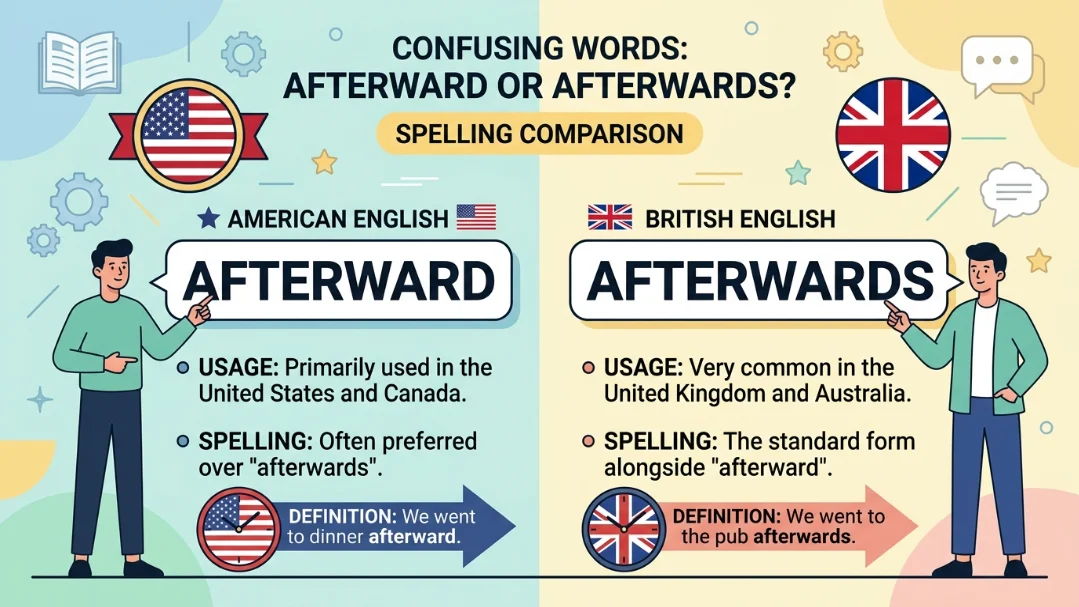
The difference between afterward and afterwards is simple. Both words mean the same thing: “at a later time” or “subsequently.” The only difference is that afterward is more common in American English, while afterwards is more common in British English. Both spellings are correct and interchangeable.
Have you ever paused while writing and wondered whether to type afterward or afterwards? This small difference confuses many writers. The two words look almost identical, and they mean exactly the same thing. However, regional preferences make one more common than the other in certain contexts.
This confusion matters because using the right form can make your writing sound more natural and appropriate for your audience. If you are writing for an American audience, afterward might sound more familiar. If you are writing for a British audience, afterwards might be preferred. Knowing the difference helps you tailor your writing to your readers.
The challenge comes from the fact that both forms are correct. Many style guides and dictionaries list both as acceptable. This means there is no clear “right” or “wrong” answer. Instead, the choice depends on context, region, and personal preference.
This article clears up the confusion once and for all. You will learn the definitions, see real examples, and discover which form works best in different situations. By the end, you will choose confidently between afterward and afterwards. Good writing depends on understanding these subtle distinctions.
The main takeaway is that afterward and afterwards mean the same thing: “at a later time.” The choice between them is mostly regional. American English prefers afterward. British English prefers afterwards. Both are correct and widely understood. Use afterward for American audiences and afterwards for British audiences. For international writing, either form works.
Definitions and Explanations
What Does “Afterward” Mean?
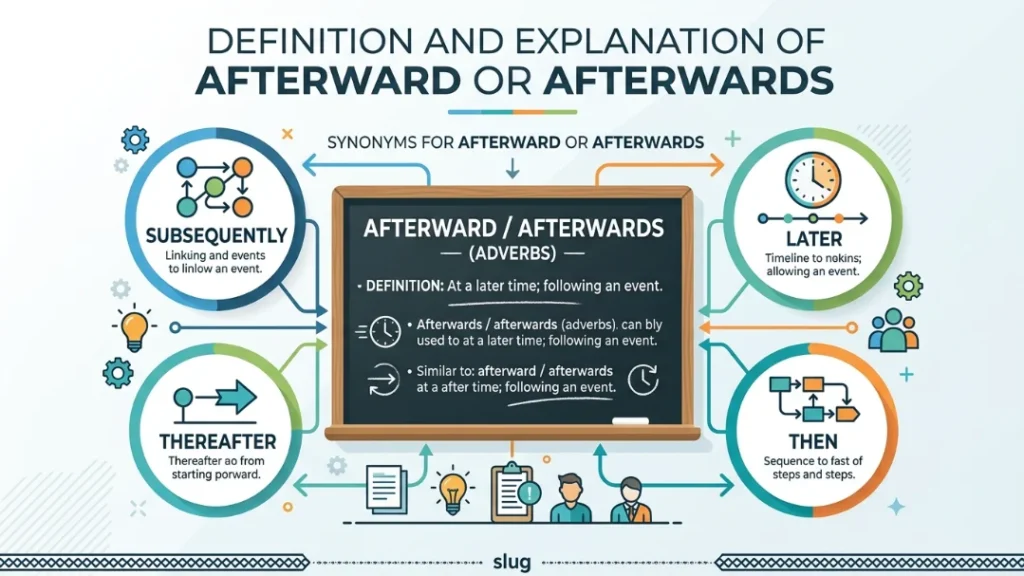
Afterward is an adverb. It means “at a later time” or “subsequently.” It refers to something that happens after a particular event or time. It is the American English preferred spelling.
For example, “We went to the movies, and afterward we had dinner.” This means we had dinner at a later time after the movies. She finished her homework and afterward watched TV.” This means she watched TV after finishing her homework.
Afterward is pronounced with three syllables: “AF-ter-ward.” The stress is on the first syllable. The word has a clear and direct sound.
| Feature | Description |
| Part of speech | Adverb |
| Meaning | At a later time, subsequently |
| Pronunciation | AF-ter-ward |
| Preferred region | American English |
What Does “Afterwards” Mean?
Afterwards is also an adverb. It means exactly the same thing as afterward: “at a later time” or “subsequently.” It is the British English preferred spelling.
For example, “We went to the cinema, and afterwards we had dinner.” This means we had dinner after the cinema. She finished her homework and afterwards watched telly.” This means she watched television after her homework.
Afterwards is pronounced with three syllables: “AF-ter-wards.” The “s” at the end is pronounced as a soft “z” sound. The stress is on the first syllable.
| Feature | Description |
| Part of speech | Adverb |
| Meaning | At a later time, subsequently |
| Pronunciation | AF-ter-wards |
| Preferred region | British English |
The Core Difference Explained
The fundamental difference is regional preference. Afterward is more common in American English. Afterwards is more common in British English. There is no difference in meaning.
Think of it like color and colour. Both mean the same thing. The choice depends on whether you are writing for an American or British audience. The same applies to afterward and afterwards.
| Form | Primary Region | Meaning |
| Afterward | American English | At a later time |
| Afterwards | British English | At a later time |
The Etymology and Origin
Understanding the history of these words helps explain why both forms exist.
- Afterward: This word comes from Old English æfterweard. It is a combination of æfter (meaning “after”) and -weard (meaning “toward”). The original meaning was “toward the back” or “behind.
- Afterwards: This is the same word with an added “s.” The “s” is an adverbial suffix that was common in Old English. Other words like towards and forwards follow the same pattern.
Over time, both forms survived. American English tended to drop the “s” in many adverbs, preferring afterward and toward. British English tended to keep the “s,” preferring afterwards and towards. This pattern applies to several similar words.
| Word | American | British |
| Afterward | ✓ | ✓ (less common) |
| Afterwards | ✓ (less common) | ✓ |
| Toward | ✓ | ✓ (less common) |
| Towards | ✓ (less common) | ✓ |
| Forward | ✓ | ✓ (less common) |
| Forwards | ✓ (less common) | ✓ |
Advantages and Disadvantages
Using the right form offers several advantages. Getting it wrong can create problems. This section explores both sides.
Advantages of Using the Correct Regional Form
Using the preferred form for your audience improves your writing.
- Familiarity: Your readers will see the form they expect. This makes your writing feel more natural and native.
- Professionalism: Using the preferred regional form shows attention to detail. It signals that you know the conventions of your audience.
- Credibility: Matching your audience’s preferences builds trust. It makes you appear more competent and knowledgeable.
- Consistency: Using one form consistently throughout your writing looks polished and professional.
- Compliance: Some style guides and publications require a specific form. Following this requirement ensures acceptance.
Disadvantages of Using the “Wrong” Form
Using a form that is less common in your region can create problems.
- Unfamiliarity: Some readers might notice the different spelling. It can draw attention away from your message.
- Confusion: In rare cases, readers might think you made a mistake. They might wonder if there is a difference in meaning.
- Inconsistency: If you mix afterward and afterwards in the same document, it can look careless.
- Regional mismatch: Using afterwards for an American audience might seem slightly foreign. The same applies to using afterward for a British audience.
| Aspect | Afterward (American) | Afterwards (British) |
| American audience | Familiar, professional | Less familiar |
| British audience | Less familiar | Familiar, professional |
| International audience | Acceptable | Acceptable |
| Consistency | Yes, if used consistently | Yes, if used consistently |
Real-World Examples
Seeing these words used correctly in real-world contexts helps solidify the difference.
Examples of “Afterward” in American English
- “We had lunch, and afterward we went shopping.” This is typical American usage.
- “She called me afterward to apologize.” This describes a later phone call.
- “The meeting ended at 3 PM, and afterward everyone went home.” This describes what happened after the meeting.
- “He studied for hours and afterward felt exhausted.” This describes the feeling after studying.
- “They got married and afterward moved to California.” This describes the move after the wedding.
Examples of “Afterwards” in British English
- “We had lunch, and afterwards we went shopping.” This is typical British usage.
- “She called me afterwards to apologise.” This describes a later phone call.
- “The meeting finished at 3 PM, and afterwards everyone went home.” This describes what happened after the meeting.
- “He studied for hours and afterwards felt exhausted.” This describes the feeling after studying.
- “They got married and afterwards moved to California.” This describes the move after the wedding.
Contrasting Examples
Seeing these words side by side shows the regional difference.
| Sentence (American) | Sentence (British) | Meaning |
| “Afterward, we went home.” | “Afterwards, we went home.” | Same meaning |
| “I saw her afterward.” | “I saw her afterwards.” | Same meaning |
| “The party ended, and afterward we cleaned up.” | “The party ended, and afterwards we cleaned up.” | Same meaning |
Other Words with the Same Pattern
The afterward/afterwards pattern appears in several other adverbs.
| American | British | Meaning |
| Toward | Towards | In the direction of |
| Forward | Forwards | In a forward direction |
| Backward | Backwards | In a backward direction |
| Downward | Downwards | In a downward direction |
| Upward | Upwards | In an upward direction |
| Homeward | Homewards | Toward home |
Regional and Global Usage
The preference for afterward or afterwards varies by region. Understanding these patterns helps you choose the right form.
American English
American English strongly prefers afterward. This is the standard form in most American publications, style guides, and schools. The Chicago Manual of Style and the Associated Press Stylebook both recommend afterward.
American speakers and writers use afterward in almost all contexts. They might encounter afterwards in British writing or in older texts. However, afterward is the clear preference.
British English
British English strongly prefers afterwards. This is the standard form in most British publications and style guides. The Oxford English Dictionary lists afterwards as the primary form and afterward as a variant.
British speakers and writers use afterwards in almost all contexts. They might encounter afterward in American writing. However, afterwards is the clear preference.
Canadian and Australian English
Canadian and Australian English follow British patterns more closely. However, American influence is also strong. In Canada and Australia, you might see both forms. The choice often depends on the publication or the writer’s preference.
International English
For international audiences, either form is acceptable. Both afterward and afterwards are widely understood. The choice might depend on the writer’s preference or the style guide being followed.
| Region | Preferred Form | Secondary Form |
| United States | Afterward | Afterwards |
| United Kingdom | Afterwards | Afterward |
| Canada | Afterwards (slight) | Afterward |
| Australia | Afterwards (slight) | Afterward |
| International | Either | Either |
Formal vs. Informal Usage
Both forms appear in formal and informal writing. There is no difference in formality. The choice is purely regional. In formal writing, consistency is more important than the specific form.
| Context | Preferred Form | Example |
| Formal (American) | Afterward | “Afterward, the committee adjourned.” |
| Formal (British) | Afterwards | “Afterwards, the committee adjourned.” |
| Informal (American) | Afterward | “Afterward, we grabbed a beer.” |
| Informal (British) | Afterwards | “Afterwards, we grabbed a pint.” |
Common Mistakes
This section highlights the most frequent errors people make with these words. Learning about them will help you avoid them.
Mistake 1: Using Both Forms Inconsistently
This is a common error. Writers sometimes use afterward in one sentence and afterwards in the next. This inconsistency can look careless or unprofessional.
Correction: Choose one form and use it consistently throughout your document. This creates a polished and professional appearance.
Mistake 2: Using the Wrong Form for the Audience
Some writers use afterwards for an American audience or afterward for a British audience. While this is not necessarily “wrong,” it can feel slightly off to native speakers. It might draw attention to your spelling choices.
Correction: Match your form to your audience. If you are writing for an American audience, use afterward. If you are writing for a British audience, use afterwards. If you are writing for an international audience, choose either and be consistent.
Mistake 3: Thinking There Is a Meaning Difference
Some people think afterward and afterwards have different meanings. They do not. They mean exactly the same thing. The only difference is regional preference.
Correction: Do not stress about meaning. Both forms mean “at a later time.” Focus on consistency and audience preference.
| Mistake | Correction |
| Using both forms | Choose one and be consistent |
| Wrong region | Match to audience |
| Thinking they differ in meaning | They mean the same thing |
Exercises
Test your knowledge with these exercises.
Exercise 1: Choose the Correct Form
Choose afterward or afterwards based on the region.
- (American) We ate dinner and _____ went to the park.
- (British) She called me _____ to say thank you.
- (American) The concert ended, and _____ we went home.
- (British) They finished work and _____ went to the pub.
- (American) He studied hard and _____ passed the exam.
- (British) The match finished, and _____ they celebrated.
Exercise 2: Identify the Error
Each sentence has a consistency error. Identify the problem and correct it.
- “We went to the museum, and afterward we had lunch. Afterward, we went shopping. Afterwards, we went home.”
- “She finished her homework, and afterwards she watched TV. Afterward, she went to bed.”
- “The meeting ended, and afterwards everyone left. Afterward, the cleaning crew arrived.”
Exercise 3: Choose the Correct Form for the Audience
Select the form that best fits the audience.
- (American audience) “_____ we will discuss the budget.”
- (British audience) “_____ we will discuss the budget.”
- (International audience) “_____ we will discuss the budget.”
Answer Key
Exercise 1 Answers:
- Afterward (American)
- Afterwards (British)
- Afterward (American)
- Afterwards (British)
- Afterward (American)
- Afterwards (British)
Exercise 2 Corrections:
- Use afterward consistently: “We went to the museum, and afterward we had lunch. Afterward, we went shopping. Afterward, we went home.” (American) or use afterwards consistently for British.
- Use afterwards consistently: “She finished her homework, and afterwards she watched TV. Afterwards, she went to bed.” (British) or use afterward consistently for American.
- Use afterwards consistently: “The meeting ended, and afterwards everyone left. Afterwards, the cleaning crew arrived.” (British) or use afterward consistently for American.
Exercise 3 Answers:
- Afterward (American audience)
- Afterwards (British audience)
- Either (International audience, be consistent)
Related Concepts and Comparisons
Understanding how these words relate to other concepts helps build a complete picture.
Afterward vs. Later
Both afterward and later mean “at a later time.” However, there is a subtle difference.
- Afterward: Refers to a time after a specific event. It often implies “after that.”
- Later: Can refer to any time in the future. It does not need a specific event.
| Word | Meaning | Example |
| Afterward | After a specific event | “We ate, and afterward we left.” |
| Later | At a future time | “We will leave later.” |
Afterward vs. Then
Then and afterward are similar but not identical.
- Afterward: Focuses on the time after an event.
- Then: Can mean “after that” but also has other meanings like “at that time.”
| Word | Meaning | Example |
| Afterward | After that time | “We ate, and afterward we left.” |
| Then | At that time / after that | “We ate, and then we left.” |
The Pattern of Adverbial “S” in English
The “s” on afterwards is part of a larger pattern. Many English adverbs end in “s.”
| Word | Without “S” | With “S” |
| Afterward | Afterward | Afterwards |
| Toward | Toward | Towards |
| Forward | Forward | Forwards |
| Backward | Backward | Backwards |
| Downward | Downward | Downwards |
| Upward | Upward | Upwards |
These pairs have the same meaning. The choice depends on regional preference. American English drops the “s.” British English keeps it.
FAQs
What is the difference between afterward and afterwards?
There is no difference in meaning. Both mean “at a later time” or “subsequently.” The difference is regional preference. American English prefers afterward. British English prefers afterwards.
Is it afterward or afterwards in American English?
In American English, the preferred spelling is afterward. This is the standard form in American publications, schools, and style guides. Use afterward for American audiences.
Is it afterward or afterwards in British English?
In British English, the preferred spelling is afterwards. This is the standard form in British publications and style guides. Use afterwards for British audiences.
Is afterward or afterwards correct?
Both are correct. They are simply regional variants. There is no “wrong” choice. The key is to match your audience and be consistent.
Should I use afterward or afterwards in a formal document?
Choose based on your audience. For an American document, use afterward. For a British document, use afterwards. For an international document, either is acceptable. The most important thing is consistency.
Can I use afterward and afterwards interchangeably?
Yes, but be careful. They are interchangeable in meaning. However, using them interchangeably in the same document can look inconsistent. Choose one form and stick with it.
What is the adverb form of after?
The adverb form is afterward or afterwards. Both are correct. They mean “at a later time.” The choice depends on regional preference.
Is afterward a word?
Yes, afterward is a standard word. It is the preferred form in American English. It means “at a later time” or “subsequently.”
Is afterwards a word?
Yes, afterwards is a standard word. It is the preferred form in British English. It means “at a later time” or “subsequently.”
How do you spell afterward in the UK?
In the UK, the preferred spelling is afterwards. The “s” is included at the end. This is the standard British spelling.
How do you spell afterward in the US?
In the US, the preferred spelling is afterward. The “s” is dropped. This is the standard American spelling.
What is the origin of afterward and afterwards?
Both words come from Old English æfterweard. The “s” on afterwards is an adverbial suffix. Both forms have existed for centuries. American English dropped the “s” over time, while British English kept it.
Conclusion
This guide has clarified the simple but important choice between afterward and afterwards. Both forms mean exactly the same thing: “at a later time.” The difference is purely regional. American English prefers afterward. British English prefers afterwards. Both are correct and widely understood.
The best practical advice is to match your spelling to your audience. If you are writing for an American audience, use afterward. If you are writing for a British audience, use afterwards. If you are writing for an international audience, choose either and be consistent. Consistency is more important than which form you choose.
Good writing depends on these subtle distinctions. Getting them right shows attention to detail and respect for your readers. Now you have the knowledge to choose confidently between afterward and afterwards. Use this guide as a reference whenever you are unsure. Over time, the correct choice will become second nature to you.