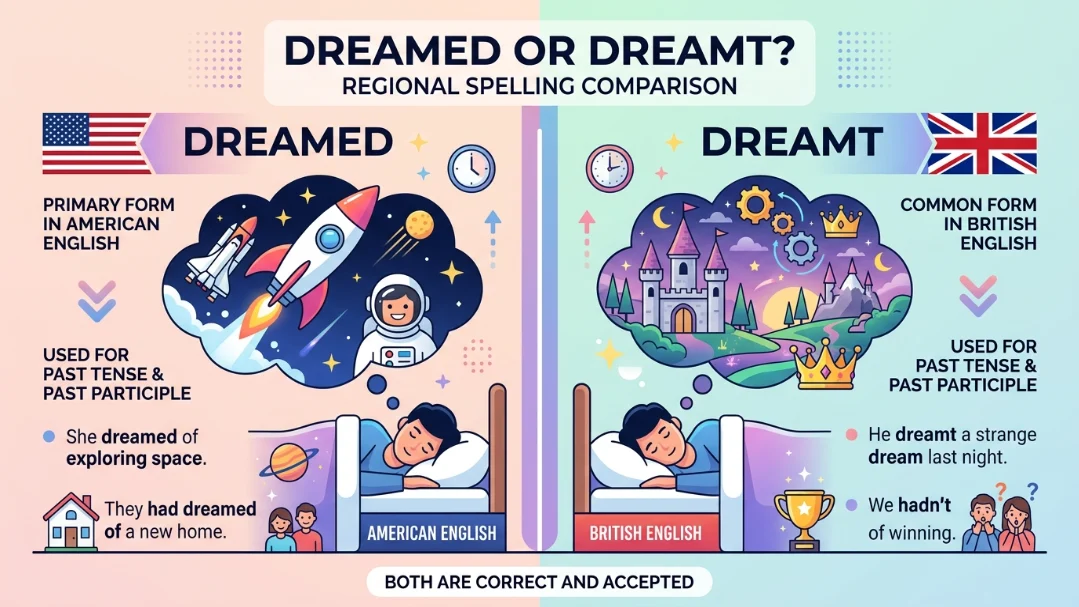
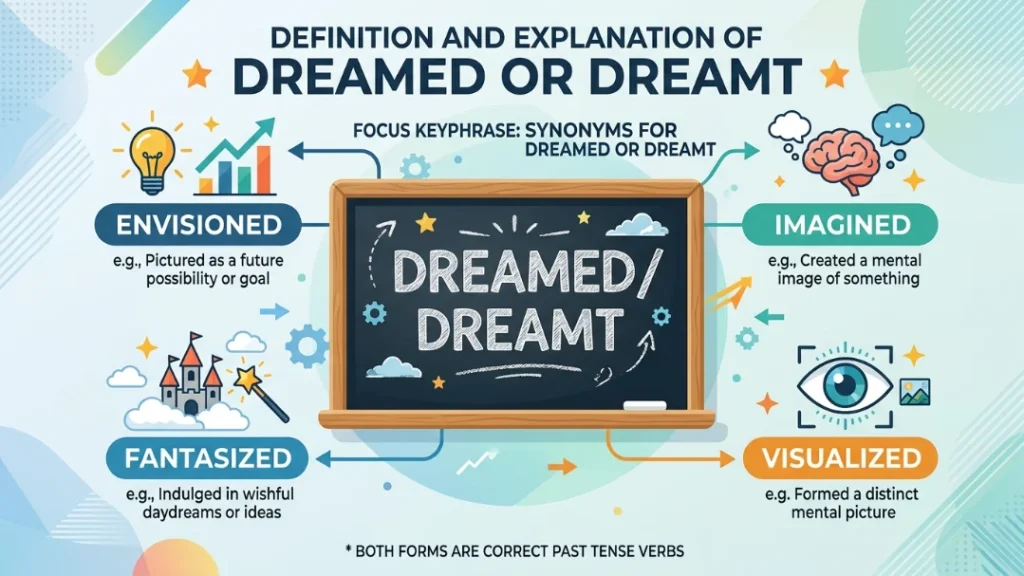
The difference between dreamed and dreamt is simple. Both are correct past tense forms of the verb dream. Dreamed follows the regular pattern of adding “-ed” and is more common in American English. Dreamt is an irregular variant that appears more frequently in British English. You can use either form in most contexts.
Have you ever been writing a story or an email and paused, unsure whether to type dreamed or dreamt? This small choice trips up many writers. The two words look different but mean exactly the same thing. Figuring out which one to use can feel confusing.
This choice matters because it affects how your writing sounds. Using the right form for your audience shows attention to detail. It helps you sound more natural and professional. The challenge comes from the fact that both forms are correct. There is no single right answer. Instead, the choice depends on where you live and what style you prefer.
The confusion around dreamed or dreamt is understandable. Many English verbs have regular and irregular past tense forms. Some are used interchangeably. Others have specific regional preferences. Dreamed and dreamt fall into the first category. They are both acceptable, but their usage varies by region and context.
This article clears up the confusion once and for all. You will learn the definitions, see real examples, and discover the subtle differences between these two forms. By the end, you will choose confidently every time. Good writing depends on these small but important decisions.
The main takeaway is that dreamed and dreamt are both correct past tense forms of the verb dream. Dreamed follows the regular verb pattern and is more common in American English . Dreamt is an irregular form that appears more frequently in British English . In practice, you can use either form in most contexts. The important thing is to be consistent in your writing.
Definitions and Explanations
What Does “Dreamed” Mean?
Dreamed is the regular past tense and past participle form of the verb dream. It follows the standard English pattern of adding “-ed” to form the past tense . This makes it a regular verb.
You use dreamed to describe something that happened in the past. For example, “I dreamed about flying last night” means the dreaming happened in the past. She has dreamed of becoming a doctor” means the dreaming started in the past and continues to the present.
Dreamed is the preferred form in American English . It is also common in British English, despite the popularity of dreamt . You will see it in newspapers, books, and everyday writing.
| Feature | Description |
| Part of speech | Verb (past tense, past participle) |
| Formation | Regular (“dream” + “-ed”) |
| Pronunciation | /driːmd/ (rhymes with “seemed”) |
| Regional preference | American English |
What Does “Dreamt” Mean?
Dreamt is the irregular past tense and past participle form of the verb dream. It is a “strong” or irregular verb form . Instead of adding “-ed,” it adds “-t” to form the past tense.
You use dreamt in exactly the same way as dreamed. For example, “I dreamt about flying last night” means the same as “I dreamed about flying last night.” “She has dreamt of becoming a doctor” means the same as “She has dreamed of becoming a doctor.
Dreamt is the preferred form in British English . It has been in use since the 14th century and appears in the works of Shakespeare . However, it is less common in American English.
| Feature | Description |
| Part of speech | Verb (past tense, past participle) |
| Formation | Irregular (“dream” + “-t”) |
| Pronunciation | /dremt/ (rhymes with “tempt”) |
| Regional preference | British English |
The Core Difference Explained
The core difference between dreamed and dreamt is regional and stylistic, not grammatical. Both forms are correct and widely accepted .
Here is a simple way to think about it:
- Dreamed = the regular, American English form.
- Dreamt = the irregular, British English form.
In practice, both forms are used in both regions. American English writers sometimes use dreamt for stylistic reasons. British English writers sometimes use dreamed for consistency. The choice is yours.
| Aspect | Dreamed | Dreamt |
| Part of speech | Verb | Verb |
| Formation | Regular (-ed) | Irregular (-t) |
| American English | More common | Less common |
| British English | Common but less | More common |
| Meaning | Same | Same |
The Etymology and Origin
Both forms have a long history in English. Dreamt has been in use since the 14th century . Shakespeare used it in his works, as seen in Romeo and Juliet: “I dreamt a dream tonight” . However, he occasionally used dreamed as well.
By the 19th century, major writers were divided. Jane Austen and William Makepeace Thackeray preferred dreamt. Edith Wharton and Virginia Woolf consistently used dreamed. Many other writers, including Charles Dickens and Mark Twain, used both .
Over time, dreamed became the dominant form worldwide. A Google Ngram search shows that dreamed is preferred in both British and American English . However, dreamt remains in active use, especially in British English .
Advantages and Disadvantages
Choosing between dreamed and dreamt offers subtle advantages and disadvantages. This section explores both sides.
Advantages of Using “Dreamed”
- Consistency with regular verbs: Dreamed follows the standard “-ed” pattern. This makes it easy to remember and use correctly.
- Wider acceptance: Dreamed is the dominant form in American English. It is also common in British English. Using it ensures your writing is widely understood .
- Clarity in pronunciation: Dreamed has a clear, distinct sound. It is less likely to be confused with other words.
- Modern usage: Dreamed is more commonly used in contemporary writing. It sounds more natural to many readers.
Advantages of Using “Dreamt”
- Literary and traditional feel: Dreamt has a classic, somewhat poetic quality. It appears in Shakespeare and other classic literature. Using it can add a literary tone to your writing .
- British English preference: If you are writing for a British audience, dreamt is the more common choice .
- Subtle stylistic effect: Some writers use dreamt when referring to hopes and ambitions. It can add a sense of longing or aspiration .
- Historical connection: Using dreamt connects your writing to English’s rich history.
Disadvantages
| Aspect | Dreamed | Dreamt |
| American audience | Clear, standard | May seem odd or literary |
| British audience | Acceptable but less common | Preferred, natural |
| Consistency | Easy to remember | Requires remembering irregular form |
| Pronunciation | Standard /driːmd/ | Less common /dremt/ |
Real-World Examples
Seeing these words used correctly in real-world contexts helps solidify the difference.
Examples of “Dreamed” in Action
- “Last night, I dreamed that I was flying over the ocean.” This describes a sleep dream .
- “She always dreamed of becoming a famous singer.” This describes a lifelong ambition.
- “The dog dreamed of chasing rabbits all night.” This describes a dream during sleep.
- “I have never dreamed of living in a big city.” This describes a past hope.
- “He dreamed that he won the lottery.” This describes a past event.
- “They dreamed up a plan to save the company.” This uses the phrasal verb “dream up” .
Examples of “Dreamt” in Action
- “I dreamt about my grandmother last night.” This describes a sleep dream .
- “He dreamt of reaching the Olympics.” This describes an ambition .
- “She dreamt of a better future for her children.” This describes a hope .
- “He had dreamt of this moment since childhood.” This uses the past perfect tense.
- “I dreamt the most vivid dream I have ever had.” This describes a past experience.
- “They dreamt up a brilliant marketing campaign.” This uses the phrasal verb “dreamt up” .
Contrasting Examples
| Sentence with “Dreamed” | Sentence with “Dreamt” | Meaning |
| “I dreamed I was a cat.” | “I dreamt I was a cat.” | Same meaning |
| “She has dreamed of this day.” | “She has dreamt of this day.” | Same meaning |
| “We dreamed up a new idea.” | “We dreamt up a new idea.” | Same meaning |
Usage in Famous Quotes
- Shakespeare: “I dreamt a dream tonight” (Romeo and Juliet) .
- Les Misérables: “I dreamed a dream” (lyrics) .
- Ernest Hemingway: “He no longer dreamed of storms” (The Old Man and the Sea) .
Regional and Global Usage
The choice between dreamed and dreamt varies by region. Understanding these patterns helps you choose the right form for your audience.
American English
In American English, dreamed is the standard and preferred form . It is the most common choice in newspapers, books, and everyday writing. However, dreamt is also considered acceptable and sometimes appears for stylistic reasons .
You will rarely see dreamt in official American publications. However, it is not considered incorrect. Some American writers use it to create a specific tone or effect .
British English
In British English, dreamt is more common than in American English . Many British writers prefer it. However, dreamed is also used and is accepted .
A Google Ngram search shows that dreamed is actually more common in British English than dreamt. However, the difference is smaller than in American English . Both forms are in active use.
| Region | Preferred Form | Common Use |
| United States | Dreamed | Standard |
| United Kingdom | Dreamt | More common, but both used |
| Canada | Dreamed | Similar to American |
| Australia | Dreamed | Similar to British |
| New Zealand | Dreamed | Similar to British |
Global English
In international or global English, dreamed is the safer choice. It is more common and widely accepted. However, dreamt is also understandable to most English speakers. The choice often comes down to personal preference or the specific audience.
Consistency Matters
Regardless of which form you choose, consistency is important. Switching between dreamed and dreamt in the same document can look sloppy . Choose one form and stick with it. This is the best way to maintain professionalism.
Common Mistakes
This section highlights the most frequent errors people make with these words. Learning about them will help you avoid them.
Mistake 1: Thinking One Form Is Incorrect
Many people believe that either dreamed or dreamt is wrong. This is false. Both forms are correct and widely used. Neither is a misspelling. Both are listed in dictionaries and accepted by grammarians .
Correction: Understand that both forms are correct. The choice is regional and stylistic, not grammatical.
Mistake 2: Inconsistent Usage
Some writers switch between dreamed and dreamt in the same document. This can look unprofessional and careless. It suggests a lack of attention to detail .
Correction: Choose one form and use it consistently. Pick the form that best matches your audience or personal preference. Stick with it throughout your writing.
Mistake 3: Using the Wrong Form for the Audience
Using dreamt in an American English context might seem odd to some readers. Using dreamed in a British English context might seem less natural. While neither is wrong, matching the regional preference can improve your writing.
Correction: Consider your audience. If you are writing for Americans, use dreamed. If you are writing for Britons, consider dreamt. This shows attention to detail.
Mistake 4: Confusing Pronunciation
Some people pronounce dreamed and dreamt the same way. They sound different. Dreamed is pronounced /driːmd/ (like “seemed”). Dreamt is pronounced /dremt/ (like “tempt”) . Mixing up the pronunciation can lead to confusion.
Correction: Practice saying the words aloud. Repeat “dreamed” (dree-md) and “dreamt” (dremt) until the difference becomes natural.
Exercises
Test your knowledge with these exercises.
Exercise 1: Fill in the Blank
Choose dreamed or dreamt to complete each sentence.
- I _________ about a unicorn last night.
- She has _________ of becoming a doctor since she was a child.
- They _________ up a great idea for the project.
- He _________ he was flying over the city.
- We have always _________ of traveling the world.
- The dog _________ of chasing squirrels.
- I _________ a dream that I was a famous singer.
- She _________ of a better future for her children.
Exercise 2: Identify the Best Choice
Choose the best form for each context.
- You are writing for an American newspaper. (dreamed/dreamt)
- You are writing a novel set in Victorian England. (dreamed/dreamt)
- You are writing a report for a British client. (dreamed/dreamt)
- You are writing a blog post for an international audience. (dreamed/dreamt)
Exercise 3: Identify the Error
Each sentence might have an error. Identify and correct any mistakes.
- “I dreamt I was flying.” (Assume American English context)
- “She had dreamed of this moment.” (Assume British English context)
- “We dreamed up a plan.” (No context given)
- “They dreamt of winning.” (No context given)
Answer Key
Answers of Exercise 1:
- Dreamed or Dreamt (both acceptable)
- Dreamed or Dreamt (both acceptable)
- Dreamed or Dreamt (both acceptable)
- Dreamed or Dreamt (both acceptable)
- Dreamed or Dreamt (both acceptable)
- Dreamed or Dreamt (both acceptable)
- Dreamed or Dreamt (both acceptable)
- Dreamed or Dreamt (both acceptable)
Exercise 2 Answers:
- Dreamed (American English preference)
- Dreamt or Dreamed (both can work, but dreamt adds historical flavor)
- Dreamt (British English preference)
- Dreamed (safer for international audience)
Exercise 3 Corrections:
- “I dreamed I was flying.” (If American English is assumed)
- “She had dreamt of this moment.” (If British English is assumed)
- No error. Both are acceptable.
- No error. Both are acceptable.
Related Concepts and Comparisons
Understanding how dreamed and dreamt relate to other concepts helps build a complete picture.
Regular vs. Irregular Verbs
Dreamed is a regular verb. It follows the standard pattern of adding “-ed” to form the past tense. Dreamt is an irregular verb. It adds “-t” instead of “-ed” .
Regular verbs are more common in English. Irregular verbs are often older and more frequent in everyday use. Dreamt is part of a group of verbs that can form the past tense with either “-ed” or “-t.”
| Verb | Regular Form | Irregular Form |
| Dream | Dreamed | Dreamt |
| Learn | Learned | Learnt |
| Burn | Burned | Burnt |
| Spell | Spelled | Spelt |
| Kneel | Kneeled | Knelt |
American vs. British English
Many verbs have different spellings in American and British English. Dreamed and dreamt are one example. Others include:
| American | British |
| Learned | Learnt |
| Burned | Burnt |
| Smelled | Smelt |
| Spelled | Spelt |
Literal vs. Figurative Usage
Some writers use dreamed and dreamt in slightly different contexts. Dreamed is often used for literal sleep dreams. Dreamt is sometimes used for hopes and ambitions .
For example: “I dreamed I was flying” (literal) vs. “I dreamt of becoming a doctor” (figurative). This distinction is not mandatory, but it exists in some writing.
| Context | Preferred Form | Example |
| Sleep dream | Dreamed | “I dreamed about my grandmother.” |
| Hope or ambition | Dreamt | “I dreamt of becoming a writer.” |
| Both | Either | “I dreamed/dreamt about flying.” |
FAQs
What is the difference between dreamed and dreamt?
There is no difference in meaning. Both are correct past tense forms of the verb dream. Dreamed is the regular form and is more common in American English. Dreamt is the irregular form and is more common in British English .
Is dreamt a word?
Yes, dreamt is a word. It has been used since the 14th century. Shakespeare used it in Romeo and Juliet. It is listed in all major dictionaries .
Is dreamed or dreamt correct?
Both are correct. Neither is a misspelling. The choice depends on your region and personal preference. Dreamed is more common in American English. Dreamt is more common in British English .
Do Americans use dreamt?
Yes, Americans use dreamt, but it is less common. It is considered acceptable in American English. Some American writers use it for stylistic reasons. However, dreamed is the standard form .
Do Brits use dreamed?
Yes, Brits use dreamed. It is common in British English. A Google Ngram search shows that dreamed is actually more common than dreamt in British English. However, dreamt is used more in Britain than in America .
Which is more common: dreamed or dreamt?
Dreamed is more common worldwide. It is the dominant form in American English and is also common in British English. Dreamt is used but less frequent .
How do you pronounce dreamt?
Dreamt is pronounced /dremt/. It rhymes with “tempt” and “attempt.” The pronunciation is different from dreamed, which is pronounced /driːmd/ (rhymes with “seemed”) .
What is the past tense of dream?
The past tense of dream can be either dreamed or dreamt. Both are correct and accepted. Choose the one that fits your audience or personal preference .
Is it dreamed or dreamt of?
Both are correct. You can say “I dreamed of” or “I dreamt of.” The meaning is the same. The choice is a matter of regional preference .
What is the difference between dreamed and dreamt in British English?
In British English, dreamt is more common than in American English. However, dreamed is also used and accepted. A Google Ngram search shows dreamed is actually more common. The choice often depends on personal style .
Conclusion
This guide has clarified the simple but important choice between dreamed and dreamt. Both forms are correct past tense versions of the verb dream. Dreamed follows the regular “-ed” pattern and is more common in American English. Dreamt is an irregular form that appears more frequently in British English.
The best practical advice is to choose one form and use it consistently. If you are writing for an American audience, use dreamed. If you are writing for a British audience, consider dreamt. For international or global audiences, dreamed is the safer choice. Regardless of your choice, consistency is the most important factor. Switching between the two forms can make your writing look sloppy.
Good writing depends on these small but important decisions. Getting them right shows attention to detail and respect for your readers. Now you have the knowledge to choose the correct form every time. Use this guide as a reference whenever you are unsure. Over time, the right choice will become second nature to you.