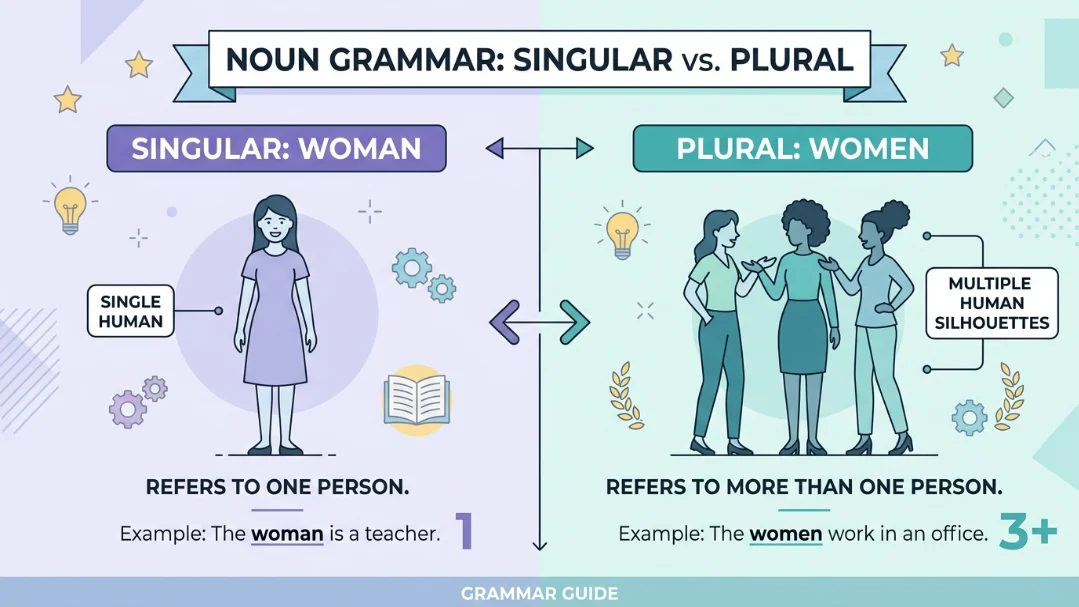
The difference between woman and women is simple. Woman is singular and refers to one adult female. Women is plural and refers to more than one adult female. Remember that woman rhymes with “german” while women rhymes with “swimmin.”
Have you ever paused while writing and wondered whether to use woman or women? This small distinction trips up countless writers every day. The two words look similar and sound almost identical in casual speech. Yet using the wrong one can make your writing look careless and unprofessional.
This confusion matters because these words appear constantly in everyday language. You will need them in emails, reports, essays, and conversations. Getting them right shows attention to detail and respect for your readers. It also helps you communicate clearly without causing any confusion.
The challenge comes from the unusual spelling change. Unlike most English plurals that simply add an “s,” women changes the vowel sound. This irregular pattern makes it harder to remember. Additionally, many people do not fully understand the grammar rules behind these words or they simply type too quickly to notice the difference.
This article clears up the confusion once and for all. You will learn the definitions, see real examples, and discover effective memory tricks. By the end, you will never second-guess this choice again. Good writing depends on these small but important distinctions.
The main takeaway is that woman is always singular and women is always plural. Woman describes one adult female individual. Women describes two or more adult female individuals. The pronunciation also differs, with woman sounding like “wuh-muhn” and women sounding like “wih-mihn.” Master both the spelling and pronunciation so you never confuse them again.
Definitions and Explanations
What Does “Woman” Mean?
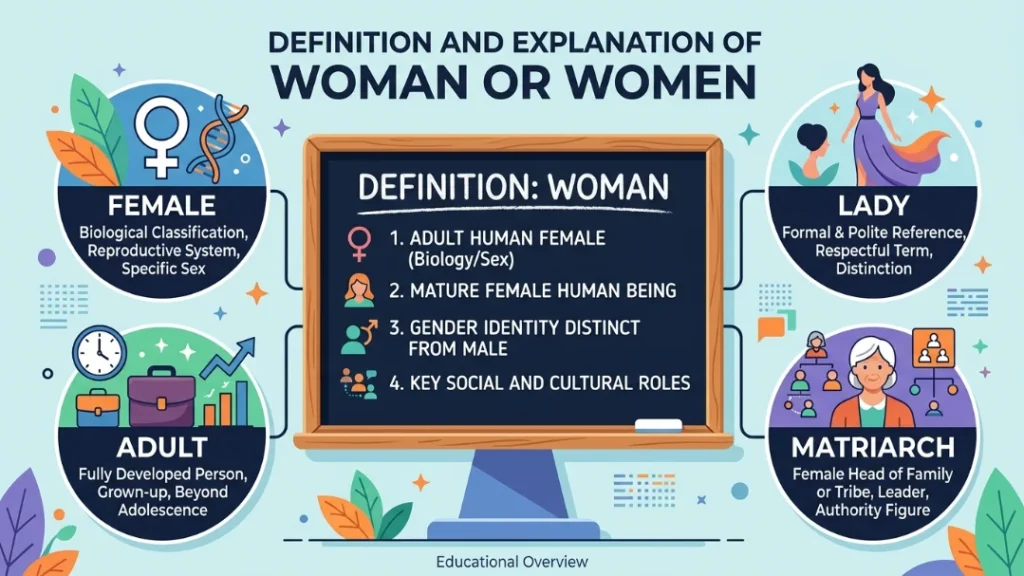
Woman is a singular noun. It refers to one adult female human being. A woman is an individual person with her own identity, experiences, and characteristics.
For example, “The woman walked down the street” describes one person. “That woman is my boss” also refers to a single individual. “She is a strong woman” describes one person’s character. In all these cases, the subject is one adult female.
The word woman appears in many compound terms. A businesswoman is one female business professional. A policewoman is one female police officer. A woman doctor means one female doctor. A woman leader means one female leader. In every case, woman stays singular because it describes one person.
| Feature | Description |
| Part of speech | Noun |
| Number | Singular |
| Meaning | One adult female |
| Pronunciation | wuh-muhn |
| Example | “The woman is here.” |
What Does “Women” Mean?
Women is a plural noun. It refers to more than one adult female human being. It describes a group of individuals.
For example, “The women walked down the street” describes two or more people. “Those women are my colleagues” refers to multiple individuals. “Women have made significant progress” describes a group as a whole. In all these cases, the subject is more than one adult female.
Women also appears in compound terms. Businesswomen means several female business professionals. Policewomen means several female police officers. Women doctors means several female doctors. Women leaders means several female leaders. In every case, women stays plural because it describes more than one person.
| Feature | Description |
| Part of speech | Noun |
| Number | Plural |
| Meaning | Two or more adult females |
| Pronunciation | wih-mihn |
| Example | “The women are here.” |
The Pronunciation Difference
The pronunciation difference is just as important as the spelling difference. Many people get the spelling wrong because they do not hear the distinction clearly.
- Woman: Pronounced /ˈwʊm.ən/ (wuh-muhn). The first syllable sounds like “woo” or “wuh.” The second syllable sounds like “muhn.” Together, it sounds like “wuh-muhn.”
- Women: Pronounced /ˈwɪm.ɪn/ (wih-mihn). The first syllable sounds like “wih” (like “win” without the “n”). The second syllable sounds like “mihn.” Together, it sounds like “wih-mihn.”
| Word | Number | Pronunciation | Meaning |
| Woman | Singular | wuh-muhn | One adult female |
| Women | Plural | wih-mihn | Two or more adult females |
The Etymology and Origin
Understanding where these words come from helps you remember the difference.
- Woman: This word comes from Old English wīfmann. It was a compound of wīf (meaning “woman” or “wife”) and mann (meaning “human being” or “person”). Over time, wīfmann became woman. The spelling changed, but the meaning stayed the same: one adult female.
- Women: This plural form appeared later as the plural of woman. The vowel change from man to men in the plural follows an old English pattern. This pattern also appears in other words like man/men and foot/feet. The irregular spelling comes from this historical linguistic change.
Advantages and Disadvantages
Using the correct form offers clear advantages. Getting it wrong creates problems. This section explores both sides.
Advantages of Using the Correct Form
Using the right word improves your writing in several ways.
- Clarity: Your reader knows exactly what you mean. There is no confusion about whether you are describing one person or multiple people.
- Professionalism: Correct grammar builds trust with your readers. It shows that you care about your writing and respect your audience.
- Credibility: Mistakes can make you look less educated or careless. Using the correct form helps you maintain your credibility.
- Respect: Accurate language shows respect for the people you are describing. It also follows standard English usage.
- Confidence: Knowing the rule gives you confidence in your writing. You will not have to pause and second-guess yourself.
Disadvantages of Using the Wrong Form
Using the wrong form can create problems for your communication.
- Confusion: Your reader might not know whether you mean one woman or several. For example, “The woman are here” is confusing.
- Unprofessionalism: Simple grammar errors can make you appear careless. This can harm your reputation in professional settings.
- Misunderstanding: In some cases, the wrong word might change your sentence’s meaning entirely.
- Embarrassment: Making this mistake in public can be embarrassing and undermine your confidence.
| Aspect | Woman (Singular) | Women (Plural) |
| Clarity | Clear when correct | Clear when correct |
| Professionalism | Professional when used correctly | Professional when used correctly |
| Credibility | Builds credibility | Builds credibility |
| Common mistake | Using “women” for one person | Using “woman” for multiple people |
Real-World Examples
Seeing these words used correctly in real-world contexts helps solidify the difference.
Examples of “Woman” in Action
- “The woman at the front desk helped me with my paperwork.” This example describes one female staff member.
- “My sister is a strong woman who always speaks her mind.” This describes one individual person.
- “A woman in a red dress walked into the room.” This describes one specific person.
- “She is the only woman on the board of directors.” This describes one female member of a group.
- “The woman I met yesterday gave me excellent advice.” This refers to one female person.
- “Every woman deserves equal opportunities.” This uses “woman” as a general category.
Examples of “Women” in Action
- “The women at the conference came from many different countries.” This describes multiple female attendees.
- “All the women in my family are excellent cooks.” This describes several female relatives.
- “Women have made significant progress in the workplace over the past few decades.” This describes female people as a group.
- “Those women over there are my colleagues.” This describes a group of people.
- “The organization supports women in technology.” This refers to multiple females in a specific field.
- “Women around the world face similar challenges.” This uses “women” as a general category.
Contrasting Examples
| Sentence with “Woman” | Meaning | Sentence with “Women” | Meaning |
| “The woman is here.” | One person is here. | “The women are here.” | Multiple people are here. |
| “A woman can do it.” | One person can do it. | “Women can do it.” | Multiple people can do it. |
| “That woman is my boss.” | One person is my boss. | “Those women are my bosses.” | Multiple people are my bosses. |
Common Phrases and Idioms
Certain common phrases use either woman or women correctly. Learning these can help you remember the usage.
| Phrase | Correct Form | Meaning |
| “The woman of the house” | Woman | One female head of household |
| “Women’s rights” | Women | Rights belonging to multiple females |
| “A woman of substance” | Woman | One impressive female person |
| “Women in leadership” | Women | Multiple females in leadership roles |
| “The woman behind the scenes” | Woman | One female working behind the scenes |
| “Women’s liberation” | Women | Movement for multiple females’ rights |
Regional and Global Usage
The distinction between woman and women is consistent across all English-speaking regions.
Global English Consistency
The distinction is the same in all major English dialects. Whether you are writing for an American, British, Australian, or Canadian audience, the rules are identical. Woman is always singular, and women is always plural. There is no regional variation in this rule.
Pronunciation Around the World
While the spelling remains the same, pronunciation can vary slightly by region. In American English, the vowel sounds are distinct and clear. In some British dialects, the difference might be more subtle. Australian and New Zealand English also have their own vowel shifts. However, the underlying rule remains the same worldwide.
| Region | Singular | Plural | Common Mistake |
| United States | Woman | Women | Using “women” for one person |
| United Kingdom | Woman | Women | Using “women” for one person |
| Australia | Woman | Women | Using “women” for one person |
| Canada | Woman | Women | Using “women” for one person |
Formal vs. Informal Usage
Both words appear in formal and informal contexts. The choice depends on whether you need a singular or plural noun, not on formality.
| Context | Preferred Form | Example |
| Formal writing | Both (correctly) | “The woman presented her research.” |
| Formal writing | Both (correctly) | “Women in the workplace face challenges.” |
| Informal conversation | Both (correctly) | “That woman is my friend.” |
| Informal conversation | Both (correctly) | “Those women are my friends.” |
Common Mistakes
This section highlights the most frequent errors people make with these words. Learning about them will help you avoid them.
Mistake 1: Using “Women” for Singular
This is the most common error. People write or say “women” when they mean only one woman. For example, “The women walked into the room” should be “The woman walked into the room” if there is only one person.
Correction: Always check whether you are describing one person or more than one. If you mean one, use woman. If you mean more than one, use women.
Mistake 2: Using “Woman” for Plural
This is less common but still happens. People use “woman” to refer to multiple females. For example, “The woman were all wearing red” is incorrect. It should be “The women were all wearing red.”
Correction: If your sentence has a plural verb (like “were” or “are”), you need the plural noun women. The subject and verb must agree in number.
Mistake 3: Confusing Pronunciation
Many people mispronounce these words, which leads to spelling errors. If you pronounce women as “wuh-min” (like woman), you might also spell it wrong. The correct pronunciation for women is “wih-mihn.”
Correction: Practice saying the words out loud. Repeat “woman” (wuh-muhn) and “women” (wih-mihn) until the difference becomes natural.
| Incorrect | Correct | Reason |
| “The women is here.” | “The woman is here.” | One person, singular verb |
| “The woman are here.” | “The women are here.” | Multiple people, plural verb |
| “Those woman are my friends.” | “Those women are my friends.” | Multiple people, plural noun |
| “That women is my boss.” | “That woman is my boss.” | One person, singular noun |
Exercises
Test your knowledge with these exercises.
Exercise 1: Fill in the Blank
Choose woman or women to complete each sentence.
- The _________ at the front desk gave me a form to fill out.
- All the _________ in the meeting agreed with the proposal.
- My mother is a very strong _________.
- The organization provides support for _________ in business.
- That _________ over there is my supervisor.
- Several _________ from the team attended the conference.
- She is the only _________ on the committee.
- Many _________ face challenges in the workplace.
Exercise 2: Identify the Error
Each sentence has a mistake. Identify the incorrect word and correct it.
- “The women walked into the room and sat down.” (Assume only one person)
- “The woman are meeting in the conference room.”
- “All the woman in the department received the email.”
- “She is one of the most talented woman I know.”
Exercise 3: Choose the Correct Form
Select the correct word to complete each sentence.
- “That _________ is my colleague.” (Woman/Women)
- “All the _________ are here.” (woman/women)
- “She is a _________ of integrity.” (woman/women)
- “The _________ in the office are all professionals.” (woman/women)
Answer Key
Answers of Exercise 1:
- Woman (one person)
- Women (more than one)
- Woman (one person, mother)
- Women (more than one, plural context)
- Woman (one person, specific)
- Women (several people)
- Woman (only one)
- Women (many people)
Exercise 2 Corrections:
- “The woman walked into the room and sat down.” (If only one person)
- “The women are meeting in the conference room.” (Plural verb requires plural noun)
- “All the women in the department received the email.” (All means more than one)
- “She is one of the most talented women I know.” (One of many requires plural)
Exercise 3 Answers:
- Woman (singular)
- women (plural)
- woman (singular)
- women (plural)
Related Concepts and Comparisons
Understanding how these words relate to other terms helps build a complete picture.
Woman vs. Girl
Both woman and girl describe female people. However, they indicate different ages. A girl is a female child or young person. A woman is an adult female. The distinction is important for accuracy and respect.
| Term | Age Group | Plural Form |
| Girl | Child or young person | Girls |
| Woman | Adult | Women |
Woman vs. Lady
Woman and lady both describe adult females. However, lady often implies politeness or formality. It can also refer to a woman of high social status. Woman is the more neutral and commonly used term.
| Term | Connotation | Usage |
| Woman | Neutral, standard | Everyday, professional, formal |
| Lady | Polite, sometimes formal | Informal, sometimes old-fashioned |
Woman vs. Female
Female is an adjective or noun that describes the sex of an organism. It can describe animals and plants too. Woman specifically describes an adult human female. Using female as a noun to describe people can sound clinical or disrespectful.
| Term | Usage | Preferred? |
| Female | Adjective or noun for any organism | Can be clinical |
| Woman | Noun for adult human female | Preferred for people |
Woman vs. Women in Compound Words
Many compound words change form based on number.
| Singular Compound | Plural Compound |
| Businesswoman | Businesswomen |
| Policewoman | Policewomen |
| Woman doctor | Women doctors |
| Woman leader | Women leaders |
| Congresswoman | Congresswomen |
FAQs
What is the difference between woman and women?
The difference is simple. Woman is singular and refers to one adult female. Women is plural and refers to more than one adult female. This is the same distinction as man and men.
Why do people confuse woman and women?
People confuse them because the words sound similar in casual speech. The spelling is also irregular, which makes it harder to remember. Many people simply do not think about the difference when writing quickly.
Is it a woman or women?
It depends on how many people you are describing. Use a woman for one person. Use women for more than one. For example, “I saw a woman” (one) and “I saw some women” (more than one).
How do you pronounce woman vs women?
Woman is pronounced “wuh-muhn.” Women is pronounced “wih-mihn.” The first syllable changes from “woo” to “wih.” The second syllable changes from “muhn” to “mihn.” Practice saying them aloud to hear the difference.
Is it women or women’s?
Women is a plural noun meaning more than one female. Women’s is the possessive form of women. It shows ownership by multiple women. For example, “The women’s room” means the room belongs to women.
Is it woman or women in “women in business”?
The correct phrase is “women in business” when referring to more than one female professional. Use “woman in business” when referring to one individual. The context of the sentence determines the correct form.
Can woman be used as an adjective?
Yes, woman can be used as an adjective in compound nouns. For example, “woman doctor” means a female doctor. Women can also be used as an adjective, as in “women’s rights.” The choice depends on whether you are describing one or multiple people.
What is the plural of woman?
The plural of woman is women. This is an irregular plural form, like man to men and foot to feet. You cannot simply add an “s” to woman to make it plural.
Why is the plural of woman women?
The plural form comes from Old English, where the vowel changed in the plural. This pattern also appears in other words like man/men and mouse/mice. It is an old linguistic habit that English has kept.
Is it woman or women in “one of the”?
Use women in the phrase “one of the women.” You are saying that the person is one among a group. For example, “She is one of the women in the department.” The plural form is correct because you are referring to a group.
What is the possessive form of woman?
The possessive form of woman is woman’s. It shows ownership by one woman. For example, “The woman’s bag” means the bag belongs to the woman. The possessive plural form is women’s.
How do I remember the difference between woman and women?
Remember that woman has one “a” and refers to one person. Women has two “e”s and refers to more than one. You can also remember the pronunciation difference: woman rhymes with “german” and women rhymes with “swimmin.”
Conclusion
This guide has clarified the simple but important difference between woman and women. Woman means one adult female. Women means more than one adult female. The pronunciation also differs, with woman sounding like “wuh-muhn” and women sounding like “wih-mihn.” Remembering these distinctions will help you communicate clearly and professionally.
The best practical advice is to always check your sentence for number agreement. If you mean one person, use woman. If you mean more than one, use women. This simple check will eliminate most errors. Take a moment to proofread your writing and ensure you have used the correct form. With practice, this distinction will become automatic.
Good writing depends on these small but important details. Getting them right shows respect for your readers and attention to your craft. Now you have the knowledge to choose the correct word every time. Use this guide as a reference whenever you are unsure. Over time, the correct usage will become second nature to you.