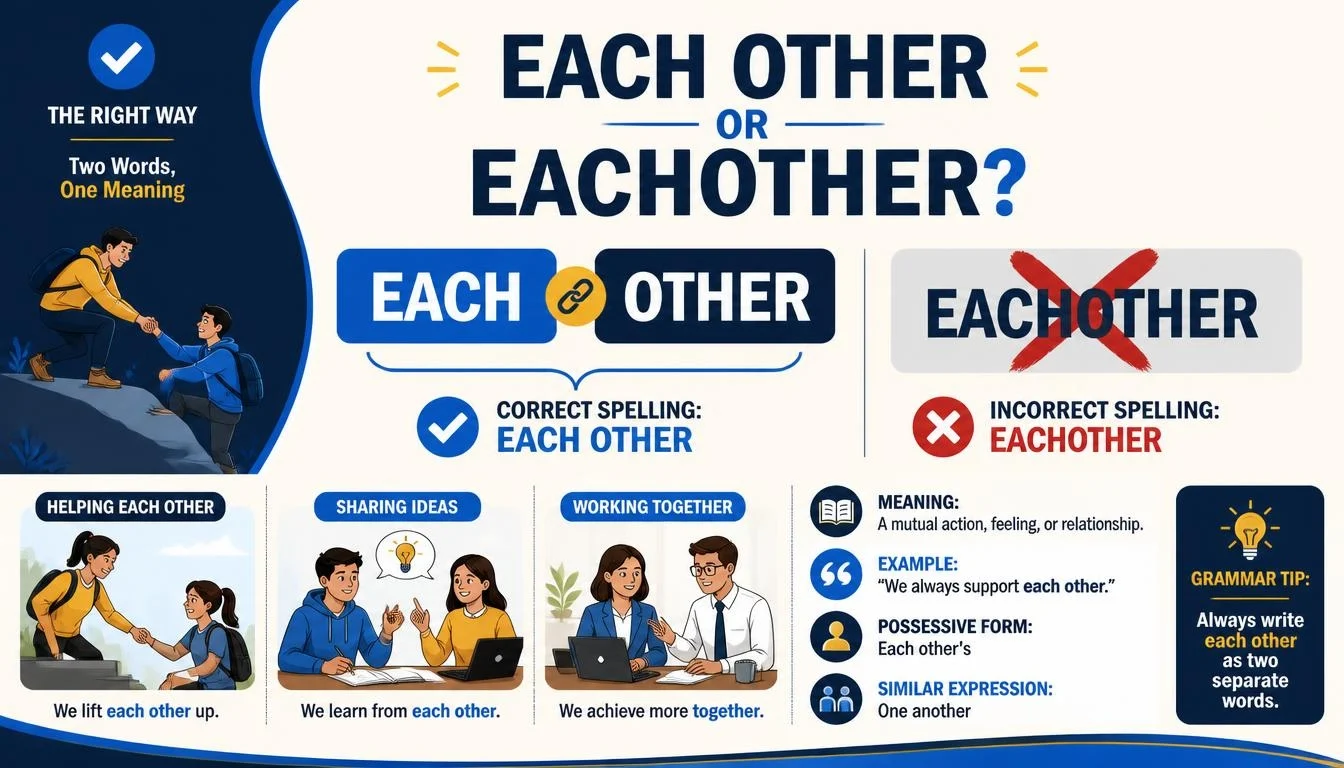
Each other is the correct spelling, while eachother is incorrect. The phrase consists of two separate words and describes a mutual relationship or action between two or more people, animals, or things. For example, “The two friends always help each other.” Always write each other as two words in standard English.
Have you ever wondered whether to write each other or eachother in a sentence? Although both versions may look familiar, only one follows standard English spelling rules. The correct form is each other, written as two separate words. However, many people mistakenly combine them, especially when typing quickly or communicating through text messages.
The expression is commonly used to describe a mutual action, feeling, relationship, or connection between people and things. For instance, friends support each other, coworkers help each other, and family members care for each other. Moreover, this phrase appears frequently in everyday conversations, academic writing, emails, social media posts, and professional communication.
Understanding this small spelling difference can improve your grammar and make your writing clearer. Therefore, this guide explains the correct spelling, meaning, grammar rules, practical examples, common mistakes, and differences between similar expressions. By the end, you’ll know exactly when and how to use each other correctly.
Each Other vs. Eachother
| Comparison | Each Other | Eachother |
|---|---|---|
| Correct spelling | Yes | No |
| Word structure | Two words | One combined word |
| Grammar | Reciprocal pronoun phrase | Nonstandard spelling |
| Meaning | Mutual action or relationship | No accepted standard meaning |
| Usage | Formal and informal English | Avoid |
| Example | They respect each other. | They respect eachother. |
What Does Each Other Mean?
Each other is a reciprocal pronoun phrase that describes an action, feeling, or relationship shared between two or more people, animals, or things.
In simple terms, it means that two or more parties do something mutually. For example, when two friends help each other, both give and receive help.
Here are some simple examples:
- The students understand each other.
- My parents love each other.
- The two teams respect each other.
- We always support each other.
- The neighbors frequently visit each other.
In each example, the action involves mutual participation. Consequently, the phrase helps explain relationships and shared activities without repeating the names of everyone involved.
Why Is Each Other Correct?
The expression each other is traditionally written as two separate words because it combines two distinct grammatical elements.
- Each: Refers to individual members of a group.
- Other: Refers to another person or thing.
Together, these words express a reciprocal relationship or action.
For example:
“Sarah and Emma help each other.”
This sentence means Sarah helps Emma, and Emma helps Sarah.
Similarly, consider this example:
“The two companies compete with each other.”
It means both companies participate in the competition.
Although English sometimes combines words into a single form, each other remains a two-word expression in standard modern English. Therefore, writing it as one word is considered a spelling mistake.
Is Eachother Ever Correct?
No. Eachother is not the accepted standard spelling of the reciprocal expression in modern English.
You may encounter it in text messages, social media comments, informal online posts, or writing mistakes. Nevertheless, its appearance online does not make it grammatically correct.
For example:
Incorrect: We should always respect eachother.
Correct: We should always respect each other.
The difference is only one space, but correct spacing matters in professional and academic writing. Therefore, always use the two-word form.
How to Use Each Other in a Sentence
The phrase each other generally works as the object of a verb or preposition. It shows that an action or relationship is mutual.
1. After an Action Verb
Use each other after a verb when two or more people perform an action mutually.
Examples:
- The children love each other.
- We trust each other completely.
- The friends encourage each other.
- They understand each other well.
2. After a Preposition
You can also use the expression after prepositions such as with, for, about, from, and to.
Examples:
- They talked to each other.
- We learned from each other.
- The students worked with each other.
- They bought gifts for each other.
- The neighbors complained about each other.
3. To Describe Relationships
The phrase is useful when discussing emotional, family, romantic, or professional relationships.
Examples:
- The couple cares deeply for each other.
- Good friends should be honest with each other.
- The coworkers respect each other.
- The family members always stand by each other.
4. In Questions
You can use each other in questions about mutual actions or relationships.
Examples:
- Do you trust each other?
- Why are they avoiding each other?
- How did you meet each other?
- Have the two teams played against each other?
Each Other vs. One Another
Both each other and one another express mutual relationships or actions. In traditional grammar teaching, each other is often associated with two people or things, while one another is associated with three or more.
However, modern English frequently uses both expressions interchangeably, even when referring to larger groups.
| Each Other | One Another |
|---|---|
| The two friends help each other. | The two friends help one another. |
| We respect each other. | We respect one another. |
| The sisters support each other. | The sisters support one another. |
Which one should you choose?
In everyday American English, both are natural. Nevertheless, each other is generally the more familiar choice in casual conversations.
Each Other vs. Eachothers
These expressions are not interchangeable.
Each other is the standard reciprocal expression. However, each other’s is the possessive form used to describe something belonging to another person in a mutual relationship.
Examples:
- They respect each other.
- They respect each other’s opinions.
- The friends know each other.
- The friends know each other’s families.
Notice that the apostrophe and s indicate possession. Therefore, do not confuse each other’s with eachother.
30 Examples of Each Other in Sentences
Here are practical examples showing how to use the correct expression naturally.
Everyday Conversation
- We always help each other.
- The children play with each other.
- They know each other very well.
- My friends support each other.
- The neighbors talk to each other every morning.
- We should listen to each other.
- The two brothers love each other.
- They smiled at each other.
- Good friends trust each other.
- We learn something from each other every day.
School and Workplace
- The students shared their notes with each other.
- Teachers and students should respect each other.
- The coworkers communicate with each other regularly.
- Our team members encourage each other.
- The employees compete with each other for promotions.
- The students explained the answers to each other.
- Both departments depend on each other.
- The colleagues congratulated each other after the presentation.
Family and Relationships
- My grandparents have loved each other for decades.
- The couple always stands by each other.
- Parents should understand each other.
- The sisters bought gifts for each other.
- We promised to support each other.
- The two friends apologized to each other.
Social Media and Texting
- We haven’t seen each other in years.
- Why are you ignoring each other?
- You two look perfect for each other.
- We should always be there for each other.
- They finally followed each other on Instagram.
- Let’s remind each other to stay positive.
Each Other in Texting and Social Media
The phrase each other is common in digital communication because it describes shared feelings, activities, and relationships.
People frequently use it in text messages, Instagram captions, Facebook posts, TikTok comments, and other online conversations.
Examples include:
- “We always have each other’s backs.”
- “I miss seeing each other every weekend.”
- “You two should talk to each other.”
- “Let’s support each other.”
- “We make each other happy.”
However, remember that informal communication does not change the correct spelling. Even in a short text message, write each other as two words.
Common Mistakes to Avoid
Although this expression is easy to understand, writers sometimes make spelling and grammatical mistakes.
Mistake 1: Writing Eachother as One Word
Incorrect: They love eachother.
Correct: They love each other.
Explanation: The standard spelling contains two separate words.
Mistake 2: Confusing Each Other With Each Other’s
Incorrect: They respect each other’s.
Correct: They respect each other.
Correct: They respect each other’s decisions.
Explanation: Use the apostrophe and s when expressing possession.
Mistake 3: Using Each Other Without a Mutual Relationship
Incorrect: I helped each other yesterday.
Correct: We helped each other yesterday.
Explanation: Each other generally requires two or more participants who share the action.
Mistake 4: Repeating Names Unnecessarily
Awkward: Sarah helps Emma, and Emma helps Sarah.
Better: Sarah and Emma help each other.
Explanation: The reciprocal phrase makes the sentence shorter and clearer.
Mistake 5: Assuming One Another Is Always Different
Some traditional grammar lessons distinguish between the two expressions based on the number of participants. However, modern English commonly uses them interchangeably.
Advantages and Disadvantages of Using Each Other
Advantages
- Clear communication: It expresses mutual actions without repeating names.
- Natural writing: The phrase sounds familiar in everyday English.
- Better sentence flow: It makes many sentences shorter and easier to read.
- Versatility: It works in personal, academic, and professional contexts.
- Relationship descriptions: It clearly communicates shared feelings and responsibilities.
Disadvantages
- Possible ambiguity: Readers may need additional context to identify the participants.
- Spelling confusion: Some writers incorrectly combine the words.
- Possessive confusion: Learners may confuse each other with each other’s.
- Repetition: Using the phrase too frequently can make writing sound repetitive.
Synonyms and Alternative Expressions for Each Other
Depending on the context, several expressions can communicate a similar idea.
| Alternative | Example |
|---|---|
| One another | They respect one another. |
| Mutually | They mutually agreed. |
| Together | We worked together. |
| Among themselves | They discussed it among themselves. |
| Reciprocally | They supported each other reciprocally. |
| In return | She helped him, and he helped her in return. |
| Back and forth | They exchanged messages back and forth. |
Important: These alternatives do not always have exactly the same grammatical function. Choose one that fits your sentence.
Related Comparisons: Commonly Confused Words
English contains many expressions that confuse writers because of their spelling or word spacing.
Here are some useful comparisons:
| Correct Form | Incorrect Form |
|---|---|
| Each other | Eachother |
| A lot | Alot |
| All right | Alright (not preferred in formal writing) |
| Every day | Everyday (when used incorrectly as an adverbial phrase) |
| In front | Infront |
| Of course | Ofcourse |
| At least | Atleast |
| No one | Noone |
| Any more | Anymore (context-dependent) |
| In between | Inbetween |
Understanding these differences can improve your spelling and overall writing accuracy.
Practice Exercises: Each Other or Eachother
Test your understanding with the following exercises.
Exercise 1: Choose the Correct Spelling
Fill in each blank with the correct form.
- The two friends always support ______.
- We should respect ______.
- They haven’t spoken to ______ for weeks.
- The students helped ______ with their homework.
- My parents love ______ very much.
- The two companies compete with ______.
- We bought presents for ______.
- The children were laughing at ______.
- Good teammates encourage ______.
- They finally met ______ at the event.
Exercise 2: Correct the Mistakes
Rewrite these sentences using the correct spelling.
- We should always help eachother.
- They understand eachother perfectly.
- The brothers care about eachother.
- My friends talk to eachother every day.
- The two teams respect eachother.
Exercise 3: Choose the Correct Sentence
- A. They love eachother.
B. They love each other. - A. We should trust each other.
B. We should trust eachother. - A. The students helped eachother.
B. The students helped each other.
Exercise Answers
1:
- Each other
- Each other
- Each other
- Each other
- Each other
- Each other
- Each other
- Each other
- Each other
- Each other
2:
- We should always help each other.
- They understand each other perfectly.
- The brothers care about each other.
- My friends talk to each other every day.
- The two teams respect each other.
3:
- B
- A
- B
Frequently Asked Questions (FAQs)
1. Is it each other or eachother?
Each other is correct. It must be written as two separate words in standard English. Eachother is a common spelling mistake.
2. Is eachother one word or two words?
The correct expression contains two words: each other. Writing it as one word is nonstandard.
3. Why do people write eachother?
People often write eachother because they type quickly, misunderstand the expression, or assume it should be combined like other English words. However, the standard spelling remains two words.
4. Is each other grammatically correct?
Yes. Each other is a grammatically correct reciprocal pronoun phrase used to describe mutual actions and relationships.
5. Can I use each other for more than two people?
Yes. Modern English allows each other to refer to three or more people or things. For example, “The team members helped each other.”
6. What is the difference between each other and one another?
Both expressions describe mutual actions or relationships. Although traditional grammar sometimes distinguishes them by number, modern English commonly uses them interchangeably.
7. Is each other’s correct?
Yes. Each other’s is the possessive form of each other. For example, “The friends respect each other’s opinions.”
8. Can I use each other in formal writing?
Absolutely. Each other is appropriate in academic papers, business emails, reports, professional documents, and everyday writing.
9. Is each other a pronoun?
Each other is traditionally classified as a reciprocal pronoun phrase. It expresses a mutual relationship between two or more participants.
10. What is another way to say each other?
Depending on the sentence, alternatives include one another, mutually, together, among themselves, and reciprocally.
11. Does each other need a hyphen?
No. The correct expression does not require a hyphen or any other punctuation between the words.
12. Which spelling should I use in American English?
Use each other in American English. It is the standard and accepted spelling.
Key Takeaways: Each Other or Eachother
Here are the most important points to remember:
- Each other is the correct spelling.
- Eachother is incorrect in standard English.
- The expression contains two separate words.
- It describes mutual actions, feelings, and relationships.
- It can refer to two or more people or things.
- One another is a common alternative.
- Each other’s is the possessive form.
- The phrase is suitable for formal and informal writing.
Conclusion
The correct choice between each other or eachother is simple: always write each other as two separate words. This reciprocal expression describes mutual actions, feelings, and relationships between two or more people or things. Although the incorrect spelling may appear in online conversations and informal messages, it is not accepted in standard English.
Moreover, understanding how to use each other can make your sentences clearer, more natural, and grammatically correct. Whether you’re writing an academic assignment, sending a text message, preparing a professional email, or sharing a social media caption, the same spelling rule applies.
Remember this simple tip: Each other = Two words, one mutual meaning. Once you understand this rule, you’ll never need to question the spelling again.