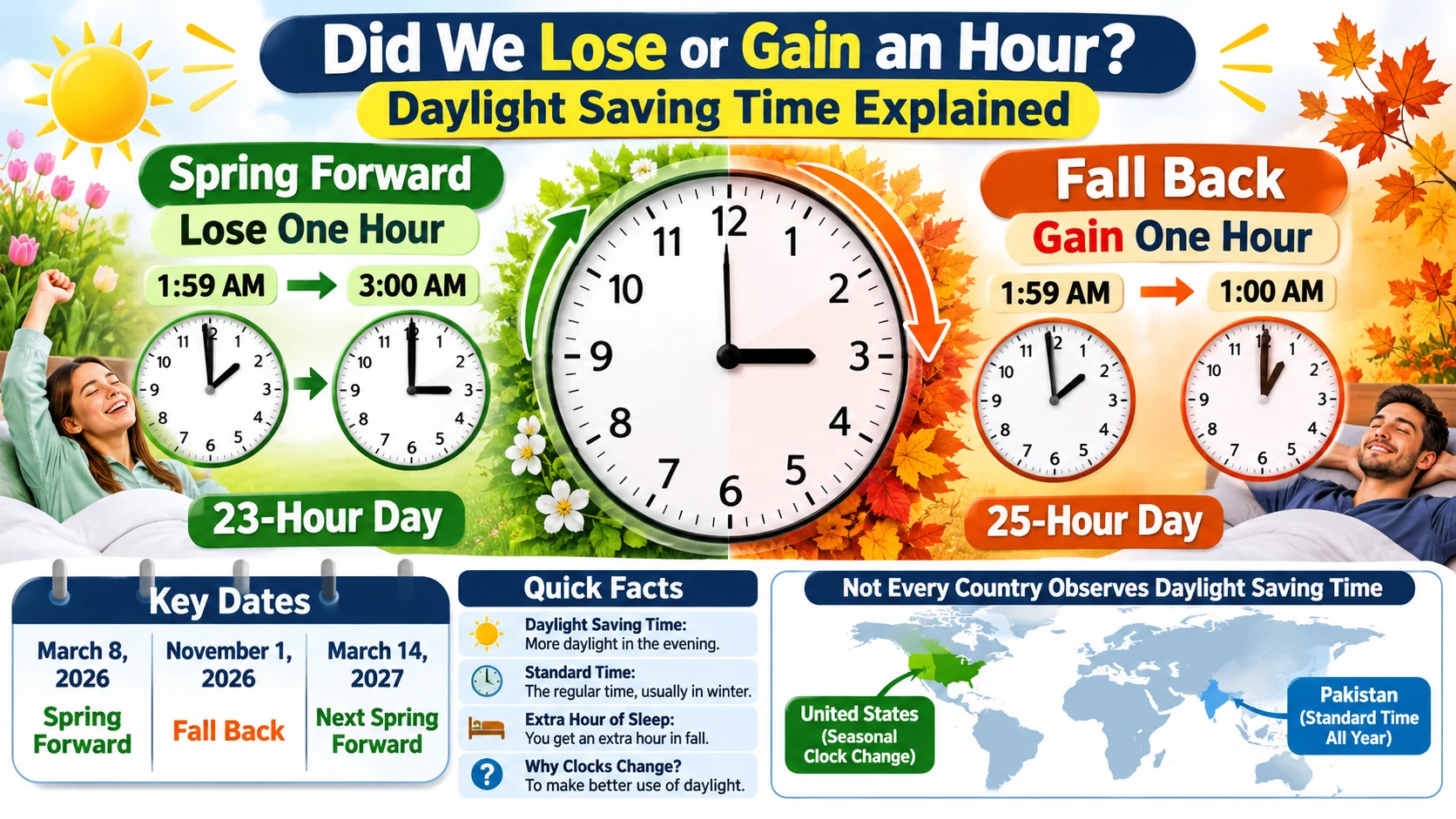
Did we lose or gain an hour? In the United States, we gained one hour when Daylight Saving Time ended on November 1, 2026. At 2:00 a.m., clocks moved backward to 1:00 a.m., giving people an extra hour. This change is called fall back. In contrast, when Daylight Saving Time begins in March, clocks move forward one hour, and people lose an hour.
Have you ever woken up wondering whether you gained an extra hour of sleep or lost one because the clocks changed overnight? The question did we lose or gain an hour becomes especially popular when Daylight Saving Time begins or ends. Although changing clocks sounds simple, remembering which direction they move can be confusing.
In the United States, clocks change twice a year in most states. During spring, people move their clocks forward by one hour, which means they lose an hour of sleep that night. However, when fall arrives, clocks move backward, allowing people to gain an additional hour.
For 2026, Daylight Saving Time ended on November 1, so most Americans gained an hour. Nevertheless, the rules are different in some locations, and several states and territories do not observe these seasonal changes.
Understanding this time adjustment can help you plan your sleep schedule, work meetings, travel arrangements, and daily activities. In this guide, you’ll discover what the clock change means, why it happens, how spring forward and fall back work, and when the next time change will occur.
Did We Lose or Gain an Hour?
| Meaning | Context | Primary Platforms | Example | Tone |
|---|---|---|---|---|
| Gained one hour | Fall clock change | Google, social media, everyday conversations | “We gained an hour of sleep!” | Informative |
| Lost one hour | Spring clock change | Google, social media, everyday conversations | “I lost an hour last night.” | Conversational |
| Fall back | End of Daylight Saving Time | News, conversations | “Remember to turn your clocks back.” | Informative |
| Spring forward | Start of Daylight Saving Time | News, conversations | “The clocks move forward tonight.” | Informative |
| Standard time | Fall and winter | Everyday conversations | “We’re back on standard time.” | Neutral |
What Does Did We Lose or Gain an Hour Mean?
The question did we lose or gain an hour refers to the seasonal clock adjustment associated with Daylight Saving Time (DST).
Daylight Saving Time is a practice in which participating regions move their clocks forward by one hour during part of the year. Later, they move their clocks backward to return to standard time.
The direction of the clock change determines whether people gain or lose an hour.
- Spring: Clocks move forward one hour, so people lose an hour.
- Fall: Clocks move backward one hour, so people gain an hour.
For example, imagine that you go to bed at 10:00 p.m. on a Saturday when the clocks are scheduled to move backward. When you wake up on Sunday morning, the clock may show an hour earlier than it would without the adjustment.
Consequently, the overnight period lasts 25 hours instead of the usual 24 hours on the clock. This creates an additional hour that people can use for sleeping, relaxing, or other activities.
On the other hand, spring’s clock adjustment creates a 23-hour day because the clock jumps forward.
Therefore, the answer depends on the season and the local time rules.
Did We Lose or Gain an Hour in 2026?
In most parts of the United States, people gained an hour when Daylight Saving Time ended in November 2026.
Here is the schedule for the United States in 2026:
| Clock Change | Date | What Happens? | Result |
|---|---|---|---|
| Spring forward | March 8, 2026 | 2:00 a.m. becomes 3:00 a.m. | Lose one hour |
| Fall back | November 1, 2026 | 2:00 a.m. becomes 1:00 a.m. | Gain one hour |
On March 8, most Americans moved their clocks forward by one hour. As a result, the morning clock time jumped from 1:59 a.m. to 3:00 a.m. after the transition.
Later, on November 1, the opposite happened. When local daylight time reached 2:00 a.m., clocks returned to 1:00 a.m. and the repeated hour occurred again.
That means most Americans gained an hour in November.
However, people living in locations that do not observe Daylight Saving Time did not experience this seasonal adjustment.
What Is Daylight Saving Time?
Daylight Saving Time is a seasonal timekeeping practice that moves clocks forward by one hour during warmer months.
The main idea is to shift an hour of daylight from the early morning to the evening. This allows people to enjoy more sunlight after traditional working and school hours.
For example, during Daylight Saving Time, someone finishing work at 5:00 p.m. may have more natural daylight available for shopping, exercising, traveling, or spending time outdoors.
When the season changes, clocks return to standard time. Consequently, sunrise and sunset occur earlier according to the clock.
Daylight Saving Time is commonly shortened to DST. Some people also casually call it daylight savings time, although daylight saving time is the formal expression.
Importantly, not every country follows the same schedule. Some countries change their clocks, while others maintain the same time throughout the year.
Why Do We Change Our Clocks Twice a Year?
The main purpose of changing clocks is to make better use of available daylight during different seasons.
During spring and summer, daylight generally lasts longer. Therefore, moving clocks forward allows more of that daylight to occur in the evening.
Historically, supporters of the practice believed that adjusting clocks could reduce energy consumption by decreasing the need for artificial lighting.
The United States first adopted Daylight Saving Time nationally in 1918 during World War I. The practice was later modified several times, and the current general schedule was established under the Energy Policy Act of 2005, taking effect in 2007.
Today, the debate continues. Supporters appreciate brighter evenings, while critics point to disrupted sleep schedules and other inconveniences.
Furthermore, modern lifestyles have changed considerably since the practice began. As a result, people continue to discuss whether changing clocks remains necessary.
Spring Forward vs. Fall Back
One of the easiest ways to understand the clock adjustment is to remember two familiar expressions: spring forward and fall back.
Spring Forward
Spring forward means moving clocks ahead by one hour when Daylight Saving Time begins.
For example:
- Before: 1:59 a.m.
- After: 3:00 a.m.
The hour between 2:00 a.m. and 2:59 a.m. disappears from that night’s clock time.
As a result, people lose an hour of sleep if they maintain the same bedtime and waking schedule.
Additionally, mornings may feel darker, while evenings remain brighter for longer.
Fall Back
Fall back means moving clocks backward by one hour when Daylight Saving Time ends.
For example:
- Before: 1:59 a.m.
- After: 1:00 a.m.
The hour between 1:00 a.m. and 1:59 a.m. happens twice.
Therefore, people gain an additional hour during the overnight transition.
In addition, mornings become brighter according to the clock, while evenings become darker earlier.
Easy Way to Remember
Spring forward, fall back.
Think of spring as moving ahead and fall as moving backward. This simple expression helps you remember which direction to adjust your clocks.
Do We Actually Get an Extra Hour of Sleep?
Yes, during the fall transition, people in regions observing Daylight Saving Time can get an additional hour of sleep.
However, gaining an hour on the clock does not automatically mean everyone sleeps longer.
For example, imagine that you normally go to bed at 11:00 p.m. and wake up at 7:00 a.m.
When clocks move backward, your overnight schedule may provide an extra hour. If you maintain your usual clock-based bedtime and waking time, you can potentially sleep nine hours instead of eight.
Nevertheless, some people continue waking up according to their body’s internal clock. Therefore, they may not actually sleep longer.
During spring, the situation reverses. People may lose an hour of sleep because the clock moves forward.
For that reason, maintaining a consistent sleeping schedule can help make seasonal adjustments easier.
Which States in the USA Do Not Change Their Clocks?
Although most American states observe Daylight Saving Time, some locations do not participate.
The main exceptions include:
- Hawaii: Does not observe Daylight Saving Time.
- Most of Arizona: Uses standard time throughout the year.
- Navajo Nation: Observes Daylight Saving Time, even though most of Arizona does not.
- American Samoa: Does not observe Daylight Saving Time.
- Guam: Does not observe Daylight Saving Time.
- Puerto Rico: Does not observe Daylight Saving Time.
- U.S. Virgin Islands: Does not observe Daylight Saving Time.
- Northern Mariana Islands: Does not observe Daylight Saving Time.
Therefore, the answer to “did we lose or gain an hour?” can depend on where someone lives.
For instance, someone in New York experiences the seasonal clock adjustment, while someone in Hawaii does not.
Always check local time rules when arranging international calls, business meetings, or travel.
When Will We Change Our Clocks Again?
After the November 2026 transition, most Americans will remain on standard time until March 2027.
The next scheduled Daylight Saving Time change in the United States is:
Sunday, March 14, 2027.
At 2:00 a.m. local standard time, clocks will move forward to 3:00 a.m.
Consequently, people in participating regions will lose one hour.
The following fall adjustment is scheduled for November 7, 2027, when clocks will move backward again.
These dates follow the general American rule:
- Second Sunday in March: Spring forward.
- First Sunday in November: Fall back.
Remember that these dates apply to participating areas in the United States. Other countries may follow entirely different schedules.
How Does the Time Change Affect Everyday Life?
The seasonal clock adjustment can affect several parts of daily life.
Although the clock only changes by one hour, the adjustment may influence sleep, work, travel, and daily routines.
Sleep Schedule
During spring, losing an hour can make some people feel tired the following morning. However, the fall adjustment may provide an opportunity to enjoy additional sleep.
Work and School
Employees and students may need time to adjust their routines. In addition, businesses operating across different time zones must update schedules carefully.
Travel Plans
Airlines, hotels, and transportation services generally follow local time rules. Therefore, travelers should check departure and arrival times rather than assuming every location follows the same clock.
Morning and Evening Activities
After the fall adjustment, sunrise and sunset happen earlier according to the clock. Consequently, people may have brighter mornings but less evening daylight.
Technology and Devices
Most smartphones, computers, and internet-connected devices automatically update their clocks when their settings are correct.
However, traditional wall clocks, some appliances, and older vehicle clocks may require manual adjustment.
Does Daylight Saving Time Affect Everyone Around the World?
No. Daylight Saving Time is not a worldwide practice.
Different countries follow different timekeeping rules depending on their geographical location, government policies, and seasonal daylight patterns.
For example, most of the United States observes seasonal clock changes. In contrast, Pakistan maintains Pakistan Standard Time (PKT) throughout the year and does not currently observe Daylight Saving Time.
Other countries, including India and China, also maintain their standard time without the same seasonal clock adjustment.
Meanwhile, some countries in the Southern Hemisphere observe daylight-saving arrangements during different months because their seasons are opposite to those in the Northern Hemisphere.
Therefore, the answer to did we lose or gain an hour depends on the country, region, and date.
Never assume that a clock change in the United States also applies to Pakistan, Europe, or another part of the world.
Common Examples of Did We Lose or Gain an Hour in Conversation
People frequently ask this question when the clocks change because they want to understand whether they have more or less time.
Here are some natural examples:
Example 1: Talking About Sleep
Person A: “Did we lose or gain an hour last night?”
Person B: “We gained an hour because the clocks moved backward.”
Example 2: Discussing Spring
Person A: “Why does it feel like I barely slept?”
Person B: “We lost an hour when Daylight Saving Time started.”
Example 3: Talking About Work
Person A: “Is our meeting still at 9:00 a.m.?”
Person B: “Yes, but check the updated time because the clocks changed.”
Example 4: Discussing Travel
Person A: “Will my flight arrive at the same local time?”
Person B: “Check the airline’s updated schedule because the destination may follow different time rules.”
Example 5: Social Media Caption
“Extra hour of sleep? Yes, please! Fall back is here.”
Example 6: Talking About the Weekend
Person A: “Do we get more time this Sunday?”
Person B: “Yes! We gain an hour when the clocks go back.”
Example 7: Discussing Morning Activities
Person A: “Why is it brighter earlier today?”
Person B: “Because we returned to standard time.”
Example 8: Explaining the Spring Change
Person A: “Why did 2:00 a.m. suddenly become 3:00 a.m.?”
Person B: “That’s what happens when Daylight Saving Time begins.”
Synonyms and Related Expressions
The question itself does not have exact synonyms in every situation. However, several expressions communicate a similar idea.
| Expression | Meaning |
|---|---|
| Spring forward | Move clocks ahead one hour |
| Fall back | Move clocks backward one hour |
| Gain an hour | Receive an additional hour during the fall adjustment |
| Lose an hour | Experience a shorter clock day during the spring adjustment |
| Daylight Saving Time | Seasonal clock adjustment |
| Standard time | Regular time outside the DST period |
| Clock change | Adjustment of clocks by one hour |
| Time change | A change in the local clock schedule |
| Extra hour of sleep | Additional potential sleeping time during fall |
| Set the clocks back | Move clocks backward one hour |
These expressions can help you understand conversations about seasonal time changes.
Common Mistakes About Daylight Saving Time
Even people who experience clock changes every year sometimes misunderstand the process.
Here are several mistakes worth avoiding.
Mistake 1: Thinking We Lose an Hour in Fall
This is incorrect for regions ending Daylight Saving Time.
In fall, clocks move backward, so people gain an hour rather than lose one.
Mistake 2: Confusing Spring Forward With Fall Back
Spring forward means moving clocks ahead. Fall back means moving them backward.
Therefore, remembering the seasons makes the direction easier to understand.
Mistake 3: Assuming Every Country Changes Its Clocks
Not every country observes Daylight Saving Time.
For example, Pakistan does not currently follow the American clock-changing schedule.
Mistake 4: Assuming Everyone Gets More Sleep
Although the fall transition provides an extra clock hour, individual sleeping habits can differ.
Some people may wake up according to their internal body clock and receive no additional sleep.
Mistake 5: Forgetting to Update Manual Clocks
Smartphones usually update automatically, but older clocks and appliances may not.
Consequently, checking your household clocks after a seasonal adjustment can prevent confusion.
Mistake 6: Assuming the Dates Are Always the Same
The dates of the spring and fall transitions change every year because they are based on specific Sundays.
For that reason, check the annual schedule instead of relying on last year’s dates.
Advantages and Disadvantages of Daylight Saving Time
Daylight Saving Time has both supporters and critics.
Advantages
More Evening Daylight: Moving clocks forward provides more daylight during the evening, which can help people enjoy outdoor activities.
Outdoor Recreation: Families and individuals may have more opportunities for walking, shopping, sports, and other activities after work.
Seasonal Flexibility: The clock adjustment changes how daylight aligns with typical working and school schedules.
Potential Energy Benefits: Supporters argue that additional evening daylight can reduce some lighting needs, although actual energy savings depend on local conditions.
Disadvantages
Sleep Disruption: Losing an hour in spring can temporarily disturb sleeping routines.
Schedule Confusion: People may become confused about meeting times, travel arrangements, and work schedules.
Health and Routine Adjustments: Some individuals find the transition difficult because their internal body clocks do not immediately match the new clock time.
Earlier Winter Sunsets: After clocks move backward, evening darkness arrives earlier according to the clock.
Technology Issues: Older devices and improperly configured systems may display incorrect times.
Ultimately, whether the advantages outweigh the disadvantages remains a subject of public discussion.
Tips for Adjusting to the Clock Change
A few simple habits can make seasonal time changes easier.
- Adjust Your Sleep Gradually: Try shifting your bedtime slightly before the clock change.
- Maintain a Consistent Routine: Keep your sleeping and waking times as regular as possible.
- Get Natural Morning Light: Exposure to daylight can help your body adjust to a new schedule.
- Check Your Devices: Make sure your smartphones and computers use the correct time zone settings.
- Update Manual Clocks: Remember appliances, wall clocks, and older vehicle clocks.
- Plan Important Meetings: Double-check appointments when communicating with people in different time zones.
- Avoid Late-Night Disruptions: Give yourself enough rest during the adjustment period.
Additionally, planning ahead can reduce confusion and help you maintain your normal daily activities.
Exercises: Test Your Understanding
Try answering these questions to see how well you understand seasonal clock changes.
Question 1: What happens when Daylight Saving Time ends in the fall?
A. Clocks move forward.
B. Clocks move backward.
C. Clocks stop.
Answer: B. Clocks move backward one hour.
Question 2: Do people gain or lose an hour when clocks move forward?
A. Gain an hour.
B. Lose an hour.
C. Nothing changes.
Answer: B. They lose an hour.
Question 3: What does fall back mean?
A. Move clocks backward.
B. Move clocks forward.
C. Stop using clocks.
Answer: A. Move clocks backward.
Question 4: Does Pakistan currently observe the American Daylight Saving Time schedule?
A. Yes.
B. No.
C. Only during winter.
Answer: B. No. Pakistan maintains its standard time throughout the year.
Question 5: What is the common American expression for the spring clock adjustment?
A. Fall back.
B. Spring forward.
C. Turn back.
Answer: B. Spring forward.
Question 6: What happens when clocks move backward from 2:00 a.m. to 1:00 a.m.?
A. An hour is repeated.
B. An hour disappears.
C. The day becomes shorter.
Answer: A. An hour is repeated.
Related Comparisons
Understanding these related expressions makes the topic easier to remember.
Spring Forward vs. Fall Back
Spring forward means clocks move ahead by one hour, while fall back means clocks move backward by one hour.
The first adjustment makes the clock day shorter, whereas the second makes it longer.
Daylight Saving Time vs. Standard Time
Daylight Saving Time is the seasonal period when clocks are advanced by one hour. Standard time is the regular time observed outside that period.
Gain an Hour vs. Lose an Hour
Gaining an hour means receiving an additional hour during the fall transition. Losing an hour means experiencing a shorter clock day during the spring transition.
Daylight vs. Sunshine
Daylight refers to the natural light available during the day. Sunshine refers specifically to sunlight reaching an area.
Although these terms are related, they do not mean exactly the same thing.
Frequently Asked Questions
1. Did we lose or gain an hour in November 2026?
Most Americans gained one hour on November 1, 2026, when Daylight Saving Time ended. Clocks moved backward from 2:00 a.m. to 1:00 a.m.
2. Do we gain an hour when clocks go backward?
Yes. When clocks move backward during the fall transition, the hour between 1:00 a.m. and 1:59 a.m. occurs twice. Consequently, the overnight clock period lasts an extra hour.
3. Do we lose an hour in spring?
Yes. When Daylight Saving Time begins, clocks move forward from 2:00 a.m. to 3:00 a.m. Therefore, the clock skips one hour.
4. Why do clocks change at 2 a.m.?
The 2:00 a.m. transition is a standardized time chosen to minimize disruption to common daytime activities. However, the exact local rules depend on the jurisdiction.
5. What does spring forward, fall back mean?
It is a simple expression used to remember the direction of seasonal clock changes. Spring forward means moving clocks ahead, while fall back means moving them backward.
6. Does everyone in the United States change their clocks?
No. Most states observe Daylight Saving Time, but Hawaii and most of Arizona do not. Several U.S. territories also maintain standard time throughout the year.
7. Does Pakistan change its clocks for Daylight Saving Time?
No. Pakistan currently follows Pakistan Standard Time (PKT), which is UTC+5, throughout the year. It does not follow the American spring and fall clock-changing schedule.
8. When will we lose an hour again?
In most participating areas of the United States, the next scheduled clock change will occur on March 14, 2027. Clocks will move forward by one hour.
9. Do phones automatically change time?
Most modern smartphones automatically update their clocks when automatic date, time, and time zone settings are enabled. Nevertheless, checking your settings is a good idea.
10. Is Daylight Saving Time the same as standard time?
No. Daylight Saving Time is the seasonal period when clocks are advanced by one hour. Standard time is the regular time used when the seasonal adjustment is not active.
11. Why does the sun set earlier after the fall clock change?
When clocks return to standard time, daylight shifts earlier according to the clock. As a result, sunrise and sunset both appear about an hour earlier by clock time compared with the previous day.
12. Is the extra hour of sleep guaranteed?
No. The clock provides an additional hour during the fall transition, but individual sleep schedules differ. Some people may wake up according to their internal body clock instead of sleeping longer.
13. What happens if I forget to change my clock?
If your device does not update automatically, it may display the wrong local time. Therefore, manually adjust traditional clocks and verify important appointments.
14. Is Daylight Saving Time used worldwide?
No. Some countries observe seasonal clock changes, while others use the same time throughout the year. The dates and rules also vary between countries.
15. What is the easiest way to remember whether we gain or lose an hour?
Remember this phrase: Spring forward, fall back. You lose an hour in spring when clocks move ahead, and gain an hour in fall when clocks move backward.
Conclusion
So, did we lose or gain an hour? The answer depends on when and where the clock change happens. In most of the United States, people gained one hour when Daylight Saving Time ended on November 1, 2026. Clocks moved backward from 2:00 a.m. to 1:00 a.m., creating an extra hour overnight.
In contrast, people lose an hour when Daylight Saving Time begins in March because clocks move forward. Remembering the simple expression spring forward, fall back makes the difference easy to understand.
However, not every country or region follows the same schedule. Some places, including Pakistan, maintain their standard time throughout the year.
Ultimately, understanding these seasonal adjustments helps you manage your sleep, appointments, travel plans, and daily routine without confusion. The next time someone asks whether we lost or gained an hour, you’ll know exactly how to answer.