Speak now or forever hold your peace is a traditional expression used to give someone a final opportunity to speak up or express an objection before a decision becomes official. It is especially associated with wedding ceremonies, where an officiant may invite anyone with a serious objection to the marriage to come forward. In everyday conversation, the phrase can also mean that someone should share their concerns now rather than remain silent and bring them up later.
The phrase speak now or forever hold your peace is a familiar expression that gives someone one final chance to voice an opinion, concern, or objection before an important decision is finalized. Many people recognize these words from traditional wedding ceremonies, where an officiant may ask whether anyone present has a reason why two people should not marry. However, the expression has a much broader meaning outside weddings.
In everyday conversations, people use this phrase when they want others to speak honestly before a particular opportunity passes. For example, someone might say it before making an important announcement, finalizing a group decision, or ending a discussion. Moreover, the expression can sound serious, dramatic, humorous, or even slightly threatening, depending on the situation.
Although the wording may seem old-fashioned, it remains popular in movies, television shows, books, social media posts, and ordinary conversations. Understanding its meaning, history, and proper usage can help you recognize when someone is inviting an honest response or giving a final warning. In this guide, you’ll discover its definition, wedding tradition, practical examples, similar expressions, and common mistakes.
What Does Speak Now or Forever Hold Your Peace Mean?
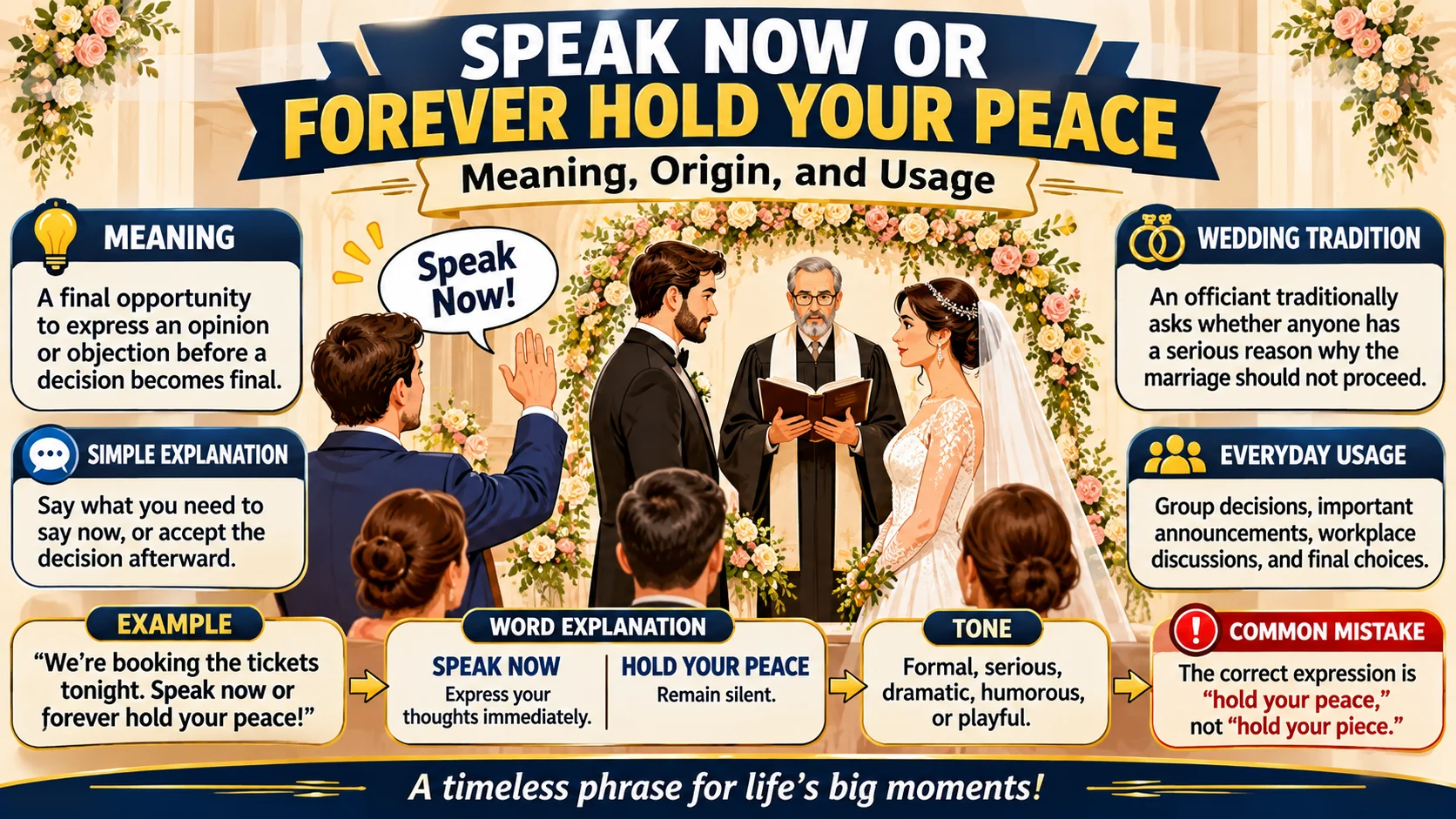
Speak now or forever hold your peace means that you have one final opportunity to express your thoughts, concerns, or objections before a decision is made permanent or a situation moves forward.
The expression contains two important ideas: speaking up and remaining silent.
- Speak now: Share your opinion, concern, objection, or reason immediately.
- Forever hold your peace: If you choose not to speak at this moment, you should accept the decision without bringing up the same objection later.
In simple terms, the phrase tells someone that the time to express disagreement is now. Once the opportunity passes, the speaker expects everyone to move forward.
For example, imagine a group of friends planning a vacation. Everyone agrees on the destination, but one person has not shared their opinion. Another friend might say, “Speak now or forever hold your peace.” This means the person should mention any concerns before the group books its tickets.
Similarly, during a wedding ceremony, the expression traditionally gives attendees an opportunity to raise a serious objection before the marriage proceeds.
However, the phrase does not always represent a literal or legally binding rule. In many situations, people use it playfully to encourage others to share their opinions.
What Does Forever Hold Your Peace Mean?
The words forever hold your peace mean to remain silent or refrain from expressing an objection after the opportunity to speak has passed.
Here, the word peace does not simply refer to the absence of war or conflict. Instead, it carries an older meaning connected with silence, quietness, or keeping one’s thoughts to oneself.
The word hold means to keep or maintain something. Therefore, to hold your peace means to remain quiet rather than speak.
When someone combines this phrase with “speak now,” the message becomes a final invitation to express an opinion.
For example:
“Everyone has agreed on the new rules. Speak now or forever hold your peace.”
This means anyone who disagrees should express their concerns before the rules become final.
Nevertheless, the word forever makes the expression sound more dramatic than an ordinary request for feedback. In everyday situations, it usually means that the current opportunity is ending rather than requiring someone to remain silent for the rest of their life.
Why Do People Say Speak Now or Forever Hold Your Peace at Weddings?
The expression is strongly associated with traditional wedding ceremonies, particularly in Western cultures.
During some traditional Christian wedding ceremonies, an officiant may ask whether anyone present knows a reason why the couple should not be joined in marriage. This invitation gives attendees an opportunity to raise a serious objection before the ceremony continues.
The traditional wording is often:
“If anyone knows of any reason why these two should not be joined in marriage, speak now or forever hold your peace.”
Although many modern weddings leave out this part of the ceremony, the expression remains widely recognized.
What Is the Purpose of This Wedding Tradition?
Historically, marriage ceremonies included opportunities to raise objections because certain circumstances could prevent a marriage from taking place.
For example, concerns might involve an existing marriage, a prohibited family relationship, or another recognized impediment under the applicable religious or legal tradition.
The announcement provided a public opportunity to bring such concerns forward before the marriage proceeded.
However, the wording and requirements have changed across cultures, religious traditions, and legal systems. Modern marriage laws generally establish their own requirements for determining whether a marriage can legally take place.
Is the Phrase Used in Every Wedding?
No. Not every wedding includes this traditional question.
Many modern couples prefer personalized ceremonies that focus on love, commitment, family, and shared promises. Consequently, officiants may skip the objection question entirely.
Additionally, some religious ceremonies follow specific rules that differ from the traditional English wording.
Even so, the expression remains a recognizable part of popular wedding culture.
The Origin and History of Speak Now or Forever Hold Your Peace
The expression comes from traditional marriage language and older uses of the word peace, meaning silence or quietness.
Its history is closely connected with the practice of announcing an intended marriage and allowing people to raise legitimate objections before the ceremony.
In English-speaking Christian traditions, marriage announcements and public objections developed as ways to identify possible impediments to a proposed marriage. These practices became associated with formal wedding ceremonies.
The wording also became familiar through traditional marriage liturgies, especially the English-language marriage service in the Book of Common Prayer.
The 1549 Book of Common Prayer, associated with the English Reformation, helped establish an influential form of English marriage liturgy. Later editions included the familiar invitation for anyone who knew of a reason why a marriage should not proceed to declare it.
Over time, the wording became deeply associated with weddings.
However, its popularity eventually expanded beyond religious ceremonies. Movies, television programs, novels, comedy sketches, and everyday conversations helped turn it into a widely understood expression.
Today, people often use it without any connection to marriage. Instead, it serves as a dramatic way to ask whether anyone has a final objection before a decision is made.
Speak Now or Forever Hold Your Peace in Simple Words
In simple English, the expression means:
“If you have something important to say, say it now. Otherwise, accept the decision and do not complain afterward.”
It is a way of encouraging people to communicate before an opportunity disappears.
Consider these everyday situations:
- A team is about to finalize a project plan.
- A family is deciding where to celebrate a holiday.
- A couple is preparing to make an important announcement.
- A manager is asking employees for final feedback.
- Friends are choosing a restaurant for dinner.
- Someone is giving others a last chance to disagree.
In each situation, the phrase communicates that the time for objections or suggestions is limited.
How Is Speak Now or Forever Hold Your Peace Used in Everyday Conversation?
Although the phrase has traditional wedding associations, people also use it in informal and professional situations.
Its meaning generally stays the same, but the tone changes according to the context.
When Making a Final Decision
Someone might use the expression before finalizing a decision.
Example:
“We’re submitting the final proposal tomorrow. Speak now or forever hold your peace.”
Meaning: Anyone who wants to suggest a change should do so before the proposal is submitted.
When Asking for Honest Opinions
The phrase can encourage people to express their real feelings.
Example:
“If anyone disagrees with the new schedule, speak now or forever hold your peace.”
Meaning: Share your concerns before everyone accepts the schedule.
When Making a Dramatic Announcement
People sometimes use it humorously before revealing important news.
Example:
“I’m moving to another city next month. Speak now or forever hold your peace if you want to convince me to stay.”
Meaning: This is the final opportunity to share an opinion before the move.
When Ending an Argument
The expression can signal that a discussion is about to end.
Example:
“This is your last chance to explain your side. Speak now or forever hold your peace.”
Meaning: The speaker wants the other person to respond before the conversation ends.
When Making a Group Decision
Friends, classmates, or coworkers may use it before agreeing on a plan.
Example:
“We’re booking the hotel tonight. Speak now or forever hold your peace.”
Meaning: Anyone with concerns should mention them before the booking is completed.
Real-Life Examples of Speak Now or Forever Hold Your Peace
Here are natural examples showing how people use the expression in different situations.
Wedding Examples
- “The officiant asked whether anyone had an objection and invited them to speak now or forever hold their peace.”
- “Everyone laughed when the wedding officiant repeated the traditional question.”
- “The couple included the famous phrase in their ceremony as a tribute to traditional weddings.”
- “No one objected, so the wedding continued without interruption.”
Everyday Conversation Examples
- “We’re choosing the vacation destination tonight, so speak now or forever hold your peace.”
- “If you have any problems with my decision, this is your chance to tell me.”
- “I’m ordering the food in five minutes. Speak now or forever hold your peace.”
- “Everyone agreed with the plan, and nobody raised an objection.”
- “This is the final version of the presentation, so speak now or forever hold your peace.”
Workplace Examples
- “Before we finalize the budget, speak now or forever hold your peace.”
- “The manager gave everyone one last chance to suggest changes.”
- “We’re closing the discussion today, so please raise any concerns now.”
- “If anyone disagrees with the proposed strategy, this is the time to speak up.”
Funny and Sarcastic Examples
- “I’m about to order pineapple pizza. Speak now or forever hold your peace.”
- “I’m cutting my hair short tomorrow. Speak now or forever hold your peace.”
- “I’m adopting another cat. This is everyone’s final warning.”
- “I’m changing the group chat name tonight. Speak now or forever hold your peace.”
- “I’m buying another pair of shoes, so anyone who wants to stop me should speak now.”
Social Media Caption Examples
People also use the expression in captions to create suspense or invite comments.
- “New chapter begins tomorrow. Speak now or forever hold your peace.”
- “Big announcement coming soon. Speak now or forever hold your peace.”
- “One last chance to change my mind!”
- “The decision is almost final. Any objections?”
- “Last call for opinions. After this, we’re moving forward.”
What Is the Tone of Speak Now or Forever Hold Your Peace?
The expression can communicate different emotions depending on the speaker’s intention and the situation.
| Tone | Meaning | Example |
|---|---|---|
| Serious | A genuine opportunity to raise an objection | “Speak now before we sign the agreement.” |
| Formal | A traditional or ceremonial announcement | “If anyone objects, speak now or forever hold your peace.” |
| Humorous | A playful invitation to disagree | “I’m ordering dessert. Speak now or forever hold your peace.” |
| Sarcastic | A slightly mocking final warning | “I’m making the decision myself. Speak now or forever hold your peace.” |
| Dramatic | A high-pressure final opportunity | “This is your last chance. Speak now or forever hold your peace.” |
| Confident | A willingness to move forward | “I’ve made my choice. Speak now or forever hold your peace.” |
The phrase can sound friendly or intimidating, so consider the audience before using it.
Is Speak Now or Forever Hold Your Peace an Idiom?
Yes, the expression can be considered an idiomatic expression because its familiar figurative meaning goes beyond the literal meanings of its individual words.
Although the words refer to speaking and remaining silent, the complete phrase communicates a specific social message: express your objection before the opportunity passes.
It is also a traditional formula associated with wedding ceremonies.
For example, someone might say, “We’re choosing the final design today, so speak now or forever hold your peace.”
The speaker is not asking anyone to remain silent for the rest of their life. Instead, they are emphasizing that the decision is about to become final.
Is Speak Now or Forever Hold Your Peace Formal or Informal?
The expression can work in both formal and informal situations.
Formal use: It is associated with traditional wedding ceremonies, official announcements, and serious decisions.
Informal use: Friends, family members, and coworkers may use it jokingly before making a group decision.
However, it is generally more dramatic and old-fashioned than everyday expressions such as “Does anyone have any objections?” or “Any final thoughts?”
Therefore, it works best when the speaker wants to create emphasis or add a little humor.
What Is the Difference Between Speak Now or Forever Hold Your Peace and Speak Up?
Both expressions encourage someone to communicate, but they have different purposes.
| Feature | Speak Now or Forever Hold Your Peace | Speak Up |
|---|---|---|
| Meaning | Express your objection before the opportunity passes | Express your thoughts or concerns |
| Timing | Usually emphasizes a final opportunity | Can happen at any time |
| Tone | Dramatic or traditional | Direct and conversational |
| Common Context | Weddings and final decisions | Everyday discussions |
| Example | “Speak now or forever hold your peace before we sign.” | “Speak up if you disagree.” |
The main difference is timing. Speak up encourages communication in general, whereas speak now or forever hold your peace emphasizes a limited opportunity to respond.
Speak Now or Forever Hold Your Peace vs. Do or Die
These expressions can both describe high-pressure situations. However, their meanings are different.
| Feature | Speak Now or Forever Hold Your Peace | Do or Die |
|---|---|---|
| Meaning | Give a final opportunity to express an objection | A situation involving extreme urgency or high stakes |
| Main Focus | Speaking before a decision | Taking action or facing failure |
| Tone | Formal, dramatic, or humorous | Intense and urgent |
| Example | “Speak now or forever hold your peace before the vote.” | “This is a do-or-die match for the team.” |
In short, the first expression focuses on communication, while the second focuses on action and consequences.
Synonyms and Similar Expressions
Several English expressions communicate an idea similar to speak now or forever hold your peace.
However, they may differ slightly in tone and context.
| Similar Expression | Meaning |
|---|---|
| Speak up now | Express your thoughts immediately |
| Any objections? | Ask whether anyone disagrees |
| Last chance to speak | Final opportunity to respond |
| Say your piece | Express your opinion |
| Voice your concerns | Share your worries or objections |
| Now or never | Take an opportunity before it disappears |
| Put it on the table | Bring an issue into discussion |
| Make yourself heard | Ensure others hear your opinion |
| Raise your hand | Signal that you want to speak |
| Get it off your chest | Express something you have been holding inside |
Best alternative for everyday conversations: “Does anyone have any objections?”
Best alternative for a serious discussion: “Please voice any concerns before we finalize the decision.”
Best alternative for a humorous situation: “Last chance to change my mind!”
Common Mistakes When Using Speak Now or Forever Hold Your Peace
Although the expression is easy to recognize, people sometimes misunderstand its meaning or use it in the wrong situation.
Thinking It Only Applies to Weddings
Many people associate the phrase exclusively with marriage ceremonies.
However, it can also be used before group decisions, announcements, plans, and important discussions.
Taking Forever Literally
The word forever makes the expression sound permanent. Nevertheless, people usually mean that the current opportunity to object is ending.
Using It to Silence Someone Unfairly
The phrase traditionally invites people to express objections. It should not become an excuse to prevent reasonable discussion later.
For example, someone should not use it to dismiss important new information that emerges after a decision.
Confusing It With Speak Up
Both expressions involve communication, but they are not interchangeable in every situation.
“Speak up” is a general request to express an opinion. In contrast, the longer phrase emphasizes a final opportunity.
Forgetting the Correct Wording
The traditional expression is:
“Speak now or forever hold your peace.”
Common incorrect variations include:
- Speak now or forever hold your piece.
- Speak now or always hold your peace.
- Speak now or hold your piece forever.
The correct expression uses peace, not piece.
Why Is It Hold Your Peace Instead of Hold Your Piece?
This is a common question because peace and piece sound identical in most English accents.
However, they have different meanings.
Peace refers to quietness, calmness, or the absence of conflict. In the expression, it means remaining silent.
Piece refers to a part or portion of something. It does not fit the traditional meaning of the phrase.
Therefore, the correct wording is always hold your peace.
For example:
- Correct: “Speak now or forever hold your peace.”
- Incorrect: “Speak now or forever hold your piece.”
Remember that the expression is about speaking or remaining silent, not holding a physical piece of something.
When Should You Use Speak Now or Forever Hold Your Peace?
You can use the expression whenever you want to give someone a final opportunity to share an opinion or objection.
It works particularly well in these situations:
Before finalizing a decision: Ask whether anyone has concerns before moving forward.
During a group discussion: Encourage quiet participants to share their thoughts.
At a wedding: Recognize the traditional wording associated with marriage ceremonies.
In a humorous conversation: Add a dramatic touch to an ordinary decision.
Before making an announcement: Give others a chance to respond before revealing or finalizing something.
However, avoid using it when people need an ongoing opportunity to provide feedback. A serious workplace decision, for instance, may require discussion even after an initial deadline.
Can You Use Speak Now or Forever Hold Your Peace in Text Messages?
Yes. People can use the phrase in text messages, group chats, and social media conversations.
Its dramatic wording makes it useful for playful announcements and last-minute decisions.
Here are some examples:
Example 1: Group Chat
“I’m ordering burgers tonight. Speak now or forever hold your peace!”
Example 2: Relationship
“I’m finally choosing the vacation destination. Any objections?”
Example 3: Friends
“I’m changing my hairstyle tomorrow. Speak now or forever hold your peace.”
Example 4: Social Media
“New chapter, new goals, and no turning back. Speak now or forever hold your peace.”
Example 5: Family Conversation
“We’re decorating the house this weekend. Anyone who has suggestions should speak now!”
The expression can make an ordinary message sound more entertaining. However, its dramatic tone works best when everyone understands that it is being used playfully.
Key Takeaways and Summary
Here are the most important points to remember about speak now or forever hold your peace:
- The phrase gives someone a final opportunity to express an opinion or objection.
- It is traditionally associated with wedding ceremonies.
- The expression can also be used in everyday conversations and group decisions.
- “Hold your peace” means to remain silent.
- The word peace is correct, not piece.
- Its tone can be serious, formal, humorous, sarcastic, or dramatic.
- The expression usually emphasizes the importance of speaking before a decision becomes final.
- It does not mean someone must literally remain silent forever.
Ultimately, the phrase reminds people to communicate their concerns before an important opportunity passes.
Practice Exercises: Speak Now or Forever Hold Your Peace
Test your understanding with these short exercises.
Exercise: Choose the Correct Meaning
What does “speak now or forever hold your peace” mean?
A. Speak loudly at all times.
B. Express your objection before the opportunity passes.
C. Avoid talking to other people.
D. Keep every opinion private.
Correct Answer: B. Express your objection before the opportunity passes.
Exercise: Fill in the Blank
Choose the correct word: peace or piece.
- Speak now or forever hold your ______.
- The room became quiet and peaceful.
- She asked everyone to raise any objections before the meeting ended.
Answers:
- Peace
- Peaceful
- Speak now or forever hold your peace.
Exercise: Identify the Context
Choose the most appropriate situation for using the expression.
A. Asking someone what time it is.
B. Giving everyone a final chance to object before a decision.
C. Saying hello to a friend.
D. Asking someone to close a window.
Correct Answer: B. Giving everyone a final chance to object before a decision.
Exercise: Write Your Own Sentence
Use the expression in a sentence about one of these situations:
- Choosing a vacation destination.
- Planning a wedding.
- Finalizing a business proposal.
- Ordering food with friends.
Sample Answer: “We’re booking the tickets tonight, so speak now or forever hold your peace!”
Frequently Asked Questions
What does speak now or forever hold your peace mean?
It means someone has one final opportunity to express an opinion, concern, or objection before a decision becomes final. If they remain silent, they are expected to accept the outcome.
Why do people say speak now or forever hold your peace at weddings?
The expression comes from traditional wedding ceremonies. It gives anyone with a serious objection an opportunity to raise it before the marriage proceeds.
What does forever hold your peace mean?
It means to remain silent after the opportunity to speak has passed. In this expression, it suggests that someone should not wait until later to raise an objection.
Is speak now or forever hold your peace an idiom?
Yes. It is commonly treated as an idiomatic expression because its figurative meaning is to speak up before an opportunity disappears.
Is speak now or forever hold your peace a threat?
Not necessarily. It can sound serious or intimidating, but people often use it humorously or playfully. Its meaning depends on the speaker’s tone and situation.
What is another way to say speak now or forever hold your peace?
You can say “Any objections?”, “Speak up now,” “Last chance to speak,” or “Does anyone have any concerns?” These alternatives communicate a similar idea.
Is it peace or piece in the expression?
The correct word is peace. It refers to silence or quietness. Piece means a part of something and does not fit the expression.
Can I use the phrase outside a wedding?
Yes. You can use it before final decisions, group discussions, announcements, or other situations where someone has a final chance to express an objection.
What is the origin of speak now or forever hold your peace?
The expression is associated with traditional Christian marriage ceremonies and older English marriage liturgies. Its familiar wording became widely recognized through wedding traditions and popular culture.
Does speak now or forever hold your peace mean you cannot complain later?
In ordinary conversation, it suggests that people should express their concerns before a decision becomes final. However, it does not remove someone’s right to raise legitimate new concerns or respond to new information later.
Is speak now or forever hold your peace still used today?
Yes. Although some modern wedding ceremonies leave out the traditional objection question, the expression remains popular in movies, television, social media, and everyday conversations.
What is the difference between hold your peace and keep quiet?
Both expressions can mean remaining silent. However, “hold your peace” sounds more traditional and formal, while “keep quiet” is a more common everyday expression.
Conclusion
The expression speak now or forever hold your peace gives people a final opportunity to express their thoughts, concerns, or objections before an important decision moves forward. Although it is best known for its connection with traditional wedding ceremonies, its meaning extends to everyday conversations, workplace discussions, group decisions, and social media.
The phrase can sound serious, humorous, or dramatic depending on how someone uses it. Moreover, understanding the words speak now and hold your peace makes its message easier to remember.
Ultimately, the expression encourages people to speak honestly when they have the opportunity rather than waiting until the moment has passed. Whether you hear it at a wedding or see it in a funny group chat, its central message remains the same: If you have something important to say, now is the time to say it.