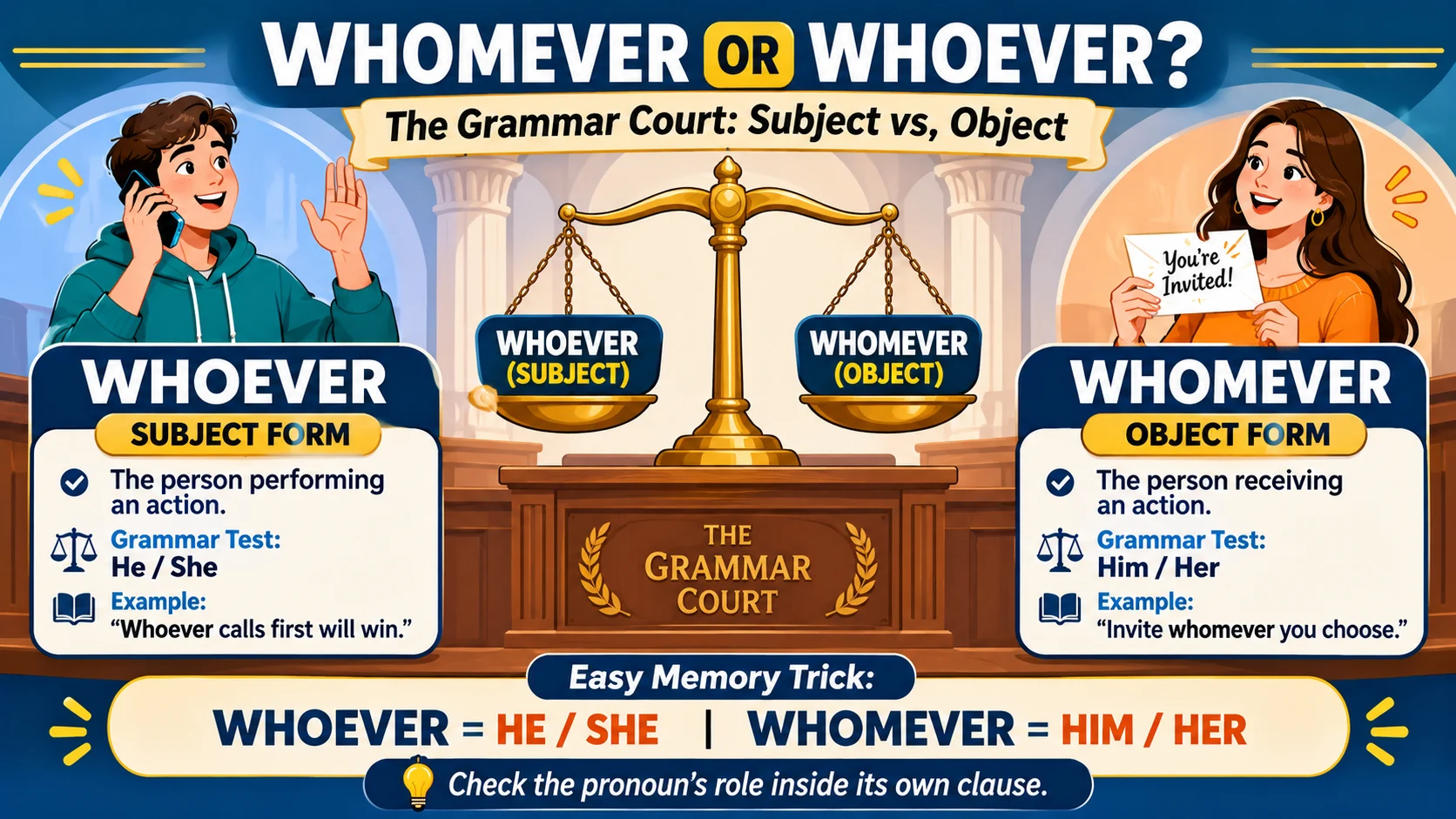
Whoever and whomever are both correct English pronouns, but they serve different grammatical roles. Use whoever when the pronoun acts as the subject of a verb. On the other hand, use whomever when it acts as the object of a verb or preposition. For example, “Whoever calls first will get the job” is correct, while “Give the invitation to whomever you choose” uses the objective form correctly.
Have you ever stopped while writing an email or message because you couldn’t decide between whomever or whoever? Although these two words look and sound similar, they follow different grammatical rules. Choosing the correct one can make your writing clearer, more professional, and grammatically accurate.
The main difference comes down to how each pronoun functions in a sentence. Whoever acts as a subject, meaning it performs an action or serves as the subject of a clause. In contrast, whomever acts as an object, meaning it receives an action or follows a preposition as its object. However, the correct choice sometimes depends on the smaller clause rather than the entire sentence.
Understanding this distinction is easier than it may seem. With a few simple grammar tests, practical examples, and everyday comparisons, you can learn when to use each word without second-guessing yourself. In this guide, we’ll explore their meanings, grammatical rules, common mistakes, and real-life examples to help you use both pronouns confidently.
Whomever or Whoever: What Is the Difference?
The difference between these words is their grammatical function.
Whoever is an indefinite relative pronoun that functions as a subject. It refers to any person who performs an action or meets a particular condition.
Whomever is the objective form of whoever. It functions as the object of a verb or preposition and refers to any person receiving an action or being affected by it.
Consider these examples:
- Whoever arrives first can choose a seat.
- You can invite whomever you like.
In the first sentence, whoever performs the action of arriving. Therefore, the subject form is necessary.
In the second sentence, whomever receives the action of inviting. Consequently, the objective form is correct in formal grammar.
Both words can refer to an unknown or unspecified person. Nevertheless, their grammatical jobs determine which one you should choose.
What Does Whoever Mean?
Whoever means any person who, no matter which person, or the person who meets a particular condition.
It is a pronoun that commonly introduces a clause and functions as its subject. In other words, it identifies the person performing the action.
For example:
- Whoever finishes the assignment first can leave early.
- I’ll support whoever needs my help.
- Whoever wins the competition will receive a trophy.
- Whoever is responsible should explain what happened.
Notice that whoever performs or identifies the subject of the action in each example.
Moreover, the word can introduce a condition or emphasize that a particular person’s identity does not matter.
Examples:
- Whoever you are, you’re welcome here.
- Whoever comes to the party should bring a gift.
- Whoever made this cake did an excellent job.
In everyday American English, whoever is widely used in conversations, emails, academic writing, and social media.
What Does Whomever Mean?
Whomever means any person whom, or the person who is receiving an action or serving as the object of a preposition.
It is the objective form of whoever. Therefore, you should use it when the pronoun performs an object function within its clause.
For example:
- Give the package to whomever you trust.
- We will hire whomever the manager recommends.
- You may invite whomever you want.
- The award will go to whomever the committee selects.
In these sentences, the pronoun receives an action or follows a preposition.
Additionally, whomever often appears in formal writing, professional communication, and carefully edited documents.
However, it is less common in everyday conversation because many English speakers naturally prefer simpler sentence structures.
Remember: Whomever does not mean a different kind of person from whoever. The difference is grammatical, not related to identity, personality, or status.
Whoever vs. Whomever: Quick Comparison
| Feature | Whoever | Whomever |
|---|---|---|
| Grammatical case | Subjective | Objective |
| Main function | Subject | Object |
| Used for | Person performing an action | Person receiving an action |
| Follows a verb | When acting as its subject | When acting as its object |
| Follows a preposition | When subject of its own clause | When object of its own clause |
| Formal usage | Common | More formal and less common |
| Example | Whoever calls can speak. | Call whomever you prefer. |
Although the table makes the distinction look simple, some sentences require closer attention. The next sections explain how to identify the correct form.
When to Use Whoever
Use whoever when the pronoun acts as the subject of a verb within its clause.
Here are the most common situations.
When Someone Performs an Action
If the person represented by the pronoun performs the action, choose whoever.
Examples:
- Whoever arrives early will get the best seat.
- Whoever breaks the rules must accept the consequences.
- Whoever answers correctly will receive a prize.
- Whoever finishes the project deserves recognition.
In each example, whoever performs the action.
When Introducing a Subject Clause
Whoever can introduce a clause that functions as the subject of a larger sentence.
Examples:
- Whoever wins the election will lead the organization.
- Whoever made this decision should explain it.
- Whoever wants to participate must register today.
Here, the entire clause acts as the subject of the main sentence.
When Referring to an Unknown Person
You can also use whoever when the person’s identity is unknown or unimportant.
Examples:
- Whoever left the door open should close it.
- Whoever sent this message made my day.
- Whoever owns that car parked it outside.
In these situations, the speaker does not need to identify a particular individual.
When to Use Whomever
Use whomever when the pronoun acts as the object within its own clause.
The following situations will help you recognize the correct usage.
When Someone Receives an Action
If the person receives the action of a verb, use whomever.
Examples:
- Choose whomever you prefer.
- The company will interview whomever the manager recommends.
- Invite whomever you want to the celebration.
- We will help whomever the committee selects.
In each example, the pronoun receives the action of the verb.
After a Preposition
Whomever is traditionally correct when it functions as the object of a preposition.
Examples:
- Give the documents to whomever you trust.
- The invitation is for whomever you choose.
- She will work with whomever the director appoints.
- You can share your concerns with whomever you prefer.
However, be careful with this rule. A pronoun that follows a preposition may still function as the subject of its own clause.
For example:
“Give the award to whoever wins.”
Here, whoever is the subject of the verb wins. Therefore, whoever is correct even though the entire clause follows the preposition to.
This is one of the most important distinctions to understand.
In Formal and Professional Writing
Whomever often appears in formal documents when the person is the object of a verb or preposition.
Examples:
- The position will be offered to whomever the board approves.
- Please forward the report to whomever you consider appropriate.
- The scholarship will support whomever the committee selects.
Nevertheless, clarity should always come first. If a sentence sounds awkward, consider rewriting it.
The Easiest Trick to Remember the Difference
One of the simplest ways to choose between whoever and whomever is to replace the word with he or him or she or her.
This method works because whoever follows the same grammatical pattern as he or she, while whomever follows the pattern of him or her.
Use He or She = Whoever
If he or she fits naturally, choose whoever.
Example:
“Whoever arrives first will get the prize.”
Test it:
“He arrives first.”
The sentence works. Therefore, whoever is correct.
Use Him or Her = Whomever
If him or her fits naturally, choose whomever.
Example:
“Invite whomever you like.”
Test it:
“You like him.”
The sentence works. Therefore, whomever is correct in formal grammar.
Quick Memory Tip
- Whoever = He / She
- Whomever = Him / Her
This simple substitution test can help you make the correct choice in most situations.
Who, Whom, Whoever, and Whomever: Understanding the Connection
To understand these words completely, you should also know the difference between who and whom.
Both pairs follow the same grammatical principle.
| Subject Form | Object Form | Example |
|---|---|---|
| Who | Whom | Who called you? |
| Whoever | Whomever | Whoever calls can speak to whomever they need. |
Who identifies the person performing an action, while whom identifies the person receiving an action.
Similarly, whoever is the subject form, and whomever is the object form.
For example:
- Who is coming to dinner?
- Whom did you invite?
- Whoever wants to join can come.
- You can invite whomever you want.
Therefore, learning who versus whom also makes whoever versus whomever much easier.
Whomever or Whoever in Different Sentence Structures
Some sentences are confusing because the pronoun appears in a position that makes its grammatical function difficult to recognize.
The following examples explain some common patterns.
Whoever Is the Subject of a Clause
Correct: Whoever you choose will receive the award.
Why? The word whoever is the subject of will receive. The fact that you choose that person does not change its role in the larger clause.
Whomever Is the Object of a Verb
Correct: You can choose whomever you want.
Why? The person is the object of the verb choose. The pronoun receives the action.
Whoever After a Preposition
Correct: Give the prize to whoever finishes first.
Why? Whoever performs the action finishes. It is the subject of that clause, even though the clause follows to.
Whomever After a Preposition
Correct: Give the prize to whomever you select.
Why? Whomever is the object of select within its clause.
As you can see, the position of the word alone does not determine its form. Instead, examine its grammatical role within the clause.
Whoever or Whomever: 20 Example Sentences
Here are practical examples to help you understand how these pronouns work in everyday English.
Whoever Examples
- Whoever calls first will get the information.
- Whoever finishes the test can leave.
- Whoever made this mistake should correct it.
- I’ll listen to whoever has a reasonable explanation.
- Whoever arrives late must wait outside.
- Whoever wins the match will receive a medal.
- Whoever wants extra help can stay after class.
- Whoever designed this website did a great job.
- Whoever is responsible must take action.
- Whoever needs assistance should contact the office.
Whomever Examples
- Invite whomever you want to the event.
- We will hire whomever the director selects.
- Give the keys to whomever you trust.
- She can choose whomever she prefers.
- The company will promote whomever the manager recommends.
- You may contact whomever you consider suitable.
- I will support whomever you choose.
- Send the invitation to whomever you wish.
- The committee will reward whomever it selects.
- He can work with whomever he trusts.
These examples show how the two pronouns work in different grammatical positions.
Common Mistakes When Using Whoever and Whomever
Even experienced English speakers sometimes confuse these words. However, understanding a few common mistakes can help you avoid them.
Using Whomever as a Subject
Incorrect: Whomever arrives first will receive a gift.
Correct: Whoever arrives first will receive a gift.
Why? The pronoun performs the action of arriving. Therefore, it needs the subject form.
Using Whoever as an Object in Formal Grammar
Incorrect: You can invite whoever you like.
Formal standard: You can invite whomever you like.
Why? The pronoun is the object of like within its clause.
Note that whoever is widely used in this position in everyday English. Nevertheless, whomever is the traditional choice in formal edited writing.
Choosing Based Only on the Preceding Word
Incorrect: Give it to whomever wins.
Correct: Give it to whoever wins.
Why? The pronoun is the subject of wins, not the object of to.
Ignoring the Smaller Clause
Incorrect: Whomever you think is the best candidate should get the job.
Correct: Whoever you think is the best candidate should get the job.
Why? The pronoun is the subject of the embedded verb phrase is the best candidate. Therefore, whoever is appropriate.
Making the Sentence Unnecessarily Complicated
Sometimes writers use whomever because they believe it sounds more intelligent or professional.
However, this can create grammatical errors when the word functions as a subject.
For clearer writing, focus on grammatical function instead of formality.
Is Whoever or Whomever More Common?
Whoever is much more common in everyday American English.
People use it in conversations, text messages, emails, social media posts, and general writing. In contrast, whomever appears more frequently in formal or carefully edited contexts.
There is also a reason for this difference. English speakers increasingly use who-based forms in situations where traditional grammar would call for whom-based forms.
For example:
- Everyday usage: “Give it to whoever you choose.”
- Traditional formal usage: “Give it to whomever you choose.”
Both versions are widely understood. However, the second follows the traditional objective-case rule.
Therefore, if you’re writing an academic paper, formal report, or professional document, learning the traditional distinction is useful.
Advantages and Disadvantages of Using Each Word
Both words have useful grammatical functions. Nevertheless, each has different strengths and potential challenges.
Advantages of Whoever
- It works naturally in everyday conversation.
- It clearly identifies the subject of an action.
- It is widely understood by English speakers.
- It works well in both casual and formal writing when used correctly.
- It can introduce a clause referring to an unknown person.
Disadvantages of Whoever
- Writers sometimes use it incorrectly as an object in formal grammar.
- Its position after a preposition can create confusion.
- It may sound informal in certain traditional grammar contexts.
Advantages of Whomever
- It follows traditional objective-case grammar.
- It works well in formal and professional writing.
- It clearly identifies the object of a verb or preposition.
- It helps maintain grammatical precision.
Disadvantages of Whomever
- It is less common in everyday conversation.
- Some readers may find it unnecessarily formal.
- Its correct use requires an understanding of clause structure.
- Writers sometimes use it incorrectly when a subject form is needed.
Ultimately, the best choice depends on the grammatical role and the writing situation.
How to Choose the Correct Word in Everyday Writing
When writing an email, essay, social media caption, or professional document, you can use a few simple steps to avoid confusion.
Identify the action: First, find the verb in the clause containing the pronoun.
Find the person performing the action: If the pronoun performs the action, use whoever.
Check whether the person receives the action: If the pronoun receives the action, use whomever in traditional formal grammar.
Try the substitution test: Replace the pronoun with he or she, or him or her.
Read the sentence aloud: Finally, check whether the sentence sounds clear and natural.
For example:
“Give the documents to whoever needs them.”
The pronoun performs the action of needing. Therefore, whoever is correct.
On the other hand:
“Give the documents to whomever you trust.”
The pronoun receives the action of trusting. Consequently, whomever is correct in formal grammar.
Related Comparisons
Understanding similar grammar pairs can strengthen your writing skills. Here are some useful comparisons:
| Word Comparison | Main Difference |
|---|---|
| Who vs. Whom | Subject vs. object |
| Whoever vs. Whomever | Subject vs. object in an indefinite relative construction |
| Who’s vs. Whose | Who is / who has vs. possession |
| Who vs. Whoever | Specific question pronoun vs. indefinite relative pronoun |
| Whose vs. Whom | Possession vs. object |
| Whoever vs. Whatever | Any person who vs. any thing that |
| Whoever vs. Whomever vs. Whom | Subject and object forms in different constructions |
These comparisons are particularly helpful for students and anyone learning American English grammar.
Practice Exercises: Whoever or Whomever?
Test your understanding by choosing the correct word in each sentence.
Fill in the Blanks
Choose whoever or whomever to complete each sentence.
- ______ arrives first should open the door.
- You may invite ______ you want.
- Give the package to ______ answers the phone.
- We will support ______ the committee selects.
- ______ finishes the assignment can leave early.
- The manager will interview ______ applies.
- She can work with ______ she trusts.
- ______ wins the competition will receive a trophy.
- Send the email to ______ you think is appropriate.
- ______ needs assistance should contact the office.
Answers and Explanations
Whoever arrives first should open the door.
Explanation: The pronoun is the subject of arrives.
You may invite whomever you want.
Explanation: The pronoun is the object of want in traditional formal grammar.
Give the package to whoever answers the phone.
Explanation: Whoever performs the action of answering.
We will support whomever the committee selects.
Explanation: The pronoun receives the action of selects.
Whoever finishes the assignment can leave early.
Explanation: The pronoun is the subject of finishes.
The manager will interview whoever applies.
Explanation: Whoever performs the action of applying.
She can work with whomever she trusts.
Explanation: The pronoun is the object of trusts.
Whoever wins the competition will receive a trophy.
Explanation: The pronoun is the subject of wins.
Send the email to whomever you think is appropriate.
Explanation: The pronoun is the object of is appropriate? More precisely, in this construction, it is the object of the understood choice or selection represented by the clause. A clearer version is: “Send the email to whomever you think is appropriate to contact.” Here, whomever is the object of contact.
Whoever needs assistance should contact the office.
Explanation: The pronoun is the subject of needs.
Frequently Asked Questions
Is it whoever or whomever?
Both are correct, but they have different grammatical functions. Use whoever as the subject of a clause and whomever as its object. For example, “Whoever calls can speak” and “Call whomever you prefer.”
How do I know when to use whoever or whomever?
Use the he or she test for whoever and the him or her test for whomever. If the subject form fits naturally, choose whoever. Conversely, if the object form fits, choose whomever in formal grammar.
Is whoever grammatically correct?
Yes. Whoever is a grammatically correct pronoun used as the subject of a clause. For example, “Whoever finishes first will win the prize.”
Is whomever grammatically correct?
Yes. Whomever is the objective form of whoever. It functions as the object of a verb or preposition within its clause. For example, “Invite whomever you like.”
Can I use whoever instead of whomever?
In everyday American English, people frequently use whoever in object positions. However, traditional formal grammar distinguishes the two forms. Therefore, whomever is the more precise choice when the pronoun functions as an object.
Is it whoever you want or whomever you want?
In traditional grammar, whomever you want is correct when the phrase functions as the object of a verb or preposition. For example, “You can invite whomever you want.”
Is it whoever wins or whomever wins?
Whoever wins is correct because the pronoun performs the action of winning. It is the subject of the verb wins.
Is it to whoever or to whomever?
It depends on the grammatical role inside the following clause. Use “to whoever wins” because whoever is the subject of wins. However, use “to whomever you select” because whomever is the object of select.
Can a sentence start with whomever?
Yes, but only when whomever has an object function within its construction. For example, “Whomever you choose will receive the invitation” is traditionally incorrect because the pronoun is the subject of will receive. A better construction is “You may invite whomever you choose.”
Is whoever more formal than whomever?
No. Whoever is not less formal simply because it is more common. Both words are appropriate in formal writing when used correctly. However, whomever can sound more formal because it is less common in everyday speech.
What is the difference between whoever, whomever, who, and whom?
Who and whoever are subject forms, while whom and whomever are object forms. Who and whom generally refer to specific people, whereas whoever and whomever can refer to any person who meets a condition or is selected.
What is an easy way to remember whoever and whomever?
Remember this simple rule: whoever goes with he or she, while whomever goes with him or her. This substitution trick makes it easier to identify the correct grammatical form.
Key Takeaways: Whomever or Whoever
Choosing between these two words becomes easier when you understand their grammatical functions.
- Whoever is the subject form and identifies the person performing an action.
- Whomever is the objective form and identifies the person receiving an action.
- Both words are grammatically correct and can appear in formal writing.
- The he or she versus him or her test helps you select the correct form.
- A pronoun’s role within its own clause matters more than its position in the complete sentence.
- Whoever is more common in everyday American English.
- Whomever is especially useful in traditional formal grammar.
Most importantly, don’t choose a word simply because it sounds more sophisticated. Instead, examine its role in the sentence and select the form that fits.
Conclusion
The difference between whomever or whoever comes down to one simple grammar rule: whoever functions as a subject, while whomever functions as an object. Although both words refer to an unspecified person, they cannot always replace each other in traditional formal English.
Remember the simple substitution trick: use whoever when he or she fits, and use whomever when him or her fits. Additionally, pay attention to the clause containing the pronoun because its grammatical role determines the correct form.
With regular practice and a little attention to sentence structure, you’ll be able to use both words confidently. Whether you’re writing a professional email, completing an assignment, or having an everyday conversation, understanding this distinction will help you communicate more clearly and accurately.