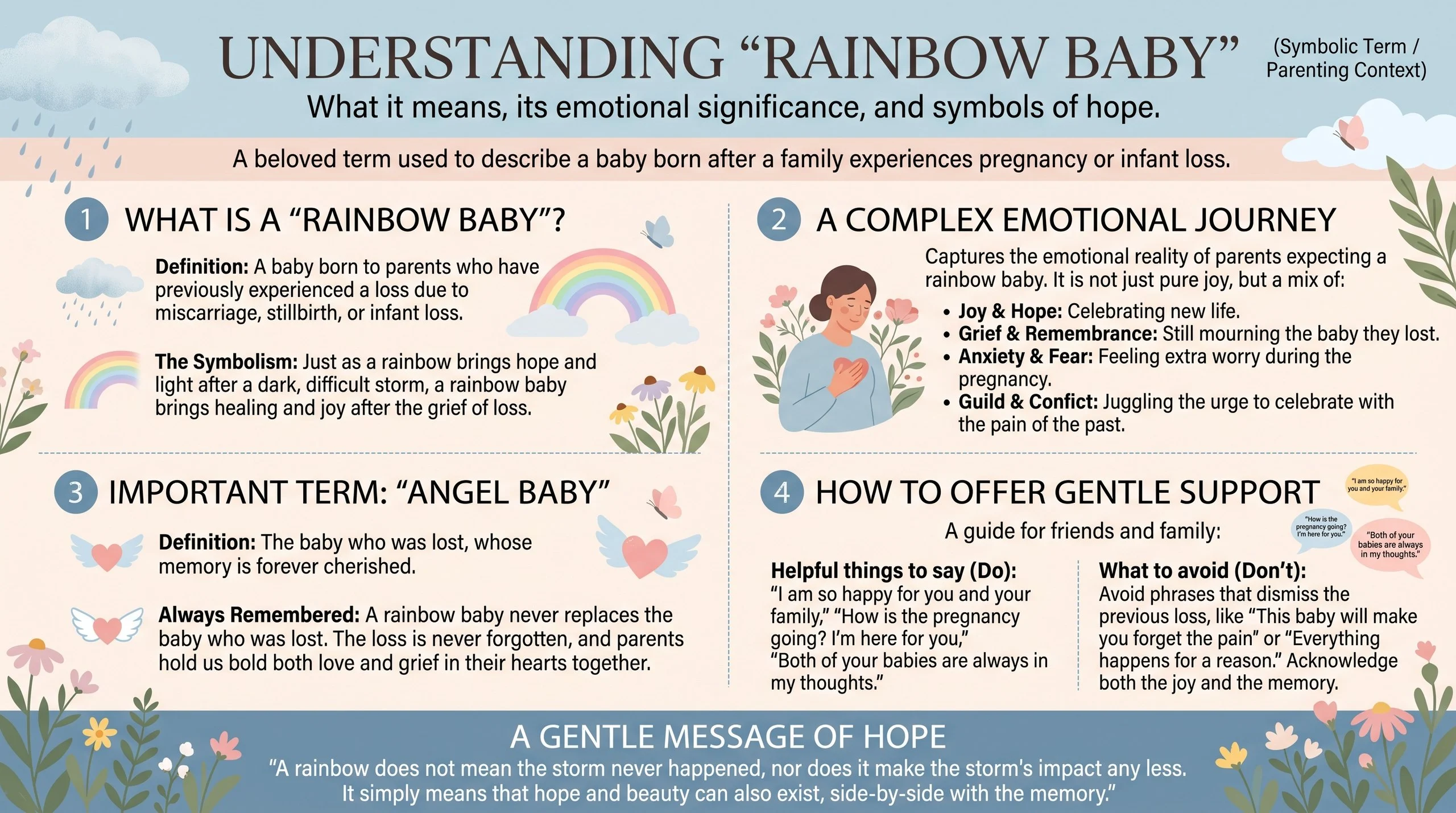
A rainbow baby is a baby born after a previous pregnancy loss, such as miscarriage, stillbirth, or sometimes infant loss. The term compares the baby’s arrival with a rainbow appearing after a storm, symbolizing hope after grief.
rainbow baby meaning refers to the emotional and symbolic idea of a baby born after a previous pregnancy loss. The phrase combines grief, hope, remembrance, and new beginnings. It is widely used by parents, families, support communities, and people discussing pregnancy journeys online.
The word “rainbow” represents hope after a difficult experience. However, the term does not suggest that a new baby erases an earlier loss. Instead, many parents use it to describe a new pregnancy or birth while continuing to remember the baby they lost.
Understanding the phrase requires more than knowing its dictionary definition. Its emotional meaning can change depending on the speaker, situation, and stage of pregnancy. For example, someone may describe a pregnancy as a rainbow pregnancy before the baby is born. After birth, they may call the child a rainbow baby.
The phrase also appears frequently in social media captions, pregnancy announcements, support groups, text messages, and conversations about fertility and loss. Therefore, context matters when using it.
Quick Answer Box
| Meaning | Context | Primary Platforms | Example | Tone |
| A baby born after a previous pregnancy loss | Pregnancy, birth, grief, family conversations | Instagram, TikTok, Facebook, texting | “Our rainbow baby is finally here.” | Hopeful, emotional, sensitive |
What Does rainbow baby meaning Mean?
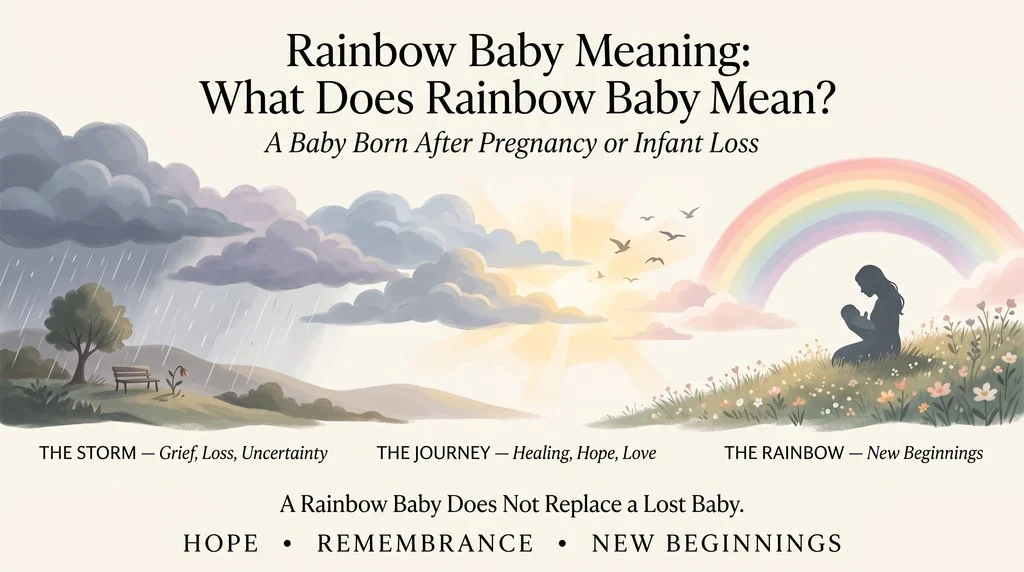
The rainbow baby meaning centers on a child born after a previous pregnancy or infant loss. The expression is metaphorical rather than medical. It describes an emotional experience and does not identify a medical condition.
The central image comes from the idea of a rainbow following a storm. In this comparison, the storm represents grief, while the rainbow represents hope, healing, and a new chapter.
Still, the metaphor has an important limitation. A rainbow does not make the storm disappear. Likewise, a new child does not replace a baby who was previously lost.
Many parents therefore use the phrase alongside language about remembrance. They may celebrate a new arrival while acknowledging the child they lost. This can create a complicated emotional experience involving happiness, anxiety, grief, gratitude, and love at the same time.
Where Did the Expression Come From?
The phrase developed within communities discussing pregnancy loss, infertility, pregnancy after loss, and infant loss. It later became more visible through online parenting communities and social media.
The metaphor became especially useful because it offered a short way to describe a complicated personal journey. Saying “rainbow baby” can communicate both a previous loss and a subsequent birth without requiring a long explanation.
However, not every parent who experiences pregnancy after loss uses this expression. Some prefer more direct language. Others may avoid symbolic terms because the experience feels too personal.
Rainbow Baby Versus Rainbow Pregnancy
These expressions are related but describe different stages.
A rainbow pregnancy usually refers to a pregnancy that occurs after a previous pregnancy loss.
A rainbow baby generally refers to the child born after that loss.
For example, someone might say, “I am having a rainbow pregnancy” while pregnant. After giving birth, the same parent might say, “My rainbow baby is here.”
The terms can overlap in casual conversation. Still, understanding the distinction helps you use them naturally.
Is It a Medical Term?
No. “Rainbow baby” is not a formal medical diagnosis or clinical classification.
Healthcare professionals may discuss pregnancy after miscarriage, pregnancy after stillbirth, or pregnancy following infant loss. The term “rainbow baby” is primarily personal, cultural, and conversational.
That distinction matters because emotional language and medical terminology serve different purposes. A parent may use the metaphor in a social media post while using clinical terminology during an appointment.
Contextual Dynamics & Nuances of the Term
The emotional meaning of this phrase depends heavily on context. Two people can use the same expression while experiencing very different emotions.
Hope and Celebration
For some parents, the phrase communicates profound happiness. A birth announcement may describe a new child as a symbol of hope after a painful period.
For example:
“After everything we went through, meeting our rainbow baby feels incredibly special.”
Here, the phrase emphasizes joy while acknowledging the difficult history behind the pregnancy.
Grief and Remembrance
The expression can also carry grief. A parent may feel happiness about a new baby while still mourning a previous loss.
For example:
“We are celebrating our rainbow baby while always remembering the little one who came before.”
This wording recognizes that grief and happiness can coexist.
Anxiety During Pregnancy
Pregnancy after loss can also involve fear and uncertainty. Some parents may find the term comforting. Others may feel uncomfortable using it before the baby is safely born.
Therefore, calling a pregnancy a “rainbow pregnancy” should generally follow the pregnant person’s own terminology.
Different Experiences of Loss
Pregnancy loss can occur at different stages. People may experience miscarriage, stillbirth, or infant loss. Experiences and terminology can vary among individuals and communities.
Because of this, avoid assuming that every person who uses the term has experienced the same kind of loss.
Personal Preference Matters
Some parents embrace the metaphor. Others do not.
A respectful approach is simple. If someone uses the phrase for themselves, you can follow their language. If they do not use it, avoid introducing it casually unless the context makes it appropriate.
Real Life Conversation Examples Using rainbow baby meaning
The phrase can appear in many types of conversations. However, the emotional tone should remain respectful.
Conversation 1: A Birth Announcement
Friend: “I saw your announcement. Congratulations!”
Parent: “Thank you. We are so happy to finally meet our rainbow baby.”
Friend: “I am incredibly happy for you. I know this journey has meant a lot.”
This conversation recognizes both celebration and the emotional history behind the birth.
Conversation 2: Asking About the Phrase
Person A: “I keep seeing people use the term rainbow baby. What does it mean?”
Person B: “It usually means a baby born after a previous pregnancy or infant loss.”
Person A: “That makes sense. I had not understood the metaphor.”
The explanation remains factual without making assumptions about anyone’s personal experience.
Conversation 3: A Social Media Caption
Parent: “Our rainbow baby is finally in our arms.”
Friend: “Congratulations. Sending your family so much love.”
Parent: “Thank you. We are feeling every emotion right now.”
The phrase here communicates celebration while leaving room for complex emotions.
Conversation 4: A Sensitive Discussion
Person A: “Would it be okay to call your baby a rainbow baby?”
Parent: “Yes, I use that term myself.”
Person A: “Thank you for telling me. I did not want to assume.”
This is a useful model because it gives the parent control over the language.
Conversation 5: Pregnancy After Loss
Friend: “How are you feeling about the pregnancy?”
Parent: “Excited, but also nervous. It is difficult after what happened before.”
Friend: “That makes complete sense. I am here for you.”
In this situation, the friend does not need to introduce a symbolic term. Supporting the person’s own words can be more appropriate.
Platform Specific Breakdown
Social platforms have helped make the expression familiar to a wider audience. Still, each platform encourages different communication styles.
How It Is Used on Snapchat
Snapchat conversations tend to be brief and personal. Someone might use the term in a private message, story caption, or photo description.
A parent might post a newborn photo with a short caption such as:
“Our rainbow baby has arrived.”
The meaning depends on the surrounding context. A private story may include more personal details, while a public story may use only a few words.
Because Snapchat content can feel informal, users may use affectionate language alongside the phrase. However, sensitivity remains important.
The Role of rainbow baby meaning on TikTok
TikTok has helped popularize many personal and community based expressions. The phrase may appear in pregnancy announcements, personal stories, educational videos, memorial content, or discussions about pregnancy after loss.
Creators may explain their experiences through videos that combine photographs, captions, narration, and music.
However, TikTok content varies greatly. One person’s use of the term may focus on celebration. Another person’s video may focus primarily on grief.
Therefore, viewers should not assume that the phrase always communicates uncomplicated happiness.
Instagram and Texting Dynamics
Instagram commonly uses the phrase in captions, reels, pregnancy announcements, birth announcements, and remembrance posts.
For example:
“Our little rainbow is finally here.”
The phrase can also appear in hashtags and community discussions.
Texting is usually more conversational. Someone might write:
“I heard you had your baby. Congratulations on your rainbow baby!”
A supportive response should follow the parent’s emotional tone. If the parent has openly used the term, repeating it may feel natural. If not, a simple “Congratulations” can be safer.
Facebook and Parenting Communities
Facebook groups often provide longer discussions than short form platforms. People may share personal stories about pregnancy loss, subsequent pregnancies, parenting, and emotional recovery.
In these spaces, the phrase can function as both a descriptive label and a community term.
Still, every group has its own norms. Some communities may prefer direct terms such as “pregnancy after loss.”
Search and AI Conversation Context
People may also encounter the phrase while searching for definitions, writing captions, understanding social posts, or interpreting messages.
A clear explanation should distinguish the symbolic meaning from medical terminology. This distinction helps prevent misunderstandings.
Alternative Meanings & NLP Variations of the Phrase
Language changes according to context. Several related expressions can communicate similar ideas.
| Expression | Typical Meaning | Common Context |
| Rainbow baby | Baby born after previous loss | Birth and parenting |
| Rainbow pregnancy | Pregnancy following previous loss | Pregnancy |
| Pregnancy after loss | Neutral description of a later pregnancy | Medical and personal |
| Baby after miscarriage | Direct description of the situation | Everyday conversation |
| Baby after pregnancy loss | Broad descriptive phrase | Support and education |
| Child born after loss | General and respectful wording | Formal writing |
| Rainbow child | Less common variation | Personal or creative writing |
| Little rainbow | Affectionate metaphor | Social media and family language |
Emotional Variations
The phrase can carry several emotional associations.
Hope: A new beginning after hardship.
Joy: Celebration of a new child.
Remembrance: Continued love for a baby who was lost.
Healing: A new chapter following grief.
Anxiety: Fear that can accompany pregnancy after loss.
Resilience: Recognition of the parent’s difficult journey.
These meanings can coexist. The expression does not require one emotional interpretation.
Linguistic Variation
People may say:
“our rainbow baby”
“my rainbow baby”
“a rainbow baby”
“our little rainbow”
“rainbow baby girl”
“rainbow baby boy”
These forms differ stylistically, but they generally point to the same core concept.
Misinterpretations: When NOT to Use rainbow baby meaning
The phrase can be meaningful, but it should not be applied automatically.
Do Not Assume Someone Wants the Label
A person who has experienced pregnancy loss may not identify with the rainbow metaphor.
Instead of saying:
“You will have your rainbow baby soon.”
consider offering neutral support:
“I am thinking of you and hoping things go well.”
The second option avoids making assumptions about the person’s future.
Do Not Suggest That a New Baby Replaces a Lost Baby
This is one of the most important distinctions.
A new child is not a replacement for a previous pregnancy or infant. The phrase is intended as a metaphor for hope, not substitution.
Do Not Use It to Minimize Grief
Avoid statements such as:
“At least you can have a rainbow baby.”
Such wording can unintentionally dismiss grief.
Pregnancy after loss can be joyful and difficult at the same time. One experience does not cancel another.
Avoid Using It Without Context in Formal Medical Writing
For a medical document, neutral terminology is usually clearer.
Instead of relying on the metaphor, use language such as:
“pregnancy following miscarriage”
or
“pregnancy after previous loss.”
The appropriate wording depends on the purpose and audience.
Avoid Turning the Term Into a Guarantee
The phrase describes a situation after a loss. It does not guarantee a future pregnancy, healthy birth, or particular outcome.
Avoid using it as a prediction.
How to Respond in Chat Comfortably
Responding well depends on the speaker’s relationship with the person and the emotional context.
When Someone Announces a Rainbow Baby
A warm response can be simple:
“Congratulations. I am so happy for you and your family.”
If the person has openly discussed previous loss, you can acknowledge the journey:
“Congratulations. I know this moment carries a lot of meaning for you.”
When Someone Explains the Term
You can respond naturally:
“Thank you for explaining. I understand the term now.”
There is no need to make the conversation overly emotional.
When Someone Shares a Difficult Story
Listening matters more than finding perfect words.
You might say:
“Thank you for trusting me with that. I am here for you.”
This response does not assume how the person should feel.
When You Are Unsure Whether to Use the Phrase
Follow the person’s wording.
If they say “rainbow baby,” you can usually use the same phrase. If they use different language, mirror their terminology instead.
When You Are Writing a Congratulations Message
Keep the message warm and personal without making the previous loss the entire focus.
For example:
“Congratulations on your beautiful new arrival. Wishing your family many peaceful and joyful moments together.”
This works even when you know the broader story but are unsure how directly to mention it.
FAQs
1. What is the rainbow baby meaning?
The term generally describes a baby born after a previous pregnancy loss, stillbirth, or sometimes infant loss. It is a symbolic expression rather than a medical term.
2. Is a rainbow baby a medical term?
No. It is an informal and symbolic term used by parents, families, support communities, and online communities.
3. Why is it called a rainbow baby?
The metaphor compares the baby with a rainbow appearing after a storm. The storm represents hardship or grief, while the rainbow represents hope and a new chapter.
4. What is a rainbow pregnancy?
A rainbow pregnancy generally means a pregnancy that occurs after a previous pregnancy loss. The term is related to, but different from, the term used for a baby born after that experience.
5. Does a rainbow baby replace a previous baby?
No. The expression is intended as a metaphor for hope after loss. It does not mean that a new child replaces someone who was lost.
6. Can someone have more than one rainbow baby?
Yes. The phrase can be used for a child born after a previous loss. A person may experience more than one pregnancy after loss, although individual terminology and experiences vary.
7. Is it okay to congratulate someone on a rainbow baby?
Yes, when the parent has openly used the term or discussed the pregnancy in that way. A simple, sincere congratulations is usually appropriate.
8. Should I use the phrase when talking to someone who had a miscarriage?
Not automatically. Some people appreciate the expression, while others prefer direct or neutral language. Follow their lead.
9. Can the term include stillbirth or infant loss?
Usage varies. Many people use the phrase broadly for a child born after pregnancy loss, stillbirth, or infant loss. However, people differ in how they describe their experiences.
10. Why can pregnancy after loss feel complicated?
A subsequent pregnancy can bring several emotions at once. A person may feel hopeful and excited while also experiencing fear, grief, or uncertainty. Those feelings can coexist.
Conclusion
The rainbow baby meaning has grown beyond a simple internet expression. It has become a widely recognized metaphor for hope following pregnancy or infant loss.
Its meaning remains deeply personal. For some parents, it represents joy and a new beginning. For others, it also represents remembrance, grief, anxiety, and the emotional complexity of pregnancy after loss.
The most important point is that the phrase should follow the person’s own language and experience. It should never be used to minimize grief or suggest that a new child replaces someone who was lost.
In everyday communication, context makes the difference. A social media announcement may use the phrase as a celebration. A private conversation may require more sensitivity. A medical discussion may benefit from clearer clinical terminology.
Ultimately, the expression works because the rainbow metaphor communicates two ideas at once: something difficult happened, and hope can still exist afterward. Those ideas can coexist without one erasing the other.