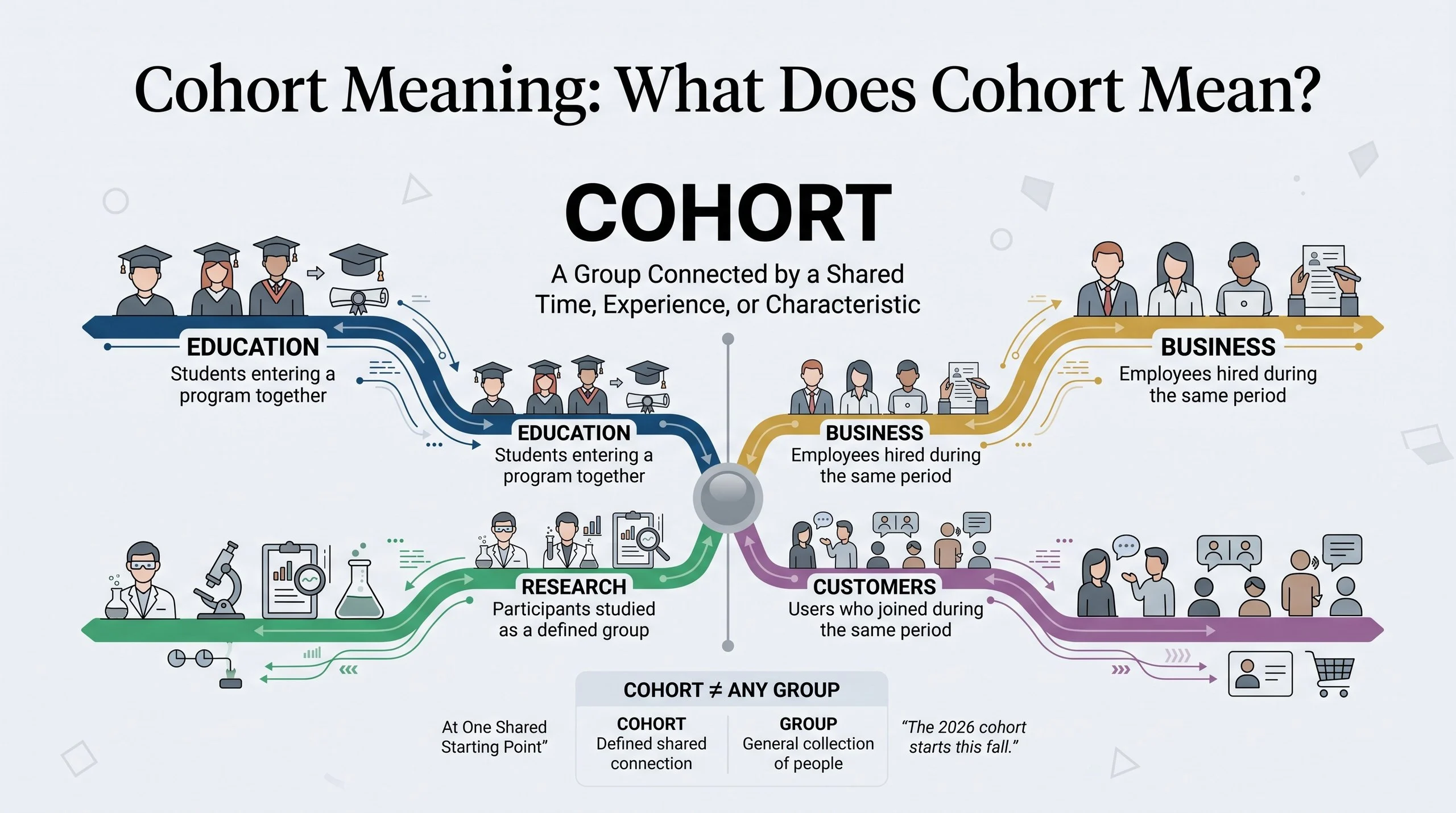
A cohort is a group of people who share a particular characteristic, experience, or time period. The term commonly describes students, employees, patients, or people born during the same period who are studied or discussed as a group.
Cohort meaning refers to a group of people who share a common characteristic, experience, or period of time. For example, a university may call students who entered in 2026 a cohort because they started their studies together.
The word appears frequently in education, healthcare, business, research, sociology, and statistics. In addition, people sometimes use it in everyday conversation to describe a group of peers or people with similar experiences.
However, cohort does not always mean a group of people who are exactly the same age. Instead, the shared connection can come from enrollment, employment, location, treatment, generation, or another defined condition.
Therefore, understanding the context is important. A “2026 cohort” might describe students beginning college that year, employees hired during the same period, or research participants enrolled during a specific study period.
This guide explains the cohort meaning, its origin, common uses, examples, related terms, and differences from words such as group, generation, and demographic.
Quick Answer Box
| Meaning | Context | Primary Use | Example | Tone |
|---|---|---|---|---|
| A group sharing a common characteristic or period | Education, research, business, healthcare | Formal grouping | “The 2026 cohort starts training in August.” | Neutral/Formal |
What Does Cohort Mean?
A cohort is a group of individuals who have something important in common.
That common factor may be a shared time period, experience, activity, condition, or status. For instance, students who begin a degree program during the same academic year may form one cohort.
Similarly, researchers may follow a cohort of patients over several years. Businesses can also organize employees into cohorts based on hiring dates or training programs.
The word usually has a more specific meaning than simply saying group. A group can contain people brought together for almost any reason. A cohort, by contrast, normally has a clearly defined connection.
Simple Definition
In simple terms:
Cohort = a group of people who share a specific characteristic, experience, or time period.
For example:
“The 2025 cohort completed the training program together.”
Here, the word identifies participants connected by their enrollment in the same training period.
What Is a Cohort in Everyday English?
In everyday English, cohort can refer to a group of people who belong to the same circle, period, or experience.
For example:
“She stayed in touch with her college cohort.”
This means she remained connected with the people who studied alongside her.
The word can sound more formal than friends, classmates, or peers. As a result, it appears more often in professional, academic, and institutional writing.
Cohort Meaning in Different Contexts
The meaning stays centered on a shared connection, although the exact connection changes by context.
1. Cohort Meaning in Education
In education, a cohort usually consists of students who begin or complete a program during the same period.
For example:
“Our MBA cohort has 40 students.”
The students do not necessarily have the same age, background, or career history. Their defining connection is participation in the same program.
Schools and universities may also use the term for:
- First-year students
- Graduate students
- Online learners
- Scholarship recipients
- Students entering during the same year
- Participants in a specific academic program
Thus, an educational cohort often creates a shared learning experience.
2. Cohort Meaning in Research
Research uses the word in a more technical way.
A research cohort is a defined group of people who share a particular characteristic and are studied over time or in relation to a specific outcome.
For example:
“Researchers followed a cohort of 5,000 adults for ten years.”
The researchers may examine factors such as lifestyle, environment, education, employment, or other variables.
In this setting, the term helps researchers clearly identify the population being observed.
3. Cohort Meaning in Healthcare
Healthcare researchers and professionals often use cohort when discussing groups of patients.
For example:
“The study examined a cohort of patients receiving the same treatment.”
The patients may share a diagnosis, treatment, age range, or enrollment period.
Importantly, the word itself does not mean that every member has identical characteristics. Instead, it identifies the feature that makes them relevant to the study or discussion.
4. Cohort Meaning in Business
Companies use cohorts to organize employees, customers, trainees, or users.
For example:
“The new employee cohort begins orientation Monday.”
Here, the cohort consists of workers who are starting their employment or training during the same period.
Businesses may also analyze customer cohorts. A company could compare customers who joined in January with those who joined in February.
This approach can reveal patterns in customer behavior, retention, or purchasing activity.
5. Cohort Meaning in Sociology
Sociologists often use cohorts to examine people who share a significant life experience or historical period.
A birth cohort, for instance, includes people born during a defined range of years.
Researchers can then examine how historical events, technology, economic conditions, or cultural changes affected that population.
However, a birth cohort should not automatically be treated as identical to a generation. Those terms overlap, but they are not always interchangeable.
Contextual Dynamics & Nuances of Cohort
The most important part of understanding cohort is identifying the connection that defines the group.
That connection might involve:
- Time
- Age
- Enrollment
- Employment
- Treatment
- Location
- Experience
- Participation
- A research condition
- A shared event
For example, “the 2026 cohort” does not tell you exactly what the people have in common. The surrounding sentence provides that information.
Consider these examples:
“The 2026 medical school cohort begins clinical training.”
Here, the cohort consists of students connected to a particular medical education period.
“The study followed a 2026 patient cohort.”
In this case, the defining connection comes from the research design.
Therefore, cohort is a context-dependent grouping term rather than a label for one specific type of person.
Real-Life Conversation Examples Using Cohort
Example 1: College
Alex: “Which year did you start college?”
Maya: “2026. I’m part of the 2026 cohort.”
Alex: “Nice. Do you have many classes together?”
Here, cohort refers to students who entered the college or program during the same period.
Example 2: Workplace
Manager: “Your cohort will complete the training program this Friday.”
Employee: “Will everyone from the new-hire group attend?”
Manager: “Yes, everyone hired during this training cycle is included.”
The term describes a group of employees connected by their training period.
Example 3: Research
Researcher: “We followed the cohort for five years.”
Assistant: “Were all participants enrolled at the same time?”
Researcher: “Yes, they entered the study during the same recruitment period.”
Here, cohort has a formal research meaning.
Example 4: Online Course
Student: “When does your course start?”
Friend: “Next month. I’m joining the January cohort.”
Student: “That sounds good. Mine starts in March.”
The word identifies learners beginning the same course during a particular intake.
Example 5: Business
Analyst: “The January customer cohort has a higher retention rate.”
Manager: “How does it compare with the February cohort?”
Analyst: “The February group has more new users, but fewer remain active.”
Here, the company is comparing groups based on when customers joined.
Platform-Specific Breakdown
Although cohort is not typical internet slang, you may encounter it on social platforms when people discuss education, careers, research, startups, or communities.
How It Is Used on Snapchat
On Snapchat, cohort is more likely to appear in formal or educational conversations than in casual slang.
For example:
“Our college cohort is planning a reunion.”
The word identifies a group of students connected by the same educational experience.
Casual users may prefer words such as class, group, friends, or batch.
The Role of Cohort on TikTok
TikTok creators may use cohort when discussing generations, education, marketing, or research.
For example:
“This cohort of students grew up with smartphones.”
In educational content, the word can also describe people entering a program together.
However, it is not a common TikTok slang term. Its meaning remains close to the standard dictionary definition.
Instagram and Texting Dynamics
On Instagram, the term can appear in captions, professional posts, educational content, and community announcements.
For example:
“Excited to welcome our newest cohort!”
A university, company, course creator, or professional organization might use this wording.
In ordinary texting, however, people often choose simpler words such as group, class, or batch.
Alternative Meanings & NLP Variations of the Phrase
The central concept remains the same, but several related expressions appear in different fields.
Cohort Group
A cohort group is a defined group whose members share a particular characteristic or experience.
The phrase can sometimes be redundant because cohort already implies a group.
Cohort Study
A cohort study follows a defined group to examine outcomes or relationships between characteristics and events.
For example, researchers might track a group of participants for ten years.
Cohort Analysis
Cohort analysis compares groups that share a starting point or characteristic.
Businesses commonly use it to study customer behavior.
For example, customers who joined in January can be compared with customers who joined in February.
Cohort Effect
A cohort effect refers to differences associated with belonging to a particular group formed during a specific period.
For instance, people who grew up during a major technological transition may develop different habits from people who grew up before it.
Birth Cohort
A birth cohort consists of people born within a defined period.
The exact years depend on the research question or classification system.
Cohort-Based Learning
Cohort-based learning places students into a group that progresses through a course or program together.
This approach can encourage interaction, collaboration, and shared progress.
Cohort vs. Group
The words are related, but they are not identical.
| Word | Meaning | Example |
|---|---|---|
| Cohort | A group defined by a shared characteristic or period | “The 2026 cohort starts in September.” |
| Group | Any collection of people or things | “A group of students entered the room.” |
The key difference is definition.
A group does not require a particular shared characteristic. A cohort normally does.
Cohort vs. Generation
These terms often overlap, but they describe different concepts.
A generation generally refers to people connected by birth years and shared historical or cultural experiences.
A cohort can be defined by many other factors.
For example:
- Students entering college in 2026 = cohort
- Employees hired in January = cohort
- People born during a defined period = birth cohort
- People belonging to a broad age-based cultural category = generation
Therefore, every generation can be examined as a cohort, but not every cohort is a generation.
Cohort vs. Demographic
A demographic describes a population characteristic or category, such as age, income, education, or location.
A cohort describes a group connected through a defined condition or period.
For example:
“Women aged 25–34” describes a demographic category.
Meanwhile:
“Customers who joined the service in January” describes a customer cohort.
The first focuses on characteristics. The second focuses on a shared grouping criterion.
Misinterpretations: When NOT to Use Cohort
Although cohort is useful, it can sound unnecessarily formal in casual situations.
For example, saying:
“My cohort and I went to the movies.”
may sound overly academic if you simply mean your friends.
In that situation, friends or group would usually sound more natural.
Likewise, do not use cohort when no meaningful shared characteristic exists.
A random collection of people is not automatically a cohort.
Common Mistakes
Mistake 1: Treating cohort as a synonym for generation
A cohort can include people of different ages.
Mistake 2: Assuming all cohort members are identical
A cohort only requires a defined connection.
Mistake 3: Using cohort in every casual situation
The word often carries a formal or analytical tone.
Mistake 4: Confusing cohort with demographic
A demographic describes characteristics. A cohort identifies a defined group.
How to Respond in Chat Comfortably
If someone uses cohort in a message, the easiest way to understand it is to identify what connects the people being discussed.
For example:
“I’m joining the fall cohort.”
You can understand this as:
“I’m joining the group of people starting the program this fall.”
Similarly:
“Our cohort finished the course.”
means:
“Our group of participants who went through the course together finished it.”
If the meaning is unclear, you can ask:
“Do you mean your class or the people who started at the same time?”
That question works well in casual conversation.
Synonyms for Cohort
The best alternative depends on the context.
Common options include:
- Group
- Class
- Batch
- Peers
- Circle
- Set
- Category
- Population
- Generation
- Community
- Participants
- Classmates
However, these words are not perfect replacements in every sentence.
For example, class works well for students, while population works better in research. Likewise, batch is common in some educational and workplace settings but can sound regional or industry-specific.
FAQs
1. What does cohort mean?
A cohort is a group of people who share a defined characteristic, experience, or period. The term is common in education, research, healthcare, business, and sociology.
2. Is cohort the same as group?
Not exactly. A group can be any collection of people, while a cohort usually has a specific defining connection.
3. What is a cohort in college?
A college cohort is a group of students connected by a particular enrollment period, academic program, class, or educational experience.
4. What is a cohort in research?
A research cohort is a defined group of participants who share a relevant characteristic or enrollment period and are studied for a specific purpose.
5. What does cohort mean in business?
In business, a cohort is a group of customers, employees, users, or participants connected by a shared period or characteristic.
6. Is a cohort the same as a generation?
No. A generation is generally based on birth years and shared historical experiences. A cohort can be defined by many other factors.
7. Can a cohort contain different ages?
Yes. Age does not have to define a cohort. Students in the same program, for example, can have very different ages.
8. What is a cohort study?
A cohort study is research that examines a defined group, often over time, to observe outcomes or relationships between variables.
9. Is cohort a formal word?
Yes. Cohort commonly has a formal, academic, professional, or analytical tone. In casual conversation, group may sound more natural.
10. What is the plural of cohort?
The plural is cohorts.
For example:
“The university welcomed three new cohorts this year.”
Conclusion
The cohort meaning centers on a group of people connected by a specific characteristic, experience, or period. The word appears especially often in education, research, healthcare, business, and sociology.
Unlike the general word group, cohort usually tells us that the members share something meaningful. That connection might involve starting a course together, joining a company during the same period, entering a research study, or becoming customers at a particular time.
Therefore, context remains the best way to understand the word. A college cohort, research cohort, customer cohort, and birth cohort can all look different while following the same basic idea.
In everyday conversation, simpler words such as group, class, or peers may sound more natural. However, when you need to describe a clearly defined population, cohort provides a precise and useful term.