What Are Synonyms?
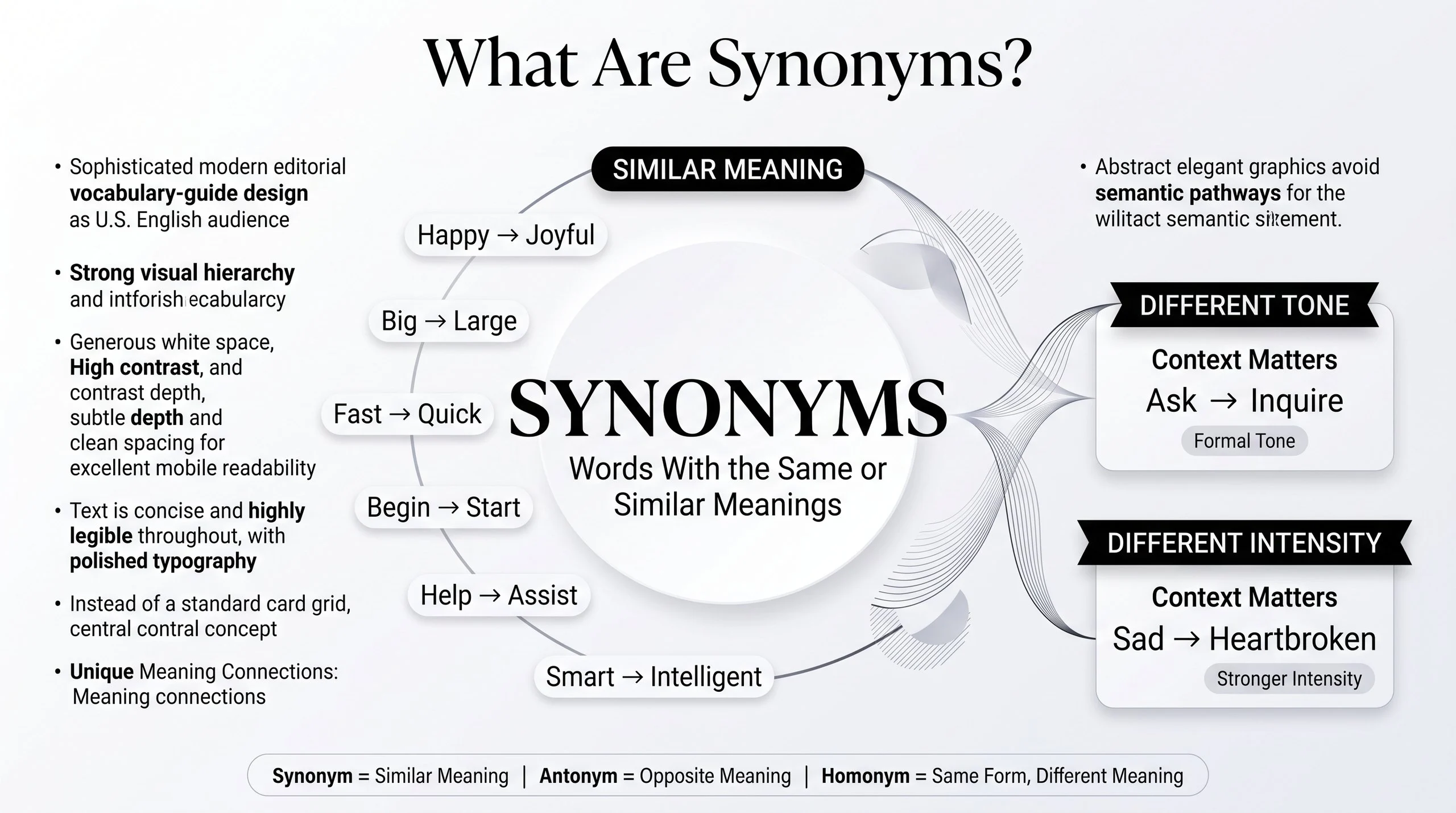
Synonyms are words that have the same or a similar meaning as another word. For example, happy and joyful are synonyms because both describe a positive emotional state. However, synonyms are not always interchangeable. Therefore, the best synonym depends on context, tone, meaning, and the situation in which you use it.
What Are Synonyms?
Definition
Synonyms are words or expressions that share the same or a closely related meaning.
For example:
- Happy → joyful
- Big → large
- Fast → quick
- Smart → intelligent
- Begin → start
- Beautiful → attractive
- Angry → furious
- Help → assist
These pairs have related meanings. However, they may differ in tone, strength, formality, or typical usage.
For instance, start and commence can both refer to beginning something. Nevertheless, commence sounds more formal.
The meeting will start at 9 a.m.
The meeting will commence at 9 a.m.
Both sentences are grammatically correct. However, the first sounds more natural in everyday American English.
Simple Meaning of Synonyms
In simple terms, a synonym is a word that means the same or nearly the same thing as another word.
Synonyms give writers more choices. As a result, they can make language clearer, more varied, and more precise.
For example, instead of repeating:
The movie was good. The acting was good, and the ending was good.
You could write:
The movie was excellent. The acting was impressive, and the ending was satisfying.
The second version provides more detail. Therefore, synonyms can improve both vocabulary and writing style.
How Do Synonyms Work?
Synonyms work by connecting words with related meanings. However, two synonyms rarely have exactly the same meaning in every situation.
Consider big and large.
She lives in a big house.
She lives in a large house.
Both sound natural.
Now consider big and enormous:
She lives in a big house.
She lives in an enormous house.
The second sentence suggests a much greater size.
Therefore, synonyms can have different levels of intensity.
Likewise, ask and inquire are related, but their tones differ:
I asked about the schedule.
I inquired about the schedule.
The first sentence sounds conversational. In contrast, the second sounds more formal.
Examples of Synonyms
The following examples show common synonym pairs.
| Word | Synonym | Example |
|---|---|---|
| Happy | Joyful | She felt joyful after the news. |
| Sad | Unhappy | He felt unhappy about the decision. |
| Big | Large | They bought a large house. |
| Small | Tiny | The box contained a tiny object. |
| Fast | Quick | She gave a quick response. |
| Smart | Intelligent | He is an intelligent student. |
| Easy | Simple | The instructions are simple. |
| Difficult | Challenging | The assignment was challenging. |
| Begin | Start | The class will start soon. |
| End | Finish | We need to finish the project. |
| Angry | Furious | She was furious about the mistake. |
| Beautiful | Attractive | The building has an attractive design. |
| Help | Assist | We can assist you with the process. |
| Important | Significant | The study produced significant findings. |
| Wrong | Incorrect | The answer is incorrect. |
Notice that these words have related meanings, but they are not always perfect substitutes.
Types of Synonyms
Synonyms can be grouped according to how closely their meanings match.
Exact Synonyms
Exact synonyms have almost identical meanings and can sometimes replace each other without changing the basic message.
However, truly exact synonyms are relatively uncommon in natural language.
For example:
- Purchase → buy
- Infant → baby
- Begin → commence
Even these examples can differ in formality or context.
Therefore, it is often more accurate to think of them as near-synonyms rather than perfectly identical words.
Near Synonyms
Near synonyms have similar meanings but differ slightly in use, tone, intensity, or context.
Examples include:
- Happy → pleased
- Angry → annoyed
- Large → enormous
- Smart → clever
- Beautiful → pretty
For example, annoyed usually describes a lower level of anger than furious.
She was annoyed by the delay.
She was furious about the delay.
Both describe negative emotions. Nevertheless, their intensity is different.
Contextual Synonyms
Contextual synonyms have related meanings in a particular situation but may not work everywhere.
For example, bright can mean intelligent in some contexts.
She is a bright student.
Here, bright means intelligent.
However:
The room is bright.
Here, bright refers to light rather than intelligence.
Therefore, context determines whether two words function as synonyms.
Register-Based Synonyms
Some synonyms differ mainly in formality.
For example:
- Ask → inquire
- Buy → purchase
- Help → assist
- Start → commence
- Get → obtain
Compare:
Can you help me?
with:
Could you assist me?
The meanings are closely related. However, assist sounds more formal.
Why Are Synonyms Important?
Synonyms play an important role in communication. They offer several practical benefits.
They Reduce Repetition
Repeating the same word can make writing monotonous.
For example:
The book was good. The characters were good. The ending was good.
A more varied version is:
The book was excellent. The characters were compelling, and the ending was satisfying.
As a result, the writing becomes more engaging.
They Improve Precision
A broad word does not always communicate the exact idea.
For example, bad can mean many things.
You could instead use:
- Poor for low quality
- Harmful for something causing damage
- Defective for a faulty product
- Unpleasant for an uncomfortable experience
- Unethical for questionable behavior
Therefore, synonyms can make a sentence more precise.
They Help Match Tone
Different situations require different levels of formality.
For example:
We bought a new computer.
sounds natural in everyday conversation.
In a formal report, you might write:
The company purchased new equipment.
Both words communicate the same basic action. However, purchased has a more formal tone.
They Strengthen Vocabulary
Learning synonyms introduces you to related words and their differences.
For example, learning these words together can expand your vocabulary:
Happy → pleased → delighted → thrilled
Each word expresses a positive emotion. However, the intensity changes as the words become stronger.
Synonyms by Context
The best synonym depends on where and how you use the word.
Synonyms in Everyday Conversation
Everyday speech usually favors simple and familiar words.
For example:
- Start → begin
- Help → assist
- Happy → glad
- Big → large
- Angry → mad
- Buy → get
Natural conversation generally favors shorter, familiar vocabulary. Therefore, overly formal synonyms can sometimes sound unnatural.
Synonyms in Professional Writing
Professional communication often requires a clear and polished tone.
Useful examples include:
- Help → assist
- Show → demonstrate
- Use → utilize
- Buy → purchase
- Need → require
- Explain → clarify
However, formal does not always mean better. In many situations, a simple word is clearer.
For example:
We need more information.
is often better than:
We require additional information.
Both are correct, but the first is more direct.
Synonyms in Academic Writing
Academic writing values precision.
Common examples include:
- Show → demonstrate
- Important → significant
- Think → argue
- Use → employ
- Help → facilitate
- Look at → examine
For example:
The results show a clear relationship.
could become:
The results demonstrate a clear relationship.
The second version may suit a formal research discussion more effectively.
Synonyms in Creative Writing
Creative writing uses synonyms to create mood, imagery, and emotional detail.
For example, instead of:
The man walked through the forest.
you might write:
The man wandered through the forest.
Or:
The man strolled through the forest.
These words all describe movement on foot. However, each creates a different image.
Wandered suggests movement without a clear direction. Meanwhile, strolled suggests a relaxed pace.
How to Choose the Right Synonym
Choosing a synonym is not simply a matter of finding a word with a similar dictionary definition. Instead, consider several factors.
Consider the Meaning
First, identify exactly what the original word means in the sentence.
For example, great can mean:
- Excellent
- Important
- Large
- Skilled
Therefore:
She made a great contribution.
could mean an important contribution, not necessarily an excellent one.
Consider the Tone
Next, think about how formal the sentence should sound.
For example:
Casual:
Can you help me?
Formal:
Could you assist me?
The meaning is similar, but the tone changes.
Consider Intensity
Some synonyms express stronger or weaker versions of an idea.
For example:
Sad → unhappy → miserable → devastated
These words are related. However, they do not communicate the same emotional intensity.
Therefore, choose the word that matches the strength of the situation.
Consider the Audience
Your readers also matter.
A technical term may work well in a professional report. However, the same term might confuse a general audience.
For example:
The machine malfunctioned.
is more widely understood than a highly technical description of the specific mechanical failure.
Consequently, effective synonym selection considers both meaning and audience.
Common Mistakes When Using Synonyms
Although synonyms are useful, they can cause problems when used incorrectly.
Assuming All Synonyms Are Interchangeable
Words with similar meanings may behave differently.
For example, house and home are related, but they are not identical.
I bought a house.
I bought a home.
The first emphasizes the physical property. The second can emphasize the place where someone lives and feels connected.
Choosing a Word That Is Too Formal
Using formal vocabulary in casual situations can make your writing sound unnatural.
For example:
I purchased some coffee.
is grammatically correct. However:
I bought some coffee.
sounds more natural in everyday conversation.
Choosing a Word That Is Too Strong
A synonym can accidentally exaggerate your meaning.
For example:
I am annoyed.
is not the same as:
I am furious.
Therefore, check the intensity before replacing a word.
Ignoring Part of Speech
Synonyms usually need to match the grammatical role of the original word.
For example:
- Quick → adjective
- Quickly → adverb
- Speed → noun
- Accelerate → verb
You cannot always substitute one form for another.
Using a Synonym That Does Not Fit the Context
Consider:
The soup was hot.
Replacing hot with warm changes the meaning.
Likewise:
The debate became heated.
Here, heated describes strong disagreement rather than physical temperature.
Therefore, dictionary similarity alone is not enough.
Synonyms vs. Antonyms
- Synonyms and antonyms have opposite relationships.
- Synonyms have similar meanings.
Examples:
- Happy → joyful
- Fast → quick
- Large → big
Antonyms have opposite meanings.
Examples:
- Happy → sad
- Fast → slow
- Large → small
Therefore, a thesaurus can help you discover both related and contrasting vocabulary, but only synonyms should be used when you want to preserve the original meaning.
Synonyms vs. Homonyms
These terms are also different.
Synonyms have similar meanings.
Big → large
Homonyms are words that share the same spelling or pronunciation but have different meanings.
For example:
Bat can mean an animal or a piece of sports equipment.
Therefore, homonyms concern word forms and multiple meanings, while synonyms concern similar meanings.
Synonyms and Antonyms Example Table
| Word | Synonym | Antonym |
|---|---|---|
| Happy | Joyful | Sad |
| Large | Big | Small |
| Fast | Quick | Slow |
| Easy | Simple | Difficult |
| Strong | Powerful | Weak |
| Beautiful | Attractive | Ugly |
| Begin | Start | End |
| Increase | Grow | Decrease |
| Accept | Approve | Reject |
| Brave | Courageous | Cowardly |
How Synonyms Improve Writing
Good synonym use can improve writing in several ways.
First, it reduces unnecessary repetition. For example, replacing repeated uses of important with significant, essential, critical, or valuable can create more variety.
Second, it improves precision. Instead of calling every negative experience bad, you can distinguish between unpleasant, harmful, disappointing, and devastating.
Moreover, synonyms can help writers match their audience. A children’s story may favor simple vocabulary, while an academic paper may require more specialized terminology.
However, variety should never become the main goal. Clear communication comes first. Therefore, use a synonym when it improves meaning, tone, or readability.
Frequently Asked Questions
What are synonyms in simple words?
Synonyms are words that have the same or a similar meaning. For example, happy and joyful are synonyms.
What is a synonym example?
One simple example is big and large. Both words describe something with considerable size.
Why do we use synonyms?
We use synonyms to reduce repetition, improve vocabulary, express ideas more precisely, and adjust the tone of our writing.
Are synonyms exactly the same?
Not always. Most synonyms have related meanings but differ in tone, intensity, formality, or context. Therefore, they cannot always replace one another.
What are the 10 examples of synonyms?
Ten common examples are:
- Happy → joyful
- Big → large
- Fast → quick
- Smart → intelligent
- Easy → simple
- Begin → start
- Help → assist
- Angry → furious
- Beautiful → attractive
- Important → significant
What is the difference between synonyms and antonyms?
Synonyms have similar meanings, while antonyms have opposite meanings. For example, happy and joyful are synonyms, whereas happy and sad are antonyms.
What is the difference between synonyms and homonyms?
Synonyms are words with similar meanings. Homonyms are words that share the same spelling or pronunciation but have different meanings.
Can synonyms change the meaning of a sentence?
Yes. Although synonyms have related meanings, they can differ in intensity, tone, or context. Therefore, replacing one word with another can slightly or significantly change a sentence.
What is the best way to learn synonyms?
Learn synonyms in groups and study them in real sentences. In addition, compare their tone, intensity, and typical contexts instead of memorizing isolated word lists.
Can synonyms improve SEO writing?
Yes. Natural use of semantically related words can make content more useful and varied. However, synonyms should support clarity and topic coverage rather than become a form of keyword stuffing.
Conclusion
So, what are synonyms? Synonyms are words or expressions that have the same or closely related meanings. Examples include happy and joyful, big and large, fast and quick, and begin and start.
However, synonyms are rarely identical in every situation. They can differ in formality, intensity, tone, grammar, and context. Therefore, effective writers do more than find a word with a similar definition. They choose the word that best matches the intended meaning and audience.
Ultimately, learning synonyms can make your vocabulary richer and your writing more precise. Instead of replacing words simply to avoid repetition, use synonyms when they add clarity, variety, accuracy, or the right tone.