What Is Another Word for Said?
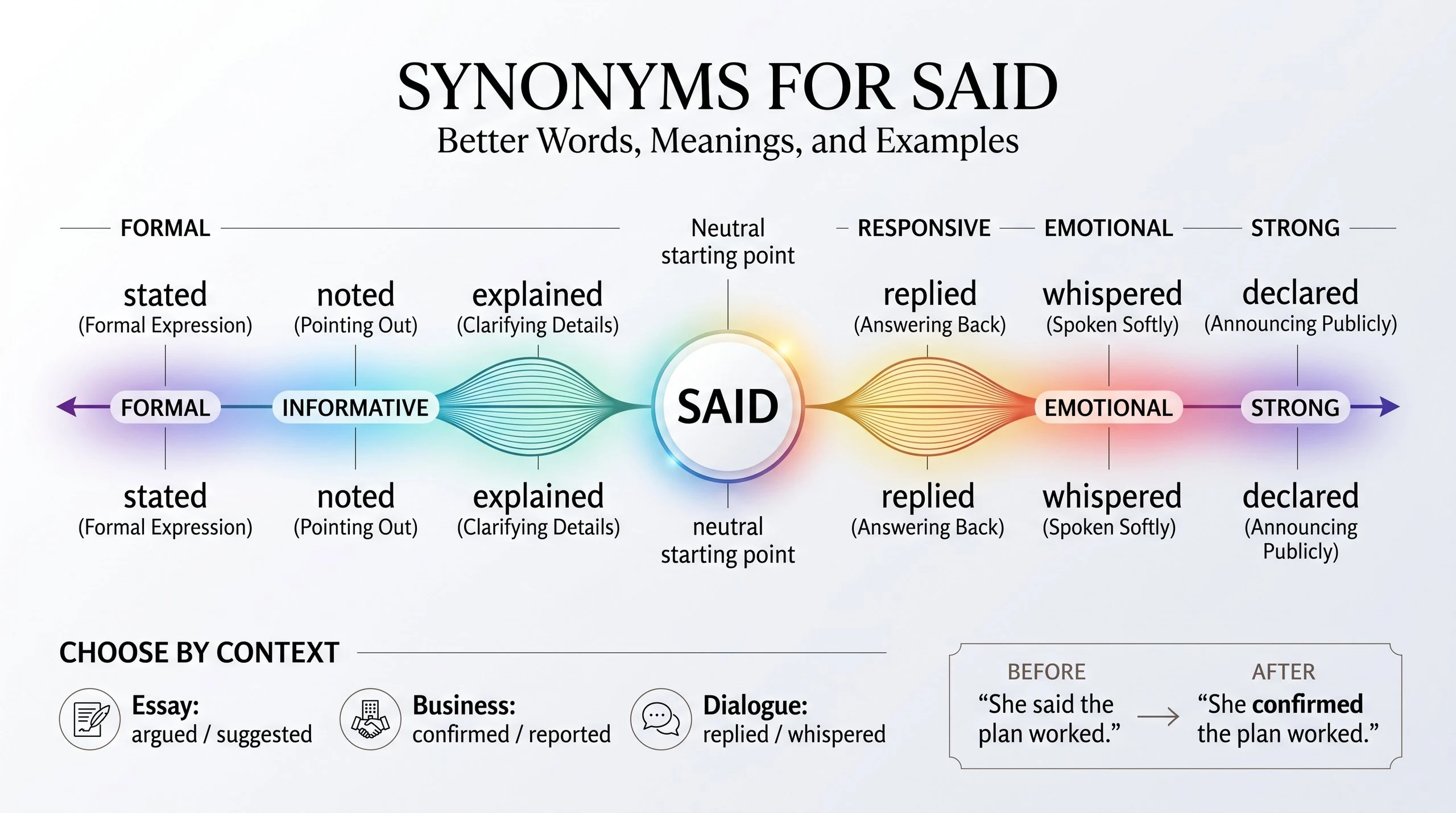
Common synonyms for said include stated, remarked, mentioned, explained, replied, answered, declared, noted, expressed, commented, announced, and told. However, the best alternative depends on the speaker’s tone and purpose. For example, stated sounds formal, replied shows a response, while whispered describes how someone spoke.
What Does “Said” Mean?
Definition
Said is the past tense and past participle of say. It means that someone spoke words, expressed an idea, gave information, or communicated something verbally.
For example:
Maria said she would arrive early.
The word works in almost any speaking situation. Therefore, it remains one of the most common dialogue and reporting words in English.
However, repeated use of said can make writing feel flat, especially in stories, essays, reports, and professional communication. Using a precise alternative can show what the speaker meant, how they spoke, or why they spoke.
Common Uses of “Said”
You can use said when someone:
- Gives information
- Shares an opinion
- Answers a question
- Makes a statement
- Expresses an emotion
- Responds to another person
- Reports something that happened
For example:
- “I agree,” she said.
- The manager said the meeting would start at nine.
- “That sounds great,” he said.
- The report said sales increased this year.
Because said is neutral, it usually does not reveal the speaker’s emotion or speaking style.
Best Synonyms for Said
| Synonym | Meaning | Best Used When | Example |
|---|---|---|---|
| Stated | Expressed something clearly | Formal or professional writing | She stated her position clearly. |
| Remarked | Made a comment | Casual or thoughtful comments | He remarked that the room was quiet. |
| Mentioned | Referred to something briefly | Short references | She mentioned the upcoming meeting. |
| Explained | Made something easier to understand | Giving information | He explained the process. |
| Replied | Responded to someone | Direct responses | She replied to the question. |
| Answered | Responded to a question | Questions and responses | He answered the interviewer. |
| Declared | Made a strong public statement | Strong or official statements | The leader declared the policy effective. |
| Noted | Pointed something out | Reports and formal writing | The researcher noted several changes. |
| Commented | Gave an opinion or observation | Opinions and observations | She commented on the results. |
| Expressed | Communicated a thought or feeling | Emotions and opinions | He expressed his concern. |
| Announced | Gave information publicly | News or important information | The company announced a new plan. |
| Told | Gave information to someone | Direct communication | She told me the truth. |
Synonyms for Said by Context
Context matters because not every synonym fits every sentence. In fact, choosing a word based on the speaker’s purpose can make your writing much more precise.
Formal Writing
For formal writing, choose words that sound precise and objective.
Good alternatives include:
- Stated
- Declared
- Noted
- Reported
- Indicated
- Explained
- Confirmed
Example:
Basic:
The researcher said the results were significant.
More formal:
The researcher stated that the results were significant.
Here, stated sounds more professional without changing the basic meaning.
Professional Writing
Business and workplace writing often needs neutral language. Therefore, stated, explained, noted, confirmed, reported, and indicated work particularly well.
Example:
The manager said the project would finish on Friday.
Better:
The manager confirmed that the project would finish on Friday.
The second sentence is more specific because confirmed suggests that the information was verified or made definite.
Academic Writing
Academic writing usually favors precise reporting verbs rather than repeatedly using said.
Useful choices include:
- Argued
- Stated
- Suggested
- Explained
- Observed
- Reported
- Noted
- Claimed
- Concluded
- Proposed
For example:
The author said social media affects communication.
A more academic version could be:
The author argued that social media affects communication.
Notice the difference. Argued suggests that the author presented reasoning to support a position.
Daily Conversation
In everyday speech, simple alternatives usually sound more natural.
Try:
- Told
- Mentioned
- Asked
- Replied
- Answered
- Commented
- Added
- Explained
For example:
Jake said he was tired.
You could write:
Jake mentioned that he was tired.
However, mentioned makes the statement sound more casual and brief.
Professional Alternatives for Said
If you’re writing an email, report, presentation, or business document, avoid replacing every instance of said with an impressive-sounding word. Instead, choose a verb that accurately describes the communication.
Stated
Stated means expressed something clearly and directly.
Best for: Formal documents, reports, business writing, and official statements.
The director stated that the company would review the policy.
Explained
Explained works when someone provides information or makes an idea easier to understand.
Best for: Instructions, meetings, reports, and educational writing.
The consultant explained how the new system works.
Confirmed
Confirmed means someone verified or affirmed information.
Best for: Business emails, schedules, appointments, and official communication.
The assistant confirmed the meeting time.
Noted
Noted means someone pointed out or observed something.
Best for: Reports, research, professional documents, and analytical writing.
The analyst noted a significant change in customer behavior.
Reported
Reported works when someone communicates information, especially information based on observation or investigation.
Best for: Journalism, research, business reports, and formal summaries.
The organization reported higher customer satisfaction.
Simple Alternatives for Said
Sometimes the best replacement is a simple word. Clear writing does not require complicated vocabulary.
Told
Use told when someone gives information directly to another person.
She told me about the problem.
Mentioned
Use mentioned when someone brings something up briefly.
He mentioned your name during the meeting.
Replied
Use replied when someone responds to what another person said.
“I agree,” she replied.
Answered
Use answered when someone responds to a question.
“Where are you going?” he asked.
“Home,” she answered.
Added
Use added when a speaker gives another piece of information.
“The plan looks good,” she said and added that the deadline was realistic.
Stronger Alternatives for Said
Sometimes, said does not communicate enough information. A stronger verb can show the force or purpose of the statement.
Declared
Declared suggests a firm or public statement.
The captain declared that the team was ready.
Announced
Announced means formally or publicly gave new information.
The company announced its new product.
Insisted
Insisted shows that someone strongly maintained a position.
She insisted that she had followed the instructions.
Argued
Argued suggests that someone presented reasons supporting a viewpoint.
The writer argued that education should be more accessible.
Claimed
Claimed means someone presented something as true. Importantly, the word can sometimes suggest that the statement has not been independently established.
The company claimed that the product was completely safe.
Alternatives for Said That Show Emotion
Dialogue becomes more vivid when the reporting verb matches the speaker’s emotion.
| Emotion or Tone | Useful Alternative | Example |
|---|---|---|
| Anger | snapped | “Leave me alone,” she snapped. |
| Happiness | cheered | “We won!” he cheered. |
| Sadness | sobbed | “I miss them,” she sobbed. |
| Quiet speech | whispered | “Be careful,” he whispered. |
| Loud speech | shouted | “Stop!” she shouted. |
| Uncertainty | muttered | “I don’t know,” he muttered. |
| Confidence | declared | “We can do this,” she declared. |
| Surprise | exclaimed | “That’s incredible!” he exclaimed. |
| Agreement | agreed | “You’re right,” she agreed. |
| Disagreement | objected | “That’s not fair,” he objected. |
However, descriptive dialogue verbs should support the writing rather than overwhelm it. In many cases, said remains the clearest option.
Difference Between Similar Synonyms
Choosing the right synonym requires more than finding a word with a similar dictionary definition. Each alternative carries a slightly different meaning.
Said vs. Stated
Said is neutral and general. Stated sounds more formal and deliberate.
She said she was ready.
She stated that she was ready.
Use stated when the statement matters in a formal context.
Said vs. Mentioned
Mentioned usually suggests a brief reference.
He said he had visited Chicago.
He mentioned that he had visited Chicago.
The second sentence suggests that the visit was brought up briefly rather than discussed in detail.
Said vs. Explained
Explained implies that the speaker provided information or clarification.
The teacher said the answer was incorrect.
The teacher explained why the answer was incorrect.
The second version gives the reader more information about the communication.
Said vs. Replied
Replied specifically indicates a response.
“Are you ready?” she asked.
“Yes,” he replied.
Using said would also work, but replied makes the conversational relationship clearer.
Said vs. Told
Told normally requires a person who receives the information.
She told me the truth.
By contrast, said often introduces the words themselves.
She said, “I know the truth.”
This grammatical difference is important when choosing between the two.
Before-and-After Examples
| Basic Sentence | Improved Alternative |
|---|---|
| The CEO said the company had grown. | The CEO reported that the company had grown. |
| She said her opinion clearly. | She stated her opinion clearly. |
| He said how the system worked. | He explained how the system worked. |
| Maria said she agreed. | Maria agreed. |
| The professor said the study had limitations. | The professor noted that the study had limitations. |
| He said the news loudly. | He announced the news. |
| She said she did not agree. | She objected. |
| The customer said there was a problem. | The customer reported a problem. |
Real-World Examples of Synonyms for Said
Business Example
During the meeting, the manager stated that the team needed a clearer deadline. She then explained the new workflow and confirmed that additional training would be available.
Here, each verb has a different job. As a result, the paragraph sounds more precise than one that repeatedly uses said.
Academic Example
The researcher argued that the results required further investigation. She also noted several limitations and suggested that future studies use a larger sample.
In academic writing, these verbs help readers understand the relationship between the author and the information.
Daily Conversation Example
“I didn’t know about the event,” Alex replied. He then mentioned that he had been busy all week.
The alternatives make the sequence of the conversation easier to follow.
Synonym Analysis at a Glance
| Word | Tone | Difficulty | Usage Frequency | Best For |
|---|---|---|---|---|
| Said | Neutral | Easy | Very Common | General writing |
| Stated | Formal | Easy | Common | Business, reports |
| Mentioned | Neutral | Easy | Very Common | Conversation, emails |
| Explained | Neutral | Easy | Very Common | Education, instructions |
| Replied | Neutral | Easy | Common | Dialogue |
| Answered | Neutral | Easy | Very Common | Questions |
| Noted | Formal | Medium | Common | Academic, analytical writing |
| Reported | Formal | Medium | Common | News, research, business |
| Declared | Strong/Formal | Medium | Less Common | Public statements |
| Argued | Academic | Medium | Common | Essays, research |
| Insisted | Strong | Medium | Common | Disagreement |
| Whispered | Descriptive | Easy | Common | Fiction, dialogue |
| Muttered | Descriptive | Medium | Common | Fiction, emotional dialogue |
| Announced | Formal/Neutral | Easy | Common | News, business |
Common Mistakes When Replacing “Said”
1. Choosing a synonym that changes the meaning
Do not use shouted simply because you want to avoid said. The word changes the meaning because it describes loud speech.
2. Using overly dramatic dialogue tags
Words such as screamed, exploded, bellowed, or roared can become distracting when used repeatedly. Instead, use them only when the scene genuinely requires that intensity.
3. Replacing every “said”
There is nothing wrong with said. In fact, readers often overlook it because it is familiar and unobtrusive. Therefore, good writing usually combines said with more specific verbs when they add useful information.
4. Ignoring grammar
Remember the difference between said and told.
Correct:
She said that she was tired.
Correct:
She told me that she was tired.
Incorrect:
She told that she was tired.
5. Choosing a word just because it sounds sophisticated
A complicated synonym is not automatically better. Stated may fit a report, while said may work better in a casual story.
What Is a Formal Synonym for Said?
The most useful formal synonyms for said include stated, declared, noted, reported, indicated, explained, and remarked.
For most professional situations, stated is a straightforward replacement. Meanwhile, reported works better when someone is communicating findings or information.
What Is a Professional Alternative to Said?
Common professional alternatives include stated, confirmed, explained, noted, reported, indicated, and mentioned.
For example:
The manager said the deadline had changed.
A more professional version is:
The manager confirmed that the deadline had changed.
What Is Another Word for Said in an Essay?
For essays, useful alternatives include argued, stated, suggested, explained, noted, observed, reported, claimed, and concluded.
However, choose the verb according to the source’s actual purpose. For example, use argued when an author presents reasons for a position, but use noted when the author simply points something out.
What Is Another Word for Said in a Story?
For storytelling, options include replied, whispered, shouted, asked, answered, muttered, exclaimed, insisted, and remarked.
Nevertheless, said remains useful in fiction because it keeps attention on the dialogue instead of drawing attention to the dialogue tag.
Opposite Words of Said
There is no single perfect antonym for said, because speaking can be contrasted with several different actions.
Depending on context, possible opposites include:
- Silenced
- Withheld
- Suppressed
- Kept quiet
- Listened
- Remained silent
- Concealed
For example, said communicates information, while withheld suggests that someone deliberately did not communicate it.
FAQs About Synonyms for Said
What is the most common synonym for said?
Stated is one of the most common formal alternatives, while mentioned and told are common in everyday communication. The best choice depends on the sentence.
What is a stronger word than said?
Words such as declared, insisted, argued, announced, and proclaimed can sound stronger than said. However, each one adds a different meaning or tone.
What is a better word for said in writing?
There is no universal replacement. Stated works well for formal writing, explained works for clarification, reported works for information, and replied works for dialogue.
What can I use instead of said in an essay?
Try argued, stated, suggested, explained, noted, observed, reported, claimed, or concluded, depending on what the author actually did.
What is a synonym for said in a professional email?
Useful choices include stated, confirmed, explained, noted, mentioned, reported, and indicated. In many emails, however, simply restructuring the sentence can sound more natural.
What is a synonym for said that shows anger?
Depending on the situation, snapped, shouted, yelled, protested, objected, or insisted can show anger or confrontation.
What is a synonym for said that shows sadness?
Words such as sobbed, murmured, whispered, or lamented can convey sadness. However, these words describe different levels or forms of emotion.
Is “told” a synonym for “said”?
Yes, told can communicate a similar basic idea, but its grammar differs. Told normally needs a person receiving the information, such as “She told me.” Said does not require that structure.
Should I avoid using “said” in writing?
No. Said is clear, natural, and neutral. Instead of removing it completely, use more specific alternatives when they add meaningful information about the speaker’s purpose, response, or tone.
Conclusion
The best synonyms for said depend on context. Stated fits formal writing, explained adds clarification, replied shows a response, mentioned suggests a brief reference, and declared communicates a stronger statement. Meanwhile, descriptive words such as whispered and shouted show how someone spoke.
Ultimately, effective writing is not about avoiding said at all costs. Rather, it is about choosing the most accurate word for the situation. When a synonym adds meaning, use it. Otherwise, said may still be the clearest choice.