What Is Another Word for Sad?
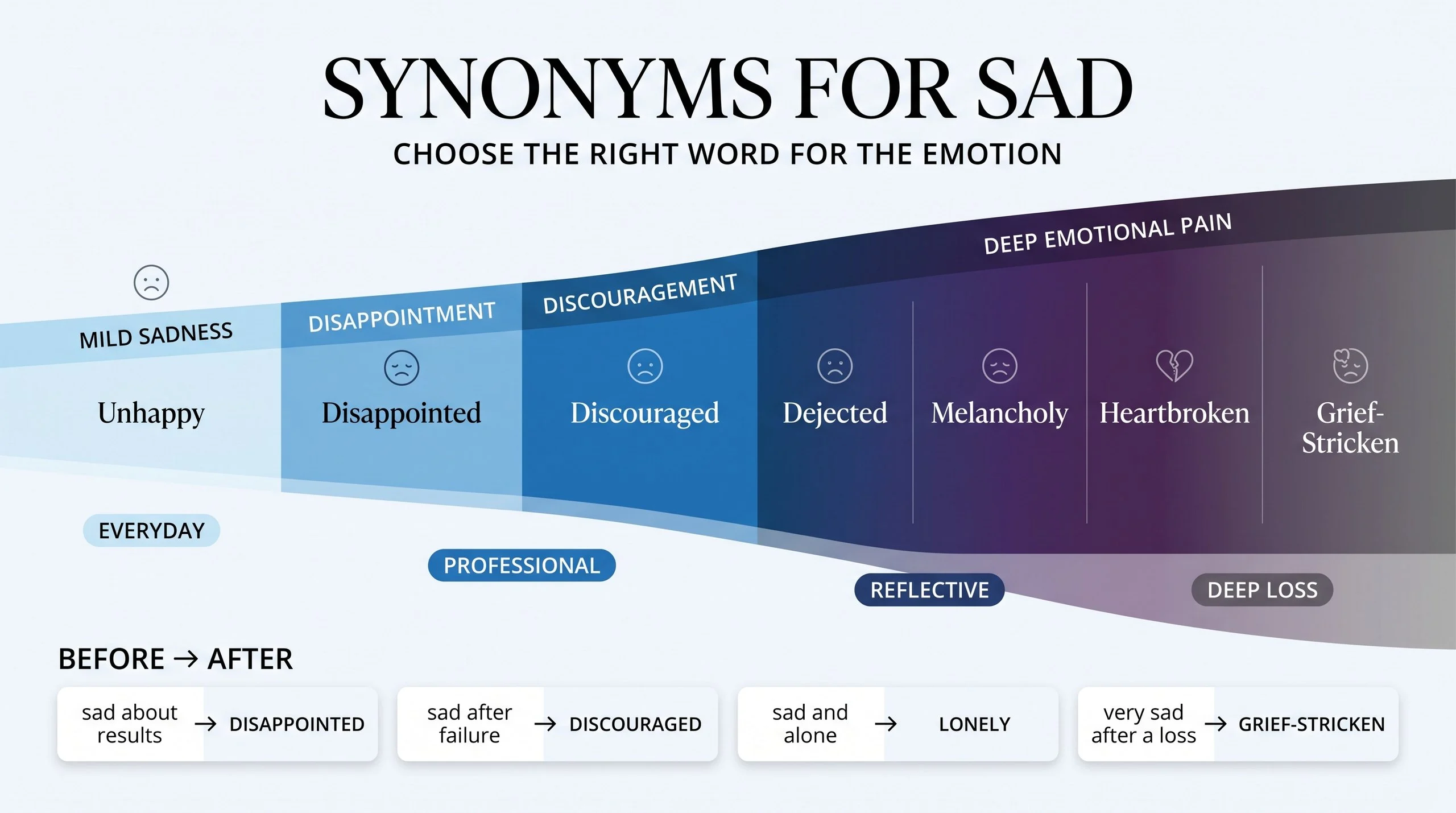
Another word for sad depends on the situation and intensity. Common synonyms include unhappy, sorrowful, unhappy, gloomy, miserable, disappointed, discouraged, heartbroken, melancholy, and dejected. However, these words are not exact substitutes. Therefore, choose one based on whether you mean ordinary sadness, disappointment, grief, loneliness, or deep emotional pain.
What Does Sad Mean?
Definition
Sad is an adjective that describes a feeling of unhappiness, sorrow, disappointment, emotional pain, or low spirits.
The word is broad, so it can describe mild disappointment as well as intense emotional suffering. Because of that range, context matters when selecting a synonym.
For example:
I feel sad today.
This sentence tells the reader how you feel, but it does not explain why. A more specific alternative could be:
I feel disappointed about the result.
Similarly:
She was sad after the loss.
could become:
She was grief-stricken after the loss.
The second sentence communicates a much stronger and more specific emotion.
Common Uses
People use sad in everyday conversations, creative writing, academic discussions, and professional communication.
For instance, you might describe a person as sad after receiving disappointing news. Likewise, a movie can have a sad ending, while a person can feel lonely after spending a long time alone.
Therefore, the best synonym depends on the source and intensity of the emotion.
Best Synonyms for Sad
| Synonym | Meaning | Best Used When | Example |
|---|---|---|---|
| Unhappy | Not feeling happy | General sadness | She felt unhappy about the decision. |
| Sorrowful | Experiencing deep sadness | Serious emotional situations | He looked sorrowful after the loss. |
| Gloomy | Low in mood or hopeful feeling | Mood, atmosphere, or outlook | The room felt gloomy. |
| Miserable | Extremely unhappy or uncomfortable | Strong personal sadness | She felt miserable after the argument. |
| Disappointed | Sad because expectations were not met | Setbacks or unmet expectations | He was disappointed by the result. |
| Discouraged | Losing confidence or motivation | Failure or setbacks | The team felt discouraged after the loss. |
| Dejected | Very low in spirits | Defeat or serious disappointment | She looked dejected after the rejection. |
| Melancholy | Quiet, thoughtful sadness | Reflective or literary contexts | The song has a melancholy tone. |
| Heartbroken | Deeply distressed by emotional loss | Relationships or personal loss | He was heartbroken after the breakup. |
| Grief-stricken | Overwhelmed by grief | Serious loss, especially death | The family was grief-stricken after the tragedy. |
| Downcast | Showing a low or sad mood | Facial expression or mood | He looked downcast during the meeting. |
| Despondent | Without hope or enthusiasm | Deep discouragement | She became despondent after repeated failures. |
Synonyms by Context
Formal Writing
Formal writing benefits from precise emotional vocabulary. Therefore, instead of repeatedly using sad, choose a word that explains the specific feeling.
Useful alternatives include:
- Sorrowful
- Melancholy
- Dejected
- Despondent
- Grief-stricken
- Disheartened
- Distressed
For example:
Basic:
The community was sad after the disaster.
More formal:
The community was deeply distressed after the disaster.
Similarly:
Basic:
The character felt sad throughout the novel.
More literary:
The character remained melancholy throughout the novel.
As a result, the revised versions communicate more specific emotional meanings.
Professional Writing
In professional communication, emotional language should usually remain measured and specific.
Useful alternatives include:
- Disappointed
- Discouraged
- Concerned
- Disheartened
- Dissatisfied
- Frustrated
For example:
The client was sad about the outcome.
A more professional version could be:
The client was disappointed with the outcome.
Likewise:
The team felt sad after the rejection.
could become:
The team felt discouraged after the proposal was rejected.
These alternatives sound more objective. Moreover, they explain the reason for the emotional response.
Academic Writing
Academic writing should avoid vague emotional descriptions when a more precise term is available.
Useful choices include:
- Distressed
- Disappointed
- Discouraged
- Melancholic
- Sorrowful
- Grief-stricken
For example:
Participants felt sad after receiving the news.
could become:
Participants reported feeling distressed after receiving the news.
However, writers should not assume an emotion without evidence. If a study specifically measures sadness, then sad may actually be the most accurate word.
Daily Conversation
Everyday American English has many natural alternatives for sad.
Common choices include:
- Unhappy
- Down
- Upset
- Miserable
- Disappointed
- Heartbroken
- Bummed out
- Downcast
For example:
I’m sad about missing the concert.
A casual alternative is:
I’m bummed out about missing the concert.
Meanwhile:
I’m heartbroken about what happened.
expresses a much stronger emotion.
Therefore, conversational synonyms should match the emotional intensity of the situation.
Professional Alternatives for Sad
When writing an email, report, workplace message, or professional document, avoid vague emotional language when a more accurate term is available.
Disappointed
Meaning: Sad or dissatisfied because an expectation was not met.
Tone: Neutral and professional.
Difficulty: Easy.
Usage Frequency: Very common.
Best for: Emails, workplace communication, customer service, and everyday situations.
Business example:
The client was disappointed with the final result.
Academic example:
Students were disappointed by the examination results.
Daily example:
I was disappointed that the event was canceled.
Because it clearly connects sadness with an unmet expectation, disappointed is one of the most useful alternatives to sad.
Discouraged
Meaning: Less confident or motivated because of difficulty or failure.
Tone: Neutral and professional.
Difficulty: Easy.
Usage Frequency: Common.
Best for: Workplace, education, goals, and setbacks.
The team felt discouraged after several unsuccessful attempts.
Here, the emotion involves reduced motivation rather than simple sadness.
Disheartened
Meaning: Losing confidence, hope, or enthusiasm.
Tone: Formal to neutral.
Difficulty: Medium.
Usage Frequency: Common.
Best for: Professional writing, achievements, setbacks, and personal challenges.
The employees were disheartened by the unexpected decision.
Therefore, disheartened can communicate emotional disappointment without sounding overly dramatic.
Distressed
Meaning: Experiencing significant emotional suffering or worry.
Tone: Formal.
Difficulty: Medium.
Usage Frequency: Common.
Best for: Serious situations, formal writing, and emotional descriptions.
The family was visibly distressed by the news.
This word generally expresses stronger emotional difficulty than sad.
Simple Alternatives for Sad
If you need an easy word that readers immediately understand, consider:
- Unhappy
- Upset
- Down
- Disappointed
- Gloomy
- Miserable
- Lonely
- Heartbroken
However, these words do not all mean exactly the same thing.
For example, lonely specifically describes sadness associated with a lack of companionship. Likewise, disappointed connects sadness to unmet expectations.
Therefore, use the simplest word that accurately expresses the situation.
Stronger Alternatives for Sad
Sometimes sad does not communicate enough emotional intensity. In those situations, stronger alternatives include:
- Miserable
- Heartbroken
- Devastated
- Despondent
- Grief-stricken
- Despairing
- Distraught
- Sorrowful
For example:
She was sad after the breakup.
A stronger version is:
She was heartbroken after the breakup.
For an even more intense situation:
She was devastated by the loss.
These words should not be used interchangeably. In particular, devastated and grief-stricken communicate much greater emotional intensity than ordinary sadness.
Synonyms for Different Types of Sadness
Because sadness has many forms, identifying the exact emotion can help you choose a better word.
Sad Because of Disappointment
Use:
- Disappointed
- Discouraged
- Disheartened
- Let down
Example:
She felt disappointed after receiving the rejection letter.
Sad Because of Loss
Use:
- Sorrowful
- Grieving
- Heartbroken
- Grief-stricken
- Devastated
Example:
The family was grieving after the loss.
Sad Because of Loneliness
Use:
- Lonely
- Isolated
- Forlorn
- Lonesome
Example:
He felt lonely after moving to a new city.
Sad Because of Failure
Use:
- Discouraged
- Dejected
- Disheartened
- Defeated
Example:
She felt dejected after failing the examination.
Quiet or Reflective Sadness
Use:
- Melancholy
- Pensive
- Wistful
- Somber
Example:
The old photograph gave him a melancholy feeling.
Thus, identifying the cause of sadness often leads to a much more accurate word.
Difference Between Similar Synonyms
Choosing the right synonym requires understanding the subtle differences between related words.
Sad vs. Unhappy
Sad generally describes an emotional state. Unhappy is broader and can describe both feelings and dissatisfaction with a situation.
She felt sad after the news.
She was unhappy with the decision.
Therefore, unhappy can sometimes mean dissatisfied rather than emotionally sorrowful.
Sad vs. Disappointed
Disappointed means you feel unhappy because something did not happen as expected.
I am sad about the situation.
I am disappointed that the plan failed.
The second sentence gives the reason for the emotion more clearly.
Sad vs. Depressed
These words should not always be treated as interchangeable.
Sad is a common word for an unhappy feeling. Depressed can have a broader psychological meaning and may refer to a clinical condition in some contexts.
Therefore, use sad when you simply mean unhappy. Use depressed only when the context supports its intended meaning.
Sad vs. Miserable
Miserable usually expresses stronger unhappiness than sad.
He felt sad after the argument.
He felt miserable after the argument.
The second sentence suggests more intense or prolonged discomfort.
Sad vs. Melancholy
Melancholy often describes a quiet, reflective, or slightly poetic sadness.
The song has a melancholy quality.
It is therefore especially useful in literature, music, art, and descriptive writing.
Sad vs. Heartbroken
Heartbroken describes intense emotional pain, often caused by romantic loss, grief, or another deeply painful event.
She was heartbroken after the breakup.
Therefore, it is much stronger than simply saying sad.
Sad vs. Grief-Stricken
Grief-stricken specifically describes overwhelming grief, usually following a serious loss.
The family was grief-stricken after the death.
As a result, it should not be used for ordinary disappointment.
Before-and-After Examples
A precise synonym can make a sentence more informative.
| Before | Better Alternative |
|---|---|
| Sad about the result | Disappointed by the result |
| Sad after the loss | Grief-stricken after the loss |
| Sad after failing | Dejected after failing |
| Sad about being alone | Lonely |
| Sad and without hope | Despondent |
| Sad after repeated setbacks | Discouraged |
| Sad and thoughtful | Melancholy |
| Very sad after a breakup | Heartbroken |
| Sad and worried | Distressed |
| Sad-looking | Downcast |
The revised words provide additional information. Therefore, they often create stronger and clearer writing.
Real-World Examples
Business Example
Basic:
The customer was sad about the delayed order.
Improved:
The customer was disappointed by the delayed order.
Here, disappointed explains why the customer felt unhappy.
Academic Example
Basic:
Students were sad after receiving their results.
Improved:
Students felt discouraged after receiving their results.
This version suggests that the results affected their confidence or motivation.
Daily Conversation Example
Basic:
She was sad after the breakup.
Improved:
She was heartbroken after the breakup.
Because the situation involves emotional loss, heartbroken communicates the intensity more effectively.
Synonym Analysis at a Glance
| Synonym | Tone | Difficulty | Usage Frequency | Best For |
|---|---|---|---|---|
| Unhappy | Neutral | Easy | Very Common | Everyday writing |
| Sorrowful | Formal | Medium | Common | Serious situations |
| Gloomy | Neutral | Easy | Common | Mood and atmosphere |
| Miserable | Strong | Easy | Very Common | Intense unhappiness |
| Disappointed | Neutral | Easy | Very Common | Setbacks and expectations |
| Discouraged | Neutral | Easy | Common | Failure and motivation |
| Dejected | Formal | Medium | Common | Defeat and disappointment |
| Melancholy | Literary | Medium | Common | Art, writing, reflection |
| Heartbroken | Strong | Easy | Very Common | Romantic or personal loss |
| Grief-stricken | Very Strong | Medium | Common | Serious bereavement |
| Downcast | Formal | Medium | Common | Appearance and mood |
| Despondent | Formal | Advanced | Less Common | Deep discouragement |
Opposite Words
Common opposites of sad include:
- Happy
- Joyful
- Cheerful
- Content
- Delighted
- Pleased
- Optimistic
- Hopeful
- Upbeat
- Glad
However, the appropriate opposite depends on the situation.
For example, happy is the broadest opposite. Meanwhile, cheerful describes a consistently positive mood, while delighted expresses strong pleasure.
Similarly, hopeful is the opposite of feeling hopeless rather than the direct opposite of sadness.
FAQs
What is another word for sad?
Common synonyms for sad include unhappy, sorrowful, gloomy, miserable, disappointed, discouraged, dejected, melancholy, heartbroken, and grief-stricken. The best choice depends on the cause and intensity of the sadness.
What is a formal synonym for sad?
Formal alternatives include sorrowful, distressed, dejected, despondent, melancholy, and grief-stricken. However, each word describes a slightly different emotional state.
What is a professional word for sad?
In professional writing, disappointed, discouraged, disheartened, distressed, or dissatisfied may be more appropriate. The best choice depends on whether the issue involves expectations, motivation, worry, or dissatisfaction.
What is a stronger word for sad?
Stronger alternatives include miserable, heartbroken, devastated, distraught, despondent, and grief-stricken. These words communicate greater emotional intensity.
What is a simple synonym for sad?
Simple alternatives include unhappy, upset, down, disappointed, gloomy, and miserable. For everyday conversation, unhappy and upset are especially easy to understand.
What is a synonym for sad about a result?
Disappointed is usually the most natural choice when sadness comes from an outcome that did not meet expectations.
What is a synonym for very sad?
Depending on the situation, use miserable, heartbroken, devastated, sorrowful, distraught, or grief-stricken.
What is a synonym for sad and lonely?
Words such as forlorn, lonesome, isolated, and melancholy can work, depending on the exact meaning.
What is a synonym for sad in a formal essay?
Depending on the context, use distressed, sorrowful, disappointed, discouraged, melancholy, or grief-stricken. Nevertheless, a precise description is often better than an emotional synonym.
What is the best synonym for sad in a resume?
Avoid simply replacing sad with another emotional word. Instead, describe the professional situation precisely with terms such as disappointed, discouraged, concerned, dissatisfied, or disheartened, depending on the context.
Conclusion
The best synonyms for sad depend on the cause, intensity, and setting of the emotion. For general unhappiness, unhappy works well. Meanwhile, disappointed fits unmet expectations, discouraged describes reduced confidence, and lonely focuses on a lack of companionship.
For deeper sadness, sorrowful, heartbroken, devastated, and grief-stricken communicate stronger emotions. In contrast, melancholy describes a quieter, more reflective form of sadness.
Ultimately, the most effective synonym does more than replace the word sad. Instead, it tells readers what kind of sadness you mean. As a result, choosing a precise word can make your writing clearer, more natural, and more emotionally accurate.