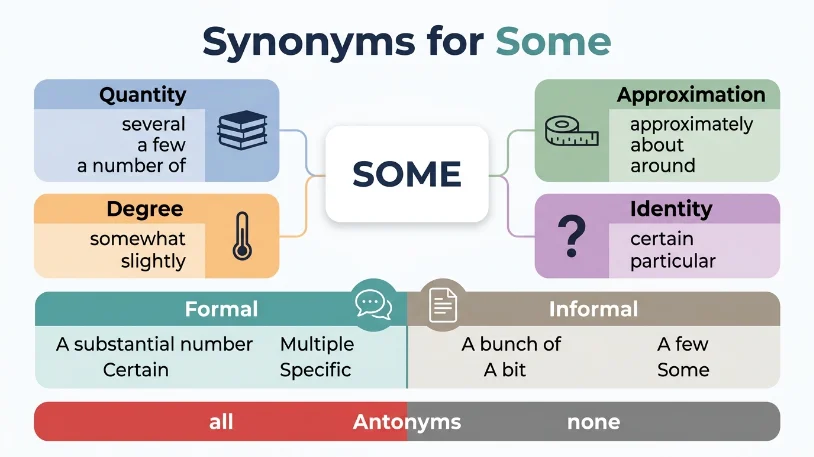
The best synonyms for some depend entirely on how you’re using the word. Are you referring to an unspecified number (“some people”), an approximate amount (“some 200 guests”), a degree of something (“feeling some better”), or an unidentified person or thing (“some guy called”)? The right alternative shifts with each meaning. Common go-to replacements include several, a few, about, certain, and somewhat but the choice matters more than you might think. This guide breaks down every major synonym for some, organized by meaning, tone, and context, so you can pick the perfect word every time.
Best Synonyms for Some
The best synonyms for some are several, a few, certain, about, and somewhat. However, the right choice depends on tone, context, and intensity. For an unspecified quantity, try several or a number of. For approximation, use approximately or roughly. For an unidentified person or thing, certain or particular works well. And for degree or extent, somewhat or slightly are your best bets.
What Does Some Mean?
At its core, some is a versatile word that indicates an unspecified amount, number, degree, or identity. It can function as a determiner (modifying a noun), a pronoun (standing alone), or an adverb (modifying a verb or adjective).
Simple definition: An unspecified quantity, number, or degree of something.
Part of speech: Determiner, pronoun, or adverb
Common usage:
- As a determiner: “I need some help with this project.”
- As a pronoun: “Some of the cookies are missing.”
- As an adverb: “He’s feeling some better today.”
Example sentences:
- “She bought some apples at the market.”
- “Some people prefer coffee over tea.”
- “The meeting lasted some three hours.”
Core Meaning of Some
The word some carries a few distinct but related meanings, and understanding these nuances is key to choosing the right synonym.
Unspecified quantity or number. This is the most common use. Some refers to an amount that isn’t precisely defined it could be a little or a lot, but the speaker either doesn’t know or doesn’t think the exact number matters. “I have some money in my wallet” tells you there’s money there, but not how much.
An unspecified person or thing. Some can also point to someone or something without naming them. “Some guy called for you” means an unidentified male caller. This usage carries a slight sense of vagueness or even dismissal.
Approximation. When placed before a number or measurement, some means “approximately” or “about.” “We walked some ten miles” means roughly ten miles, not exactly ten.
A degree or extent. As an adverb, some modifies adjectives or verbs to indicate a moderate amount. “I’m feeling some tired” (informal) or “The situation has improved some” means to a certain extent.
A remarkable or notable thing. In informal speech, some can emphasize that something is impressive or unusual. “That was some game!” means it was quite a game remarkable in some way.
Grammar and Usage Notes
Understanding how some functions grammatically helps you replace it correctly.
Part of speech: Determiner, pronoun, or adverb
Common sentence patterns:
- Determiner + noun: “some water,” “some books”
- Pronoun (standalone): “Some are ripe; others aren’t.”
- Adverb + adjective/verb: “some better,” “improved some“
Common collocations and phrases:
- some of (followed by a noun phrase): “some of the students”
- some … or other: “some reason or other”
- and then some: “That will cost $50 and then some” (meaning more than that)
- some kind of: “some kind of machine”
- some day: at an unspecified future time
When some sounds natural:
- In everyday conversation where precision isn’t needed
- When making polite requests (“Could I have some water?”)
- When you want to be vague or modest
- In informal writing and casual contexts
When a synonym may work better:
- When you need more precision (use seven instead of some)
- When you want to sound more formal (use approximately or several)
- When you need to emphasize a small quantity (use a few)
- When you want to highlight variety (use various or assorted)
- When you’re writing for an academic or professional audience that expects exactness
A note on countability: Some works with both countable nouns (“some apples”) and uncountable nouns (“some water”). Many synonyms don’t share this flexibility. Several and a few only work with countable nouns, while a little only works with uncountable ones.
Best Synonyms for Some
| Synonym | Meaning | Tone | Best Use Case | Example Sentence |
|---|---|---|---|---|
| Several | More than two, not many | Neutral to formal | Countable nouns, moderate quantity | Several students arrived early. |
| A few | A small number | Casual, informal | Countable nouns, small quantity | I need a few minutes to finish. |
| A number of | An unspecified quantity | Formal, academic | Countable nouns, neutral quantity | A number of factors influenced the decision. |
| Certain | Specific but unnamed | Formal, precise | Referring to particular items or people | Certain members disagreed with the proposal. |
| Various | Different kinds, diverse | Neutral to formal | Emphasizing variety | She visited various countries in Europe. |
| Approximately | Close to but not exact | Formal, precise | Numbers and measurements | Approximately 200 people attended. |
| About | Roughly, around | Casual to neutral | Numbers and measurements | The trip took about three hours. |
| Somewhat | To a moderate degree | Formal to neutral | Adverbial use, degree | The results were somewhat surprising. |
| Slightly | To a small degree | Neutral | Adverbial use, small degree | He’s slightly better today. |
| A portion of | A part of a whole | Formal | Partitive use, emphasizing division | A portion of the budget goes to research. |
| A handful of | A small, manageable number | Casual, conversational | Countable nouns, small quantity | Only a handful of people knew the truth. |
Common Synonyms for Some
These are the everyday alternatives you’ll hear in conversation and see in regular writing.
Several
Meaning: More than two, but not a large number.
Best context: When you want to indicate a moderate, unspecified quantity of countable items.
Example: “Several colleagues offered to help with the presentation.”
A Few
Meaning: A small number, more than one.
Best context: Casual situations where you’re referring to a small but indefinite count.
Example: “Grab a few chairs from the storage room.”
A Couple Of
Meaning: Approximately two, or a small number.
Best context: Very casual conversation; often used loosely to mean “a few.”
Example: “I’ll be there in a couple of minutes.”
Certain
Meaning: Specific individuals or things, but not named.
Best context: When you want to refer to particular members of a group without identifying them.
Example: “Certain people just don’t understand the concept.”
Various
Meaning: Different kinds or types; diverse.
Best context: When you want to emphasize variety rather than quantity.
Example: “The store sells various types of organic produce.”
A Number Of
Meaning: An unspecified quantity.
Best context: Slightly formal writing where you want to sound professional.
Example: “A number of issues still need to be addressed.”
Some Of
Meaning: A portion of a larger group or amount.
Best context: When you’re referring to a part of a specific whole.
Example: “Some of the suggestions were actually helpful.”
Formal Synonyms for Some
When you’re writing academic papers, business reports, or professional correspondence, these formal alternatives will serve you well.
Several
A safe, neutral choice for formal writing when referring to a moderate, unspecified number of countable items. It’s precise enough to be taken seriously but vague enough when exact numbers aren’t available.
Example: “Several departments have submitted their quarterly reports.”
A Number Of
This phrase carries a formal, academic tone and works well in research papers and official documents. It suggests a quantity worth noting without committing to a specific figure.
Example: “A number of studies have confirmed these findings.”
Various
Use this when you want to highlight diversity or multiple categories. It’s particularly effective in formal descriptions of data, categories, or types.
Example: “The survey covered various demographic groups.”
Certain
In formal contexts, certain can refer to specific but unnamed items or people, often implying that the speaker knows more than they’re revealing.
Example: “Certain conditions must be met before approval.”
Approximately
When you’re citing numbers, measurements, or statistics that aren’t exact, approximately is the gold standard. It’s precise about being imprecise.
Example: “Approximately 85% of respondents agreed with the statement.”
A Portion Of
Use this when discussing parts of a whole budgets, resources, populations, or any divisible quantity.
Example: “A portion of the funds will be allocated to infrastructure.”
Considerable
When some means “a significant but unspecified amount,” considerable adds weight and formality.
Example: “The project required considerable time and resources.”
Select
This implies careful choice or exclusivity, making it suitable for formal contexts where quality or special status matters.
Example: “Only select candidates were invited for the final interview.”
Informal Synonyms for Some
For everyday conversation, text messages, social media, and casual writing, these alternatives feel natural and relaxed.
A Few
Simple, direct, and universally understood. It’s the go-to casual replacement for some when you’re talking about a small number.
Example: “I’ve got a few things to do before we leave.”
A Couple Of
Very casual and conversational. People often use it to mean “a few” rather than strictly “two.”
Example: “Grab a couple of sodas from the fridge.”
A Handful Of
This colorful phrase suggests a small, manageable number often with a hint that the number is limited or scarce.
Example: “Only a handful of people showed up to the party.”
A Bit Of
Works well with uncountable nouns in casual speech, especially with abstract concepts like time, help, or advice.
Example: “I could use a bit of advice on this.”
Around
The informal cousin of approximately. Use it when you’re giving rough estimates in conversation.
Example: “There were around 50 people at the concert.”
Like
In very casual speech, like can function as a filler that implies approximation, though it’s best reserved for informal contexts.
Example: “It cost like twenty bucks.”
Kind Of / Sort Of
These phrases work as adverbial substitutes when some means “to a degree.” They’re distinctly informal.
Example: “I’m kind of tired today.
Pretty
Another informal adverb meaning “to a considerable degree.” It’s less formal than somewhat but more natural in conversation.
Example: “The movie was pretty good.”
Strong Synonyms for Some
Sometimes you need a word that carries more weight, emphasis, or intensity than some. These stronger alternatives add punch to your writing.
Numerous
When some implies a large but unspecified number, numerous drives the point home. It suggests abundance without being specific.
Example: “Numerous opportunities are available for qualified candidates.”
When to use: When you want to emphasize that there are many more than just “some.”
When it’s too strong: In casual conversation or when the quantity is actually small.
Considerable
This word adds heft to some when it means “a significant amount.” It implies that the quantity is worth noticing.
Example: “The company has invested considerable resources in research.”
When to use: In formal writing when you want to stress importance or magnitude.
When it’s too strong: When the amount is actually modest or when you want to downplay.
A Good Number Of
This phrase suggests a satisfying or notable quantity more than just a few, and often with a positive implication.
Example: “A good number of volunteers signed up for the event.”
When to use: When you want to sound positive about the quantity.
When it’s too strong: In neutral or negative contexts where you don’t want to sound enthusiastic.
Quite A Few
Similar to “a good number of,” this phrase indicates a surprisingly or impressively large amount.
Example: “Quite a few people have already responded to the invitation.”
When to use: When you want to emphasize that the number is larger than expected.
When it’s too strong: When the number is actually small or average.
Many
The most direct strong alternative. Many leaves no doubt that we’re talking about a large quantity.
Example: “Many factors contribute to climate change.”
When to use: When you’re confident the quantity is large and you want to state it plainly.
When it’s too strong: When the quantity is moderate or unknown.
Mild Synonyms for Some
When you want to soften your language, downplay a quantity, or sound modest, these milder alternatives work beautifully.
A Little
Perfect for uncountable nouns when you want to indicate a small amount. It’s gentle and unassuming.
Example: “Could I have a little more time to decide?”
When to use: When you want to request or refer to a small, manageable amount.
When it’s too mild: When the quantity is actually significant.
A Bit
Similar to “a little,” but even more casual. Use it in conversation and informal writing.
Example: “I need a bit of help with this spreadsheet.”
When to use: In casual contexts where you want to sound approachable.
When it’s too mild: In formal writing or when you need precision.
Slightly
As an adverb, slightly is the mild alternative to somewhat. It indicates a very small degree of change or difference.
Example: “The new model is slightly more efficient.”
When to use: When you’re describing a minor difference or small change.
When it’s too mild: When the difference or change is actually significant.
Moderately
This word suggests a middle ground not too much, not too little. It’s neutral and measured.
Example: “The restaurant is moderately priced.”
When to use: When you want to indicate a balanced or average amount.
When it’s too mild: When you need to emphasize intensity or extremity.
A Touch
This delicate word implies a very small amount, often with a sense of refinement or subtlety.
Example: “Add a touch of salt to enhance the flavor.”
When to use: In descriptive or sensory contexts where subtlety matters.
When it’s too mild: When the amount is more than minimal.
To Some Extent
This phrase is the mild, cautious way of saying “somewhat” or “partially.” It’s diplomatic and noncommittal.
Example: “The policy has been successful to some extent.”
When to use: When you want to acknowledge a partial truth without overstating.
When it’s too mild: When you’re ready to make a stronger claim.
Synonyms for Some by Context
The best synonym for some depends heavily on where and how you’re writing. Here’s how to choose based on context.
Everyday Conversation
In casual speech, clarity and naturalness matter most. Stick with simple, familiar words like a few, a couple of, a little, around, and kind of. These sound natural and won’t make you sound like a dictionary.
Example: “I’ll be there in a few minutes.” (Instead of: “I’ll be there in some minutes.”)
Professional Writing
Business emails, memos, and reports call for a balance of professionalism and clarity. Several, a number of, various, and approximately strike the right tone formal enough to be taken seriously but not so stiff that you sound unnatural.
Example: “Several clients have requested this feature.” (Instead of: “Some clients have requested this feature.”)
Academic Writing
In research papers, essays, and scholarly articles, precision and formality are paramount. A number of, certain, various, approximately, and considerable are your best choices. Avoid casual alternatives like a couple of or kind of.
Example: “A number of variables were controlled for in the experiment.” (Instead of: “Some variables were controlled for.”)
Creative Writing
Fiction, poetry, and creative nonfiction give you more freedom to play with tone. A handful of, scattered, select, a touch of, and a hint of can add color and atmosphere to your prose.
Example: “Only a handful of stars were visible through the clouds.” (Instead of: “Some stars were visible.”)
Marketing Copy
When you’re writing to persuade, choose words that sound confident and appealing. Numerous, a wide range of, various, and select can make your product or service sound more impressive.
Example: “Numerous satisfied customers recommend our product.” (Instead of: “Some customers recommend our product.”)
Emotional Expression
When you’re describing feelings, moods, or personal experiences, choose words that match the emotional weight. Somewhat and slightly work for mild emotions; considerable and quite a bit for stronger ones.
Example: “I’m somewhat disappointed with the results.” (Instead of: “I’m some disappointed.”)
Technical Writing
Manuals, instructions, and technical documentation demand precision. Approximately is your go-to for measurements. For quantities, use exact numbers when possible; when you can’t, a number of or several are acceptable.
Example: “Approximately 5 mL of solution is required.” (Instead of: “Some 5 mL of solution is required.”)
Personal Communication
Letters, emails to friends, and personal messages allow for a relaxed tone. A few, a little, a bit, and around feel warm and natural.
Example: “I’ve been feeling a bit under the weather lately.” (Instead of: “I’ve been feeling some under the weather.”)
Another Word for Some in a Sentence
Here are 15 natural example sentences using different synonyms for some in realistic contexts.
- Several guests arrived early and helped set up the decorations.
- Could you spare a few minutes to review my presentation?
- A number of employees have requested flexible working hours.
- Certain details of the plan still need to be finalized.
- The hotel offers various amenities, including a pool and a gym.
- The concert drew approximately 5,000 fans to the stadium.
- We waited about twenty minutes before the manager showed up.
- The new policy was somewhat unpopular with the staff.
- Her mood improved slightly after she heard the good news.
- Only a handful of students scored above 90% on the exam.
- A portion of the proceeds will go to local charities.
- Numerous studies have linked exercise to better mental health.
- She’s made considerable progress since she started the program.
- I just need a little more information before I can decide.
- The movie was kind of boring, to be honest.
Some Synonyms Compared
Not all synonyms for some are created equal. Here’s how closely related alternatives differ in meaning, tone, and use.
Several vs. A Few vs. A Couple Of
All three refer to small, unspecified quantities of countable nouns, but they differ in number and formality.
- Several suggests more than two, often three to ten, and carries a neutral to formal tone. “Several people complained” sounds more serious than the alternatives.
- A few implies a small number usually three to five and feels casual. “A few people complained” softens the statement.
- A couple of technically means two, but in casual use, it often means “a few.” It’s the most informal of the three. “A couple of people complained” sounds almost dismissive.
Verdict: Choose several for formal writing, a few for everyday use, and a couple of only in casual conversation.
Approximately vs. About vs. Around
These synonyms work when some means “roughly” before a number.
- Approximately is the most formal and precise-sounding. Use it in academic or professional writing.
- About is neutral and widely used in both speech and writing. It’s the safest all-purpose choice.
- Around is the most casual and conversational. It works well in informal contexts but may sound too relaxed in formal writing.
Verdict: Approximately for formal contexts, about for everything else, around for casual conversation.
Somewhat vs. Slightly vs. Kind Of
These adverbs replace some when it modifies an adjective or verb to indicate degree.
- Somewhat is formal and measured. It suggests a moderate but noticeable degree. “Somewhat disappointed” means clearly disappointed, but not extremely.
- Slightly implies a very small degree. “Slightly disappointed” means barely disappointed at all.
- Kind of is informal and vague. It’s the go-to for casual speech but inappropriate in formal writing.
Verdict: Somewhat for formal writing, slightly when you mean a tiny amount, kind of only in conversation.
Certain vs. Particular vs. Specific
These synonyms work when some refers to an unidentified person or thing.
- Certain implies the speaker knows who or what they mean but isn’t naming them. It has a slightly mysterious or knowing tone. “Certain people” suggests the speaker has specific people in mind.
- Particular emphasizes that the person or thing is distinct from others. “Particular people” means specific individuals with unique characteristics.
- Specific is the most precise. It suggests that the identity could be named if the speaker chose to. “Specific people” implies a known, identifiable group.
Verdict: Use certain for vagueness with implication, particular for distinctiveness, and specific for precision.
Various vs. Assorted vs. Diverse
These synonyms emphasize variety rather than quantity.
- Various is the most neutral and widely used. It simply means “different kinds of.”
- Assorted suggests a random or mixed collection, often with a casual tone. “Assorted snacks” means a mix of different types.
- Diverse emphasizes significant differences and often carries a positive connotation of richness or variety. It’s more formal and weighty than various.
Verdict: Various for most contexts, assorted for casual mixed collections, diverse when you want to emphasize meaningful differences.
Words Similar to Some
These words belong to the same semantic field as some but aren’t always direct replacements. Understanding the differences helps you use them correctly.
Any
Any is similar to some in that it refers to an unspecified quantity, but it’s used in questions, negatives, and conditional statements. “Do you have any water?” vs. “I have some water.” They’re not interchangeable.
When it’s useful: In questions and negative sentences where some wouldn’t work.
All
All is the opposite of some in terms of quantity it means the entire amount or every member of a group. But it’s related because both are quantifiers.
When it’s useful: When you need to contrast partial vs. complete.
None
The zero-quantity counterpart to some. If some means “an unspecified amount,” none means “not any.”
When it’s useful: When you want to emphasize the absence of something.
A Portion
This is more specific than some because it implies a part of a divisible whole. Some can refer to a portion, but it can also refer to a standalone quantity.
When it’s useful: When you want to emphasize the part-to-whole relationship.
A Segment
Similar to a portion, but often used for things that are divided into distinct parts, like markets, audiences, or time periods.
When it’s useful: In business or analytical writing when discussing divisions.
A Fraction
This implies a small part of a whole, often with a mathematical or precise connotation.
When it’s useful: When you want to emphasize that the part is relatively small.
An Amount
This is a more formal way to refer to a quantity, especially of uncountable nouns. It’s related to some but lacks the vagueness.
When it’s useful: In formal writing when you want to sound precise about quantity.
Antonyms of Some
Understanding what some isn’t helps clarify what it is. Here are the main antonyms.
| Antonym | Meaning | Example Sentence |
|---|---|---|
| All | The entire quantity or every member | All the students passed the exam. |
| None | Not any; zero quantity | None of the cookies were left. |
| Every | Each individual member of a group | Every person in the room agreed. |
| Each | Every one individually | Each participant received a certificate. |
| The whole | The entire thing | The whole cake was eaten. |
| Entire | Complete; whole | The entire budget was spent. |
| Total | The full amount | Total costs exceeded expectations. |
| Every single | Emphasizes each and every one | Every single seat was occupied. |
How to Choose the Right Synonym for Some
Choosing the right synonym isn’t complicated, but it does require you to think about a few key factors.
Match the context. Where are you writing? Academic papers demand formality; text messages don’t. Choose a synonym that fits the setting. Approximately belongs in a research paper; around belongs in a conversation.
Match the tone. Think about how you want to sound. Formal? Casual? Authoritative? Modest? Each synonym carries its own emotional weight. Numerous sounds confident and impressive; a few sounds humble and unassuming.
Check the intensity. Are you talking about a large quantity or a small one? A strong effect or a mild one? Choose a synonym that matches the intensity you intend. Considerable is stronger than some; slight is milder.
Think about your reader. Will they understand the word? Will it sound natural to them? Avoid overly formal words in casual contexts and overly casual words in formal ones. Your reader’s expectations matter.
Check whether the synonym is exact or only related. Not every word in this guide is a perfect replacement for some in every use. Various emphasizes variety, not just quantity. Certain emphasizes specificity, not vagueness. Make sure the synonym actually means what you want to say.
Keep the sentence natural. Read your sentence aloud with the new word. Does it flow? Does it sound like something a real person would say? If it feels forced or awkward, try a different synonym.
Use simple words when clarity matters. When in doubt, choose the simplest, clearest word. Several, a few, and about are almost always safe choices that readers will understand instantly.
Common Mistakes When Using Synonyms for Some
Even experienced writers make mistakes when replacing some. Here are the most common pitfalls and how to avoid them.
Choosing a word with the wrong tone. Using approximately in a text message (“I’ll be there approximately 5 minutes”) sounds stiff and unnatural. Using around in an academic paper (“Around 85% of participants agreed”) sounds too casual. Match the tone to the context.
Using a synonym that is too strong. Numerous implies a large quantity. If you only mean a few, you’ll sound like you’re exaggerating. “Numerous people came” when only five showed up is misleading.
Using a formal word in casual writing. “I need a number of minutes to finish” sounds awkward in conversation. “A few minutes” is more natural.
Using a casual word in professional writing. “We’ve got a couple of issues to address” might be too informal for a client report. “We have several issues to address” sounds more professional.
Replacing some without checking meaning. Various means “different kinds of,” not just “an unspecified number.” If you say “various people” when you mean “some people,” you’re implying diversity that may not exist.
Treating related words as exact synonyms. A portion implies a part of a whole. If you say “a portion of people,” you’re suggesting they’re part of a larger group. That might not be what you mean.
Making the sentence sound unnatural. Forcing a synonym into a sentence where it doesn’t belong creates awkward phrasing. If the sentence sounds better with some, leave it.
Overusing synonyms. Replacing every instance of some with a different word can make your writing feel forced. Sometimes some is simply the right word. Use synonyms when they improve clarity or tone, not just for the sake of variety.
Quick Synonym List for Some
Common Synonyms
- Several
- A few
- A couple of
- Certain
- Various
- A number of
Formal Synonyms
- Approximately
- A number of
- Various
- Certain
- Considerable
- A portion of
- Select
Informal Synonyms
- A few
- A couple of
- A handful of
- A bit of
- Around
- Kind of / sort of
Strong Synonyms
- Numerous
- Considerable
- A good number of
- Quite a few
- Many
Mild Synonyms
- A little
- A bit
- Slightly
- Moderately
- A touch
- To some extent
Related Words
- Any
- A portion
- A segment
- A fraction
- An amount
FAQs
What is the best synonym for some?
The best synonym depends on your context. For quantity, several and a few are top choices. For approximation, approximately and about work well. For degree, somewhat and slightly are excellent. For unspecified identity, certain and particular are your best bets. Choose based on your tone and what you’re trying to say.
What is another word for some?
Common alternatives include several, a few, certain, various, approximately, about, somewhat, and a number of. The right one depends on whether you’re referring to quantity, approximation, degree, or an unspecified person or thing.
What is a formal synonym for some?
Formal synonyms include approximately (for numbers), a number of (for quantities), various (for diversity), certain (for specific but unnamed items), considerable (for significant amounts), and a portion of (for parts of a whole). These work well in academic, business, and professional writing.
What is an informal synonym for some?
Informal synonyms include a few, a couple of, a handful of, around, kind of, sort of, and a bit of. These are perfect for conversation, text messages, social media, and casual writing.
What is a stronger word for some?
Stronger alternatives include numerous, considerable, many, a good number of, and quite a few. These words emphasize that the quantity is larger or more significant than some suggests.
What is a milder word for some?
Milder alternatives include a little, a bit, slightly, moderately, a touch, and to some extent. These words downplay the quantity or degree, making your statement softer or more modest.
What words are similar to some?
Related words include any, a portion, a segment, a fraction, and an amount. These belong to the same semantic field but aren’t always direct replacements. Any works in questions and negatives; a portion emphasizes part of a whole.
What is the opposite of some?
The main antonyms are all, none, every, each, the whole, entire, and total. All means the complete quantity; none means zero. These words represent the extremes that some sits between.
How do I choose the right synonym for some?
Consider your context, tone, intensity, and reader. Match the formality level formal for academic and professional writing, informal for conversation. Think about whether you’re emphasizing quantity, variety, approximation, or degree. Read your sentence aloud with the new word to make sure it sounds natural.
Conclusion
Some is one of the most versatile words in English, but that versatility comes with a catch: there’s no single perfect synonym. The right replacement depends on what you’re trying to say and how you want to say it. For quantity, several and a few are reliable choices. For approximation, approximately and about do the job well. For degree, somewhat and slightly offer precision. And for unspecified identity, certain and particular add clarity.
The key is to match your word to your context, tone, and intended intensity. Don’t force a synonym where it doesn’t belong, and don’t be afraid to stick with some when it’s the most natural choice. With the options in this guide, you have the tools to write more precisely, sound more professional, and communicate more effectively every single time.