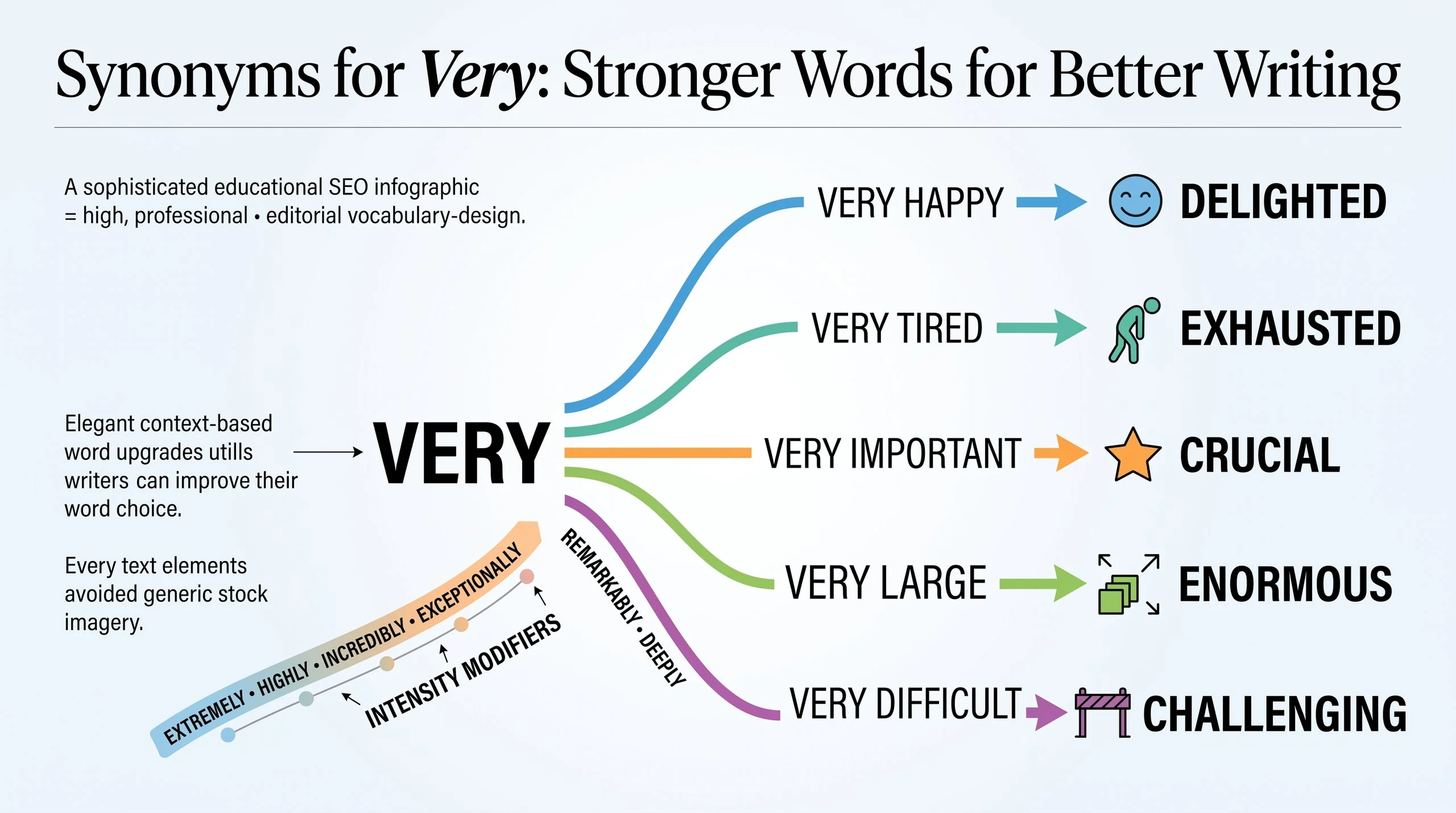
The best synonyms for very include extremely, highly, incredibly, exceptionally, remarkably, particularly, especially, deeply, truly, genuinely, immensely, intensely, profoundly, thoroughly, greatly, and absolutely. However, the strongest replacement often depends on the adjective that follows. For example, instead of “very happy,” you can write delighted, while “very tired” becomes exhausted.
What Does “Very” Mean?
Very is an adverb used to increase the intensity of an adjective or another adverb. It shows that something exists to a high degree.
For example:
- very happy = extremely happy
- very important = extremely important
- very large = extremely large
- very difficult = extremely difficult
However, repeating very too often can make writing feel weak or predictable. Therefore, choosing a more precise synonym can make your sentences clearer and more engaging.
Best Synonyms for Very
| Synonym | Meaning / Use | Tone | Difficulty | Frequency | Best For |
|---|---|---|---|---|---|
| Extremely | To a very high degree | Strong | Easy | Very Common | Formal & general writing |
| Highly | To a notably high degree | Formal | Easy | Common | Business & academic |
| Incredibly | To an unusually high degree | Emphatic | Easy | Very Common | General writing |
| Exceptionally | Beyond what is normal | Formal | Medium | Common | Professional writing |
| Remarkably | Noticeably or unusually | Polished | Medium | Common | Essays & reports |
| Particularly | To a notable degree | Neutral | Easy | Very Common | Academic writing |
| Especially | More than usual | Neutral | Easy | Very Common | Everyday writing |
| Deeply | With strong emotional intensity | Emotional | Easy | Common | Personal writing |
| Truly | Genuinely or sincerely | Neutral | Easy | Very Common | General writing |
| Genuinely | In a sincere or real way | Neutral | Easy | Common | Personal & professional |
| Immensely | To a great extent | Formal | Medium | Common | Formal writing |
| Intensely | With great strength | Strong | Medium | Common | Emotions & experiences |
| Profoundly | To a deep or significant degree | Formal | Advanced | Less Common | Academic writing |
| Thoroughly | Completely or fully | Neutral | Easy | Common | Actions & processes |
| Greatly | To a considerable degree | Formal | Easy | Common | Business & academic |
| Absolutely | Completely or without doubt | Strong | Easy | Very Common | Emphasis |
| Really | To a considerable degree | Casual | Easy | Very Common | Conversation |
| Totally | Completely | Casual | Easy | Common | Informal writing |
| Quite | To a fairly high degree | Neutral | Easy | Common | General writing |
| Utterly | Completely; often extreme | Strong | Medium | Common | Negative or dramatic contexts |
1. Extremely
Extremely is one of the closest and most useful synonyms for very. It indicates a particularly high degree of something.
Examples:
- The exam was extremely difficult.
- She is extremely talented.
- The weather became extremely cold.
For formal writing, extremely often sounds more precise than repeatedly using very.
2. Highly
Highly works especially well with words related to ability, quality, probability, or evaluation.
For example:
- He is a highly skilled engineer.
- This is a highly effective strategy.
- The book is highly recommended.
Unlike very, highly does not work naturally with every adjective. Therefore, use it where the combination sounds idiomatic.
3. Incredibly
Incredibly adds strong emphasis and often appears in conversational or expressive writing.
Examples include:
- The view was incredibly beautiful.
- She was incredibly helpful.
- The project became incredibly successful.
It sounds stronger and more expressive than ordinary very.
4. Exceptionally
Exceptionally suggests that something stands above the normal or expected level.
For example:
- She is an exceptionally talented writer.
- The hotel provided exceptionally good service.
- He showed exceptionally strong leadership.
As a result, this word works particularly well in professional and academic contexts.
5. Remarkably
Use remarkably when something deserves attention because it is unusual, impressive, or noticeable.
Examples:
- The patient recovered remarkably quickly.
- The company performed remarkably well.
- The device is remarkably efficient.
Moreover, remarkably can make analytical writing sound more polished.
6. Particularly
Particularly means to a notable or greater degree.
Examples:
- This lesson is particularly useful.
- The issue is particularly important.
- She was particularly interested in the topic.
It is especially useful when you want emphasis without sounding dramatic.
7. Especially
Especially highlights something as more significant than other things in the same group.
For example:
- I enjoy winter, especially the holidays.
- This advice is especially helpful for beginners.
- The restaurant is especially popular on weekends.
Therefore, especially often works better when you want to single out one item.
8. Deeply
Deeply usually describes strong emotions, beliefs, concerns, or personal reactions.
Examples:
- She was deeply concerned.
- He felt deeply grateful.
- They were deeply disappointed.
Instead of saying “very concerned,” deeply concerned sounds more natural and meaningful.
9. Truly
Truly emphasizes sincerity, genuineness, or strong quality.
Examples:
- She is truly remarkable.
- This was a truly memorable experience.
- I am truly grateful for your help.
Furthermore, it can add warmth without making the sentence overly dramatic.
10. Genuinely
Genuinely means sincerely or in a real way.
Examples:
- He was genuinely excited.
- She is genuinely interested in helping.
- The team was genuinely surprised.
This alternative works particularly well when the writer wants to emphasize authentic emotion.
11. Immensely
Immensely means to a very great degree.
Examples:
- The experience was immensely valuable.
- She was immensely proud of her achievement.
- The program has been immensely successful.
Because it sounds somewhat formal, immensely fits professional, academic, and polished writing.
12. Intensely
Intensely describes something experienced with great strength.
Examples:
- He felt intensely nervous.
- The debate was intensely competitive.
- She became intensely focused on the task.
Consequently, it works best with emotions, concentration, experiences, and strong conditions.
13. Profoundly
Profoundly means deeply or significantly. It is stronger and more formal than everyday very.
Examples:
- The experience was profoundly meaningful.
- The discovery profoundly changed the field.
- She was profoundly affected by the event.
This word is particularly suitable for academic, analytical, and serious writing.
14. Thoroughly
Thoroughly means completely or in a detailed manner.
Examples:
- Please read the instructions thoroughly.
- The team thoroughly reviewed the report.
- The room was thoroughly cleaned.
Unlike many synonyms for very, it often modifies verbs rather than adjectives.
15. Greatly
Greatly means to a considerable degree.
Examples:
- Your support is greatly appreciated.
- The changes greatly improved the process.
- His work greatly influenced the project.
As a result, greatly is a useful choice for professional and formal writing.
Stronger Alternatives to “Very + Adjective”
One of the best ways to avoid very is to replace the entire phrase with a stronger adjective.
| Instead of | Use |
|---|---|
| Very happy | Delighted |
| Very sad | Devastated |
| Very tired | Exhausted |
| Very angry | Furious |
| Very scared | Terrified |
| Very important | Crucial |
| Very good | Excellent |
| Very bad | Terrible |
| Very large | Enormous |
| Very small | Tiny |
| Very difficult | Challenging |
| Very easy | Effortless |
| Very beautiful | Gorgeous |
| Very ugly | Hideous |
| Very smart | Brilliant |
| Very fast | Rapid |
| Very slow | Sluggish |
| Very cold | Freezing |
| Very hot | Scorching |
| Very hungry | Starving |
| Very thirsty | Parched |
| Very funny | Hilarious |
| Very clean | Spotless |
| Very dirty | Filthy |
| Very old | Ancient |
| Very new | Brand-new |
| Very noisy | Deafening |
| Very quiet | Silent |
| Very strong | Powerful |
| Very weak | Feeble |
This approach usually produces stronger writing because the replacement communicates intensity directly.
Synonyms for “Very” in Different Contexts
Very in Formal Writing
For academic, business, or professional writing, consider:
- Extremely
- Highly
- Exceptionally
- Remarkably
- Particularly
- Significantly
- Substantially
- Profoundly
- Greatly
Example:
The new process is very effective.
Better:
The new process is highly effective.
Very in Casual Conversation
Everyday speech often uses:
- Really
- Extremely
- Incredibly
- Totally
- Absolutely
- So
- Quite
Example:
That movie was very funny.
Natural alternatives include:
That movie was really funny.
Or:
That movie was hilarious.
Very in Emotional Writing
When emotions are involved, more specific words often work better:
- Deeply
- Intensely
- Truly
- Genuinely
- Profoundly
- Incredibly
For example:
She was very disappointed.
A stronger version is:
She was deeply disappointed.
Very vs. Extremely
Both words increase intensity. However, extremely generally communicates a stronger degree.
- Very cold → strong cold
- Extremely cold → exceptionally high cold
Therefore, choose extremely when you want clear, powerful emphasis.
Very vs. Really
Really is common in casual speech, while very works across both casual and formal contexts.
Compare:
- She is very talented.
- She is really talented.
Both sound natural. However, really often feels more conversational.
Very vs. Highly
These words overlap, but their usage differs.
Very can modify many ordinary adjectives:
very happy
very cold
very tired
Highly works naturally with certain evaluative or ability-related adjectives:
highly effective
highly skilled
highly successful
highly respected
Therefore, do not automatically replace every instance of very with highly.
Very vs. Absolutely
Absolutely often means completely or without qualification.
Compare:
- very certain
- absolutely certain
The second phrase expresses a stronger sense of certainty.
Similarly:
- very perfect ❌
- absolutely perfect ✅
Some adjectives describe absolute states, so absolutely may fit better than very.
How to Choose the Right Synonym for Very
The best alternative depends on meaning, tone, and context.
| If You Want to… | Try… |
|---|---|
| Add strong intensity | Extremely |
| Sound professional | Highly |
| Emphasize something unusual | Remarkably |
| Highlight exceptional quality | Exceptionally |
| Show emotional depth | Deeply |
| Sound sincere | Truly |
| Emphasize authenticity | Genuinely |
| Show great scale | Immensely |
| Describe powerful emotion | Intensely |
| Sound academic | Profoundly |
| Emphasize completeness | Thoroughly |
| Sound conversational | Really |
| Express certainty | Absolutely |
Before and After: Replace “Very” in Your Writing
Example 1
Before:
The company has a very strong reputation.
After:
The company has a powerful reputation.
Example 2
Before:
She was very happy with the results.
After:
She was delighted with the results.
Example 3
Before:
The instructions were very clear.
After:
The instructions were crystal clear.
Example 4
Before:
The problem was very difficult.
After:
The problem was challenging.
Example 5
Before:
The building is very large.
After:
The building is enormous.
Notice how the second versions often communicate the exact meaning more efficiently.
Common Mistakes When Using Synonyms for Very
1. Choosing a Word That Does Not Fit
Not every synonym works with every adjective.
For example, deeply cold sounds unnatural in most contexts. Instead, use extremely cold or freezing.
2. Overusing Extremely
Replacing every instance of very with extremely does not solve repetition. Instead, vary your vocabulary according to context.
3. Ignoring Tone
Words such as profoundly and immensely can sound formal. Meanwhile, really and totally are more conversational.
4. Adding Unnecessary Intensifiers
Sometimes the strongest sentence removes the intensifier completely.
Instead of:
She was very exhausted.
Write:
She was exhausted.
The stronger adjective already expresses the intended intensity.
Synonym Analysis: Very
Word: Very
Part of Speech: Adverb
Core Function: Increases the degree or intensity of an adjective or adverb.
Best General Synonyms
Extremely, highly, incredibly, exceptionally, remarkably, particularly, especially, truly, deeply, immensely
Best Formal Alternatives
Highly, exceptionally, remarkably, significantly, substantially, profoundly, greatly
Best Casual Alternatives
Really, totally, so, incredibly, absolutely
Best Emotional Alternatives
Deeply, intensely, genuinely, profoundly, incredibly
Best Strategy
When possible, replace very + adjective with one precise adjective rather than simply replacing very.
Frequently Asked Questions
What is the best synonym for very?
Extremely is one of the closest general synonyms for very. However, the best choice depends on the sentence and the degree of emphasis you need.
What is a stronger word than very?
Words such as extremely, exceptionally, incredibly, immensely, and intensely can express stronger intensity. Alternatively, replace the complete phrase with a powerful adjective.
What can I use instead of very in formal writing?
Use highly, exceptionally, remarkably, significantly, substantially, profoundly, or greatly, depending on the sentence.
What is another word for very good?
Depending on the context, you can use excellent, outstanding, exceptional, superb, impressive, remarkable, or superior.
What is another word for very happy?
Useful alternatives include delighted, joyful, thrilled, ecstatic, elated, and overjoyed.
What is another word for very important?
Try crucial, essential, vital, critical, significant, or indispensable.
Is “really” a synonym for “very”?
Yes. Really can function as an intensifier similar to very, especially in conversational English. However, the two words do not work identically in every sentence.
How can I stop using “very” too much?
First, identify the adjective after very. Then, look for a more precise adjective that expresses the same intensity. For example, change very tired to exhausted or very large to enormous.
Key Takeaway
The best synonyms for very include extremely, highly, incredibly, exceptionally, remarkably, particularly, deeply, truly, genuinely, immensely, intensely, and profoundly. Still, the most effective approach is often to replace very + adjective with a stronger, more precise word.
For example, very happy becomes delighted, while very important becomes crucial. As a result, your writing becomes shorter, clearer, and more expressive.
Conclusion
Although very is useful and grammatically correct, repeated use can make writing feel less precise. Fortunately, English offers many alternatives that communicate different levels of intensity and tone.
For formal writing, choose words such as highly, exceptionally, remarkably, or profoundly. In everyday conversation, really and incredibly may sound more natural. Meanwhile, emotional contexts often benefit from deeply, intensely, or genuinely.
Most importantly, do not replace very mechanically. Instead, consider what you actually mean and choose the word that expresses that meaning most accurately.