Clean is one of those words we use constantly. It describes everything from freshly washed sheets to a spotless kitchen counter. It can refer to pure air, clear water, honest living, or even a well-designed piece of code.
If you’re looking for synonyms for clean, you’ve probably noticed that not every alternative works in every situation. Some words sound too formal. Others feel too casual. Some carry heavy emotional weight, while others are neutral and straightforward.
The best synonym for clean depends entirely on what you’re describing, who you’re talking to, and what tone you want to strike. This guide breaks down more than forty alternatives, explains their subtle differences, and shows you exactly when to use each one.
Best Synonyms for Clean
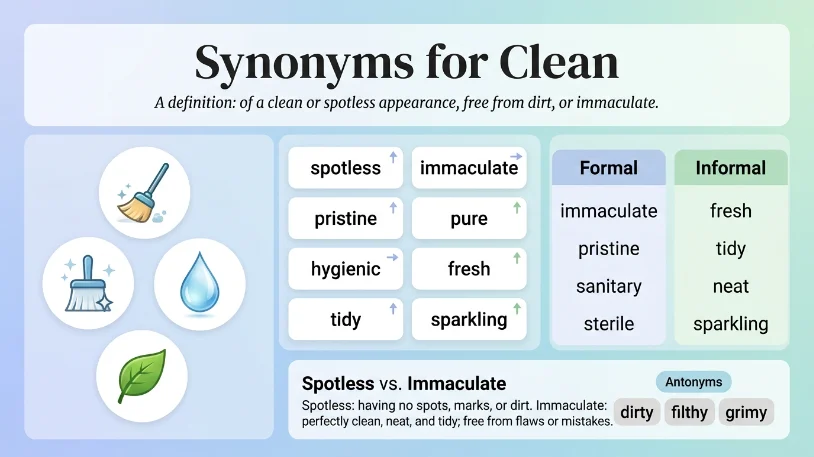
The best synonyms for clean are spotless, immaculate, pristine, pure, and hygienic. Choose spotless for surfaces, immaculate for presentation, pristine for natural beauty, pure for substances, and hygienic for health-related contexts.
What Does Clean Mean?
At its simplest, clean means free from dirt, marks, or unwanted substances. But the word carries multiple meanings depending on the context.
A clean surface has no visible grime or stains. Clean water contains no harmful contaminants. Clean living means avoiding unhealthy habits. A clean joke stays within polite boundaries.
Part of speech: Clean works as an adjective, verb, and adverb, though this guide focuses on the adjective form.
Core definition: Free from dirt, pollution, impurities, or anything that mars, stains, or contaminates.
Simple examples:
- The kitchen counters were clean after just ten minutes of wiping.
- She prefers clean, simple designs without unnecessary clutter.
Core Meaning of Clean
Clean describes a state of being unsoiled, unmarked, or free from what is unwanted. The word applies broadly to physical objects, abstract concepts, and even moral character.
Physical cleanliness involves removing visible dirt, dust, stains, and grime from surfaces, objects, or bodies. Hygienic cleanliness extends further to eliminate germs, bacteria, and harmful microorganisms.
Beyond the physical, clean can describe something that is free from corruption, dishonesty, or unethical behavior. A clean record means no criminal history. Clean energy comes from renewable sources without pollution. A clean design avoids unnecessary ornamentation.
The word also suggests orderliness and clarity. A clean room doesn’t just lack dirt—it often feels organized and uncluttered. Clean prose communicates ideas without unnecessary words. Clean code follows logical structure and avoids complexity for its own sake.
Grammar and Usage Notes
Clean functions primarily as an adjective, but it also serves as a verb and occasionally an adverb.
Adjective examples:
- She wore a clean white blouse.
- The apartment looked clean and inviting.
Verb examples:
- Please clean your room before dinner.
- He cleaned the windows until they sparkled.
Adverb example:
- The knife cut clean through the rope.
Common collocations and phrases:
- Clean slate
- Clean break
- Clean bill of health
- Clean sweep
- Come clean
- Clean cut
- Clean living
- Clean energy
When clean sounds natural:
Clean fits most everyday situations. It works for physical cleaning, general descriptions, and informal conversations. It feels natural in both spoken and written English.
When a synonym works better:
Consider alternatives when you need more precision, formality, or emotional impact. “Spotless” emphasizes complete absence of dirt. “Immaculate” suggests perfection. “Hygienic” highlights health benefits. “Pure” works for substances and moral qualities.
Best Synonyms for Clean
| Synonym | Meaning | Tone | Best Use Case | Example Sentence |
| Spotless | Completely free of any dirt or stains | Neutral to positive | Describing surfaces, homes, or clothing | The kitchen floor was spotless after mopping. |
| Immaculate | Perfectly clean and tidy with no flaws | Sophisticated, elevated | Formal descriptions, reviews, high standards | The hotel suite was immaculate. |
| Pristine | Clean and untouched in original condition | Elevated, descriptive | Natural settings, antiques, new items | The beach looked pristine after the storm. |
| Pure | Free from any contaminants or impurities | Formal, serious | Substances, air, water, moral contexts | The mountain stream provided pure drinking water. |
| Hygienic | Clean in a way that prevents disease | Practical, health-focused | Food prep, healthcare, public spaces | The restaurant maintained hygienic kitchen conditions. |
| Sanitary | Free from germs and infection-causing agents | Formal, health-related | Medical settings, food safety, public health | The clinic followed strict sanitary protocols. |
| Unsoiled | Not stained or dirtied | Neutral to formal | Fabrics, surfaces, white items | The tablecloth remained unsoiled throughout dinner. |
| Sterile | Completely free of all microorganisms | Medical, scientific | Surgery, laboratories, food processing | The instruments were sterile and ready for use. |
| Clear | Free from cloudiness or obstruction | Neutral | Liquids, glass, explanations, conscience | The lake water was so clear you could see the bottom. |
| Fresh | Clean in a renewed or pleasant way | Casual, positive | Laundry, air, produce, feeling | The sheets smelled fresh after drying in the sun. |
Common Synonyms for Clean
Spotless
Meaning: Completely clean with no marks, spots, or stains.
Best context: Describing surfaces, homes, or clothing after thorough cleaning.
Example: Her house stays spotless even with three kids and two dogs.
Immaculate
Meaning: Perfectly clean and tidy, with no visible flaws or imperfections.
Best context: High-end reviews, formal descriptions, or setting high standards.
Example: The caterers left the kitchen immaculate after the event.
Pristine
Meaning: Clean and in original, unspoiled condition.
Best context: Natural environments, antiques, or new items.
Example: The museum preserved the manuscript in pristine condition.
Pure
Meaning: Clean with no admixture of anything else.
Best context: Drinking water, air quality, ingredients, or moral integrity.
Example: This soap contains only pure, natural ingredients.
Hygienic
Meaning: Clean and protective against germs.
Best context: Food preparation, healthcare, public facilities.
Example: The school taught children proper hygienic handwashing practices.
Fresh
Meaning: Clean and pleasant in a newly cleaned or renewed way.
Best context: Laundry, air, produce, or describing a feeling.
Example: After the rain, the whole garden smelled fresh.
Clear
Meaning: Clean and transparent, free from cloudiness.
Best context: Liquids, glass, or explanations.
Example: The glass was so clear you could barely see it.
Unblemished
Meaning: Without marks, spots, or imperfections.
Best context: Surfaces, reputations, or records.
Example: The marble countertop remained unblemished after years of use.
Formal Synonyms for Clean
When writing academic papers, business reports, or professional communications, elevate your language with these formal alternatives.
Immaculate
Use immaculate when describing something that meets the highest standards of cleanliness and tidiness. It suggests perfection without visible flaws. This word works beautifully in hotel reviews, inspection reports, and professional recommendations.
Example: The laboratory maintained immaculate conditions for all experiments.
Pristine
Pristine conveys cleanliness combined with untouched, original quality. Use it for natural settings, preserved artifacts, or items in new condition. In business writing, it emphasizes quality and careful maintenance.
Example: The newly constructed facility featured pristine workstations.
Sanitary
Sanitary applies to conditions that protect public health. It signals professionalism in healthcare, food service, and facilities management. This word sounds more technical and formal than “clean.”
Example: The health department inspected the restaurant’s sanitary conditions.
Sterile
Sterile describes absolute cleanliness with no living germs. It’s the most technical and formal choice. Use it strictly for medical, scientific, or industrial contexts where contamination matters.
Example: Surgeons performed the procedure in a sterile operating room.
Unblemished
Unblemished suggests complete cleanliness without any marks or flaws. It works well in legal, business, and reputation contexts.
Example: The company maintained an unblemished safety record.
Pure
Pure conveys freedom from contaminants or corrupting elements. It fits formal contexts involving water quality, air standards, and ethical discussions.
Example: The pharmaceutical company required pure ingredients for its medications.
Informal Synonyms for Clean
For everyday conversations, texts, and social media, these casual alternatives sound natural and friendly.
Fresh
Fresh is the go-to informal choice for anything recently cleaned or renewed. It works for laundry, air, and even people who have just showered.
Example: The whole apartment smells fresh now that we’ve aired it out.
Spick-and-span
This playful phrase means clean and tidy. It has a cheerful, slightly old-fashioned feel that works in casual descriptions.
Example: The kids had the playroom spick-and-span in twenty minutes.
Sparkling
Sparkling suggests so clean that it shines. It feels enthusiastic and informal, perfect for describing windows, floors, or countertops.
Example: She scrubbed until the whole kitchen was sparkling.
Shipshape
This nautical-derived term describes a clean and orderly space. It sounds friendly and slightly humorous.
Example: The garage is finally shipshape after the weekend cleanup.
Tidy
Tidy emphasizes orderliness and neatness. It often pairs with clean in casual conversation.
Example: The office looked tidy when the CEO walked through.
Good as new
This phrase describes something cleaned so well that it seems brand new.
Example: The carpet looks good as new after professional cleaning.
Crisp
Crisp suggests clean and fresh with a feeling of sharpness or clarity.
Example: She wore a crisp white shirt to the interview.
Strong Synonyms for Clean
Some synonyms carry extra emotional weight, intensity, or emphasis. Use these when you want to make a powerful impression or when simple “clean” doesn’t capture the full meaning.
Immaculate
Beyond mere cleanliness, immaculate suggests absolute perfection. It conveys not just clean but flawless. Use it when impressing readers with exceptional standards.
Example: The Michelin-starred restaurant maintained immaculate kitchen conditions.
Spotless
Spotless is a powerful choice that emphasizes complete absence of any stain. It leaves no room for compromise.
Example: After hours of scrubbing, the bathtub was spotless.
Pristine
Pristine goes beyond clean to describe something in its original, untouched state. This word packs emotional resonance for natural environments or rare artifacts.
Example: The diver explored pristine coral reefs untouched by pollution.
Sterile
Sterile communicates absolute cleanliness on a scientific level. It feels serious and absolute, with no room for error.
Example: The laboratory required sterile conditions for all biological testing.
Unblemished
Unblemished emphasizes absence of any marks or imperfections. It works powerfully for reputations and records.
Example: His unblemished record earned him the promotion.
Mild Synonyms for Clean
For gentle, neutral, or softer descriptions, choose these milder alternatives.
Tidy
Tidy focuses more on orderliness than cleanliness. It suggests neatness without necessarily emphasizing dirt removal. This is a safer, gentler choice.
Example: She kept a tidy desk with everything in its place.
Neat
Neat means clean, orderly, and well-arranged. It’s softer than “spotless” and works for everyday situations.
Example: The guest room was clean and neat when they arrived.
Clear
Clear suggests cleanliness without visible cloudiness or obstruction. It works gently for liquids and explanations.
Example: The water in the vase remained clear all week.
Fresh
Fresh provides a mild, pleasant feeling of cleanliness without overstatement.
Example: The linens smelled fresh from the closet.
Presentable
Presentable means clean enough to appear in public or host guests. It’s a humble, realistic choice.
Example: The apartment was presentable in case the landlord stopped by.
Decent
Decent suggests acceptable or satisfactory levels of cleanliness.
Example: The hotel room was clean and decent enough for our stay.
Synonyms for Clean by Context
Everyday Conversation
In daily speech, simple words work best. Fresh, tidy, sparkling, and spotless feel natural without sounding forced. Neat also fits well for describing organized spaces.
Example: The kids finally cleaned their rooms, and they actually look tidy.
Professional Writing
Business and workplace writing require more polished choices. Immaculate, pristine, and sanitary convey professionalism. Use hygienic for health or food contexts. Unblemished works for records and reputations.
Example: The annual inspection confirmed the facility met all sanitary guidelines.
Academic Writing
Scholarly work demands precision and formality. Sterile and sanitary fit scientific contexts. Pure works for substances. Immaculate and pristine work for descriptions requiring sophisticated vocabulary.
Example: The researchers maintained sterile conditions throughout the experiment.
Creative Writing
For fiction, poetry, and creative nonfiction, choose emotionally rich synonyms. Pristine paints vivid natural scenes. Immaculate describes characters or settings with perfection. Spotless creates concrete imagery. Sparkling adds brightness to descriptions.
Example: The morning light revealed a pristine landscape untouched by human hands.
Marketing Copy
Advertising benefits from strong, sensory words. Sparkling, fresh, and spotless attract attention. Pristine suggests luxury and quality. Good as new promises restoration. Hygienic builds trust in health products.
Example: Enjoy the fresh, clean feel of our hypoallergenic laundry sheets.
Emotional Expression
For describing how cleanliness feels, choose subjective words. Fresh implies renewal. Pure suggests moral or spiritual cleanliness. Clear suggests mental clarity or peace of mind.
Example: After meditating, his mind felt clear and focused.
Technical Writing
Precision matters in technical documentation. Sterile and hygienic have exact meanings in medical writing. Contaminant-free and purified work for industrial contexts. Unblemished describes flawless surfaces or materials.
Example: Use sterile equipment to prevent cross-contamination during the procedure.
Another Word for Clean in a Sentence
These example sentences show how different synonyms replace “clean” naturally in realistic contexts.
- The windows were spotless after the professional cleaning crew finished.
- She presented an immaculate white tablecloth for the formal dinner.
- The mountain trail led to a pristine alpine lake.
- The water filtration system produced pure drinking water.
- The restaurant passed inspection for hygienic food preparation practices.
- Hospital staff followed sanitary procedures in all patient rooms.
- The freshly laundered towels smelled fresh and inviting.
- The newly renovated kitchen featured sparkling granite countertops.
- The surgeon prepared the sterile instruments carefully.
- He maintained an unblemished professional record for twenty years.
- The glass table was so clear you could barely see it.
- The cabin was tidy and ready for the weekend guests.
- She arranged the neat stacks of papers on her desk.
- The antique furniture remained in pristine condition.
- After the deep clean, the carpets looked good as new.
Clean Synonyms Compared
Spotless vs. Immaculate
Both words describe high-level cleanliness, but they differ in nuance. Spotless focuses on absence of visible marks or stains. Immaculate suggests absolute perfection with no flaws at all.
Spotless example: The bathroom floor was spotless after scrubbing.
Immaculate example: The bride wore an immaculate white gown.
Pristine vs. Pure
Pristine describes clean, untouched natural or original states. Pure means free from admixture or contamination.
Pristine example: The forest remained pristine without human interference.
Pure example: The lab uses 100% pure distilled water.
Hygienic vs. Sanitary
Hygienic focuses on cleanliness practices that promote health. Sanitary emphasizes preventing disease by eliminating germs and bacteria. They’re often used interchangeably but have slightly different technical connotations.
Hygienic example: The bakery maintains hygienic food handling protocols.
Sanitary example: The public restrooms met all sanitary requirements.
Fresh vs. Clean
Fresh suggests renewal, pleasantness, and a recently cleaned state. Clean simply describes absence of dirt.
Fresh example: The air after the storm smelled fresh and clean.
Clean example: The closet was clean but cluttered.
Words Similar to Clean
Neat
Neat means clean and orderly. While it’s often paired with clean, neat focuses on arrangement and tidiness rather than dirt removal.
When to use: For organized, tidy spaces or appearance.
Why it may not replace clean: A space can be neat without being clean.
Tidy
Tidy resembles neat in emphasizing order and organization. It’s a related concept but not an exact synonym for cleanliness.
When to use: Describing organized rooms or habits.
Why it may not replace clean: Tidy spaces can still contain dirt or germs.
Sharp
In fashion or design contexts, “sharp” can mean clean, stylish, and well-defined. It’s related but not interchangeable for all uses of clean.
When to use: Describing clothing, hairstyles, or design.
Why it may not replace clean: Sharp implies style and precision, not dirt absence.
Sleek
Sleek describes clean, smooth, and streamlined surfaces. It works for cars, phones, and modern design.
When to use: Describing modern products or surfaces.
Why it may not replace clean: Sleek implies design elegance, not necessarily cleanliness.
Clear
Clear describes transparency or freedom from obstruction. It relates to clean in contexts involving water, glass, or explanations.
When to use: Describing liquids, glass, vision, or understanding.
Why it may not replace clean: Clear doesn’t mean free from dirt, only free from cloudiness.
Fair
In the context of skin or complexion, “fair” means clean and light. However, this usage is specific and doesn’t replace clean generally.
When to use: Describing skin complexion.
Why it may not replace clean: Fair refers to skin tone, not cleanliness.
Antonyms of Clean
| Antonym | Meaning | Example Sentence |
| Dirty | Covered or marked with dirt | The kitchen floor was dirty after the cooking session. |
| Filthy | Extremely dirty and unpleasant | The abandoned building was filthy with trash everywhere. |
| Grimy | Covered with ingrained dirt or soot | His hands were grimy from working on the car engine. |
| Stained | Marked with a stain or discoloration | The tablecloth was stained with red wine. |
| Soiled | Dirty or defiled by contact with something unclean | The napkin was soiled from the greasy meal. |
| Polluted | Contaminated with harmful substances | The river was polluted with industrial chemicals. |
| Contaminated | Made impure by exposure to harmful substances | The water was contaminated with bacteria. |
| Unsanitary | Not clean enough to protect health | The restaurant was closed for unsanitary conditions. |
| Tainted | Contaminated or infected | The food was tainted with salmonella. |
| Sullied | Made dirty or tarnished | The white sheets were sullied by the mud. |
How to Choose the Right Synonym for Clean
Match the Context
Think about what you’re describing. Surfaces need words like spotless or sparkling. Health contexts call for hygienic or sanitary. Natural settings fit pristine or pure.
Match the Tone
Formal writing demands polished words like immaculate or sterile. Casual conversations work best with fresh, neat, or sparkling. Marketing copy benefits from strong, sensory options.
Check the Intensity
Ask yourself how clean you mean. Spotless and immaculate mean extremely clean. Tidy and neat mean moderately clean. Fresh suggests pleasantness more than deep cleaning.
Think About Your Reader
Consider who will read your writing. Professionals and academics expect formal vocabulary. Friends and family appreciate casual language. Marketing copy should excite and persuade.
Test the Fit
Try replacing “clean” with your chosen synonym. Does the sentence sound natural? Does the meaning stay accurate? Does the tone match the rest of the text?
Keep It Natural
Avoid forcing uncommon words where simple ones work. “Fresh” often fits better than “pristine” in everyday contexts. Choose the word that feels most natural for your situation.
Common Mistakes When Using Synonyms for Clean
Choosing the Wrong Tone
Using sterile for a casual conversation sounds stiff and overly technical. Using neat for a hospital operating room seems understated and inaccurate.
Using a Word That’s Too Strong
Immaculate might sound exaggerated for a moderately clean room. Sterile implies absolute germ-free conditions that rarely exist outside medical settings.
Using a Word That’s Too Mild
Tidy doesn’t capture the degree of cleaning in “The kitchen is spotless.” Neat focuses on organization, not actual dirt removal.
Using a Formal Word Casually
“Her new car is immaculate” sounds overly dramatic. “Her new car is clean” sounds more natural. Save formal synonyms for appropriate settings.
Using a Casual Word Formally
“She maintained sterile conditions” works in medical contexts. But “She maintained fresh conditions” sounds vague and inappropriate for a surgical setting.
Treating Related Words as Exact Synonyms
Neat doesn’t mean clean. Sleek doesn’t imply cleanliness. Clear doesn’t always mean dirt-free. Understand the distinction before replacing clean with related words.
Forcing Synonyms into Unnatural Sentences
Don’t sacrifice readability for variety. If “clean” fits perfectly, use it. Forced synonyms make writing awkward and confuse readers.
Quick Synonym List for Clean
Common Synonyms
- Spotless
- Immaculate
- Pristine
- Pure
- Fresh
- Tidy
- Neat
- Sparkling
- Clear
- Good as new
Formal Synonyms
- Immaculate
- Pristine
- Sanitary
- Sterile
- Unblemished
- Pure
- Unsoiled
- Hygienic
Informal Synonyms
- Fresh
- Tidy
- Neat
- Sparkling
- Crisp
- Spick-and-span
- Shipshape
- Good as new
Strong Synonyms
- Immaculate
- Spotless
- Pristine
- Sterile
- Unblemished
- Sparkling
Mild Synonyms
- Tidy
- Neat
- Clear
- Fresh
- Presentable
- Decent
Related Words
- Neat
- Tidy
- Sleek
- Sharp
- Clear
- Fair
FAQs
What is the best synonym for clean?
The best synonym depends on context. Spotless works for surfaces, immaculate for perfection, pristine for natural states, pure for substances, and hygienic for health contexts. Choose the word that matches your specific situation.
What is another word for clean?
Common alternatives include spotless, immaculate, pristine, fresh, tidy, neat, and pure. Formal choices include sanitary and sterile. Informal options include sparkling and spick-and-span.
What is a formal synonym for clean?
Immaculate, pristine, sanitary, sterile, and pure serve as formal alternatives. Use these in academic, professional, or scientific writing to elevate your vocabulary and maintain a polished tone.
What is an informal synonym for clean?
Fresh, tidy, neat, sparkling, and spick-and-span work well for casual conversations and informal writing. These choices feel natural and approachable in everyday contexts.
What is a stronger word for clean?
Immaculate, spotless, pristine, and sterile carry extra emphasis. These words suggest exceptional cleanliness beyond the ordinary. Use them when you want to make a powerful impression.
What is a milder word for clean?
Tidy, neat, presentable, and decent offer gentler alternatives. These words suggest cleanliness without overstatement. They work well for moderate descriptions.
What words are similar to clean?
Neat, tidy, sleek, sharp, and clear relate to clean but aren’t exact synonyms. Neat and tidy focus on order. Sleek suggests polished surfaces. Sharp describes stylish appearance. Clear means transparent or unobstructed.
What is the opposite of clean?
Primary antonyms include dirty, filthy, grimy, and soiled. Other opposites are polluted, contaminated, and stained. These words describe various states of uncleanliness.
How do I choose the right synonym for clean?
Match the context, tone, and intensity. Consider your reader and the purpose of your writing. Test the synonym in your sentence to check for natural flow. When in doubt, “clean” itself usually works perfectly well.
Conclusion
Clean is a wonderfully versatile word that fits countless situations. Sometimes, however, you need a more precise term. Spotless emphasizes the absence of stains. Immaculate suggests flawless perfection. Pristine evokes untouched natural beauty. Pure communicates freedom from contamination. Hygienic addresses health and safety.
The right synonym depends on your subject, your audience, and the impression you want to make. Academic writing calls for formal choices like sterile and sanitary. Casual conversations welcome fresh and tidy. Strong emotions demand stronger words like immaculate and spotless. Gentle descriptions prefer milder terms like neat and presentable.
Ultimately, choosing the best word means thinking carefully about context and meaning. The simplest choice often works best. But when you need extra precision or nuance, this guide gives you the tools to find the perfect synonym.