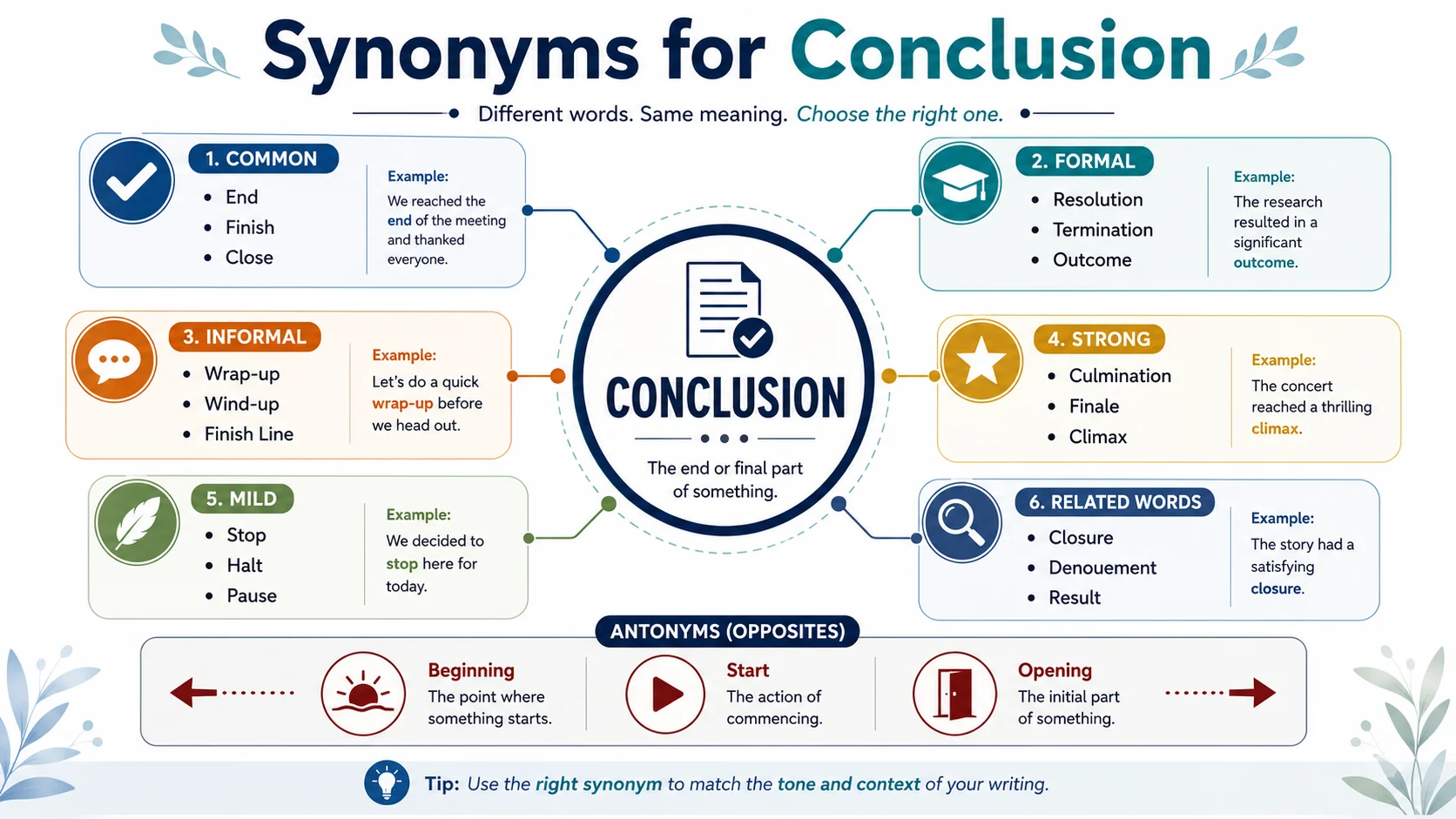
When you’re wrapping up an idea, finishing a presentation, or ending a piece of writing, the word “conclusion” often comes to mind. But sometimes it feels repetitive, too formal, or not quite right for the situation. That’s where knowing good synonyms for conclusion becomes useful.
The best synonyms for conclusion are ending, close, finale, resolution, and wrap-up. The right choice depends entirely on your tone, audience, and the specific context. Whether you need a formal term for an academic paper, a casual word for conversation, or a stronger alternative for emotional impact, there’s a perfect word waiting to be used.
Best Synonyms for Conclusion
The best synonyms for conclusion are ending, close, finale, resolution, wrap-up, and termination. Choose “ending” for general use, “resolution” when solving a problem, “finale” for creative works, “wrap-up” for casual settings, and “termination” for formal or legal contexts. Each carries a slightly different shade of meaning.
What Does Conclusion Mean?
A conclusion is the final part of something the point where an event, process, piece of writing, or line of reasoning comes to an end. It represents the last stage or the outcome that follows from everything that came before.
Part of speech: Noun
Simple definition: The end or final part of something; a judgment or decision reached after consideration.
Common usage: People use “conclusion” to refer to the final section of essays, speeches, reports, and presentations, as well as the outcome of events, investigations, or arguments.
Example sentences:
- The professor asked everyone to write a strong conclusion for their research papers.
- After reviewing all the evidence, the detective reached a surprising conclusion.
Core Meaning of Conclusion
At its heart, the word “conclusion” carries two related but distinct ideas. First, it means the final point of something the natural stopping place where everything comes together. This could be the last paragraph of an article, the final scene of a movie, or the closing moments of a speech.
Second, “conclusion” refers to a judgment or decision formed after careful thought. When you examine facts, weigh options, or analyze a situation, the conclusion is the understanding you reach at the end of that process.
These two meanings often overlap. A well-written essay conclusion, for example, doesn’t just stop; it also offers a final judgment about the topic. Understanding this dual nature helps explain why so many different synonyms for conclusion exist each one highlights a slightly different aspect of what it means to end or decide.
Grammar and Usage Notes
Part of speech: Noun (countable and uncountable)
Common sentence patterns:
- “In conclusion,…” (used to introduce final remarks)
- “The conclusion of [something]…” (referring to the ending of an event)
- “Reach/come to a conclusion” (arrive at a decision)
- “Draw a conclusion” (make an inference)
- “Jump to a conclusion” (make a hasty decision)
Common collocations:
- Bring to a conclusion
- Come to a conclusion
- Draw a conclusion
- Reach a conclusion
- In conclusion
- Foregone conclusion
- Logical conclusion
When “conclusion” sounds natural:
- Academic and professional writing
- Formal speeches and presentations
- Discussions about research, investigations, or arguments
- References to the ending of events or processes
When a synonym may work better:
- Creative writing often benefits from more vivid alternatives like “finale” or “denouement”
- Casual conversations call for simpler words like “end” or “wrap-up”
- Legal or business contexts sometimes prefer “termination” or “resolution”
- Emotional situations might need stronger words like “culmination”
Best Synonyms for Conclusion
| Synonym | Meaning | Tone | Best Use Case | Example Sentence |
|---|---|---|---|---|
| Ending | The final part of something | Neutral | General use, everyday writing | The movie had a satisfying ending. |
| Close | The conclusion or finish | Neutral to formal | Events, meetings, business | The project is now drawing to a close. |
| Finale | The grand or climactic ending | Expressive | Creative works, performances | The orchestra’s finale brought the audience to its feet. |
| Resolution | The solution or final outcome | Formal | Problem-solving, conflicts | The conflict reached a peaceful resolution. |
| Wrap-up | A final summary or finish | Informal | Casual situations, meetings | Let’s do a quick wrap-up of today’s discussion. |
| Termination | The act of ending | Formal | Legal, business, official | The contract requires termination notice. |
| Culmination | The highest or final point | Formal | Climactic moments, achievements | This victory was the culmination of years of training. |
| Denouement | The final resolution in a story | Literary | Creative writing, storytelling | The novel’s denouement surprised everyone. |
| Closure | A sense of final resolution | Emotional | Personal situations, emotional contexts | She finally found closure after the difficult breakup. |
| Completion | The state of being finished | Neutral | Tasks, projects, processes | We’re celebrating the completion of the project. |
Common Synonyms for Conclusion
These everyday synonyms work in most writing and conversation situations. They’re familiar, easy to understand, and appropriate for general use.
End
The simplest and most direct synonym. “End” works in almost any context and is the safest choice when you need a straightforward alternative.
Best context: General writing, conversation, anything where clarity matters most.
Example: At the end of the presentation, she opened the floor for questions.
Finish
“Finish” emphasizes completion, often with a sense of accomplishment or reaching a goal. It carries a slightly more active feeling than “end.”
Best context: Tasks, projects, races, processes.
Example: The finish of the marathon was emotional for all the runners.
Close
“Close” suggests something drawing to a natural end, often with a sense of completeness. It works well in professional and formal settings.
Best context: Meetings, deals, events, business discussions.
Example: The sale brought the negotiations to a close.
Final Part
A straightforward phrase that describes the concluding portion of something. It’s neutral and works in almost any context.
Best context: Writing, speeches, processes.
Example: The final part of the book ties together all the characters’ stories.
Last Part
Similar to “final part,” but slightly more casual. This option works best in conversation and informal writing.
Best context: Conversations, friendly writing, informal descriptions.
Example: The last part of the documentary was the most moving.
Formal Synonyms for Conclusion
When writing academic papers, business reports, legal documents, or professional communications, these formal alternatives add polish and precision.
Termination
A highly formal word that suggests an official or definitive ending. It often appears in legal, business, and professional contexts.
Best use: Legal documents, contracts, official announcements, business writing.
Example: The company announced the termination of the employment agreement.
Resolution
“Resolution” emphasizes the solution aspect of a conclusion the final outcome after a process of discussion, negotiation, or problem-solving.
Best use: Conflict resolution, business decisions, academic discussions, policy matters.
Example: The board reached a resolution after three hours of discussion.
Cessation
This formal word means a stopping or ceasing of something. It’s more clinical and less emotional than other options.
Best use: Medical contexts, formal reports, discussions about activities stopping.
Example: The cessation of hostilities was announced at dawn.
Determination
“Determination” refers to a decision reached after careful consideration. It emphasizes the judgment aspect of a conclusion.
Best use: Legal decisions, scientific findings, policy determinations.
Example: The court’s determination set a new legal precedent.
Judgment
A formal term for a conclusion reached after evaluating evidence or considering arguments. It’s especially common in legal, academic, and professional settings.
Best use: Legal contexts, academic analysis, professional evaluations.
Example: The panel’s judgment was based on extensive research.
Outcome
“Outcome” emphasizes the result or consequence of a process. It’s a neutral, professional word suitable for many formal contexts.
Best use: Business reports, academic papers, strategic planning.
Example: The outcome of the study surprised the research team.
Finalization
This formal noun refers to the act of completing or making something final. It’s useful in project management and professional settings.
Best use: Project management, business processes, legal matters.
Example: The finalization of the contract took three months.
Denouement
Though originally from French literature, “denouement” has become a formal English word used primarily in literary analysis and creative writing. It describes the final resolution of a story’s plot.
Best use: Literary criticism, academic writing about stories, creative writing.
Example: The denouement of the mystery novel revealed the detective’s brilliant deduction.
Informal Synonyms for Conclusion
These casual alternatives work well in conversation, friendly writing, social media posts, and personal messages. They’re approachable and don’t sound stiff or overly formal.
Wrap-Up
A friendly, conversational word for a final summary or ending. It’s common in meetings, classes, and casual writing.
Best use: Team meetings, social media posts, friendly writing, conversations.
Example: At the wrap-up of the conference, everyone shared their key takeaways.
Wind-Up
This informal word describes the final part of an event or process. It’s more common in British English but widely understood in US English.
Best use: Casual conversations, informal writing, descriptions of events.
Example: The wind-up of the charity event included a heartfelt speech.
Finish Line
A metaphorical term borrowed from racing. It suggests reaching the final point of something, often with a sense of accomplishment.
Best use: Projects, goals, personal achievements, motivational contexts.
Example: We’re finally approaching the finish line on this project.
Last Leg
This casual phrase describes the final portion of a journey or process. It’s friendly and slightly idiomatic.
Best use: Travel, projects, events, any ongoing process.
Example: We’re on the last leg of our home renovation.
End of the Road
A metaphorical phrase meaning the final conclusion or limit of something. It can sound final or even slightly dramatic.
Best use: Personal situations, informal writing, storytelling.
Example: We reached the end of the road in our negotiations.
Strong Synonyms for Conclusion
These alternatives carry more weight, emotion, or intensity than the neutral “conclusion.” Use them when you want to emphasize significance or drama.
Culmination
This powerful word means the highest or final point of something, especially after a long process. It suggests achievement, peak, and significance.
Best use: Accomplishments, achievements, dramatic moments, narratives.
Example: Winning the championship was the culmination of her entire athletic career.
Climax
“Climax” refers to the most intense or exciting point in a story, event, or process. While it often comes near the end, it’s not exactly the same as the conclusion it’s the peak moment.
Best use: Stories, events, performances, dramatic situations.
Example: The trial’s climax came when the surprise witness testified.
Finale
A theatrical and expressive word for a grand or impressive ending. It’s perfect for creative works, performances, and any conclusion that deserves fanfare.
Best use: Performances, creative writing, celebrations, entertainment.
Example: The fireworks finale lit up the night sky.
Completion
“Completion” suggests finishing something fully and thoroughly. It carries a sense of accomplishment and satisfaction.
Best use: Projects, tasks, goals, achievements.
Example: The completion of the bridge marked a major milestone.
Fruition
This word means the realization or achievement of something after work or effort. It’s often used with “come to” and carries a sense of fulfillment.
Best use: Goals, dreams, plans, projects.
Example: Years of research finally came to fruition.
Consummation
A formal word for the final achievement or completion of something, often with a sense of perfection or fulfillment. It can sound quite literary or ceremonial.
Best use: Formal writing, literary contexts, ceremonial occasions.
Example: The consummation of the peace treaty brought hope to the region.
Mild Synonyms for Conclusion
When a softer, gentler, or more neutral word is appropriate, these mild alternatives work well. They’re less forceful than “conclusion” and often feel more approachable.
Stop
A simple, neutral word for an ending. It’s direct and clear without any emotional weight.
Best use: Processes, actions, simple statements.
Example: We came to a stop after a long day of travel.
Halt
Slightly more formal than “stop,” “halt” suggests a temporary or definitive stopping point. It’s neutral but slightly more emphatic.
Best use: Processes, activities, official statements.
Example: The negotiations came to a halt unexpectedly.
Pause
While a pause is technically a temporary stop, it can serve as a mild alternative for a brief conclusion or a stopping point.
Best use: Conversations, processes, moments of reflection.
Example: The meeting reached a natural pause before the next agenda item.
Stopping Point
A casual phrase that describes where something ends or pauses. It’s friendly and unpretentious.
Best use: Conversations, informal writing, project discussions.
Example: We’ll work until this stopping point and continue tomorrow.
Synonyms for Conclusion by Context
The right synonym depends heavily on where and how you’re using it. Here’s how to choose based on your specific context.
Everyday Conversation
In casual conversation, keep it simple and friendly. “End,” “wrap-up,” and “finish” work best. You might also use “last part” or “stopping point” for clarity.
Best choices: End, wrap-up, finish, last part, stopping point
Professional Writing
In business and professional contexts, choose words that sound competent and clear. “Resolution,” “outcome,” “close,” and “termination” all fit well. Avoid overly casual words like “wrap-up” in formal documents.
Best choices: Resolution, outcome, close, termination, finalization
Academic Writing
Academic writing demands precision and formality. “Judgment,” “determination,” “conclusion” itself, and “denouement” (for literary analysis) work well.
Best choices: Judgment, determination, resolution, outcome
Creative Writing
Creative writing offers the most flexibility. Use vivid alternatives like “finale,” “denouement,” “climax,” “culmination,” and “finish” to add color and emotion.
Best choices: Finale, denouement, culmination, climax, resolution
Marketing Copy
Marketing writing needs to be compelling and clear. “Close,” “wrap-up,” “finish line,” and “completion” all work well, depending on your tone.
Best choices: Close, wrap-up, finish line, completion, outcome
Emotional Expression
When writing about personal matters or emotional situations, choose words that carry appropriate feeling. “Closure” and “culmination” work well for significant moments.
Best choices: Closure, culmination, resolution, finish
Technical Writing
Technical and scientific writing values precision. Stick with neutral, clear terms like “end,” “termination,” “completion,” and “outcome.”
Best choices: Termination, completion, outcome, end, cessation
Personal Communication
In personal messages, friendly notes, and social media, choose approachable words that sound like you. “Wrap-up,” “finish,” “end,” and “last part” all work well.
Best choices: Wrap-up, finish, end, last leg, stopping point
Another Word for Conclusion in a Sentence
Here are realistic examples showing how different synonyms for conclusion work in various sentences:
- After three weeks of negotiations, the deal finally reached a close.
- The professor’s lecture came to a natural ending right at the bell.
- The movie’s dramatic finale left everyone in the theater breathless.
- Years of therapy gave her the closure she needed to move forward.
- The culmination of their efforts was a successful product launch.
- His hasty judgment proved incorrect after more evidence appeared.
- The contract’s termination clause allowed either party to end the agreement.
- We’re planning a celebration at the completion of the construction project.
- The unexpected denouement caught even the most careful readers by surprise.
- Let’s do a quick wrap-up before everyone leaves the meeting.
- The resolution of the conflict required compromise from both sides.
- The trial reached its climax when the defendant took the stand.
- The committee’s determination set new standards for the industry.
- The last outcome of the experiment confirmed their hypothesis.
- After years of planning, her dream finally came to fruition.
Conclusion Synonyms Compared
Some synonyms are so similar that choosing between them can be tricky. Here’s how to tell them apart:
End vs. Conclusion
“End” is the broader, more neutral term. It simply means the final point of something and works in almost any context. “Conclusion” carries more weight it suggests a deliberate stopping point, often with a sense of resolution or judgment. Use “end” when you want simplicity, and “conclusion” when you want to sound more thoughtful or formal.
Resolution vs. Conclusion
“Resolution” emphasizes solving a problem or settling a conflict. It’s the outcome after something was unclear or disputed. “Conclusion” can refer to any ending, not just one that resolves a problem. Use “resolution” when you want to highlight the solution aspect.
Finale vs. Conclusion
“Finale” is theatrical and dramatic. It suggests a grand, impressive ending designed for effect. “Conclusion” is neutral and works in any setting. Use “finale” for creative works, performances, and any ending that deserves fanfare.
Closure vs. Conclusion
“Closure” carries emotional weight. It means a sense of final resolution that brings peace or acceptance. “Conclusion” is neutral and can be purely factual. Use “closure” when the ending involves emotional or personal significance.
Culmination vs. Conclusion
“Culmination” suggests a peak or high point reached after a process. It’s more elevated and significant than “conclusion.” Use “culmination” when the ending represents the highest achievement or most important moment.
Words Similar to Conclusion
These words belong to the same semantic family as “conclusion” but aren’t exact synonyms. They capture related concepts and can sometimes work as alternatives.
Finale
A dramatic, impressive ending, especially for performances or creative works. While similar to “conclusion,” “finale” always carries a sense of showmanship and significance.
Denouement
The final resolution of a story’s plot, specifically in literary contexts. It’s a more specialized word than “conclusion” and belongs primarily in discussions about fiction.
Outcome
The result or consequence of an event or process. “Outcome” focuses more on what happened at the end rather than the ending itself. It’s related but not always interchangeable with “conclusion.”
Result
Similar to “outcome,” “result” emphasizes what came from a process. It’s narrower than “conclusion” and doesn’t necessarily imply an ending.
Decision
A choice made after consideration. While a conclusion can be a decision, “decision” focuses on the choosing rather than the final point of something.
Judgment
A conclusion reached after evaluating evidence. It’s a type of conclusion but specifically one that involves evaluation and assessment.
Final Thought
A last idea or observation, especially in writing. It’s a closing remark rather than the entire conclusion.
Closing Statement
The final remarks in a speech, argument, or presentation. It’s a specific type of conclusion.
Consequence
The result of an action or condition. It’s related to conclusions but focuses on results rather than endings.
When to use these similar words: These alternatives work when “conclusion” feels too broad or when you want to emphasize a specific aspect of the ending whether it’s the dramatic quality, the solution, the result, or the final impression.
Antonyms of Conclusion
Understanding what “conclusion” means also means understanding what it isn’t. Here are its common opposites:
Beginning
Meaning: The first part or starting point of something.
Example: The beginning of the project went smoothly, but the conclusion was challenging.
Start
Meaning: The point where something begins.
Example: Every start has a conclusion, and every conclusion has a start.
Opening
Meaning: The initial part of an event, speech, or process.
Example: The opening of the presentation set the tone for the conclusion.
Origin
Meaning: The source or starting point.
Example: The origin of the tradition is as important as its conclusion.
Initiation
Meaning: The act of beginning or starting something.
Example: The initiation of the program led to its eventual conclusion.
Commencement
Meaning: The beginning or start, often of a formal event.
Example: The commencement ceremony marked the beginning, not the conclusion, of their careers.
How to Choose the Right Synonym for Conclusion
Picking the perfect synonym doesn’t have to be complicated. Here’s a simple process to follow:
Match the Context
Start by considering where you’re writing. Academic papers demand different language than social media posts. Business reports need different words than personal letters. Let your context guide your choice.
Match the Tone
Think about how you want to sound. Formal words like “termination” and “determination” project professionalism. Casual words like “wrap-up” and “finish line” sound friendly and approachable. Vivid words like “culmination” and “finale” add drama and emotion.
Check the Intensity
Consider how much emphasis you need. Strong words like “culmination” and “consummation” carry weight. Neutral words like “end” and “finish” work for simple statements. Mild words like “pause” and “stop” are softer alternatives.
Think About the Reader
Who’s reading your writing? Experts may appreciate precise terms like “denouement.” General readers need simpler words like “ending.” Tailor your choice to what your audience will understand and appreciate.
Test the Exactness
Is the synonym an exact replacement or just similar? Words like “end” and “close” are true synonyms. Words like “outcome” and “result” are related but not exact replacements. Make sure you’re using a word that actually fits the meaning you need.
Keep It Natural
The best word is the one that sounds natural in your sentence. If a synonym feels forced, awkward, or out of place, try a different one. Naturalness beats fancy vocabulary every time.
Prioritize Clarity
When in doubt, choose the simpler word. “End” is almost always clear and correct. Fancy alternatives can impress, but they can also confuse. Clarity should never be sacrificed for variety.
Common Mistakes When Using Synonyms for Conclusion
Even experienced writers sometimes make errors when choosing synonyms. Here are the most common pitfalls to avoid:
Choosing the Wrong Tone
Using “termination” in a friendly email sounds cold and harsh. Using “wrap-up” in an academic paper sounds unprofessional. Match the tone to the context.
Using a Synonym That’s Too Strong
“Climax” and “culmination” suggest peak moments of importance. Using them for minor endings sounds exaggerated and silly. Save strong words for truly significant conclusions.
Using a Formal Word Casually
Saying “the termination of the movie” sounds awkward and overly formal. Movies have endings or finales, not terminations. Choose words that fit the subject.
Using a Casual Word Formally
“The wrap-up of the research study” sounds too casual for academic writing. Use “conclusion” or “outcome” in formal research contexts.
Replacing Without Checking Meaning
“Outcome” and “conclusion” are related but not identical. An outcome is what happened as a result. A conclusion is the ending or the decision reached. Make sure the synonym matches your intended meaning.
Treating Related Words as Exact Synonyms
“Denouement” only applies to stories. “Closure” has emotional connotations. “Cessation” means stopping. Not all related words are interchangeable with “conclusion.”
Making the Sentence Unnatural
Don’t force a fancy synonym into a simple sentence. If “The conclusion of the book” works fine, “The denouement of the book” might sound pretentious. Naturalness matters more than variety.
Quick Synonym List for Conclusion
Common Synonyms:
- End
- Finish
- Close
- Final part
- Last part
Formal Synonyms:
- Termination
- Resolution
- Cessation
- Determination
- Judgment
- Outcome
- Finalization
Informal Synonyms:
- Wrap-up
- Wind-up
- Finish line
- Last leg
- End of the road
Strong Synonyms:
- Culmination
- Climax
- Finale
- Completion
- Fruition
- Consummation
Mild Synonyms:
- Stop
- Halt
- Pause
- Stopping point
Related Words:
- Denouement
- Closure
- Result
- Decision
- Consequence
- Final thought
- Closing statement
FAQs
What is the best synonym for conclusion?
The best synonym depends on your context. For general use, “ending” works well. For formal writing, choose “resolution” or “termination.” For casual situations, “wrap-up” is a friendly option. For dramatic endings, “finale” or “culmination” work better.
What is another word for conclusion in an essay?
In academic essays, you can use “ending,” “closing,” “final section,” or “concluding remarks.” For the final paragraph specifically, “conclusion” itself is standard. Some writers also use “summary” or “synthesis” for the concluding section.
What is a formal synonym for conclusion?
Formal synonyms include “termination,” “resolution,” “cessation,” “determination,” “judgment,” “outcome,” and “finalization.” These work well in legal, academic, and professional writing.
What is an informal synonym for conclusion?
Informal synonyms include “wrap-up,” “wind-up,” “finish line,” “last leg,” and “end of the road.” These are great for conversations, friendly writing, and casual situations.
What is a stronger word for conclusion?
Stronger words include “culmination,” “climax,” “finale,” “fruition,” and “consummation.” These carry more weight, drama, or emotional intensity than the neutral “conclusion.”
What is a milder word for conclusion?
Milder alternatives include “stop,” “halt,” “pause,” and “stopping point.” These are softer and less definitive than “conclusion.”
What words are similar to conclusion?
Related words include “denouement,” “closure,” “outcome,” “result,” “decision,” “consequence,” and “final thought.” These share meaning with “conclusion” but focus on specific aspects of the ending.
What is the opposite of conclusion?
Common antonyms include “beginning,” “start,” “opening,” “origin,” “initiation,” and “commencement.” These represent the starting point rather than the ending.
How do I choose the right synonym for conclusion?
Consider your context, tone, audience, and the intensity you need. Test whether the synonym is an exact replacement or just similar. Prioritize naturalness and clarity over fancy vocabulary. When in doubt, “end” is always a safe choice.
Can conclusion be used in different parts of speech?
While “conclusion” is primarily a noun, it has related verb forms. “Conclude” is the verb form, meaning to bring something to an end or to reach a decision. “Concluding” is the present participle and can function as an adjective in phrases like “concluding remarks.”
Conclusion
Choosing the right synonym for conclusion doesn’t have to be difficult. With so many excellent alternatives available from simple words like “end” and “finish” to more expressive options like “culmination” and “denouement” you can always find the perfect fit for your writing.
The key is matching the word to your context, tone, and audience. Formal situations call for formal words. Casual conversations welcome casual alternatives. Strong emotions need strong language. And when clarity matters most, simpler is always better.
Remember that the best word is the one that sounds natural, expresses your intended meaning accurately, and connects with your readers. Whether you’re writing an academic paper, a business report, a creative story, or a friendly message, there’s a perfect synonym for conclusion waiting to be used.
Now you have the tools to choose wisely and write with confidence. The next time you need a word for an ending, a final thought, or a resolution, you’ll know exactly which one to pick.

Charlotte Wilson is a language writer passionate about word meanings, synonyms, and clear communication. She creates accurate and engaging content to help readers expand their vocabulary and language skills.





3 thoughts on “Synonyms for Conclusion| Meaning, Examples and Better Word Choices For 2026”