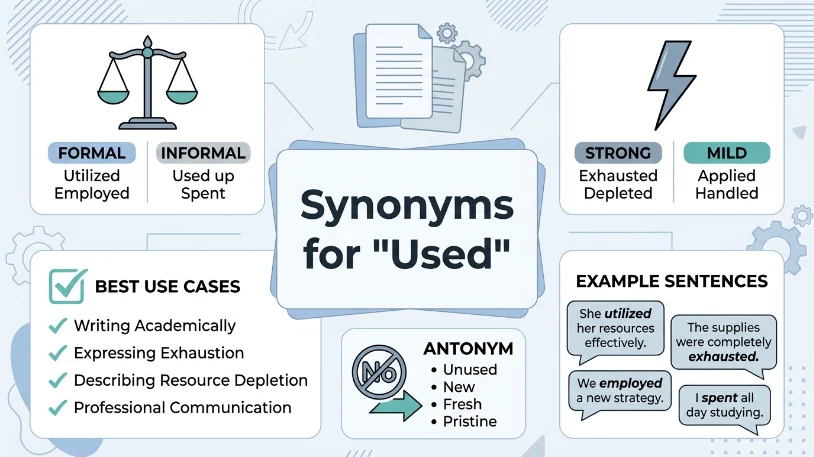
Finding the right words is essential for clear and effective communication. While “used” is a common and versatile word, relying on it too often can make your writing sound repetitive and vague. This guide explores the best synonyms for “used,” helping you choose the perfect word for any situation. The best synonym depends heavily on context, tone, and what you are trying to express. Whether you are writing a professional report, a casual email, or a creative story, this article will help you find a more precise and powerful alternative.
Best Synonyms for “Used”
The best synonyms for “used” are employed, utilized, applied, and leveraged. The right choice depends on tone, context, and intensity. For example, “employed” is a strong formal choice, “leveraged” implies strategic advantage, and “applied” suggests practicality. If you are talking about an object that is not new, secondhand, pre-owned, or worn are the best adjectives to use.
What Does “Used” Mean?
At its core, “used” signifies that something has been put into service, consumed, or has served a purpose. It indicates that an object, method, or resource is no longer in its original, unused state, or that an action has been performed to achieve a specific goal. It is a past-tense verb and also a common adjective.
Part of Speech: Verb (past tense) and Adjective.
Common Usage Examples:
- Verb: “She used her phone to call for help.”
- Adjective: “He bought a used car to save money.”
Core Meaning of “Used”
The main concept behind “used” is the application of something to achieve an end. When you use a tool, you are applying its function. When you use a strategy, you are putting a plan into action. It can also denote consumption, like using up the last of the milk. Its broad and general nature is both its strength and its weakness it is widely understood, but often lacks the specificity that makes writing truly engaging and clear.
Grammar and Usage Notes
- Verb Form: “Used” is the simple past and past participle of the verb “to use.” It often appears with an object (e.g., “He used the hammer.”).
- Adjective Form: As an adjective, “used” almost always describes something that is not new or has been previously owned. It goes before a noun (e.g., “a used textbook”).
- Common Collocations: “Used to” (indicating a past habit), “used for” (indicating purpose), “make use of,” and “put to use.”
- Formality: The verb “used” is neutral. It works in almost any context. However, using it too frequently can make writing sound simplistic.
- When a Synonym Works Better: A synonym is better when you need to add precision, emphasize a specific aspect of the action (like “exploited” for unfairness or “utilized” for creative resourcefulness), or simply elevate the formality and style of your writing.
Best Synonyms for “Used”
This table provides a quick reference for the most effective synonyms for “used.” It’s your go-to list for finding a more precise word.
| Synonym | Meaning | Tone | Best Use Case | Example Sentence |
|---|---|---|---|---|
| Employed | To make use of a tool, skill, or method. | Formal | Professional reports, resumes, academic writing. | The researcher employed a new statistical model for the study. |
| Utilized | To make practical and effective use of something, often creatively. | Formal | Technical writing, business strategies, and when highlighting ingenuity. | The team utilized the existing data to forecast future trends. |
| Applied | To put something (a rule, principle, or substance) to a specific use. | Neutral/Formal | Scientific or practical contexts, legal writing. | The contractor applied a sealant to protect the wood. |
| Leveraged | To use something to maximum advantage, often for financial or strategic gain. | Business Formal | Business strategies, marketing, or project planning. | We leveraged our network to secure the partnership. |
| Deployed | To use a resource, workforce, or tool in a strategic or organized way. | Formal | Military, business, and technology contexts. | The company deployed its best engineers to solve the issue. |
| Wielded | To hold and use a tool or weapon, or to have and use power or influence. | Formal/Literary | Creative writing, historical narratives, political commentary. | The king wielded his influence to keep the peace. |
| Operated | To use and control a machine or system. | Neutral/Formal | Technical and instructional contexts. | He operated the heavy machinery with great skill. |
| Secondhand | Not new; having been owned or used by someone else. | Neutral | Describing physical goods (clothes, cars, books). | She found a beautiful secondhand coat at the thrift store. |
| Pre-owned | Not new; previously owned. Often used in marketing. | Formal/Commercial | Describing luxury goods, cars, and items for sale. | The dealership specializes in pre-owned luxury sedans. |
| Worn | Showing signs of age or use, often due to friction. | Neutral | Describing clothing, shoes, or mechanical parts. | His favorite chair was old and worn but very comfortable. |
Common Synonyms for “Used”
These are everyday synonyms you can use in normal writing and conversation. They are versatile and will help you avoid the overuse of “used.”
- Employed: This is a polished and professional alternative. It’s perfect for a resume or discussing the use of a method.
- Sentence: The author skillfully employed metaphors to convey his message.
- Applied: This is a practical synonym that suggests a direct, hands-on use of something.
- Sentence: The technician applied a new layer of paint to the wall.
- Operated: This is the go-to word when referring to machines, vehicles, or complex systems.
- Sentence: She operated the complex audio system during the concert.
- Exercised: This is a good choice for non-physical uses, like power, caution, or a right.
- Sentence: The manager exercised her authority to approve the budget.
- Drew on: This is a great phrase for using a source of information, inspiration, or experience.
- Sentence: The playwright drew on his own childhood for the story.
Formal Synonyms for “Used”
Elevate your writing in academic, business, or professional reports with these formal alternatives. They add a layer of sophistication and precision.
- Utilized: This synonym is highly regarded in formal writing. It emphasizes that something was put to practical or effective use, often in an innovative way.
- Best Use: Project reports, research papers, and business plans.
- Sentence: The team utilized open-source software to build the prototype.
- Employed: A direct and excellent formal substitute. It works for tools, people, and methods.
- Best Use: Resumes, academic writing, and formal proposals.
- Sentence: The researcher employed a double-blind methodology to ensure accuracy.
- Leveraged: This word is for strategic advantage. It means you used something to achieve a better result or gain an edge.
- Best Use: Marketing plans, business strategies, and finance.
- Sentence: The startup successfully leveraged social media to build its brand.
- Deployed: This suggests a strategic, organized, and often large-scale use of assets, people, or systems.
- Best Use: Military, business, and technology contexts.
- Sentence: The IT department deployed the new software across the entire organization.
- Implemented: This means to put a plan, system, or decision into effect. It focuses on the execution of a larger idea.
- Best Use: Project management, policy writing, and business discussions.
- Sentence: The company implemented a new remote-work policy.
Informal Synonyms for “Used”
For casual conversations, social media posts, or friendly messages, these informal alternatives feel more natural and relaxed.
- Employed (Casually): While “employed” is formal, in phrases like “employed a trick,” it can feel more playful and creative.
- Sentence: He employed a clever trick to win the game.
- Put to use: This is a very common and straightforward phrase that is neither too formal nor too informal.
- Sentence: Now that you have the skills, it’s time to put them to use.
- Broke out: This phrase means to use something that has been stored away for a specific occasion.
- Sentence: We broke out the good champagne to celebrate.
- Got into: This phrase implies using something, usually to examine, organize, or start a project.
- Sentence: I got into the old boxes in the attic this weekend.
- Called on: This means to use one’s resources, such as knowledge or a skill.
- Sentence: She called on her negotiating skills to get a better price.
Strong Synonyms for “Used”
When you need a word that carries more weight, emotion, or intensity, these are the synonyms to consider. Use them to make a point with authority or to describe a negative action.
- Exploited: This is a very strong word. It implies using a person, situation, or resource unfairly for your own benefit. It has a clear negative connotation.
- When to Use: Critiquing power dynamics, discussing social injustice, or describing an unfair business practice.
- Sentence: The factory was accused of exploiting its workers with low wages.
- Wielded: This synonym suggests possessing and controlling power or influence, often with skill or authority.
- When to Use: Describing a powerful person, a leader, or someone in control of a weapon.
- Sentence: The CEO wielded enormous influence over the board of directors.
- Harnessed: This means to control and use the power of something, often a natural force, for a productive purpose. It implies great potential and control.
- When to Use: Describing new technology, renewable energy, or untapped potential.
- Sentence: Engineers are finding new ways to harness the power of the sun.
- Deployed: This word is strong because it implies a deliberate and often large-scale use of resources. It’s not a casual word.
- When to Use: Military action, large-scale software rollouts, or strategic business moves.
- Sentence: The company deployed all its resources to meet the manufacturing deadline.
- Exerted: This word means to apply force, pressure, or influence. It suggests effort and potential resistance.
- When to Use: Discussing physical effort, political pressure, or personal willpower.
- Sentence: He had to exert all his strength to open the jar.
Mild Synonyms for “Used”
When you want to soften your language or sound more neutral and polite, these mild synonyms are your best bet. They are great for descriptive, non-confrontational contexts.
- Employed (Mildly): When used in a straightforward, neutral way, it simply means “used” without any extra emotional charge.
- Sentence: The baker employed a traditional recipe for the cake.
- Applied: This is a very neutral and mild synonym. It simply means to put something on or into effect.
- Sentence: He applied some lotion to his dry hands.
- Drew on: This is a mild and pleasant phrase for using a source of inspiration, memory, or experience.
- Sentence: For her art, she drew on her travels for inspiration.
- Made use of: This phrase is neutral and emphasizes the action of using something that was available.
- Sentence: The children made use of the old sheets to build a fort.
- Utilized (Mildly): While formal, “utilized” can be used in a mild way to simply state that something was put to effective use.
- Sentence: The chef utilized every part of the vegetable to avoid waste.
Synonyms for “Used” by Context
The perfect word depends on where and how you are writing. Here are the best synonyms for used, broken down by common contexts.
Everyday Conversation
In casual speech, simplicity is key. Words like used, applied, and phrases like broke out or put to use work best. You wouldn’t use “leverage” to describe using a spoon, but you might “call on” a friend’s help.
- Example: “I used a coupon to get a discount.”
- Example: “We should put our new grill to use this weekend.”
Professional Writing
Professional communication requires clarity and a touch of formality. Employed, utilized, and implemented are excellent choices. Leveraged is particularly effective in marketing and strategic documents.
- Example: “We employed a new project management tool to track our progress.”
- Example: “The marketing team leveraged influencer partnerships to boost sales.”
Academic Writing
Precision and formality are paramount. Use utilized, employed, applied, or implemented. Avoid vague or emotional language. Your word choice should show a command of the subject matter.
- Example: “The study employed a longitudinal design to track participants over five years.”
- Example: “Researchers utilized a computational model to simulate the experiment.”
Creative Writing
Creative writing allows for the most expression. A character can wield a sword, harness the wind, or draw on their memories. The choice of word paints a vivid picture of their actions and the world around them.
- Example: “The ancient wizard wielded a staff of incredible power.”
- Example: “She drew on her deepest fears to write the haunting melody.”
Another Word for “Used” in a Sentence
Here are several natural sentences demonstrating different synonyms for “used” in action. This variety will help you understand how each word fits into a real-world context.
- The carpenter employed a chisel to carve the intricate details.
- Our team utilized the latest technology to design the prototype.
- The baker applied a thick layer of icing to the cake.
- The company leveraged its assets to secure a better loan.
- The army deployed its troops to the border.
- She skillfully wielded a paintbrush to create a masterpiece.
- They harnessed the power of the river to generate electricity.
- My brother bought a secondhand bicycle to ride to school.
- He called on his extensive network of contacts to find a job.
- The information can be put to use to solve a variety of problems.
- The manager exercised caution when handling the sensitive situation.
- The artist’s inspiration drew on a variety of cultural traditions.
- The mechanic operated the diagnostic machine to find the problem.
- The project manager implemented the new schedule immediately.
- The residents exploited a loophole in the law to bypass the regulation.
“Used” Synonyms Compared
Some synonyms for “used” are very close in meaning, but their subtle differences can change the impact of a sentence. Here is a comparison of two often-confused pairs.
Employed vs. Utilized
Both are formal, but “employed” is a more direct and general synonym. It simply means you used something.
“Utilized” implies you used something in a practical, effective, and perhaps novel way.
- Example: “I employed a hammer to hang the picture.” (Direct, standard action).
- Example: “I utilized an old shoelace to hang the picture.” (Creative, practical use of an object not normally used for that purpose).
Leveraged vs. Exploited
Both imply using something to your advantage, but they are vastly different in tone. “Leveraged” has a positive or neutral connotation. It means you used a resource strategically and fairly to achieve a better outcome.
“Exploited” is almost always negative. It means you used a person or situation unfairly and selfishly.
- Example: “We leveraged our strong reputation to win the contract.” (Ethical and strategic).
- Example: “The company exploited its dominant market position to crush new competitors.” (Unfair and predatory).
Words Similar to “Used”
These words belong to the same semantic field as “used” but have specific meanings that prevent them from being direct synonyms in every case.
- Abused: Means to use something or someone in a bad, dishonest, or harmful way. It is related to “use” but implies misuse.
- Why it’s different: It suggests use is improper and harmful.
- When it’s useful: To describe a violation of trust or rights.
- Consumed: Means to use up a resource. It often implies that the item is depleted.
- Why it’s different: It focuses on the depletion or destruction of what was used.
- When it’s useful: Describing the use of food, fuel, or resources.
- Disposed of: Means to get rid of or throw something away. It is related because something is “used” and then disposed of.
- Why it’s different: It relates to the end-of-life of an item, not its application.
- When it’s useful: When discussing waste, recycling, or cleaning.
- Tapped: Means to use or draw from a source of supply, especially a resource.
- Why it’s different: It implies accessing a potential source that wasn’t previously active.
- When it’s useful: Discussing natural resources, talent, or data reserves.
- Adopted: Means to start using a new method, system, or idea.
- Why it’s different: It focuses on the choice to accept and implement something new.
- When it’s useful: Describing the acceptance of technology, policies, or habits.
Antonyms of “Used”
Just as important as knowing synonyms is knowing what “used” is not. Here are some common antonyms.
- New: This is the most direct antonym, referring to something that has never been used or is in its original condition.
- Sentence: She bought a new car instead of a used one.
- Fresh: Implies something is recently made or obtained and hasn’t been used or deteriorated.
- Sentence: He used fresh ingredients in his cooking.
- Unused: This directly means not having been used.
- Sentence: The unused gym equipment was still in its packaging.
- Pristine: Means in its original, unspoiled condition, almost perfect.
- Sentence: The house was in pristine condition, with no signs of wear.
- Untouched: Describes something that has not been used, handled, or affected by someone.
- Sentence: The crime scene was left untouched by the officers.
How to Choose the Right Synonym for “Used”
Choosing the right word is a simple process if you follow these guidelines:
- Match the Context: Are you writing a professional report, a text to a friend, or a novel? The formality of your writing is your first clue.
- Match the Tone: Do you want to sound neutral, positive, negative, or powerful? Choose a synonym that fits the overall feeling you want to convey.
- Check the Intensity: Ask yourself if the word is strong enough or too strong. “Exploited” is a very serious accusation, whereas “applied” is neutral.
- Consider Your Reader: Think about who will be reading your work. A technical paper might call for “utilized,” while a general audience might appreciate “employed.”
- Test the Fit: Read the sentence with your chosen synonym out loud. Does it sound natural? Does it maintain the original meaning while adding precision?
- Avoid Over-Optimization: Don’t stuff your writing with fancy synonyms. The goal is clarity and impact, not to use a thesaurus. Sometimes, the simple word “used” is the best choice.
Common Mistakes When Using Synonyms for “Used”
Even experienced writers can make mistakes when trying to find a better word. Here are a few common pitfalls to avoid.
- Choosing a Word with the Wrong Tone: Using a highly formal word like “leverage” in an email to a close friend feels awkward and out of place. Conversely, using “broke out” in a legal document is far too casual.
- Using a Synonym that Is Too Strong: Using “exploited” when you mean “applied” is a serious mistake. The former implies unethical behavior, which is likely not what you intended.
- Treating Related Words as Exact Synonyms: “Used” and “disposed of” are related but not the same. One describes the action of using something, while the other describes throwing it away. Using them interchangeably will confuse your reader.
- Making the Sentence Sound Unnatural: Forcing a synonym just for the sake of variety often backfires. It can make your writing feel clunky and unnatural. If a synonym makes your sentence sound overly complex or strange, choose a simpler one.
Quick Synonym List for “Used”
Here is a scannable list of synonyms for “used” for quick reference.
- Common Synonyms: Employed, applied, operated, exercised.
- Formal Synonyms: Utilized, leveraged, deployed, implemented.
- Informal Synonyms: Put to use, broke out, got into, called on.
- Strong Synonyms: Exploited, wielded, harnessed, exerted.
- Mild Synonyms: Drew on, made use of, turned to.
- Related Words: Abused, consumed, adopted, tapped.
FAQs
What is the best synonym for “used”?
The best synonym depends on your context. For professional writing, employed or utilized are excellent. For casual conversation, applied or the phrase put to use works best. For describing a pre-owned item, secondhand is ideal.
What is another word for “used” in a resume?
The best words for a resume are employed, utilized, implemented, and leveraged. These are strong, active verbs that demonstrate your skills and experience effectively to employers.
What is a formal synonym for “used”?
Formal synonyms for “used” include utilized, deployed, implemented, and leveraged. These are ideal for academic papers, business reports, and professional correspondence.
What is an informal synonym for “used”?
Informal synonyms for “used” are broke out, got into, and the phrase put to use. They are best for conversations, personal messages, and friendly interactions.
What is a stronger word for “used”?
Stronger words for “used” include exploited, wielded, and harnessed. “Exploited” has a negative connotation of unfair use, while “wielded” and “harnessed” suggest power and skillful control.
What is a milder word for “used”?
Milder synonyms for “used” include applied, drew on, and made use of. They are neutral and soft, making them suitable for contexts where you want to avoid being too forceful or dramatic.
What words are similar to “used”?
Words similar to “used” include abused, consumed, adopted, and tapped. They are related to the concept of applying something but carry distinct nuances that prevent them from being direct synonyms in every context.
What is the opposite of “used”?
The most direct antonyms for “used” are new, unused, and fresh. They all describe something that is in its original, unutilized, or pristine condition.
How do I choose the right synonym for “used”?
To choose the right synonym, consider the context (formal or informal), the tone (neutral, positive, negative), and the intensity (mild or strong) of your writing. Always test the word in your sentence to see if it sounds natural and conveys your exact meaning.
Conclusion
The word “used” is a common part of our language, but it doesn’t have to be a default choice. By expanding your vocabulary and understanding the nuances of its synonyms, you can make your writing more precise, professional, and engaging. Remember, the best synonym is the one that fits your specific context, matches your intended tone, and conveys your message with the appropriate level of intensity. By using the right word for the right situation, you ensure your communication is always clear and effective.