The best synonyms for then depend on how you’re using the word. If you mean “at that time,” try at that moment or back then. For sequence, use next, afterwards, or subsequently. For cause and effect, therefore or consequently work well. The right choice depends on your meaning, tone, context, and how strong or formal you need to be. This guide covers over 30 alternatives, explains when to use each one, and shows you real examples so you can write with more precision and variety.
Best Synonyms for Then
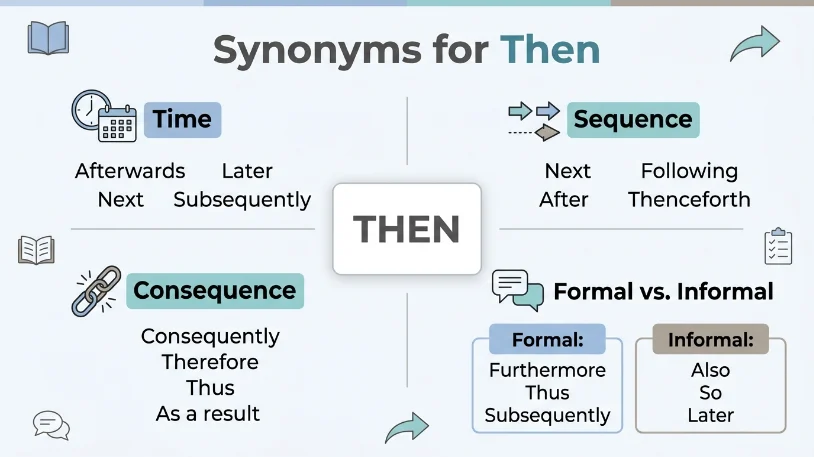
The best synonyms for then are afterwards, subsequently, next, later, therefore, consequently, at that time, and in that case. The right choice depends on whether you’re talking about time, sequence, or consequence. For casual writing, next and later work well. For formal writing, subsequently and therefore are stronger choices.
What Does Then Mean?
Then is primarily an adverb with three core meanings:
- At a specific time (past or future): “I was living in Chicago then.”
- After that (in sequence): “We ate dinner, and then we went for a walk.”
- As a result (consequence): “If you’re tired, then you should rest.”
It can also function as an adjective (the then-president) or a noun (by then), but adverbial uses are most common.
Simple example sentences:
- “She graduated in 2010. I was still in high school then.”
- “Finish your homework, and then you can play video games.”
- “If the store is closed, then we’ll come back tomorrow.”
Core Meaning of Then
At its heart, then is about order whether order in time, order in a sequence, or order in logic. It connects one thing to another, showing when something happened, what came next, or what follows as a result.
Think of then as a bridge. It tells your reader:
- “This happened at that moment.”
- “This happened after that.”
- “This happens because of that.”
That’s why then appears so often in storytelling, instructions, and logical arguments. It keeps things moving in a clear, understandable direction.
Grammar and Usage Notes
Part of speech: Adverb (most common), adjective, noun
Common sentence patterns:
- Time: [Subject] [verb] then. (“I called her then.”)
- Sequence: [Action 1], then [Action 2]. (“We shopped, then we ate.”)
- Consequence: If [condition], then [result]. (“If it rains, then we’ll stay inside.”)
Common collocations and phrases:
- back then — referring to a past time
- by then — by that time
- from then on — starting at that time
- now and then — occasionally
- then and there — immediately, on the spot
- just then — at that exact moment
When then sounds natural:
Then fits almost any context. It’s neutral, clear, and widely understood. Use it when you want straightforward, unpretentious writing.
When a synonym may work better:
Consider a synonym when:
- You’ve used then multiple times in a paragraph and need variety.
- You want a more formal or academic tone.
- You need to emphasize a specific meaning (like consequence or sequence).
- You want to sound more sophisticated or precise.
Best Synonyms for Then
| Synonym | Meaning | Tone | Best Use Case | Example Sentence |
|---|---|---|---|---|
| afterwards | after that | Neutral | General sequence | We went to the museum, and afterwards we had lunch. |
| subsequently | after that (formal) | Formal | Academic, professional writing | The company reported losses and subsequently filed for bankruptcy. |
| next | immediately after | Neutral | Instructions, lists | First, preheat the oven. Next, mix the dry ingredients. |
| later | at a future time | Neutral | General time reference | I’ll finish my work, and later we can watch a movie. |
| thereafter | after that point | Formal | Legal, business, academic | He signed the contract and thereafter assumed full responsibility. |
| therefore | as a result | Formal | Logical conclusions | The evidence was clear; therefore, the jury found him guilty. |
| consequently | as a result | Formal | Cause and effect | She missed the bus and consequently arrived late. |
| at that time | during that period | Neutral | Referring to a specific past moment | I was working abroad at that time. |
| at that moment | exactly then | Neutral | Emphasizing a precise instant | Just at that moment, the phone rang. |
| in that case | if that’s true | Neutral | Conditional situations | You don’t like pizza? In that case, we’ll order pasta. |
| hence | for this reason | Formal | Academic, logical writing | The costs were too high; hence, we abandoned the project. |
| thus | as a result | Formal | Academic, formal writing | He trained hard and thus won the championship. |
Common Synonyms for Then
These everyday synonyms work well in normal conversation and casual writing.
Afterwards
Meaning: After an event or time.
Best context: Describing what happened following something else.
Example: “We finished the project, and afterwards we celebrated.”
Next
Meaning: Immediately after in order.
Best context: Giving instructions, steps, or lists.
Example: “Add the eggs, and next stir in the flour.”
Later
Meaning: At a time in the future or after something.
Best context: Referring to a time that comes after the present or after another event.
Example: “I’ll call you later when I’m free.”
At that time
Meaning: During a specific period in the past.
Best context: Referring back to a particular moment or era.
Example: “I was living in New York at that time.”
After that
Meaning: Following that event.
Best context: Sequential storytelling.
Example: “She graduated from college. After that, she traveled through Europe.”
Soon after
Meaning: Shortly following an event.
Best context: Emphasizing that something happened quickly afterward.
Example: “The rain stopped, and soon after the sun came out.”
Formal Synonyms for Then
When you’re writing academic papers, business reports, or professional correspondence, these formal alternatives add polish and precision.
Subsequently
Meaning: After a particular event or time.
Best context: Academic writing, legal documents, formal reports.
Example: “The initial data was collected in 2015; subsequently, a second round of testing was conducted.”
Thereafter
Meaning: After that time.
Best context: Legal contracts, official records, historical writing.
Example: “He served as CEO for five years and thereafter joined the board as chairman.”
Therefore
Meaning: As a logical result.
Best context: Arguments, conclusions, persuasive writing.
Example: “The company failed to meet its targets; therefore, the board decided to restructure.”
Consequently
Meaning: As a direct result.
Best context: Cause-and-effect explanations, research papers.
Example: “The temperature dropped sharply, and consequently the crops were damaged.”
Hence
Meaning: For this reason.
Best context: Academic writing, formal explanations.
Example: “The experiment was flawed; hence, the results cannot be trusted.”
Thus
Meaning: As a result or in this way.
Best context: Formal writing, philosophical or logical arguments.
Example: “The theory was proven, and thus a new framework was established.”
In that case
Meaning: If that is true.
Best context: Formal conditional statements.
Example: “If the proposal is rejected, in that case we will need a backup plan.”
Accordingly
Meaning: In a way that is appropriate to the circumstances.
Best context: Business writing, formal instructions.
Example: “The rules have changed; accordingly, we must update our procedures.
Informal Synonyms for Then
For conversations, text messages, social media, and friendly writing, these casual alternatives keep things natural and approachable.
And then
Meaning: After that (casual).
Best context: Storytelling, casual narration.
Example: “We went to the beach, and then we got ice cream.”
So
Meaning: As a result (informal).
Best context: Casual explanations.
Example: “I was tired, so I went to bed early.”
Afterward
Meaning: After that.
Best context: Everyday conversation.
Example: “We went for a walk, and afterward we watched a movie.”
Next up
Meaning: The following thing.
Best context: Casual lists, presentations.
Example: “We’ve covered the main points. Next up, we’ll discuss the budget.”
From there
Meaning: After that point.
Best context: Storytelling, directions.
Example: “We drove to the coast, and from there we took a ferry to the island.”
And
Meaning: Then (used as a connector).
Best context: Very casual speech.
Example: “I woke up and made breakfast.”
Well then
Meaning: In that case (conversational).
Best context: Responding to a situation.
Example: “You don’t want to go? Well then, I’ll go alone.”
Strong Synonyms for Then
These synonyms carry more weight, emphasis, or emotional intensity. Use them when you want to underscore a point or make a stronger impression.
Consequently
This word emphasizes a direct, often serious cause-and-effect relationship. It’s stronger than a simple “then” because it highlights that the result was inevitable.
Example: “He ignored the warning signs and consequently paid a heavy price.”
Therefore
Therefore signals a firm logical conclusion. It’s not just “then” it’s “and for that reason, this must be true.”
Example: “All the evidence points to one person; therefore, the suspect must be arrested.”
Henceforth
Meaning: From this time onward.
Best context: Strong declarations, official announcements.
Example: “The old rules are abolished; henceforth, new guidelines will apply.”
Ergo
Meaning: Therefore (very formal, almost philosophical).
Best context: Intellectual or dramatic statements.
Example: “I think, ergo I exist.”
Immediately afterward
Meaning: Right after, with no delay.
Best context: Emphasizing quick succession.
Example: “The alarm sounded, and immediately afterward everyone evacuated.”
As a result
Meaning: Because of that.
Best context: Emphasizing consequences.
Example: “She trained for months and as a result won the competition.”
Mild Synonyms for Then
When you want to soften your language or keep things neutral and unemphasized, these milder alternatives work well.
Later on
Meaning: At some future time (soft, vague).
Best context: When you don’t want to be too specific about timing.
Example: “We can discuss that later on.”
At that point
Meaning: At that specific time (neutral, unemphasized).
Best context: Objective narration.
Example: “At that point, we decided to turn back.”
In due course
Meaning: After a normal amount of time.
Best context: Polite, patient language.
Example: “Your application will be processed in due course.”
Eventually
Meaning: At some later time (often after a delay).
Best context: When the timing is uncertain or drawn out.
Example: “Eventually, we found our way home.”
By that time
Meaning: Before or at that moment.
Best context: Referring to a completed state by a certain point.
Example: “By that time, everyone had already left.”
Following that
Meaning: After that (neutral, almost clinical).
Best context: Objective reporting.
Example: “Following that, the committee adjourned.”
Synonyms for Then by Context
Everyday Conversation
In daily talk, keep it simple. Then itself works fine, but you can also use and then, afterward, later, or so to keep the flow natural.
- “We grabbed coffee, and then we walked around the park.”
- “I was tired, so I took a nap.”
Professional Writing
Business emails, memos, and reports call for clear, polished language. Subsequently, thereafter, and accordingly sound more professional than casual alternatives.
- “The project was approved; subsequently, we allocated the budget.”
- “The client requested changes, and accordingly we revised the proposal.”
Academic Writing
In essays and research papers, precision matters. Use consequently, therefore, thus, and hence to show logical relationships clearly.
- “The sample size was insufficient; consequently, the findings are not generalizable.”
- “The hypothesis was confirmed, and thus the theory gained support.”
Creative Writing
Writers often avoid repeating then to keep prose engaging. Try afterwards, next, at that moment, or soon after for variety.
- “She opened the door. At that moment, the wind howled through the trees.”
- “They danced until midnight. Afterwards, they walked home under the stars.”
Marketing Copy
Marketing writing benefits from strong, action-oriented language. Use next, then, as a result, or consequently to guide the reader through a narrative.
- “You sign up for our newsletter. Next, you receive exclusive deals.”
- “You invest in quality. As a result, you save money in the long run.”
Technical Writing
Instructions and manuals need absolute clarity. Next, then, after that, and subsequently are your best bets.
- “Install the software. Next, restart your computer.”
- “Connect the cables. After that, power on the device.”
Another Word for Then in a Sentence
Here are 15 example sentences using different synonyms for then.
- “We finished our homework and then watched a movie.”
- “She worked as a teacher, and afterwards she became a principal.”
- “First, gather your materials. Next, read the instructions carefully.”
- “He missed the bus and consequently arrived late to the meeting.”
- “I was living in London at that time.”
- “The contract was signed, and thereafter the project began.”
- “The evidence was overwhelming; therefore, the jury reached a swift verdict.”
- “Add the eggs, then whisk the mixture until smooth.”
- “She trained hard for months and as a result won the gold medal.”
- “The storm passed, and soon after the sun appeared.”
- “If you’re not hungry, in that case we’ll skip dinner.”
- “He was a lawyer back then, but now he’s a writer.”
- “The rules changed; hence, we updated our policy.”
- “We drove to the coast and from there took a boat to the island.”
- “I’ll finish this report, and later I’ll send you the draft.”
Then Synonyms Compared
Some synonyms for then are close in meaning but differ in tone, formality, or emphasis.
Words Similar to Then
These words belong to the same semantic family but aren’t always direct replacements.
Meanwhile
Meaning: At the same time.
Why it’s related: It deals with time, but it means “during” rather than “after” or “at that time.”
When it works: When you want to show simultaneous actions.
Example: “I cooked dinner. Meanwhile, my husband set the table.”
Previously
Meaning: Before the time in question.
Why it’s related: It refers to time, but it points backward, not forward.
When it works: When you need to refer to an earlier event.
Example: “The building was previously a hospital.”
Formerly
Meaning: In the past.
Why it’s related: Like previously, it points to an earlier time.
When it works: When describing a past state or role.
Example: “The formerly empty lot is now a park.”
Now
Meaning: At the present time.
Why it’s related: It’s the opposite of then in time reference.
When it works: When contrasting past and present.
Example: “I was a student then; I’m a teacher now.”
Earlier
Meaning: Before now or before a specified time.
Why it’s related: It refers to time, but in the opposite direction.
When it works: When referring to something that happened before another event.
Example: “Earlier, I mentioned the budget. Now let’s discuss the timeline.”
Antonyms of Then
While then doesn’t have a single perfect opposite, several words contrast with it depending on the meaning.
| Antonym | Meaning | Example Sentence |
|---|---|---|
| Now | At the present time | “I was a child then, but I’m an adult now.” |
| Before | At an earlier time | “We met before the ceremony, not then.” |
| Earlier | Before now | “Earlier, we had coffee. Then, we went for a walk.” |
| Previously | At an earlier time | “The policy was previously different from what it is then.” |
| Currently | At the present moment | “She was unemployed then; she is currently employed.” |
| Meanwhile | At the same time | “I waited. Meanwhile, he finished his work.” |
How to Choose the Right Synonym for Then
Choosing the right synonym isn’t complicated, but it does require a little thought. Here’s a practical approach.
Match the context.
Are you writing a text message or a research paper? Casual writing calls for casual words. Formal writing needs formal alternatives.
Match the tone.
Do you want to sound friendly, authoritative, neutral, or dramatic? Your word choice sets the tone.
Check the intensity.
Do you need to emphasize a strong consequence or just mention a sequence? Strong words like consequently and therefore carry more weight than later or afterwards.
Think about your reader.
Will your reader understand the word? Fancy synonyms like henceforth or ergo might confuse some audiences. When clarity matters, choose simpler words.
Check if the synonym is exact or only related.
Not every word that means “time-related” replaces then. Meanwhile and previously are time words, but they don’t mean the same thing. Make sure your chosen word fits the specific meaning you intend.
Keep the sentence natural.
Read the sentence aloud with your chosen synonym. Does it sound like something a real person would say? If it sounds forced or awkward, try a different word.
Use simple words when clarity matters.
Sometimes then is simply the best word. Don’t overcomplicate your writing just to avoid repetition.
Common Mistakes When Using Synonyms for Then
Even experienced writers make mistakes with synonyms. Here are the most common pitfalls.
Choosing a word with the wrong tone.
Using subsequently in a text message sounds stiff. Using so in a research paper sounds too casual. Match the tone to the context.
Using a synonym that is too strong.
Consequently and therefore are strong words. Use them only when there’s a real cause-and-effect relationship. Don’t use them for simple sequences.
Using a formal word in casual writing.
Formal words stand out in casual writing and not in a good way. They make you sound like you’re trying too hard.
Using a casual word in professional writing.
Casual words can undermine your credibility in professional contexts. And then and so are fine for emails to colleagues but not for client reports.
Replacing then without checking meaning.
Not all synonyms are interchangeable. Meanwhile doesn’t mean then. Previously doesn’t mean then. Always check the definition.
Treating related words as exact synonyms.
Just because a word is in the same category doesn’t mean it works in the same sentence. “We ate, and meanwhile we watched TV” doesn’t mean the same as “We ate, and then we watched TV.”
Making the sentence sound unnatural.
If the synonym makes the sentence longer, clunkier, or harder to understand, don’t use it. Clear writing beats fancy writing every time.
Quick Synonym List for Then
Common Synonyms
- afterwards
- next
- later
- after that
- at that time
- soon after
Formal Synonyms
- subsequently
- thereafter
- therefore
- consequently
- hence
- thus
- accordingly
Informal Synonyms
- and then
- so
- afterward
- next up
- from there
- well then
Strong Synonyms
- consequently
- therefore
- henceforth
- ergo
- as a result
Mild Synonyms
- later on
- at that point
- in due course
- eventually
- by that time
Related Words (Not Exact Synonyms)
- meanwhile
- previously
- formerly
- now
- earlier
FAQs
What is the best synonym for then?
The best synonym depends on your meaning. For time, use at that time or back then. For sequence, use next or afterwards. For consequence, use therefore or consequently.
What is another word for then in formal writing?
In formal writing, use subsequently, thereafter, therefore, consequently, hence, or thus. These words add precision and professionalism.
What is an informal synonym for then?
Informal synonyms include and then, so, afterward, next up, and from there. These work well in conversation and casual writing.
What is a stronger word for then?
Stronger synonyms include consequently, therefore, henceforth, and as a result. These emphasize cause-and-effect relationships and carry more weight.
What is a milder word for then?
Milder synonyms include later on, at that point, in due course, and eventually. These soften the language and sound less emphatic.
What words are similar to then?
Words like meanwhile, previously, formerly, now, and earlier are related to time but are not exact synonyms. Use them carefully.
What is the opposite of then?
The opposite depends on context. Now contrasts with then in time. Before or previously contrasts with then in sequence.
How do I choose the right synonym for then?
Match the context, tone, and intensity. Consider your reader and whether the synonym is an exact fit. Read the sentence aloud to check if it sounds natural.
Conclusion
Finding the right synonym for then comes down to understanding what you actually mean. Are you pointing to a specific time? Use at that time or back then. Are you describing what comes next? Try afterwards, next, or subsequently. Are you showing a result? Therefore, consequently or thus will serve you well.
The best writers don’t just grab the first synonym they see. They think about context, tone, and clarity. They choose words that fit the situation and sound natural to the reader. And they remember that sometimes especially when clarity matters most then is simply the right word to use.
Keep this guide handy, and you’ll never struggle to find the perfect alternative for then again.