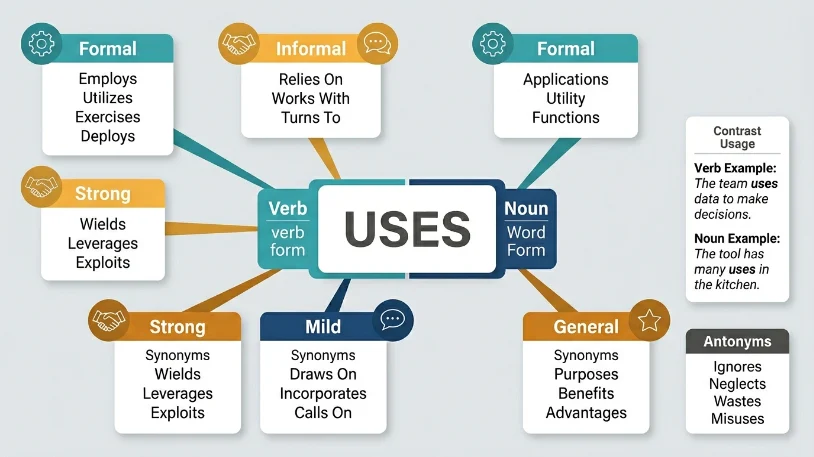
If you’re searching for synonyms for uses, the best options include employs, utilizes, applies, operates, and exercises when uses is a verb. When uses is a noun, strong alternatives include applications, functions, purposes, and benefits. The word uses is unusual because it does two different jobs depending on the sentence, and that double role means the right synonym depends entirely on which meaning you’re working with. This guide covers both, with clear explanations, example sentences, and practical tips for choosing the word that fits your writing best.
Best Synonyms for Uses
The best synonyms for uses (verb) are employs, utilizes, applies, operates, and exercises. The best synonyms for uses (noun) are applications, functions, purposes, benefits, and advantages. The right choice depends on whether uses is a verb or a noun in your sentence, and on the tone, context, and intensity you need.
What Does Uses Mean?
Uses is the third-person singular present tense form of the verb use, and the plural form of the noun use. These two roles give the word very different meanings depending on context.
As a verb: Uses means puts something into action, employs a tool or method, or takes advantage of something available. She uses the software to track project milestones.
As a noun: Uses refers to the purposes, functions, or practical applications of something. There are many uses for baking soda around the house.
Part of speech: Verb (third-person singular present) and noun (plural)
Both meanings are common in everyday English, and the synonym you choose will differ depending on which role uses plays in your sentence.
Core Meaning of Uses
When uses functions as a verb, the core idea is action putting something to work, applying a tool, method, or resource toward a goal. The word is neutral and broad, which is both its strength and its weakness. It covers everything from using a pencil to using a legal strategy, which is why context almost always calls for a more specific synonym.
When uses functions as a noun, the core idea is purpose or utility the range of things something can do or be used for. Saying a material “has many uses” points to its versatility and practical value.
Both meanings connect to the idea of value in action: a thing is only as useful as what it can do, and uses names that potential directly.
Grammar and Usage Notes
Verb form: Uses is the third-person singular present tense. It appears with subjects like he, she, it, the company, the system, and other singular nouns. The engineer uses a calibration tool before every test run.
Noun form: Uses is the plural of use as a noun. It appears after words like many, several, various, practical, multiple, and common. Vinegar has a surprising number of household uses.
Common verb collocations: uses a tool, uses a method, uses a system, uses technology, uses force, uses data, uses language, uses resources
Common noun collocations: practical uses, many uses, common uses, various uses, potential uses, medical uses, industrial uses, everyday uses
When uses sounds natural: In everyday speech and general writing, uses is perfectly natural and rarely sounds out of place. Its neutrality is an asset in casual and semi-professional contexts.
When a synonym works better: In formal or academic writing, more precise words like employs or utilizes often read better than uses, which can seem too casual. In technical writing, operates or applies may be more accurate. For the noun form, applications or functions tends to sound more professional than uses in formal documents.
Best Synonyms for Uses (Verb)
| Synonym | Meaning | Tone | Best Use Case | Example Sentence |
| Employs | Puts something into service or makes use of | Formal / precise | Business, academic, professional writing | The firm employs a rigorous vetting process for new hires. |
| Utilizes | Makes practical or efficient use of | Formal / technical | Scientific, technical, business writing | The system utilizes machine learning to flag anomalies. |
| Applies | Puts something into practice or use in a specific context | Neutral | Education, science, professional writing | The surgeon applies a standard protocol before every procedure. |
| Operates | Runs or controls a machine, system, or process | Technical / neutral | Engineering, IT, industrial contexts | The technician operates the equipment remotely. |
| Exercises | Makes active use of a right, power, skill, or faculty | Formal | Legal, professional, formal writing | The board exercises full authority over budget decisions. |
| Leverages | Uses something strategically to gain maximum advantage | Business / modern | Marketing, business, strategy writing | The startup leverages social media to reach new audiences. |
| Deploys | Puts something into active use, especially a resource or tool | Technical / formal | IT, military, project management | The company deploys automated tools for quality control. |
| Wields | Uses something with skill or authority, especially power or influence | Strong / vivid | Narrative, political, leadership writing | The CEO wields considerable influence over the industry. |
Best Synonyms for Uses (Noun)
| Synonym | Meaning | Tone | Best Use Case | Example Sentence |
| Applications | Specific practical uses of something | Formal / technical | Science, technology, academic writing | The material has applications in aerospace and medicine. |
| Functions | The roles or purposes something performs | Neutral / formal | Technical, professional, general writing | Each component serves distinct functions within the system. |
| Purposes | The intended goals or reasons for which something is used | Neutral | General, academic, professional writing | The tool serves multiple purposes in a home workshop. |
| Benefits | The positive results or advantages of using something | Positive / accessible | Marketing, health, general writing | The herb has well-documented benefits in traditional medicine. |
| Advantages | Favorable qualities or conditions provided by something | Neutral / positive | Business, comparative, general writing | Solar panels offer clear advantages in off-grid locations. |
| Utility | The practical usefulness of something | Formal / abstract | Academic, economic, policy writing | Researchers questioned the utility of the new screening method. |
Common Synonyms for Uses
These everyday alternatives work across general writing and conversation.
Employs The most natural formal replacement for uses as a verb. It implies deliberate, purposeful use often of a method, strategy, or resource. The chef employs a slow-roasting method for maximum flavor.
Applies Works well when something is being put to use in a specific situation or context. It often suggests a methodical or thoughtful approach. The analyst applies the same framework to every quarterly review.
Makes use of A phrase that replaces uses directly and sounds natural in both spoken and written English. Slightly more emphatic than uses. She makes use of every available resource to meet the deadline.
Takes advantage of Neutral when applied to opportunities or features; slightly negative when applied to people. Choose carefully based on context. The app takes advantage of the phone’s built-in GPS to track routes.
Works with Casual and practical. Suggests active engagement with a tool or system. He works with a simple spreadsheet to manage his weekly budget.
Formal Synonyms for Uses
These alternatives are best suited to academic papers, professional reports, business writing, legal documents, and formal essays.
Employs (verb) Precise and widely accepted in formal writing. Implies intentional, purposeful use of a method, strategy, or resource. The study employs a mixed-methods approach to analyze participant behavior.
Utilizes (verb) Slightly more technical than employs. Suggests making practical or efficient use of something. Common in scientific and business writing, though sometimes criticized as unnecessarily formal when uses would do. The platform utilizes encryption to protect user data.
Exercises (verb) Best when the subject involves a right, power, authority, or skill. The committee exercises its discretion when reviewing exceptional cases.
Applications (noun) The most natural formal replacement for uses as a noun in technical and academic contexts. Graphene has promising applications in electronics and energy storage.
Utility (noun) Abstract and formal. Best in academic, economic, or policy contexts where the concept of usefulness is being discussed at a high level. Critics debated the utility of the proposed regulation in practice.
Functions (noun) Clear and precise. Works well in technical documentation and formal descriptions of systems or tools. The device performs three primary functions: monitoring, recording, and reporting.
Informal Synonyms for Uses
These work in casual conversation, everyday writing, social media, and personal messages.
Uses up Informal phrasal verb. Means consumes or exhausts a supply of something. She uses up an entire notebook every month for her journaling practice.
Goes through Very casual. Suggests consuming or making regular use of something. He goes through two pens a week at work.
Relies on Conversational. Implies depending on something regularly. She relies on her morning checklist to stay organized throughout the day.
Turns to Informal and slightly narrative in tone. Suggests reaching for something as a resource. Whenever he’s stressed, he turns to music to reset his mood.
Works with Simple and natural in everyday speech. Suggests active, practical use. Our team works with a project management tool to keep everyone aligned.
Strong Synonyms for Uses
These carry more force, authority, or strategic weight than uses.
Wields (verb) Implies using something with skill, authority, or power. Often used for influence, tools, or language. The prosecutor wielded the evidence with precision during closing arguments.
Leverages (verb) Modern business language. Implies using something strategically to maximize advantage or outcome. The organization leverages its network of partners to expand its reach.
Deploys (verb) Suggests putting a resource, system, or strategy into active and deliberate use. Often used in technology, military, and project management contexts. The campaign deployed targeted advertising across three digital platforms.
Exploits (verb) Strong and double-edged. Means making full, sometimes aggressive use of something. Can be neutral (exploiting an opportunity) or negative (exploiting a person or weakness). Use carefully. The team exploited a gap in the competitor’s pricing strategy.
Commands (verb) Implies authoritative use, especially of respect, attention, or resources. The speaker commands the audience’s attention from the first sentence.
These words add energy and specificity, but they can overstate if the situation doesn’t call for that level of force. Use them when the action genuinely carries weight.
Mild Synonyms for Uses
These softer alternatives suggest using something in a light, routine, or incidental way.
Relies on Implies comfortable, regular use without urgency. The program relies on volunteer support to run its weekend events.
Draws on Gentle and natural. Suggests tapping into a resource or quality without force. She draws on her background in theater when presenting to large groups.
Makes use of Neutral and practical. Works when the use is routine or unremarkable. The committee makes use of an existing template for its monthly reports.
Incorporates Mild and professional. Suggests folding something into a process or approach. The updated curriculum incorporates new digital tools at each grade level.
Calls on Suggests drawing on a resource or skill when needed, rather than constantly. He calls on his network whenever a new opportunity comes up.
Synonyms for Uses by Context
Everyday Conversation
In casual speech, uses is perfectly natural and rarely needs replacing. When it does, relies on, works with, goes through, and turns to all feel natural without sounding forced.
She relies on her phone for almost everything these days.
Professional Writing
Employs, utilizes, applies, and leverages all work well in business communication and workplace reports. Choose based on whether the emphasis is on method (employs, applies), efficiency (utilizes), or strategy (leverages).
The sales team employs a consultative approach to every client conversation.
Academic Writing
Employs, applies, utilizes, and exercises are all appropriate in academic papers. For the noun sense, applications, utility, and functions are strong choices. Be careful with utilizes some style guides flag it as unnecessarily formal when uses would work just as well.
The author employs a critical theory lens to examine the text’s power dynamics.
Technical Writing
Operates, deploys, applies, and functions (noun) are the clearest choices in technical documentation, engineering reports, and software writing.
The system deploys a microservices architecture to handle high traffic loads.
Creative Writing
Wields, draws on, calls on, and turns to all add texture and character to fiction and narrative nonfiction. They suggest intentionality and personality in a way that uses doesn’t.
She wielded sarcasm like a finely sharpened tool.
Marketing Copy
Leverages, harnesses, unlocks, and powers (used as verbs) all perform well in marketing language. They carry energy and forward momentum without the dryness of utilizes or the plainness of uses.
This platform harnesses real-time data to help you make smarter decisions.
Another Word for Uses in a Sentence
Here are 14 natural example sentences using different synonyms for uses, covering both the verb and noun forms.
- The architect employs sustainable materials in every project she designs.
- The software utilizes cloud storage to keep files accessible from any device.
- The trainer applies progressive overload principles to every client’s program.
- The technician operates three different systems simultaneously during peak hours.
- Management exercises careful judgment before approving major expenditures.
- The nonprofit leverages community partnerships to extend its reach citywide.
- The director deploys a rotating cast to keep production costs manageable.
- The scientist draws on decades of field research to inform the new study.
- She wields language with the confidence of someone who has written for years.
- The team relies on a shared calendar to coordinate its weekly schedule.
- Turmeric has well-documented applications in both cooking and natural medicine.
- Engineers are exploring new functions for the lightweight composite material.
- There are dozens of practical uses for white vinegar around the home.
- The redesigned tool offers clear advantages over the original model.
Uses Synonyms Compared
Some of the closest synonyms for uses look nearly identical at first glance. The differences are real and worth knowing.
| Word | Verb or Noun | Formality | Implies Strategy? | Implies Efficiency? | Best Fit |
| Uses | Both | Neutral | No | No | Any context |
| Employs | Verb | Formal | Sometimes | No | Methods, strategies, approaches |
| Utilizes | Verb | Formal / technical | No | Yes | Systems, resources, processes |
| Applies | Verb | Neutral | No | No | Techniques, rules, principles |
| Leverages | Verb | Business / modern | Yes | Sometimes | Strategic advantage |
| Deploys | Verb | Technical | Yes | No | Resources, tools, technology |
| Wields | Verb | Strong / vivid | Yes | No | Power, influence, skill |
| Applications | Noun | Formal | No | No | Technical, scientific contexts |
| Functions | Noun | Neutral / formal | No | No | Technical descriptions |
| Purposes | Noun | Neutral | No | No | General contexts |
Employs vs. utilizes: Both are formal replacements for uses, but employs focuses on deliberate choice of a method or approach, while utilizes emphasizes efficient or practical use of a resource. Many style guides recommend against utilizes when uses or employs would work equally well, since it can read as inflated.
Applies vs. employs: Applies suggests putting something to use in a specific situation it’s context-dependent. Employs is broader and suggests making regular or deliberate use of something.
Leverages vs. deploys: Leverages is about strategic advantage using something to get more out of it than its face value. Deploys is about activation putting something into use, often in a coordinated way.
Applications vs. functions vs. purposes: Applications focuses on how something is put to use in a specific field. Functions describes what a thing does its role or operation. Purposes describes the reason or intention behind using it.
Words Similar to Uses
These words are related to uses but work differently in sentences or carry meanings that don’t always overlap directly.
Consumes (verb) Related to uses but specifically means uses up or depletes a resource. You consume fuel, food, or time not a strategy or a method. The server consumes a significant amount of energy during peak processing hours. Not interchangeable with uses when the subject is a method or tool, only when something is being spent or exhausted.
Handles (verb) Means manages, operates, or deals with something. Related to uses but implies more active management or responsibility. She handles all client communications through a single shared inbox.
Manages (verb) Implies ongoing oversight and control, not just a single act of use. He manages a complex set of tools to keep the project on track.
Harnesses (verb) Means captures and directs something often energy, talent, or potential toward a productive purpose. More vivid and specific than uses. The turbines harness wind energy and convert it into electricity.
Exploits (noun form: exploitation) Can mean uses something to its full potential (neutral) or takes unfair advantage (negative). Context determines which meaning applies. The film exploits the tension between tradition and modernity to great effect.
Antonyms of Uses
| Antonym | Meaning | Example Sentence |
| Ignores | Pays no attention to; fails to use | The team ignores the available data and relies on intuition instead. |
| Neglects | Fails to use or care for something properly | The equipment was neglected for years and fell into disrepair. |
| Wastes | Uses something carelessly or without benefit | The process wastes both time and materials at every stage. |
| Misuses | Uses something in the wrong way or for the wrong purpose | The supervisor misused company funds over a period of three years. |
| Abandons | Gives up using something entirely | The department abandoned the old tracking system after the upgrade. |
| Discards | Throws away or stops using something | The team discarded the outdated method in favor of a new approach. |
| Avoids | Deliberately stays away from using something | She avoids using jargon in client-facing communications. |
How to Choose the Right Synonym for Uses
Identify the part of speech first. Is uses a verb or a noun in your sentence? That single question narrows the field immediately.
Match the formality. Employs and utilizes belong in formal writing. Works with and relies on belong in conversation. Mixing registers makes writing feel inconsistent.
Think about what’s being used. A person uses a method (employs), a system (operates, utilizes), a skill (exercises), a resource (draws on, leverages), or a tool (operates, deploys). Matching the synonym to the object often makes the sentence more precise.
Consider whether strategy is implied. Leverages and deploys carry a sense of intentional positioning. Applies and employs are more neutral. If the action is routine, avoid words that imply strategic force.
Watch out for utilizes. It’s a common first instinct as a formal synonym, but many writing guides flag it as unnecessarily long when uses or employs would be cleaner. If uses would work just as well, it usually should.
For the noun form, match the context. Applications works in science and technology. Purposes works in general and educational writing. Functions works in technical writing. Benefits works in health, marketing, and public-facing communication.
Common Mistakes When Using Synonyms for Uses
Using utilizes when uses would be cleaner. This is the most common error. Utilizes is not inherently more professional it just sounds longer. In most sentences, uses or employs is the better choice.
Using exploits without considering the negative connotation. When applied to people, exploits almost always implies unfair advantage. When applied to opportunities or situations, it can be neutral. Check the object before using it.
Replacing uses (noun) with a verb synonym. If your sentence has uses as a noun (“the many uses of this technique”), you can’t swap it for employs or utilizes without rewriting the sentence. Choose a noun synonym: applications, functions, purposes.
Using wields or leverages for routine actions. These words carry weight and intention. Using them for everyday or mundane actions like saying someone “wields a calculator” reads as overwritten.
Treating employs and applies as fully interchangeable. Employs is broader. Applies implies a specific context or situation. “The company employs a tracking tool” means it uses one regularly. “The analyst applies the tool to each data set” means it’s used in a specific, deliberate way each time.
Confusing functions with purposes. Functions describes what something does mechanically or operationally. Purposes describes why it exists or why it’s being used. A hammer’s function is to drive nails; its purpose might be to build a shelter.
Quick Synonym List for Uses
Common synonyms (verb): employs, applies, utilizes, operates, makes use of, works with
Formal synonyms (verb): employs, utilizes, exercises, deploys, engages
Informal synonyms (verb): relies on, goes through, turns to, works with, calls on
Strong synonyms (verb): wields, leverages, deploys, exploits, commands
Mild synonyms (verb): draws on, incorporates, calls on, makes use of, relies on
Common synonyms (noun): applications, functions, purposes, benefits, advantages
Formal synonyms (noun): applications, utility, functions, purposes
Related words (not always exact synonyms): consumes, handles, manages, harnesses, takes advantage of
FAQs
What is the best synonym for uses?
For uses as a verb, employs is the most widely useful formal synonym. It works in academic, business, and professional writing without sounding inflated. In casual contexts, relies on or works with often sounds more natural. For uses as a noun, applications is the strongest formal choice, while purposes works well in general writing.
What is another word for uses?
Common verb alternatives include employs, utilizes, applies, operates, exercises, leverages, and deploys. Common noun alternatives include applications, functions, purposes, benefits, and advantages. The best option depends on whether uses is functioning as a verb or noun in your sentence.
What is a formal synonym for uses?
Employs and utilizes are the most widely used formal verb synonyms. For the noun, applications and utility are the strongest formal choices. Exercises works well in legal and professional writing when referring to rights, powers, or skills.
What is an informal synonym for uses?
Relies on, goes through, works with, and turns to are all casual, natural-sounding alternatives. In informal speech, restructuring the sentence to use use in a different form is often simpler than finding a synonym.
What is a stronger word for uses?
Wields, leverages, deploys, and exploits are all stronger than uses. They imply skill, strategy, authority, or force. Use them only when the situation genuinely calls for that level of intensity.
What is a milder word for uses?
Draws on, calls on, incorporates, and makes use of are softer alternatives that suggest light, routine, or incidental use rather than deliberate action or strategy.
What words are similar to uses but not exact synonyms?
Consumes, handles, manages, and harnesses all relate to using something but carry their own specific meanings. Consumes implies depletion. Handles implies management and responsibility. Harnesses implies capturing and directing potential or energy.
What is the opposite of uses?
The clearest antonyms are ignores, neglects, and wastes all describe failing to use something effectively or at all. Misuses and avoids also work as opposites in specific contexts.
Conclusion
Uses is one of those everyday words that gets the job done in almost any situation but that same versatility means it can sometimes feel vague or flat in writing that calls for more precision. For the verb, employs gives you formality and intentionality, applies gives you context-specific precision, leverages gives you strategic energy, and draws on gives you a lighter, more natural touch. For the noun, applications fits technical writing, purposes fits general communication, and benefits fits anything people-facing.
The right word is never just about replacing uses it’s about sharpening what you mean. When tone, formality, and context all align, the synonym you choose makes the sentence clearer, more credible, and more engaging for the reader.