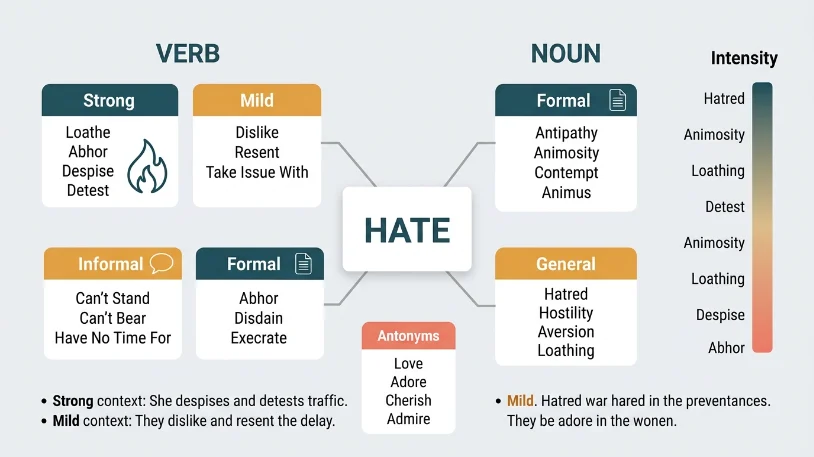
If you’re looking for synonyms for hate, the strongest options include detest, loathe, abhor, and despise. Milder alternatives include dislike, resent, and can’t stand. As a noun, hate can be replaced with hatred, animosity, hostility, contempt, or aversion, depending on how intense and how formal the feeling is.
The right synonym depends on the depth of the emotion, the tone of your writing, and whether you’re describing a passing irritation or a deep, lasting feeling. This guide covers the full range from the most extreme alternatives to the softest with example sentences and clear advice for every context.
Best Synonyms for Hate
The best synonyms for hate (verb) are detest, loathe, despise, abhor, and can’t stand. The best synonyms for hate (noun) are hatred, animosity, hostility, contempt, and aversion. The right choice depends on intensity, tone, and context. Loathe and abhor are the most intense. Dislike and resent are milder. Despise and contempt add a layer of looking down on something or someone.
What Does Hate Mean?
Hate is both a verb and a noun. As a verb, it means to feel intense dislike, hostility, or aversion toward someone or something. As a noun, it refers to that intense negative feeling itself.
Part of speech: Verb and noun
As a verb: Hate describes an active feeling of strong dislike or aversion. She hates being kept waiting without explanation.
As a noun: Hate names the emotion often used in phrases like hate speech, a look of hate, or filled with hate. His eyes were full of hate as he read the letter.
Common usage: Hate appears in everyday conversation as both a strong emotion word and, frequently, a hyperbolic one. People say “I hate Mondays” without meaning it with the full emotional weight of the word. This casual use is important to keep in mind when choosing synonyms some alternatives carry far more weight than the speaker intends.
Core Meaning of Hate
At its most serious, hate describes one of the most powerful negative emotions a person can feel a deep, sustained hostility or aversion toward someone or something. It goes beyond simple dislike because it implies intensity and often some element of rejection, disgust, or wish for harm.
But hate also lives at a more casual level in everyday English. “I hate the commute,” “she hates cilantro,” “he hates being late” in these sentences, hate means strong dislike rather than genuine emotional hostility. This range is exactly why synonyms matter: the word you choose signals how seriously you mean it.
When hate functions as a noun, it often describes a collective or lasting attitude hate as a social force, a personal wound, or a defining emotional state.
Grammar and Usage Notes
Verb form: Hate is a transitive verb it usually takes an object. He hates confrontation. It also commonly appears before an infinitive or gerund: She hates to be interrupted. / She hates being interrupted.
Noun form: As a noun, hate is usually uncountable. The speech was filled with hate. In compound forms: hate speech, hate crime, hate mail
Common verb collocations: hate the idea of, hate to admit, hate when, hate each other, hate yourself
Common noun collocations: full of hate, filled with hate, driven by hate, hate speech, hate crime, object of hate
When hate sounds natural: In everyday speech, casual writing, and emotional expression. Also in formal contexts when the emotion is genuinely extreme.
When a synonym works better: In literary or formal writing, loathe, detest, or abhor add precision and register. When the feeling is milder than true hate, dislike, resent, or can’t stand are more accurate. When contempt is the dominant emotion, despise or disdain captures the feeling more precisely.
Best Synonyms for Hate (Verb)
| Synonym | Meaning | Tone | Intensity | Example Sentence |
| Detest | To feel strong dislike or disgust toward | Neutral to formal | High | She detests dishonesty in any form. |
| Loathe | To feel deep disgust or intense aversion | Formal / literary | Very high | He loathes the smell of cigarette smoke in enclosed spaces. |
| Abhor | To regard with horror or moral disgust | Formal / strong | Very high | The community abhors any form of violence against children. |
| Despise | To regard with contempt or scorn, looking down on | Neutral to formal | High | She despises people who treat service workers rudely. |
| Resent | To feel bitter displeasure, often due to perceived unfairness | Neutral | Moderate | He resents being passed over for promotion year after year. |
| Dislike | To not like something; a softer, less intense aversion | Neutral | Low to moderate | She dislikes crowded spaces but manages them well. |
| Can’t stand | To find something extremely irritating or unbearable | Informal | Moderate to high | I can’t stand the sound of styrofoam being squeezed. |
| Disdain | To regard as unworthy of consideration; to look down on | Formal | Moderate to high | He disdains shortcuts and always insists on doing things properly. |
Best Synonyms for Hate (Noun)
| Synonym | Meaning | Tone | Intensity | Example Sentence |
| Hatred | A deep, sustained feeling of intense dislike or hostility | Neutral to formal | Very high | The film explored the long-term consequences of racial hatred. |
| Animosity | Active hostility or ill will between people or groups | Neutral to formal | High | Years of animosity between the two departments made collaboration difficult. |
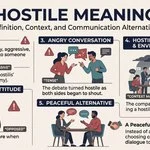
| Hostility | Unfriendly, aggressive, or oppositional feeling or behavior | Neutral | Moderate to high | The new policy was met with open hostility from the union. |
| Contempt | A feeling that something or someone is beneath consideration or worthless | Formal | High | She looked at him with barely concealed contempt. |
| Aversion | A strong, often instinctive dislike or reluctance | Neutral | Moderate | He has a deep aversion to anything involving public speaking. |
| Antipathy | A settled, strong dislike or opposition | Formal | High | His antipathy toward bureaucracy was well known among colleagues. |
| Loathing | A feeling of intense disgust or extreme dislike | Neutral to literary | Very high | She read the message with a growing sense of loathing. |
| Disdain | A feeling that something is unworthy of consideration | Formal | Moderate to high | He spoke of the old system with undisguised disdain. |
Common Synonyms for Hate
These everyday alternatives work across general writing, conversation, and personal expression.
Detest The most direct formal synonym for hate. It implies strong, sustained dislike without the additional layer of contempt that despise carries. Works in almost any context where hate would but sounds more deliberate. He detests being asked the same question twice in a meeting.
Can’t stand The most natural informal replacement. Widely used in speech and casual writing to express strong dislike without necessarily implying deep emotional hostility. She can’t stand when people talk through a film.
Dislike The safest and most accurate replacement when the feeling is genuine but not extreme. Honest and direct without overstating. He dislikes confrontational conversations but handles them when necessary.
Resent Works when the dislike is connected to a sense of injustice or perceived unfair treatment. Carries bitterness as well as dislike. She resents the fact that her contributions are rarely acknowledged.
Formal Synonyms for Hate
These alternatives suit academic writing, literary analysis, professional communication, journalism, and formal essays.
Abhor (verb) The most morally charged formal synonym. Implies not just strong dislike but moral horror or revulsion. Often used for ethical or principled rejection of something. The organization abhors any policy that discriminates on the basis of religion.
Loathe (verb) Intense and visceral. Suggests deep disgust often physical as much as emotional. Common in literary writing. She loathed the very idea of returning to that place.
Despise (verb) Combines intense dislike with contempt. You don’t just dislike the person or thing you look down on them as well. He despises cowardice and has little patience for those who won’t speak their minds.
Antipathy (noun) A formal, somewhat academic word for a settled, deep-seated dislike or opposition. Often used in psychology and formal analysis. The report documented deep-seated antipathy between rival factions within the organization.
Contempt (noun) Implies both dislike and a sense that the subject is beneath consideration or respect. Strong and precise. The auditor’s contempt for sloppy record-keeping was evident throughout the review.
Animus (noun) A formal, slightly legal or journalistic word for a strong feeling of hostility or ill will. Often implies a personal or motivated dislike. The lawsuit alleged that the decision was driven by personal animus rather than professional judgment.
Informal Synonyms for Hate
These casual alternatives work in conversation, social media, personal writing, and friendly communication.
Can’t stand The most universally natural informal synonym. Works for mild irritation and genuine strong dislike alike. I can’t stand how slowly that page loads every single time.
Can’t bear Slightly more dramatic than can’t stand. Suggests the feeling is almost physically uncomfortable. She can’t bear the thought of starting all over again.
Have no time for Implies dismissal as much as dislike you find something so unworthy or irritating that you won’t engage with it. He has no time for people who refuse to take responsibility for their actions.
Not a fan of Very casual and understated. Often used humorously or when softening a stronger feeling. I’m not a fan of how the new update rearranged everything.
Hate with a passion Informal intensifier. Adds emphasis to hate itself. She hates with a passion anything that involves waiting in a long line.
Strong Synonyms for Hate
These words carry the most emotional intensity. Use them when the feeling is genuinely extreme.
Abhor (verb) Implies moral revulsion hatred that has a principled or ethical basis. The strongest formal option. Many citizens abhor the use of torture under any circumstances.
Loathe (verb) Visceral and deep. Often implies a physical as well as emotional reaction the feeling is almost nauseating. He loathed the man so completely that even hearing his name made his jaw tighten.
Abominate (verb) Rare in modern usage but intensely strong. Implies something is viewed as utterly reprehensible or monstrous. The ancient texts described certain practices as things the gods themselves abominated.
Execrate (verb) Literary and archaic. Means to curse or feel intense hatred toward. Best in historical or literary contexts. The tyrant was execrated by generations who came after him.
Loathing (noun) The noun form of loathe. Carries the same visceral, deep-seated intensity. She could barely disguise her loathing during the entire exchange.
These words are powerful precisely because they’re rare. Overusing them dilutes their effect. Reserve them for situations where the emotion genuinely calls for that level of force.
Mild Synonyms for Hate
These softer alternatives are useful when the feeling is real but not extreme or when you want to express dislike without overstating.
Dislike (verb/noun) The clearest, most honest mild synonym. Accurate and straightforward when the feeling is a genuine but moderate aversion. She dislikes the early morning shift but accepts it as part of the job.
Resent (verb) Implies dislike rooted in a sense of unfairness. Warmer than hate but with its own distinct emotional flavor. He resented the constant comparisons to his older sibling.
Aversion (noun) Describes a strong but not necessarily hostile dislike often instinctive or emotional rather than reasoned. Her aversion to seafood developed after a bad experience as a child.
Take issue with Formal and measured. Implies disagreement or disapproval without emotional hostility. She takes issue with the way the data has been interpreted in the report.
Mind (verb) Very mild. Used in constructions like “I don’t mind, but…” or “he minds being…” to suggest low-level discomfort. He minds the noise more than he lets on.
Synonyms for Hate by Context
Everyday Conversation
In casual speech, hate is used loosely and often hyperbolically. Can’t stand, not a fan of, drives me laughable and really dislike all land naturally without sounding dramatic or out of place.
I can’t stand when the WiFi cuts out right in the middle of something important.
Professional Writing
In workplace communication, genuine expressions of hate are rare and usually inappropriate. Take issue with, strongly oppose, have reservations about, and find deeply problematic are all more measured and professional ways to express strong disapproval.
The committee strongly opposes any changes that would reduce transparency in the process.
Academic Writing
Deplore, abhor, harbor animosity toward, express antipathy toward, and regard with contempt all fit the formal register of academic writing. The noun forms animosity, antipathy, hostility, contempt are particularly useful for describing attitudes in research and analysis.
The historical record shows deep antipathy between the two factions that predated the conflict by decades.
Creative Writing
Loathe, despise, detest, and abhor add texture and specificity to fiction and literary nonfiction. They signal the depth and character of a feeling more vividly than hate alone. The noun forms loathing, contempt, disdain are excellent for showing rather than telling a character’s emotional state.
She looked at the painting with a loathing she couldn’t quite explain something about the eyes.
Emotional Expression
When someone is processing a genuine strong feeling, detest, can’t stand, resent, and despise all allow for nuance. Encouraging more precise language are you feeling contempt, resentment, aversion, or disgust? can help clarify what’s actually being felt.
I don’t just dislike the situation I genuinely resent being put in this position.
Marketing and Public Communication
Brands and public communicators rarely use hate or its strongest synonyms. Strongly disagree with, oppose, find unacceptable, and stand against are common in advocacy and public messaging.
We stand firmly against practices that harm the communities we serve.
Another Word for Hate in a Sentence
Here are 14 natural example sentences using different synonyms for hate, covering both verb and noun forms.
- She detests any form of dishonesty, especially in close relationships.
- He loathes the idea of asking anyone for help, even when he clearly needs it.
- The committee abhors any action that undermines the integrity of the process.
- They had despised each other since a falling-out years earlier.
- She resents always being expected to take on extra work without recognition.
- He simply dislikes mornings it has nothing to do with the job.
- I can’t stand the way the new system logs you out every fifteen minutes.
- The rivalry was fueled by years of mutual animosity between the two firms.
- His contempt for shortcuts was evident in the quality of everything he produced.
- She read his message with growing loathing before finally closing her laptop.
- There’s a deep hostility in the neighborhood toward any proposed development.
- His aversion to flying meant he traveled everywhere by train or car.
- The philosopher argued that antipathy toward the unfamiliar is a deeply human tendency.
- She spoke about the experience with a disdain she hadn’t quite managed to let go of.
Hate Synonyms Compared
The words closest in meaning to hate often look interchangeable but carry important differences in intensity and emotional flavor.
| Word | Includes Contempt? | Includes Disgust? | Moral Dimension? | Intensity |
| Hate | Sometimes | Sometimes | No | High |
| Detest | No | Sometimes | No | High |
| Loathe | No | Yes | No | Very high |
| Abhor | No | Yes | Yes | Very high |
| Despise | Yes | Sometimes | No | High |
| Disdain | Yes | No | No | Moderate to high |
| Resent | No | No | No | Moderate |
| Dislike | No | No | No | Low to moderate |
Loathe vs. abhor: Both are intense and include an element of disgust. The difference is that abhor often carries moral weight you abhor something because it violates your values or principles. Loathe is more visceral and personal the feeling can be about almost anything, from a person to a smell.
Despise vs. disdain: Both involve looking down on something or someone, but despise is more emotionally heated. Disdain is cooler more detached and dismissive. A character who despises someone feels it intensely. A character who disdains something treats it as simply beneath them.
Detest vs. hate: Detest is often described as a more formal and deliberate version of hate. It implies sustained, considered dislike rather than a passing or hyperbolic feeling. Where hate can be casual (“I hate traffic”), detest always sounds intentional.
Resent vs. hate: Resent is not as strong as hate and carries a specific emotional origin it arises from perceived injustice or unfair treatment. You can hate something that has nothing to do with fairness; resentment is always about feeling wronged.
Words Similar to Hate
These words belong to the same emotional territory as hate but don’t always work as direct substitutes.
Disgust (noun/verb) Related to hate but focuses on revulsion a feeling that something is deeply unpleasant or morally offensive. Disgust is often more visceral and immediate than hate. She felt a wave of disgust at the conditions inside the facility. Not always a synonym you can be disgusted without hating, and you can hate without feeling disgust.
Anger (noun) Related but distinct. Anger is an active, heated emotion that doesn’t necessarily involve lasting aversion. You can be angry at someone you love. Hate implies a more settled, persistent negative feeling. His anger faded by the next morning, but the resentment lingered.
Bitterness (noun) Describes a prolonged, painful form of resentment or disappointment. Related to hate but more about wounded feeling than hostility. Years of bitterness had made her reluctant to trust anyone new.
Envy (noun) Often confused with resentment in everyday speech, but envy is about wanting what someone else has not necessarily disliking or hating them. His envy of her success was obvious, even if he never admitted it.
Intolerance (noun) An unwillingness to accept differences in people, beliefs, or behaviors. Related to hate in the sense of rejection, but describes an attitude rather than an emotion. The training program was designed to reduce intolerance in the workplace.
Antonyms of Hate
| Antonym | Meaning | Example Sentence |
| Love | Deep affection or attachment | She discovered a love for early morning runs she never expected. |
| Adore | To love or admire deeply and warmly | He adores his younger sister and has always looked out for her. |
| Cherish | To hold something dear; to value deeply | She cherishes the letters her grandmother wrote during the war. |
| Admire | To regard with respect and warm approval | The whole team admires the way she handles pressure without losing composure. |
| Appreciate | To recognize and value the worth of something | He genuinely appreciates the effort people put into their work. |
| Embrace | To accept or welcome something willingly | She has learned to embrace change rather than resist it. |
| Relish | To enjoy or take pleasure in something | He relishes a challenge and performs best under pressure. |
How to Choose the Right Synonym for Hate
Match the intensity to the actual feeling. This is the most important rule. If the feeling is genuinely extreme, loathe or abhor is appropriate. If it’s real but moderate, dislike or resent is more honest. Overstating with abhor when you mean dislike damages credibility.
Decide whether contempt is part of the feeling. If you look down on the object of your feeling not just dislike it, but consider it beneath you then despise or disdain is more accurate than hate.
Consider whether the feeling is moral or personal. Abhor is the right word when something violates your principles. Loathe is better for personal, visceral reactions. Resent is best when the feeling comes from a sense of unfair treatment.
Match the register to your writing. Abhor, abominate, and antipathy belong in formal or literary writing. Can’t stand and not a fan of belong in conversation and casual writing. Mixing these registers makes writing feel inconsistent.
Be honest about whether hate is hyperbolic. In everyday speech, hate is often used as a mild intensifier (“I hate when that happens”). If that’s the level of feeling you mean, don’t replace it with loathe or abhor use dislike, find annoying, or can’t stand instead.
Common Mistakes When Using Synonyms for Hate
Using loathe or abhor for minor irritations. These words carry enormous emotional weight. Using them for small frustrations “I loathe this font” reads as comically overdramatic unless that’s the intended effect.
Confusing despise with hate. Despise adds contempt to the equation a sense that the subject is inferior or unworthy. If you hate something without looking down on it, despise isn’t quite right.
Using resent as a direct synonym for hate. Resentment has a specific emotional origin perceived unfairness. You can hate something without resenting it, and you can resent something without hating it. They overlap but aren’t interchangeable.
Treating animosity and hostility as identical. Animosity is a feeling an internal state of ill will. Hostility describes both a feeling and behavior it can be observed in someone’s actions and tone. Animosity is about how someone feels; hostility can be about what they do.
Using disdain when the emotion is hot rather than cool. Disdain is dismissive and detached it reads as cold. If the emotion is intense and heated, despise or detest is more accurate.
Replacing hate with contempt when contempt is only part of the feeling. Contempt is a noun that implies looking down on something as inferior. It doesn’t capture the full range of meanings that hatred does, especially when hostility or aversion rather than scorn is the dominant emotion.
Quick Synonym List for Hate
Common synonyms (verb): detest, dislike, resent, can’t stand, despise
Formal synonyms (verb): abhor, loathe, despise, disdain, execrate, abominate
Informal synonyms (verb): can’t stand, can’t bear, have no time for, not a fan of
Strong synonyms (verb): loathe, abhor, despise, abominate, execrate
Mild synonyms (verb): dislike, resent, take issue with, mind, object to
Common synonyms (noun): hatred, hostility, animosity, contempt, aversion
Formal synonyms (noun): antipathy, animus, animosity, contempt, disdain, loathing
Related words (not always exact synonyms): disgust, bitterness, anger, envy, intolerance
FAQs
What is the best synonym for hate?
For the verb, detest is the most versatile formal synonym it captures genuine, sustained dislike without the additional layers of contempt (despise) or moral horror (abhor). In casual writing, can’t stand is the most natural replacement. For the noun, hatred is the closest and most direct, while animosity and contempt work well when a specific type of hostility is meant.
What is another word for hate?
Strong verb alternatives include detest, loathe, abhor, despise, and resent. Noun alternatives include hatred, animosity, hostility, contempt, antipathy, and aversion. Informal options include can’t stand, can’t bear, and have no time for.
What is a formal synonym for hate?
Abhor, loathe, despise, and detest are the strongest formal verb synonyms. For the noun, antipathy, animosity, animus, and contempt all fit formal and academic writing. Abhor is particularly strong when the hatred has a moral or principled basis.
What is an informal synonym for hate?
Can’t stand is the most widely used casual synonym. Can’t bear, not a fan of, and have no time for are also natural in conversation and informal writing. In very casual speech, hate itself is often used hyperbolically and doesn’t need replacing.
What is a stronger word for hate?
Loathe, abhor, and abominate are all stronger than hate in terms of emotional intensity. Loathe adds visceral disgust. Abhor adds moral revulsion. Abominate is rare in modern usage but the most extreme of the three.
What is a milder word for hate?
Dislike is the clearest mild alternative honest and precise when the feeling is real but not extreme. Resent works when the dislike comes from a sense of unfairness. Take issue with is the most professional and measured option for formal contexts.
What words are similar to hate but not exact synonyms?
Disgust, anger, bitterness, and envy all belong to the same emotional family but carry distinct meanings. Disgust is about revulsion. Anger is heated but not necessarily lasting. Bitterness is more about wounded feeling than hostility. Envy is about wanting what someone else has, not disliking them for having it.
What is the opposite of hate?
The clearest antonyms are love, adore, and cherish all describing deep positive feeling or attachment. Admire, appreciate, and relish are softer positive alternatives that work in specific contexts where love would be too strong.
Conclusion
Hate is a word with enormous emotional range from the casual (“I hate elevator music”) to the profound (“a society built on hate”). That range is why choosing a synonym requires care. Loathe and abhor belong at the extreme end, reserved for genuine deep revulsion. Despise and disdain add contempt to the mix. Detest is a precise, deliberate formal replacement. Resent points to injustice. Dislike is honest when the feeling is real but moderate. And can’t stand handles the everyday, informal expression of strong aversion without drama.
For the noun, hatred stays closest to the source. Animosity and hostility capture group-level or interpersonal conflict. Contempt isolates the scornful dimension. Aversion describes an instinctive, sometimes physical pull away from something.
The best synonym doesn’t just replace hate it makes your writing more precise, more honest, and more emotionally accurate. That’s the real reason word choice matters.