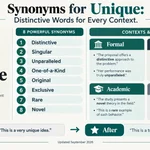
Maybe is one of the most common words in English, but it’s not always the best choice. Depending on your context, tone, and audience, you might want a more formal, stronger, or more precise alternative. The best synonyms for maybe include perhaps, possibly, conceivably, and potentially but the right choice depends on what you’re trying to say and who you’re saying it to.
Best Synonyms for Maybe
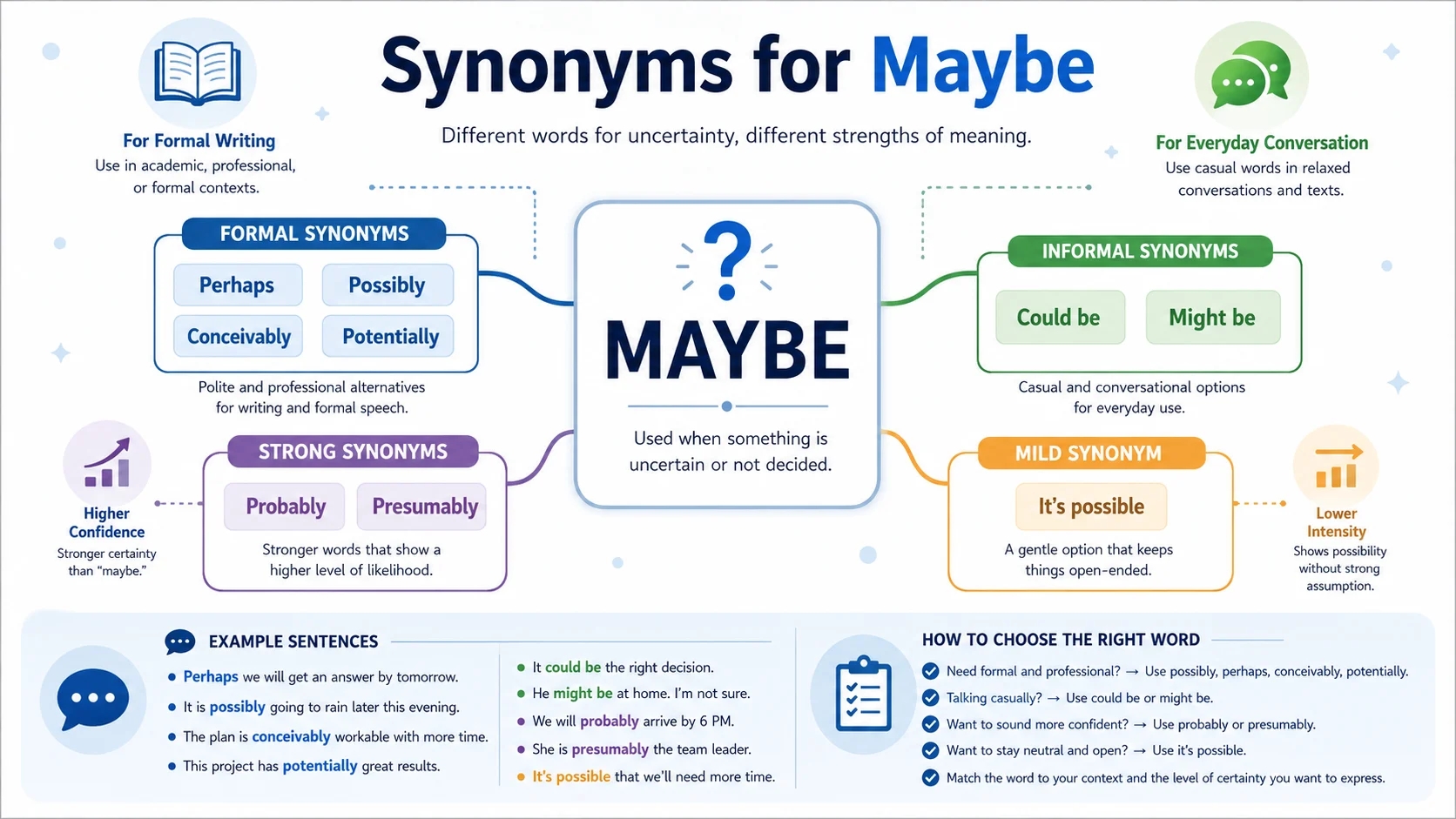
The best synonyms for maybe are perhaps, possibly, conceivably, and potentially. Use perhaps for a slightly more formal tone in everyday writing. Choose possibly when you want to emphasize uncertainty or a lower likelihood. Pick conceivably when you want to stress that something is imaginable or not outside the realm of possibility. Select potentially when you’re talking about future outcomes that could unfold under the right conditions.
What Does Maybe Mean?
At its core, maybe is an adverb that expresses uncertainty. You use it when you’re not entirely sure about something whether an event will happen, whether a statement is true, or whether a choice is correct.
Part of speech: Adverb
Simple definition: Possibly but not certainly; used when you are not sure about something.
Example sentences:
- “Maybe we’ll go to the beach tomorrow if the weather clears up.”
- “She asked if I wanted to join the team, and I said maybe.”
Core Meaning of Maybe
Maybe sits at the center of a spectrum of uncertainty. When you say “maybe,” you’re communicating that something could happen or be true, but you’re not committing to it. It expresses a middle ground between “yes” and “no” a tentative, open-ended position.
The word carries a neutral, everyday tone. It fits almost any situation, from casual conversations to professional emails. But because it’s so common and general, it doesn’t always carry the nuance you might want. Sometimes you need a word that communicates a specific degree of doubt, a particular level of formality, or a clearer sense of possibility.
Grammar and Usage Notes
Part of speech: Adverb
Common sentence patterns:
- At the beginning of a sentence: “Maybe we should leave early.”
- In the middle: “We could maybe try a different approach.”
- As a standalone response: “Do you want to go?” “Maybe.”
Common collocations:
- “maybe not” — expressing doubt about a positive outcome
- “maybe so” — expressing tentative agreement
- “maybe then” — suggesting a possible timeline or condition
When “maybe” sounds natural:
- Everyday conversation
- Informal writing
- Expressing polite hesitation
- Leaving options open
When a synonym may work better:
- Formal writing (use “perhaps” or “possibly”)
- Academic papers (use “conceivably” or “potentially”)
- When you need to express a stronger or weaker degree of certainty
Best Synonyms for Maybe
| Synonym | Meaning | Tone | Best Use Case | Example Sentence |
|---|---|---|---|---|
| perhaps | Possibly, but not certainly | Slightly formal | Academic writing, professional communication | “Perhaps we should reconsider the timeline.” |
| possibly | Maybe, with emphasis on uncertainty | Neutral | Everyday use, expressing lower likelihood | “She could possibly arrive late due to traffic.” |
| conceivably | Imaginably; within the realm of possibility | Formal | Speculative arguments, hypothetical scenarios | “A solution could conceivably be reached by next week.” |
| potentially | Capable of becoming true or happening | Formal/Professional | Business, science, future outcomes | “This new drug could potentially save thousands of lives.” |
| perchance | Perhaps; by chance | Very formal/Archaic | Literary writing, humorous effect | “Do you perchance have a moment to talk?” |
| plausibly | Apparently true or likely | Formal | Logical arguments, reasoned speculation | “The theory could plausibly explain the experimental results.” |
Common Synonyms for Maybe
Perhaps
Meaning: Possibly, but not certainly. Perhaps is the closest and most direct synonym for maybe, with only a slight difference in formality.
Best context: Writing, professional communication, or when you want to sound slightly more polished than “maybe.”
Example sentence: “Perhaps the meeting will run shorter than expected.
Possibly
Meaning: Maybe, but with a stronger sense that something is unknown or uncertain. Possibly often suggests a lower probability than “maybe” or “perhaps.”
Best context: When you want to emphasize uncertainty or when you’re estimating a small chance.
Example sentence: “There are possibly three or four options we haven’t considered yet.”
Conceivably
Meaning: It’s possible to imagine or conceive; it could happen or be true.
Best context: Speculative writing, academic arguments, or when you’re discussing something that’s theoretically possible but uncertain.
Example sentence: “With the right funding, the project could conceivably be completed in six months.”
Potentially
Meaning: Capable of becoming true or happening in the future, especially if conditions align.
Best context: Business writing, scientific discussion, marketing, or when discussing outcomes that depend on other factors.
Example sentence: “This new feature could potentially attract a younger audience.”
Formal Synonyms for Maybe
When you’re writing for academic, business, or professional audiences, you often want to avoid the casual tone of “maybe.” These formal alternatives can help you sound more polished and precise.
Perhaps
Perhaps is the go-to formal alternative for maybe. It fits seamlessly into professional emails, academic papers, and business reports. The difference in formality is subtle but noticeable using perhaps signals that you’re taking the conversation seriously.
Example: “Perhaps we could schedule the meeting for Thursday afternoon.”
Possibly
Possibly is more common in formal writing than many people realize. It works well when you want to indicate uncertainty without sounding wishy-washy.
Example: “The committee will possibly issue a decision by the end of the month.”
Conceivably
Conceivably is ideal for formal arguments and hypothetical reasoning. It suggests that something is within the realm of logical possibility, even if it’s not certain.
Example: “The data could conceivably support a different interpretation.”
Potentially
Potentially is the formal choice when you’re talking about future outcomes or capabilities. It often appears in business and scientific writing.
Example: “This approach could potentially reduce costs by twenty percent.”
Plausibly
Plausibly indicates that something is likely or appears to be true. It’s a stronger formal synonym than “possibly” but weaker than “probably.
Example: “The defense attorney argued plausibly that her client was not at the scene.”
Informal Synonyms for Maybe
These casual alternatives are perfect for conversations, text messages, social media, and friendly writing. They carry the same basic meaning as maybe but with a more relaxed, conversational feel.
Could be
Meaning: It might be true or it might happen. This phrase is common in everyday speech and carries a neutral, informal tone.
Example: “Do you think she’ll come to the party?” “Could be. She mentioned she was free that night.”
Might be
Meaning: Possibly is true or could happen. Similar to “could be” but with a slightly more speculative feel.
Example: “There might be a few spots left if you want to sign up.”
It’s a possibility
Meaning: That could happen or be true. This phrase often implies that you’re considering an option but haven’t committed.
Example: “Taking the train instead of driving?” “It’s a possibility.”
Perhaps not / maybe not
These casual phrases are ways of saying “possibly not” without sounding too direct or negative.
Example: “Are you coming to the game?” “Maybe not. I have a lot of work to catch up on.”
Strong Synonyms for Maybe
Some synonyms for maybe carry more weight, suggesting a higher likelihood or a more significant possibility. These words convey that something is not just possible but quite likely or seriously conceivable.
Probably
Meaning: Very likely; almost certain. Probably is stronger than maybe because it suggests a high probability rather than simple uncertainty.
Use when: You want to indicate something is likely to happen but you’re not completely certain.
Example: “She’ll probably get the promotion given her track record.”
Presumably
Meaning: Assumed to be true based on evidence or reasonable judgment. Presumably suggests you’re making an informed guess.
Use when: You’re drawing a logical conclusion based on available information.
Example: “He’s not answering his phone presumably he’s in a meeting.”
Undoubtedly
Meaning: Without question; certainly. This is much stronger than maybe and leaves little room for doubt.
Use when: You’re confident about something, but you want to acknowledge a tiny possibility of being wrong.
Example: “She is undoubtedly the best candidate for the position.”
Surely
Meaning: Confidently believed to be true. Surely carries a tone of confidence and sometimes mild exasperation.
Use when: You’re expressing a strong belief about something.
Example: “Surely you can understand why we made that decision.”
Mild Synonyms for Maybe
Sometimes you want to express uncertainty in a softer, less committed way. These mild alternatives are perfect when you don’t want to sound too definite or when you want to avoid pressure.
Perhaps (mild use)
Perhaps can be a milder alternative to maybe when you want to sound tentative or polite.
Example: “Perhaps we could try a different approach.”
Possibly (mild use)
Possibly conveys a gentle uncertainty, especially when you’re not sure about something but don’t want to dismiss it outright.
Example: “I could possibly help you with that later today.”
It’s possible
This phrase sounds less committal than maybe because it keeps the focus on the situation rather than your opinion.
Example: “It’s possible the package will arrive tomorrow.”
I’m not sure
This phrase directly communicates uncertainty without trying to sound positive or negative.
Example: “I’m not sure if that’s the best solution.”
Could happen
This is a casual, mild way to acknowledge a possibility without committing to it.
Example: “With the new strategy, some big wins could happen.”
Synonyms for Maybe by Context
Everyday Conversation
In casual conversations, stick with common, simple words. Maybe, perhaps, and possibly work well. You can also use casual phrases like could be or might be for a natural, conversational tone .
Example: “Could be we’ll see them at the party.”
Professional Writing
In professional settings, choose perhaps or possibly to maintain a polished tone. Potentially is excellent for business contexts when discussing outcomes or opportunities .
Example: “We could potentially expand into new markets next year.”
Academic Writing
Academic papers call for formal synonyms like conceivably, plausibly, or it is arguable that . These phrases signal careful reasoning and measured speculation.
Example: “It is arguable that economic growth contributes to improved social outcomes.”
Creative Writing
Creative writers can play with a wider range of synonyms. Perchance adds a literary or old-fashioned flavor . Conceivably works well for speculative or philosophical writing.
Example: “If, perchance, the stars align, we might find our way home.”
Emotional Expression
When expressing feelings or opinions, choose synonyms that match your emotional tone. Probably suggests cautious optimism. Possibly conveys hesitation.
Example: “I probably shouldn’t have said that.”
Another Word for Maybe in a Sentence
- “Perhaps the movie will start a bit late.”
- “There are possibly five people who have already signed up.”
- “This change could potentially affect everyone in the department.”
- “A solution could conceivably be found by the end of the month.”
- “She argued, rather plausibly, that her schedule was too full.”
- “Do you perchance know where the meeting is being held?”
- “It is arguable that the new policy will improve retention.”
- “We might be able to finish this by Friday.”
- “It’s possible the train has already left the station.”
- “The team could probably win if they stay focused.”
- “I’m not sure I agree with that assessment.”
- “Presumably, everyone has received the memo by now.”
Maybe Synonyms Compared
Let’s look at how the closest synonyms differ from each other.
| Word | Meaning | Formality | Intensity | Best For |
|---|---|---|---|---|
| maybe | Possibly but not certainly | Neutral | Moderate | Everyday use |
| perhaps | Possibly but not certainly | Slightly formal | Moderate | Writing, professional settings |
| possibly | Maybe, emphasizing uncertainty | Neutral | Lower | Expressing doubt |
| probably | Very likely | Neutral | Higher | Indicating high likelihood |
| conceivably | Imaginable, possible | Formal | Moderate | Speculative arguments |
| potentially | Capable of becoming true | Formal | Moderate | Future outcomes |
Words Similar to Maybe
Some words don’t directly replace maybe but belong to the same semantic family of uncertainty and possibility. These related words can enrich your vocabulary even if they’re not exact synonyms.
Probably
Why it’s related: Probably expresses a higher degree of certainty than maybe. It means “almost certainly” rather than “possibly.”
When it’s useful: When you want to sound confident but acknowledge a small margin of error.
Example: “She’ll probably win the race.”
Presumably
Why it’s related: Presumably suggests that something is reasonable to assume based on available facts.
When it’s useful: When you’re making an educated guess.
Example: “He’s presumably the best candidate.”
Supposedly
Why it’s related: Supposedly indicates that something is believed to be true by others, but you might doubt it.
When it’s useful: When you want to distance yourself from the claim.
Example: “She’s supposedly an expert on the topic.”
Doubtlessly
Why it’s related: Doubtlessly is a strong word that indicates certainty, essentially the opposite end of the uncertainty spectrum from maybe.
When it’s useful: When you want to emphasize confidence.
Example: “He doubtlessly knew the answer.”
Antonyms of Maybe
| Antonym | Meaning | Example Sentence |
|---|---|---|
| certainly | Without doubt; absolutely | “She will certainly be at the meeting.” |
| definitely | Without question; unmistakably | We will definitely finish the project on time.” |
| undoubtedly | Without question; beyond doubt | “He is undoubtedly the best person for the job.” |
| surely | Confidently; without doubt | “You must surely understand the risks.” |
| absolutely | Completely; without exception | “I absolutely agree with your proposal.” |
How to Choose the Right Synonym for Maybe
Choosing the right word depends on several factors. Here’s a practical guide to help you decide.
Match the Context
- Everyday conversations: Stick with maybe, perhaps, or possibly
- Professional emails: Use perhaps or potentially
- Academic writing: Choose conceivably, plausibly, or it is arguable that
- Creative writing: Consider perchance or conceivably
Match the Tone
- Formal tone: Use perhaps, possibly, conceivably, potentially
- Informal tone: Use maybe, could be, might be
- Neutral tone: Use maybe, possibly
Check the Intensity
- Low certainty: Use possibly, maybe, conceivably
- Moderate certainty: Use perhaps, potentially
- High certainty: Use probably, presumably
Think About Your Reader
- Casual readers: Use simple words like maybe or perhaps
- Professional readers: Use potentially or possibly
- Academic readers: Use conceivably or plausibly
Keep the Sentence Natural
Read your sentence aloud with the synonym you’re considering. If it sounds awkward or forced, choose a simpler word. Maybe is fine in most everyday situations there’s no need to use a fancy synonym just to sound intelligent.
Common Mistakes When Using Synonyms for Maybe
Using the Wrong Tone
Mistake: Using “perhaps” in a casual text message when “maybe” would sound more natural.
Fix: Match your word choice to your audience and context.
Choosing a Synonym That Is Too Strong
Mistake: Using “probably” when you really mean “possibly.”
Fix: Be honest about your level of certainty. If you’re not sure, don’t sound like you are.
Using Formal Words in Casual Writing
Mistake: Using “conceivably” in a friendly email.
Fix: Keep it simple unless the context demands formal language.
Using Casual Words in Professional Writing
Mistake: Using “maybe” in a business report.
Fix: Choose perhaps or potentially to maintain a professional tone.
Treating Related Words as Exact Synonyms
Mistake: Using “presumably” when you mean “maybe.”
Fix: Remember that presumably implies a reasonable assumption, not mere possibility.
Making Sentences Sound Unnatural
Mistake: Forcing a synonym into a sentence where it doesn’t fit.
Fix: If the word sounds awkward, choose a simpler alternative.
Quick Synonym List for Maybe
Common Synonyms
- perhaps
- possibly
- could be
- might be
Formal Synonyms
- conceivably
- potentially
- plausibly
- it is arguable that
Informal Synonyms
- could be
- might be
- it’s a possibility
Strong Synonyms
- probably
- presumably
- undoubtedly
Mild Synonyms
- I’m not sure
- it’s possible
- could happen
Related Words
- potentially
- presumably
- plausibly
- conceivably
- perchance
- mayhap
FAQs
What is the best synonym for maybe?
Perhaps is the closest and most direct synonym for maybe . It carries nearly the same meaning but with a slightly more formal tone.
What is another word for maybe in formal writing?
Formal alternatives include perhaps, possibly, conceivably, and potentially . Perhaps is the most common and versatile formal option.
What is an informal synonym for maybe?
Common informal synonyms include could be, might be, and it’s a possibility. These phrases fit naturally into everyday conversation and casual writing.
What is a stronger word for maybe?
Probably and presumably are stronger than maybe because they indicate a higher likelihood. Probably suggests something is very likely, while presumably suggests a reasonable assumption based on evidence.
What is a milder way to say maybe?
Mild alternatives include it’s possible, I’m not sure, and could happen. These phrases express uncertainty without committing to any particular outcome.
What words are similar to maybe?
Related words include probably, presumably, supposedly, and doubtlessly. These words all deal with degrees of uncertainty and possibility, though they each carry slightly different shades of meaning.
What is the opposite of maybe?
Antonyms include certainly, definitely, and undoubtedly . These words express certainty and confidence rather than doubt.
How do I choose the right synonym for maybe?
Consider your context, audience, tone, and the level of certainty you want to express. Match the synonym to the situation casual for everyday use, formal for professional writing, and stronger words when you’re more confident .
Conclusion
Maybe is a perfectly good word, but it’s rarely the only option. Depending on your audience, context, and desired tone, you can choose from a wide range of synonyms that offer more precision, formality, or emotional weight. Perhaps, possibly, conceivably, and potentially all serve different purposes and carry different levels of certainty. The key to choosing the right synonym is understanding the subtle differences between them and matching your word choice to the situation. Next time you reach for “maybe,” pause and consider whether a more precise alternative might serve you better.

Jack Murphy is a language writer with a passion for word meanings, synonyms, and effective communication. He creates informative and easy to understand content to help readers enhance their vocabulary and language skills.