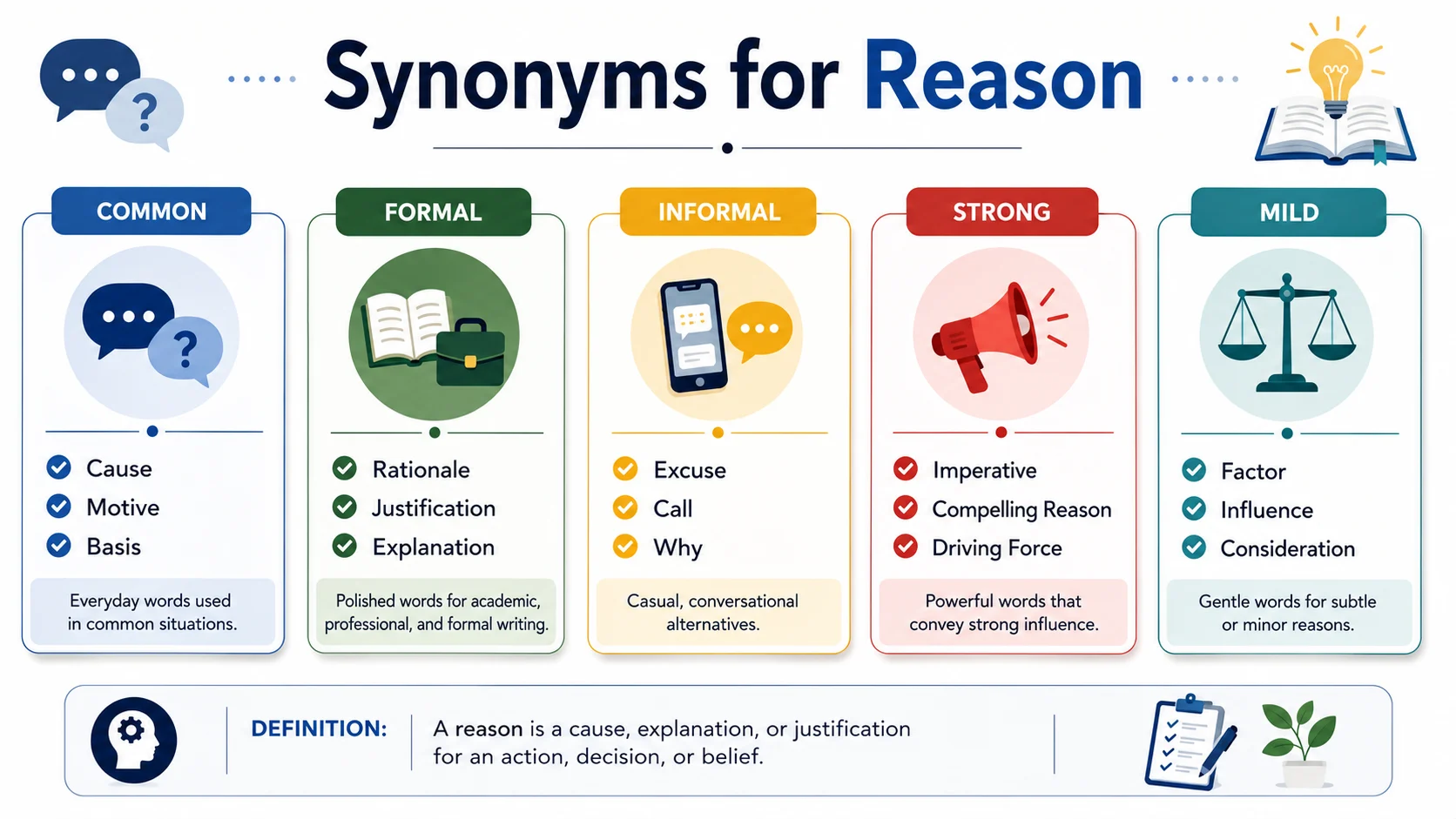
Understanding the many synonyms for reason can significantly improve your writing and speaking. “Reason” is a common word with several layers of meaning, so the best synonym depends heavily on your context. Perhaps you’re looking for a formal alternative for an academic paper, a casual word for a conversation, or a more intense word to express a strong argument. This guide explores all the best options, helping you choose the perfect word every time.
Best Synonyms for Reason
The best synonyms for reason are cause, explanation, motive, rationale, and basis. The right choice depends on your specific context. Use cause when discussing what makes something happen, explanation to clarify an event, and rationale for a formal justification. For a more personal drive, choose motive, and for the foundation of an idea, basis is ideal.
What Does Reason Mean?
A reason is a cause, explanation, or justification for an action or event. It’s the “why” behind something. For instance, you might give a reason for being late or explain the reason behind a scientific discovery. In philosophy and logic, reason is also the power of the mind to think, understand, and form judgments logically.
Core Meaning of Reason
At its heart, “reason” represents the process of logical thinking and the conclusions that stem from it. It’s the mental faculty that allows us to move from premises to a conclusion. In everyday use, it’s the thought process that helps us make decisions, solve problems, and justify our actions. Reason is what separates a random guess from a calculated decision.
Grammar and Usage Notes
“Reason” is primarily a noun and a verb.
- As a noun: It can be countable (e.g., “She had several reasons for her decision”) or uncountable (e.g., “He’s a man of reason”).
- As a verb: It means to think logically or to persuade someone using logic (e.g., “I tried to reason with him”).
Common sentence patterns include:
- “The reason for [X] is [Y].”
- “There is no reason to believe that…”
- “For reasons of [X]…”
Common collocations include “main reason,” “logical reason,” “valid reason,” “reason for,” and “reason why.” While “reason why” is common in spoken English, many style guides recommend “reason that” for formal writing.
Best Synonyms for Reason
The following table provides some of the most effective synonyms for reason, categorized by their meaning and best use case.
| Synonym | Meaning | Tone | Best Use Case | Example Sentence |
|---|---|---|---|---|
| Cause | Something that produces an effect. | Neutral | Describing direct origins and results. | The primary cause of the fire was an electrical fault. |
| Explanation | A statement that makes something clear. | Neutral | Clarifying how or why something occurred. | She offered a simple explanation for her absence. |
| Motive | A person’s underlying reason for doing something. | Neutral/Investigative | Analyzing personal drives and intentions. | The detective was searching for the killer’s motive. |
| Rationale | A set of reasons for a belief or action. | Formal | Justifying policies, strategies, or academic theses. | The rationale behind the new policy was to increase efficiency. |
| Basis | The fundamental principle or foundation. | Formal/Neutral | Describing the foundation of a theory or argument. | There is a strong scientific basis for this claim. |
| Justification | A good reason or defense for an action. | Formal | Defending a decision or action against criticism. | They provided no legal justification for the invasion. |
| Grounds | A legal or logical basis for an action. | Formal/Legal | Explaining a legal action or a formal complaint. | There are solid grounds for a lawsuit. |
Common Synonyms for Reason
Everyday language is full of practical alternatives to “reason.” These words are perfect for regular conversation and standard writing.
- Cause: The direct agent that produces an effect.
- Context: Discussing physical events or simple problems.
- Example: The cause of the crash is still being investigated.
- Explanation: Details that make a situation understandable.
- Context: Providing clarity for a confusing event.
- Example: His explanation for the mix-up was quite plausible.
- Motive: The hidden or personal drive behind an act.
- Context: Understanding personal behavior or psychology.
- Example: Her main motive for taking the job was the high salary.
- Basis: The fundamental idea or fact that supports something else.
- Context: Discussing the foundation of an argument or system.
- Example: Trust is the basis of any strong relationship.
- Grounds: A valid or justifiable reason for an action.
- Context: Especially common in legal or formal complaints.
- Example: They believed they had sufficient grounds to terminate the contract.
Formal Synonyms for Reason
For academic essays, business reports, and professional communication, a more sophisticated vocabulary is essential. These formal synonyms for reason add gravitas and precision to your work.
- Rationale: This is the fundamental reasoning behind a decision or policy. It’s the why explained systematically.
- Context: Best for explaining strategic business decisions, scientific methods, or government policies.
- Example: The rationale for the company’s merger was to capture a larger market share.
- Justification: This word emphasizes the act of defending a decision or action, especially when it has been questioned.
- Context: Useful in legal briefs, formal apologies, or when defending a controversial policy.
- Example: He offered no justification for the budget cuts other than financial necessity.
- Expediency: This is a reason based on what is practical and convenient, rather than what is fair or moral.
- Context: Often used in politics or business, sometimes with a negative connotation.
- Example: The decision was made more for political expediency than for the public good.
- Impetus: This describes a reason that serves as a driving force for action.
- Context: Explaining what started or motivated a significant change.
- Example: The new discovery provided the impetus for a complete overhaul of the theory.
- Pretext: A reason that is given to hide the real one.
- Context: Often used when the true motivation is dishonest or hidden.
- Example: He visited on the pretext of returning a book, but he really wanted to see her.
Informal Synonyms for Reason
When chatting with friends, posting on social media, or writing informally, you can use simpler, more casual language.
- Why: The ultimate question-word used to ask for a reason.
- Context: The most direct and common way to ask about a reason.
- Example: “The why behind his decision is a mystery.”
- Excuse: A reason given to explain or defend a fault or failure, often not a very good one.
- Context: Explaining why you were late or couldn’t do something.
- Example: He always has a convenient excuse for missing work.
- Call: A tough decision or reason based on instinct.
- Context: Common in sports or business jargon when a quick decision is made.
- Example: It was a risky call, but it paid off in the end.
- Sake: A purpose or end that is the reason for an action.
- Context: Used to explain doing something for a specific benefit or goal.
- Example: For the sake of her health, she decided to start exercising.
- Good Reason: A simple and strong phrase for a valid justification.
- Context: Validating a decision or feeling.
- Example: He had good reason to be angry.
Strong Synonyms for Reason
When you need to convey a powerful, unshakeable, or compelling reason, these strong synonyms are your best tools.
- Imperative: An essential or urgent reason.
- When to use: When the reason is not just a preference, but a necessity.
- Caution: Overusing this word can make your writing sound overly dramatic.
- Driving Force: The main reason that is propelling an action.
- When to use: When discussing ambition, motivation, or powerful social movements.
- Caution: Best used for singular, dominant reasons, not for minor justifications.
- Compelling Reason: A reason that is so strong it demands agreement or action.
- When to use: In persuasive arguments or when motivating a team.
- Caution: It should be saved for arguments that are genuinely difficult to refute.
Mild Synonyms for Reason
Sometimes, you need to downplay a reason or choose neutral, non-confrontational language.
- Factor: A smaller, contributing reason among many.
- When to use: When the reason is just one part of a larger picture.
- Caution: Avoid using it for the only or main reason.
- Consideration: A fact or thing that must be thought about when deciding.
- When to use: When outlining the pros and cons of a decision.
- Caution: It’s more of a thought-process than a direct cause.
- Intention: A purpose or plan behind an action.
- When to use: When the focus is on the goal, not the trigger.
- Caution: It focuses more on the end goal than the origin of the action.
Synonyms for Reason by Context
The perfect synonym changes depending on where you are using it. Here is a breakdown of the best choices for different writing environments.
Everyday Conversation
In casual talk, clarity and simplicity are key. Use words like cause, why, and excuse. You might also use the simple phrase “the reason” itself. The goal is to be easily understood without sounding pretentious. For example, “The reason I was late was…”.
Professional Writing
In business and professional settings, you need to demonstrate logic and sound judgment. Words like rationale, basis, and grounds are excellent choices. They sound polished and professional, adding weight to your proposals and reports. For instance, you might present the “rationale for a new marketing strategy.”
Academic Writing
Academia demands high precision. Use rationale for the logic behind a study, basis for theoretical foundations, and impetus for the reason behind a historical or scientific development. Justification is also crucial for defending a methodology or conclusion.
Creative Writing
Here, you can be more expressive. Use motive to give a character depth, impetus to describe a plot-driving force, or driving force to explain a character’s core ambition. You can also use more emotional words like inspiration or stimulus to convey artistic or personal reasons.
Emotional Expression
When explaining personal feelings, motive and intention are useful. For example, “His motive was pure love,” or “Her intention was never to hurt you.” These words help explain the complex emotional reasons behind human interactions.
Another Word for Reason in a Sentence
Seeing synonyms in action is the best way to understand their usage. Here are 15 example sentences using different synonyms for reason.
- The cause of the global recession was complex.
- She didn’t give any explanation for her sudden departure.
- His motive for helping was surprisingly selfless.
- The professor explained the rationale behind the research project.
- There is no scientific basis for that belief.
- The lawyer argued there was no legal justification for the search.
- They had good grounds to suspect foul play.
- The primary impetus for change came from the younger generation.
- He called her on the pretext of needing a book recommendation.
- The main factor in their decision was cost.
- Her intention was to start a new chapter in her life.
- Pride was the driving force behind his decision not to ask for help.
- The company’s rationale for the policy was employee well-being.
- For the sake of transparency, we’ll release the full report.
- She had a very compelling reason to attend the event.
Reason Synonyms Compared
Some synonyms are so similar that the choice between them can be tricky. Let’s break down the subtle differences.
- Rationale vs. Justification: While often used interchangeably, rationale is more about explaining the logical reasoning before a decision, whereas justification is about defending it after it has been made or challenged. You might have a “rationale for a plan,” but you offer a “justification for a mistake.”
- Cause vs. Motive: Cause is the general reason something happens, often external and objective, like weather causing a flood. Motive is a personal, internal driver, like a motive for a crime. One is typically neutral, the other is personal.
- Basis vs. Grounds: Basis is the foundational principle for an idea or system, like “the basis of democracy.” Grounds are specific reasons for a particular action, especially in legal contexts, like “grounds for divorce.”
Words Similar to Reason
Some words belong to the same semantic field but are not direct synonyms. They are related by association rather than direct substitution.
- Logic: This is the system of thinking that produces reason. It’s the method, not the result. You wouldn’t say “What is your logic for being late?” but you could say “There’s no logic in that decision.”
- Intellect: This is the general capacity for knowledge and thinking. Reason is a key function of the intellect.
- Argument: This is a reason or set of reasons given in support of an idea. It is the presentation of reason, often in a debate.
- Sanity: Sound reason is often equated with mental stability. “Reason” can be a synonym for sanity, as in “fearing for his reason.” This is a more figurative use.
- Syllogism: This is a specific form of logical reasoning.
Antonyms of Reason
Understanding what “reason” is not is just as helpful. Here are some common antonyms.
| Antonym | Short Meaning | Example Sentence |
|---|---|---|
| Illogic | A lack of sense or reason. | His argument was full of illogic. |
| Emotion | A strong feeling, often contrasted with reason. | She made the decision based on emotion, not reason. |
| Instinct | An innate, often irrational, impulse. | He acted on instinct rather than reason. |
| Nonsense | Absurd or meaningless words or ideas. | Everything he said was sheer nonsense. |
| Intuition | Direct perception of truth without reasoning. | She trusted her intuition instead of reason. |
How to Choose the Right Synonym for Reason
Selecting the perfect synonym is a key skill. Follow these practical steps to make the right choice every time.
- Match the Context: Is the situation professional, academic, or casual? A boardroom demands formal language like “rationale,” while a text to a friend just needs “why.”
- Check the Intensity: Are you describing a minor contributing factor, or a powerful, decisive one? Use mild words like “factor” for the former, and strong words like “imperative” for the latter.
- Consider Your Audience: Who is reading or listening? Use accessible language for a general audience and specialized terms like “impetus” for a scholarly one.
- Use a Thesaurus… Carefully: A thesaurus is a great starting point, but always double-check the meaning of a word before using it. Don’t just swap “reason” for the first suggestion you see.
- Keep it Natural: The best synonym is the one that sounds most natural in your sentence. Read it out loud. If it sounds clunky or out of place, try a different word.
Common Mistakes When Using Synonyms for Reason
Even experienced writers make these errors. Avoid them to ensure your writing is as effective as possible.
- Choosing the Wrong Tone: Using a formal word like “rationale” in a casual setting can sound pompous. Conversely, using “excuse” in a professional report can undermine your seriousness.
- Forcing Unnatural Replacements: Not every sentence with “reason” needs a synonym. Sometimes, a sentence is perfectly fine as it is.
- Mixing Up “Cause” and “Motive”: Remember that a “cause” is external and an effect, while a “motive” is internal and personal.
- Ignoring Collocations: Some words naturally pair with others. You can have “compelling reasons” and “strong grounds,” but “strong reasons” and “compelling grounds” sound odd.
- Overcomplicating Your Writing: The goal is clarity. Don’t use a complicated synonym just to sound smart. If “reason” is the best word, use it.
Quick Synonym List for Reason
- Common: Cause, Explanation, Motive, Basis, Grounds
- Formal: Rationale, Justification, Impetus, Pretext, Expediency
- Informal: Why, Excuse, Call, Sake
- Strong: Imperative, Compelling Reason, Driving Force
- Mild: Factor, Consideration, Intention
- Related: Logic, Intellect, Argument, Sanity
FAQs
What is the best synonym for reason?
The best synonym for reason is cause, explanation, or rationale, depending on the context. “Cause” is best for direct origins, “explanation” for clarity, and “rationale” for formal justifications.
What is another word for reason in an argument?
Another word for reason in an argument is rationale. It describes the underlying logic and justification for a specific position or claim.
What is a formal synonym for reason?
A strong formal synonym for reason is justification. Other excellent options include rationale, basis, and impetus, depending on the nuance you need.
What is an informal synonym for reason?
An informal synonym for reason is excuse or why. These are commonly used in everyday conversation and casual writing.
What is a stronger word for reason?
A stronger word for reason is imperative or the phrase compelling reason. These are used when a reason is urgent, decisive, or nearly impossible to ignore.
What is a milder word for reason?
A milder word for reason is factor or consideration. These are useful when you want to downplay the reason or present it as just one element of a larger situation.
What words are similar to reason?
Words similar to reason include logic, intellect, and argument. These words are related to the process and presentation of thought but are not direct synonyms.
What is the opposite of reason?
The opposite of reason is emotion, instinct, or nonsense. These represent actions or thoughts that are not based on logical thinking.
How do I choose the right synonym for reason?
To choose the right synonym, consider your context, audience, and the intended intensity. Match the tone of your writing and read the sentence aloud to ensure it sounds natural.
Conclusion
Finding the perfect synonyms for reason is about more than just avoiding repetition. It’s about choosing the precise word that conveys your exact meaning, tone, and intent. Whether you opt for the formal “rationale,” the powerful “driving force,” or the simple “why,” your choice will shape how your audience understands your message. By keeping context, audience, and intensity in mind, you can confidently elevate your writing and speaking to the next level.

Jack Murphy is a language writer with a passion for word meanings, synonyms, and effective communication. He creates informative and easy to understand content to help readers enhance their vocabulary and language skills.







9 thoughts on “Synonyms for Reason| Meaning, Examples and Better Word Choices For 2026”