The best synonym for “no” depends entirely on your situation. Are you turning down a dinner invitation? Rejecting a business proposal? Responding to a child’s request? Each scenario calls for a different word. While “no” works perfectly well in many contexts, having a range of alternatives at your disposal makes your communication more precise, more polite, or more powerful when needed.
This guide covers everything you need to know about synonyms for no. You’ll find formal and informal options, strong and mild alternatives, example sentences, and practical advice for choosing the right word every time.
Best Synonyms for No
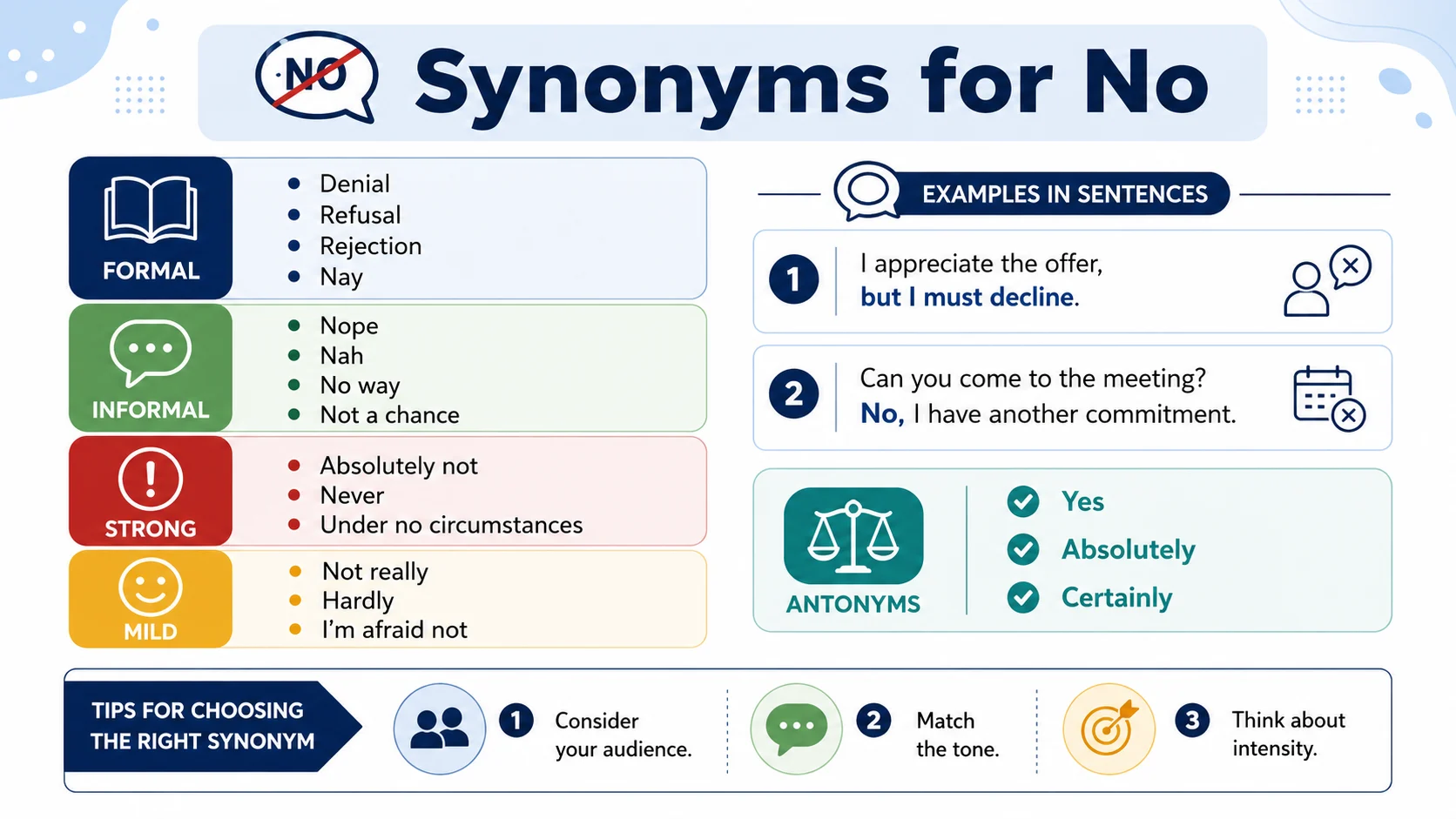
The best synonyms for no are not, never, none, negative, denial, refusal, rejection, and nay. The right choice depends on tone, context, and intensity. For polite refusals, try “I’m afraid not” or “unfortunately not.” For formal settings, use “negative” or “rejection.” For casual conversation, “nah” or “nope” work well.
What Does No Mean?
“No” is a negative response, denial, or refusal. It expresses disagreement, rejection, or the absence of something. As an adverb, it negates a statement or question. As a noun, it represents a negative vote, answer, or decision.
The word serves several purposes:
- Refusing an offer or request
- Disagreeing with a statement
- Expressing prohibition or unavailability
- Indicating the absence of something
Here are two simple examples:
- “Do you want more coffee?” “No, thank you.”
- The committee voted no on the proposal.
Core Meaning of No
At its heart, “no” communicates negation. It tells someone that something is not true, not available, not acceptable, or not happening. The word closes doors, sets boundaries, and creates clarity.
“No” carries finality. When you say it, you’re making a statement. You’re drawing a line. This finality is both the word’s strength and its limitation. Sometimes you need a softer approach. Other times you need a firmer stance. That’s exactly when synonyms for no become valuable.
The word also signals absence. “There is no milk” means milk doesn’t exist in that context. “No problem” means a problem doesn’t exist. This absence meaning overlaps with words like “none” and “nothing.
Grammar and Usage Notes
Part of speech: Adverb, noun, adjective, and interjection
Common sentence patterns:
- As an adverb: “No, I don’t agree.”
- As a noun: “The vote ended with a no.”
- As an adjective: “There are no seats available.”
- As an interjection: “No! Stop!”
Common collocations:
- Say no
- Vote no
- No way
- No thanks
- No longer
- No more
- No chance
- No doubt
When “no” sounds natural:
In most everyday situations, “no” works perfectly. It’s direct, clear, and universally understood. Use it when you need a simple, unambiguous response.
When a synonym works better:
Consider alternatives when you need to soften the blow, sound more professional, express stronger emotion, or match a specific tone. For example, “I’m afraid not” sounds more polite than a blunt “no” when declining an invitation.
Best Synonyms for No
This table organizes the most useful synonyms for no by their meaning, tone, and best use cases.
| Synonym | Meaning | Tone | Best Use Case | Example Sentence |
|---|---|---|---|---|
| Not | Negation of a statement | Neutral | Everyday speech | “I am not going.” |
| Never | Negation at all times | Strong | Emphatic refusal | “I will never agree.” |
| None | Not any | Neutral | Quantity absence | “There are none left.” |
| Negative | Formal refusal or denial | Formal | Military, business, or professional settings | “The test came back negative.” |
| Nay | Formal vote against | Formal | Voting, parliamentary procedure | “The nays have it.” |
| Denial | Statement that something is false | Neutral | Legal, formal contexts | “His denial surprised everyone.” |
| Refusal | Act of saying no | Neutral | Rejecting an offer or request | “Her refusal was firm.” |
| Rejection | Act of dismissing or refusing | Strong | When something is turned down | “He faced rejection from the committee.” |
| Nope | Casual no | Informal | Conversation with friends | “Nope, I haven’t seen it.” |
| Nah | Very casual no | Informal | Texting, casual speech | “Nah, I’m good.” |
| Not at all | Emphatic denial | Polite | Responding to thanks or questions | “Not at all, I was happy to help.” |
| By no means | Strong denial | Formal | Emphatic disagreement | “This is by no means finished.” |
| Absolutely not | Strong refusal | Emphatic | Clear, firm rejection | “Absolutely not, that’s unacceptable.” |
| Under no circumstances | Very strong denial | Formal | Absolute prohibition | “Under no circumstances should you do that.” |
| Hardly | Mild negation | Neutral | Partial or near negation | “I hardly know him.” |
Common Synonyms for No
These everyday alternatives appear frequently in writing and conversation.
Not
The most common negative word in English. It negates verbs, adjectives, and nouns. Use it in nearly any context when you need a standard negation.
Example: “She is not coming to the party.”
Never
This word expresses negation across all time. It means “at no time” or “not ever.” Use it when you want to emphasize permanence.
Example: “I never said that.”
None
Use “none” when referring to not any person or thing. It works well when the quantity is zero.
Example: “None of the students passed the exam.”
Nope
A casual, friendly version of no. Perfect for text messages, social media, and conversations with people you know well.
Example: “Nope, that’s not what happened.”
Nah
Even more casual than “nope.” Common in texting and very informal speech. Use it with friends or in laid-back situations.
Example: “Nah, I’ll pass on that.”
Negative
Often used in professional, military, or radio communication to mean “no.” It sounds official and clear.
Example: “Negative, we don’t have that information.”
Formal Synonyms for No
When writing academic papers, business documents, or professional correspondence, these formal alternatives sound more appropriate than a simple “no.”
Denial
A formal statement that something is not true or that a request is rejected. Use it in legal, academic, or official contexts.
Example: “The company issued a formal denial of the allegations.”
Refusal
The act of saying no to something offered or requested. This word carries weight and sounds professional.
Example: “His refusal to participate was noted in the report.”
Rejection
A strong formal word for when something is dismissed or not accepted. Common in academic, professional, and legal writing.
Example: “The journal sent a rejection of her manuscript.”
Nay
An old-fashioned formal word used in voting contexts. You’ll most often encounter it in parliamentary procedures or historical writing.
Example: “The motion was defeated, with eight nays.”
By no means
A formal phrase that means “not at all” or “definitely not.” Use it for strong, emphatic denials in professional writing.
Example: “This report is by no means complete.”
Under no circumstances
A very formal and emphatic way to say no. Use it when you need to make an absolute prohibition clear.
Example: “Under no circumstances shall employees share confidential information.”
In no way
A formal phrase meaning “not at all.” It sounds professional and measured.
Example: “The new policy is in no way intended to punish employees.”
Informal Synonyms for No
Casual situations call for relaxed language. These informal alternatives for no fit perfectly in everyday conversation, text messages, and social media posts.
Nope
The go-to casual no. It’s friendly, quick, and widely understood. Use it with friends, family, and colleagues you know well.
Example: “Nope, I haven’t seen that movie yet.”
Nah
This word is even more laid-back than “nope.” It signals that you’re not taking the interaction too seriously.
Example: “Nah, let’s just stay home tonight.”
Not really
A soft way to say no that doesn’t feel harsh or final. Use it when you want to disagree gently.
Example: “Do you like that band?” “Not really.”
Not a chance
A colorful, emphatic way to refuse. It sounds very casual and slightly dramatic.
Example: “Will I help you move this weekend?” “Not a chance.”
No way
This phrase expresses strong disbelief or refusal. It’s common in casual speech among friends.
Example: “No way, I’m not doing that.”
Uhh, no
Adding “uhh” before “no” makes it sound hesitant and informal. It’s perfect for expressing mild disagreement.
Example: “Should we go?” “Uhh, no, I’m tired.”
Not gonna happen
A very casual phrase that predicts future refusal. It sounds confident and informal.
Example: “Your plan to get rich overnight? Not gonna happen.”
Strong Synonyms for No
Sometimes you need to say no with force. These strong alternatives carry more emotional weight, power, and intensity than a simple “no.”
Absolutely not
This phrase leaves no room for doubt. It’s a firm, unwavering refusal.
Example: “Absolutely not, that is completely unacceptable.”
Never
When you want to emphasize that something will not happen now or ever, “never” delivers a powerful message.
Example: “I would never agree to those terms.”
Under no circumstances
This phrase means there is no situation in which the answer would be yes. It’s absolute and unyielding.
Example: “Under no circumstances will we compromise our safety standards.”
Not in a million years
A colorful, emphatic way to say no. It suggests the answer will never change.
Example: “Not in a million years would I move back to that city.”
Not on your life
An informal but very strong refusal. It means the answer is absolutely no.
Example: “Will you drive that car?” “Not on your life!”
No way in hell
A very strong, somewhat crude way to say no. Use it only in informal settings with people who won’t be offended.
Example: “No way in hell I’m going to that party.”
Out of the question
This phrase means something is so unacceptable that it shouldn’t even be discussed. It’s firm and absolute.
Example: “Missing the deadline is out of the question.”
Mild Synonyms for No
When you want to avoid harshness or confrontation, use these softer alternatives. They express negation gently and politely.
Not really
A gentle way to disagree without causing offense. It softens the refusal.
Example: “Do you want more food?” “Not really, I’m full.”
Not exactly
This phrase suggests something is close to accurate but not quite. It’s a polite way to disagree.
Example: “Is that the answer?” “Not exactly, it’s a bit more complicated.”
Hardly
A mild word that means “almost not” or “only just.” It softens the negative statement.
Example: “I hardly know the person you’re describing.”
I’m afraid not
A very polite way to say no. It shows regret about the negative answer.
Example: “Can you help me today?” “I’m afraid not, I’m completely booked.”
Unfortunately not
Similar to “I’m afraid not,” this phrase expresses regret about the negative response.
Example: “Are you available next week?” “Unfortunately not, I’ll be traveling.”
Not at all
A polite way to negate someone’s concern or thanks. It shows you don’t mind something.
Example: “Thank you for your help.” “Not at all, it was my pleasure.”
Scarcely
A mild word meaning “almost not.” It creates a gentle negative.
Example: “I scarcely recognized her after all these years.”
Synonyms for No by Context
Everyday Conversation
In casual, daily interactions, choose simple, clear alternatives. “Nope” and “nah” work well with friends and family. For polite situations, “not really” or “I’m afraid not” sound better.
- Best options: Not, nope, nah, not really, no thanks
- Example: “Want to grab lunch?” “Nah, I brought food today.”
Professional Writing
Business emails, reports, and professional communication require formal, measured language. Avoid casual alternatives like “nah” or “nope” in these settings.
- Best options: Denial, refusal, negative, not at this time, unfortunately not
- Example: “The proposal received a denial from the board.”
Academic Writing
Scholarly work demands precise, formal language. Use “denial,” “rejection,” “negation,” or “refusal” when discussing negative responses.
- Best options: Denial, rejection, negation, negative response, non-acceptance
- Example: “The participant’s refusal to complete the survey affected the results.”
Creative Writing
Fiction and creative nonfiction allow for more colorful language. Choose alternatives that fit your character’s voice and the scene’s emotional tone.
- Best options: Never, not a chance, absolutely not, no way, hardly, scarcely
- Example: “He shook his head. ‘Not a chance,’ he said with a grim smile.”
Emotional Expression
When emotions run high, choose words that match the intensity of the situation. “Absolutely not” shows anger or determination. “I’m afraid not” expresses regret.
- Best options: Absolutely not, never, not in a million years, I wish I could, but no
- Example: “I absolutely refuse to accept that outcome.”
Another Word for No in a Sentence
Here are realistic examples using different synonyms for no:
- Not: “I am not interested in buying a new car right now.”
- Never: “She never misses her morning workout.”
- None: “None of the applicants had the required experience.”
- Nope: “Nope, I haven’t seen your keys anywhere.”
- Nah: “Nah, I think I’ll skip the gym today.”
- Denial: “His denial of the accusation only made things worse.”
- Refusal: “Her refusal to compromise ended the negotiation.”
- Rejection: “The publisher’s rejection left him feeling discouraged.”
- Not at all: “Not at all, I really appreciate your help.”
- By no means: “This solution is by no means perfect, but it works.”
- Absolutely not: “Absolutely not, I won’t tolerate that behavior.”
- Hardly: “I hardly recognize this neighborhood anymore.”
- I’m afraid not: “I’m afraid not, we’re fully booked for the weekend.”
- Unfortunately not: “Unfortunately not, the project is behind schedule.”
- Under no circumstances: “Under no circumstances should you use that software without permission.”
No Synonyms Compared
Some synonyms for no overlap in meaning but differ in tone, intensity, or formality. Here’s how to distinguish between them.
| Word | Meaning | Tone | Intensity | Formality | Best Use |
|---|---|---|---|---|---|
| Not | General negation | Neutral | Standard | Neutral | Most situations |
| Never | Emphatic, permanent | Strong | High | Neutral | Emphasizing permanence |
| Nope | Casual refusal | Friendly | Low | Very informal | Friends, family |
| Denial | Formal refusal or rejection | Neutral | Medium | Formal | Legal, professional |
| Refusal | Act of saying no | Neutral | Medium | Formal | Professional contexts |
| Rejection | Dismissal of something | Strong | High | Formal | Academic, professional |
| Absolutely not | Firm refusal | Emphatic | Very high | Neutral | Strong disagreement |
| Not really | Soft no | Gentle | Low | Neutral | Polite disagreement |
Words Similar to No
These words belong to the same semantic family as “no” but aren’t exact synonyms. Use them carefully.
Never
It means “at no time” rather than just “no.” It’s related to “no” but focuses on time rather than the response itself.
Example: “I have never been there.”
Nothing
This means “not anything.” While related to “no,” it refers to objects rather than responses.
Example: “There is nothing in the box.”
Nobody
Means “no person.” Related to “no” but specifically about people.
Example: “Nobody showed up to the meeting.”
Nowhere
Means “no place.” It’s a spatial version of “no.”
Example: “I have nowhere to sit.”
Neither
Means “not one and not the other.” It’s a specific form of negation.
Example: “Neither option appeals to me.”
Barely
Means “only just” or “almost not.” It’s softer than “no” and suggests closeness.
Example: “I barely made it on time.”
Antonyms of No
These words mean the opposite of no and express affirmation or agreement.
| Antonym | Meaning | Example Sentence |
|---|---|---|
| Yes | Affirmative response | “Yes, I would love to go.” |
| Yeah | Casual yes | “Yeah, that sounds great.” |
| Yep | Very casual yes | “Yep, I saw that movie.” |
| Absolutely | Complete agreement | “Absolutely, that’s a great idea.” |
| Certainly | Strong agreement | “Certainly, I can help with that.” |
| Definitely | Firm agreement | “Definitely, count me in.” |
| Exactly | Precise agreement | “Exactly, that’s what I meant.” |
| Affirmative | Formal yes | “Affirmative, we copy that.” |
| Surely | Polite agreement | “Surely, you can stay for dinner.” |
| Indeed | Emphatic agreement | “Indeed, that is the best choice.” |
How to Choose the Right Synonym for No
Choosing the perfect synonym for no involves several factors. Here’s a practical guide:
Match the context. A casual “nah” works in a text message but fails in a boardroom. Consider where and how you’re communicating.
Match the tone. Think about how you want to sound. Formal? Friendly? Firm? Gentle? Each synonym carries its own emotional weight.
Check the intensity. Do you need a soft refusal or an absolute prohibition? “Hardly” sounds mild while “under no circumstances” leaves no room for negotiation.
Think about your reader. How will your audience interpret your words? A boss expects professional language. A friend appreciates casual communication.
Consider your relationship. Close friends can handle “no way.” Professional contacts need “I’m afraid not.” Adjust your word choice to reflect your relationship with the listener.
Keep the sentence natural. Forced synonyms sound awkward. Read your sentence aloud. If it sounds unnatural, choose a different word.
Prioritize clarity. Sometimes “no” is the clearest option. Don’t sacrifice clarity for variety.
Common Mistakes When Using Synonyms for No
Choosing the wrong tone. Using “absolutely not” with a stranger sounds aggressive. Using “nah” with your boss sounds disrespectful. Match your word to the situation.
Using a synonym that’s too strong. “Under no circumstances” sounds extreme for declining a cookie. Soften your language when the situation calls for it.
Using a formal word in casual writing. “Denial” sounds odd in a text to a friend. “Nope” sounds unprofessional in an email to a client.
Using a casual word in professional writing. “Nah” has no place in business correspondence. Professional contexts need professional language.
Replacing “no” without checking meaning. Some synonyms don’t mean the same thing. “Hardly” doesn’t mean the same as “no” in every context.
Treating related words as exact synonyms. “Nothing” and “no” aren’t interchangeable. Understand the difference before using them.
Making the sentence sound unnatural. Don’t force a synonym into every sentence. Sometimes “no” is the best word for the job.
Quick Synonym List for No
Common Synonyms:
- Not
- Never
- None
- Nope
- Nah
- Negative
Formal Synonyms:
- Denial
- Refusal
- Rejection
- Nay
- By no means
- Under no circumstances
- In no way
Informal Synonyms:
- Nope
- Nah
- Not really
- Not a chance
- No way
- Uhh, no
- Not gonna happen
Strong Synonyms:
- Absolutely not
- Never
- Under no circumstances
- Not in a million years
- Not on your life
- No way in hell
- Out of the question
Mild Synonyms:
- Not really
- Not exactly
- Hardly
- I’m afraid not
- Unfortunately not
- Not at all
- Scarcely
Related Words:
- Nothing
- Nobody
- Nowhere
- Neither
- Barely
- Never
FAQs
What is the best synonym for no?
The best synonym depends on context. For everyday use, “not” or “nope” work well. For formal settings, “denial” or “refusal” sound more professional. For emphasis, “absolutely not” delivers a strong message.
What is another word for no?
Common alternatives include not, never, none, nope, nah, denial, refusal, rejection, and negative. The right choice depends on your situation.
What is a formal synonym for no?
Formal synonyms include denial, refusal, rejection, nay, and “by no means.” Use these in academic writing, business communication, and official documents.
What is an informal synonym for no?
Informal synonyms include nope, nah, “not really,” “no way,” and “not a chance.” These work in casual conversations, text messages, and social media.
What is a stronger word for no?
Stronger alternatives include “absolutely not,” “never,” “under no circumstances,” and “not in a million years.” These carry more emotional weight and firmness.
What is a milder word for no?
Milder options include “not really,” “not exactly,” “hardly,” “I’m afraid not,” and “unfortunately not.” These soften the refusal and sound more polite.
What words are similar to no?
Related words include nothing, nobody, nowhere, neither, and barely. These share the idea of negation but aren’t exact synonyms for “no.”
What is the opposite of no?
The main antonyms are yes, yeah, yep, absolutely, certainly, definitely, exactly, affirmative, surely, and indeed. These all express agreement or affirmation.
How do I choose the right synonym for no?
Consider your context, tone, intensity needs, and audience. Formal settings call for professional language. Casual situations allow for relaxed alternatives. Match your word to the situation.
Conclusion
“No” is a powerful word, but it’s not your only option. A wide range of alternatives helps you express negation with the right tone, intensity, and formality for any situation. From casual “nah” to formal “denial,” from mild “I’m afraid not” to strong “absolutely not,” each synonym serves a specific purpose.
The best synonym depends on your context, audience, and emotional intent. Consider the situation carefully. Think about your reader. Choose the word that matches both your meaning and your tone. With this guide, you can move beyond “no” and communicate with greater precision, politeness, and impact.

Charlotte Wilson is a language writer passionate about word meanings, synonyms, and clear communication. She creates accurate and engaging content to help readers expand their vocabulary and language skills.



1 thought on “Synonyms for No| Meaning, Examples and Better Word Choices For 2026”