Feeling lonely is a universal human experience, but finding the right word to describe that feeling can be surprisingly tricky. The best synonyms for lonely are lonesome, isolated, forlorn, and solitary, yet each carries a unique nuance that changes the sentence’s tone and impact. A person might feel “lonesome” on a quiet evening, while a remote “isolated” village conveys physical separation. This guide explores the full spectrum of lonely synonyms, offering clear distinctions, example sentences, and practical advice to help you choose the perfect word for any context.
Best Synonyms for Lonely
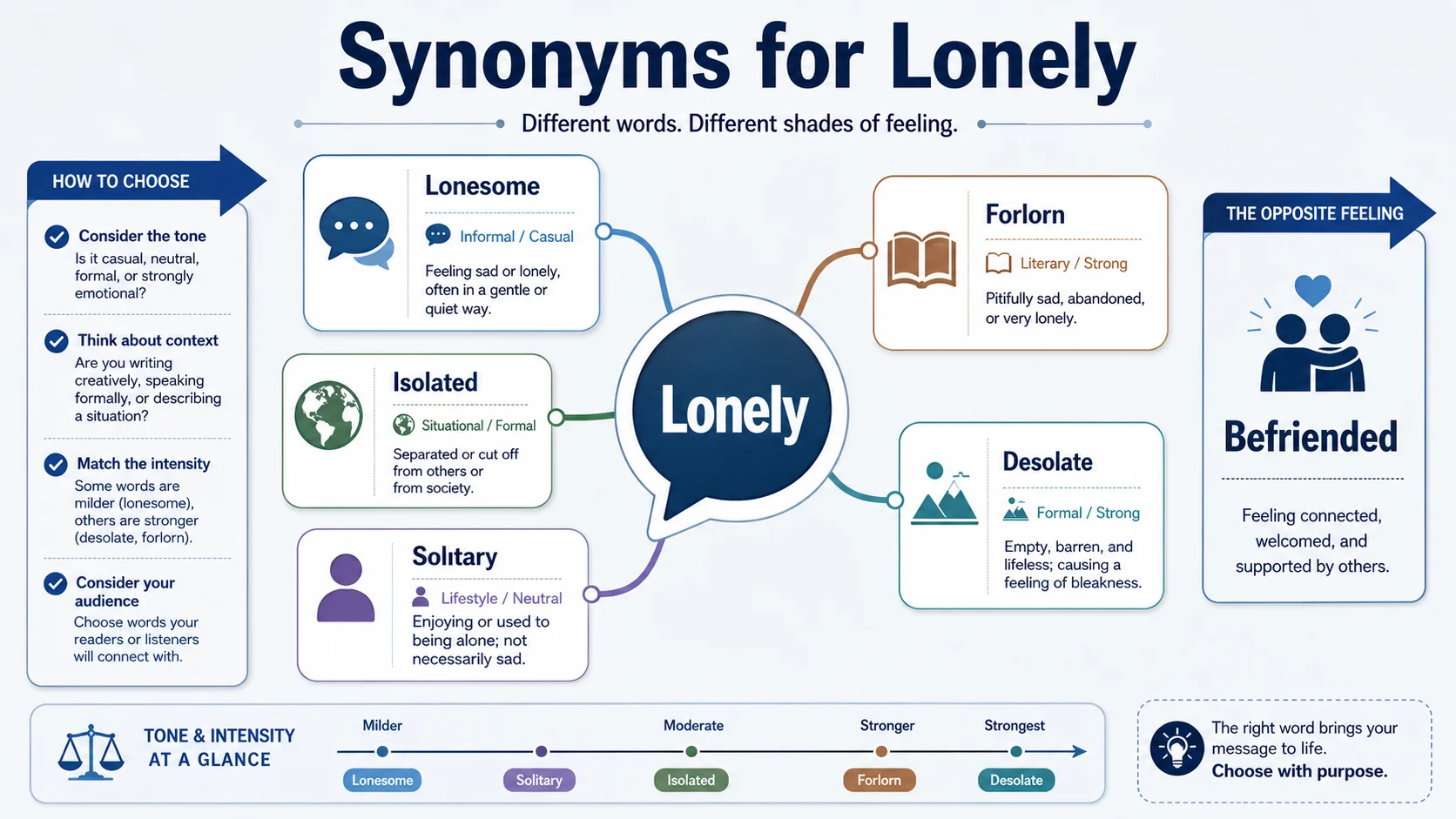
The best synonyms for lonely are lonesome, isolated, forlorn, and solitary. “Lonesome” is a common, informal American term for the sad feeling of being alone . “Isolated” describes feeling cut off from others, often due to circumstances . “Forlorn” is a more literary word for someone who is sad and alone . “Solitary” can describe a preference for being alone or a state of physical aloneness .
What Does Lonely Mean?
The word lonely is an adjective that describes a feeling of sadness or unhappiness because you lack companionship or feel separated from others . It can also describe a place that is remote and uninhabited, or an action done without company. It is a common word used in all contexts to express a state of solitude that is often unwanted .
- Simple definition: Feeling sad because you are alone or without friends.
- Core idea: An emotional state stemming from a perceived lack of social connection.
- Part of speech: Adjective.
- Example sentence: “I’ve been lonely since my friends moved away.”
Core Meaning of Lonely
At its heart, loneliness is a subjective emotional state. It’s more than just being physically alone; it’s the distressing feeling that comes from a gap between the social connections you have and the ones you want. A person can feel lonely even in a crowded room. The term generally carries a negative connotation, suggesting an absence that causes pain. However, “lonely” can also describe a preference for solitude, such as a “lonely existence” that a person might actually enjoy . The word’s power lies in its ability to convey both internal emotion and external circumstance.
Grammar and Usage Notes
As an adjective, “lonely” is typically used to describe a person’s feelings, a state of existence, or a place. Here are some common usage patterns:
- Part of speech: Adjective. Its comparative form is “lonelier,” and the superlative is “loneliest.”
- Common collocations: “Lonely heart,” “lonely road,” “lonely existence,” “feel lonely.”
- Sentence patterns: It frequently appears with linking verbs like “feel,” “seem,” or “be.” For example, “She felt lonely” or “He seems lonely.”
- Appropriate use: “Lonely” sounds natural when discussing personal feelings, describing remote locations, or characterizing a solitary lifestyle.
- Choosing a synonym: A synonym may be better if you need to specify why a person is alone (e.g., “friendless”) or if you want a word with a stronger literary or formal tone (e.g., “forlorn,” “desolate”).
Best Synonyms for Lonely
The following table organizes the most accurate synonyms for “lonely,” highlighting their subtle differences.
| Synonym | Meaning | Tone | Best Use Case | Example Sentence |
|---|---|---|---|---|
| Lonesome | Sad because of being without company . | Informal, primarily US | Everyday conversation, personal feelings. | “I’m feeling lonesome now that the kids are gone.” |
| Isolated | Feeling cut off from others, separated from the rest of the world . | Neutral, descriptive | Describing a situation or location causing loneliness. | “Living in a rural area made her feel isolated.” |
| Forlorn | Sad and lonely, often in a desperate or pitiful way . | Literary, formal | Creative writing, dramatic descriptions. | “He looked like a forlorn figure standing in the rain.” |
| Solitary | Being alone, either by choice or as a state of being . | Neutral, formal | Describing a preference for being alone or a lifestyle. | “He led a quiet, solitary life.” |
| Desolate | Barren and empty, causing a feeling of great sadness . | Strong, formal | Describing a place or a person’s severe emotional state. | “The loss left her feeling desolate.” |
Common Synonyms for Lonely
These everyday synonyms are perfect for general use when you need a direct replacement for “lonely” in conversation or standard writing.
- Lonesome: As noted, this is a very common synonym in American English for the sad feeling of being alone .
- Example: “It gets lonesome out here on the farm.”
- Alone: While often just a state of being, “alone” can be used to mean lonely, particularly in emotional contexts .
- Example: “Never in her life had she felt so alone.”
- Friendless: This is a more specific term that means having no friends.
- Example: “He was a shy, friendless child.”
- Abandoned: This implies being left behind or deserted, leading to a feeling of loneliness.
- Example: “She felt abandoned by her closest friends.”
Formal Synonyms for Lonely
For academic, business, or professional writing, these formal synonyms are excellent choices. They are often used to describe situations or states of being with more detachment.
- Isolated: This is a versatile and formal word suitable for describing a state of being cut off from others, whether by location or social circumstances .
- Best Use: Reports, analytical writing. “The study focused on the effects of social isolation on isolated elderly populations.”
- Desolate: This word conveys a deep, bleak, and often hopeless loneliness. It’s formal and powerful, often used to describe a place that feels empty and sad .
- Best Use: Formal writing, literature, describing severe emotional states or barren landscapes. “After the war, the town was a desolate place.”
- Solitary: This word is a refined way to describe someone or something being alone. It can imply a preference for solitude or simply a state of being without companions .
- Best Use: Professional or academic descriptions of lifestyle, habits, or conditions. “His solitary nature made him an excellent researcher.”
Informal Synonyms for Lonely
When chatting with friends, sending a text, or writing casually, these informal synonyms are natural and relatable.
- Lonesome: This is the most common informal substitute for “lonely” in US English, carrying the exact same emotional weight .
- Best Use: Casual conversations, personal messages. “Come over, I’m feeling a bit lonesome.”
- All alone: This phrase emphasizes being completely by oneself, often with a tone of sadness or vulnerability.
- Best Use: Emotional conversations, social media posts. “It’s tough being all alone in a new city.”
- By yourself: While simply meaning “alone,” this phrase can be used in a lighthearted way to describe a state of being without others .
- Best Use: Friendly advice, casual observations. “Are you okay just sitting by yourself?”
Strong Synonyms for Lonely
These synonyms carry a significantly stronger, more intense emotional weight. Use them when you need to express profound sadness, desperation, or a desolate state.
- Desolate: This is a powerfully bleak term. It suggests not just loneliness, but a feeling of utter emptiness and hopelessness .
- When to use: In writing to create a powerful emotional impact, describing a character’s lowest point. Caution: It sounds too dramatic for everyday use.
- Forlorn: This word evokes a sense of pitiful sadness, abandonment, and hopelessness. It’s a very strong, literary adjective .
- When to use: In creative writing, memoirs, or emotional recounts. Caution: Can seem exaggerated if used in casual conversation.
- Lorn: An archaic and literary synonym meaning “alone and unhappy .
- When to use: Almost exclusively in a poetic or literary context. Caution: Will sound outdated in any modern, everyday setting.
Mild Synonyms for Lonely
These words soften the feeling of loneliness, describing a state of being alone without the heavy sadness. They are neutral or even positive alternatives.
- Solitary: This word is perfect when the state of being alone is neutral or even preferred. It describes a lifestyle or characteristic without a negative judgment .
- Example: “He enjoyed the solitary life of a lighthouse keeper.”
- Alone: In many contexts, “alone” simply means “without other people” and carries no emotional baggage .
- Example: “She spent the afternoon alone in her garden, reading.”
- Unaccompanied: A formal, neutral word meaning “without a companion .
- Example: “Unaccompanied minors are not allowed on the flight.”
Synonyms for Lonely by Context
The best word choice often depends on the context in which you are writing or speaking. Here’s how to choose a synonym for different situations.
Everyday Conversation
For daily talk with friends and family, simple and direct words are best. Lonesome is a top choice for expressing a sad feeling. Alone and friendless are also perfectly natural and clear.
Professional Writing
In professional settings, it’s best to avoid overly emotional language. Isolated is a great choice for describing a situation where someone is cut off from their team. Solitary can be used to describe a person’s preferred work style. These words are descriptive and neutral.
Academic Writing
Academics often analyze loneliness as a social or psychological phenomenon. Words like isolated and desolate are appropriate for describing conditions, while solitary works for behaviors.
Creative Writing
Creative writers have the richest palette. They can use forlorn to paint a picture of a pitiful character, desolate to describe a bleak landscape, or lorn for a poetic feel . The choice here is all about setting the perfect mood.
Another Word for Lonely in a Sentence
Seeing synonyms in action is the best way to understand them. Here are numerous example sentences using different alternatives for “lonely.
- She felt a deep sense of isolation in the new office.
- The old dog seemed forlorn after its owner passed away.
- His solitary walks in the woods were his only form of relaxation.
- The orphaned child felt abandoned and scared.
- I’ve grown so lonesome since you left for college.
- The remote village was a desolate place, especially in winter.
- He was a friendless teenager who spent most of his time indoors.
- We found a secluded beach away from the crowds.
- The lone figure on the mountain made a dramatic silhouette.
- She lived a reclusive life, rarely seeing anyone.
- The team was left stranded without any supplies.
- The old manor was godforsaken, standing empty for decades.
Lonely Synonyms Compared
Understanding the small differences between the most common synonyms will help you choose the exact word you need.
| Synonym | Meaning | Tone | Best Use Case |
|---|---|---|---|
| Lonesome | Feeling sad due to being alone . | Informal, American English | Everyday conversation, personal feelings. |
| Isolated | Separated from others, feeling cut off . | Neutral, descriptive | Situational loneliness, describing conditions. |
| Forlorn | Pitifully sad and abandoned . | Literary, formal | Creative writing, dramatic emotional expression. |
| Solitary | Done or existing alone . | Neutral, formal | Describing a lifestyle, preference, or state. |
| Desolate | Empty and bleak, causing great sadness . | Strong, formal | Powerful emotions, barren landscapes. |
Words Similar to Lonely
Some words are related to loneliness but are not always direct synonyms. They belong to the same semantic field and can be useful depending on what you want to emphasize.
- Reclusive: This describes a person who prefers to live alone and avoids other people. It’s related to loneliness but suggests a choice rather than a sad circumstance. Example: “The reclusive author rarely gave interviews.”
- Secluded: This word is used to describe a place that is private and hidden away from people. It’s not a feeling but a characteristic of a location. Example: “They have a secluded cabin in the mountains.”
- Remote: Similar to secluded, this describes a place that is far away from towns and cities . It can cause loneliness but is not a direct synonym for the feeling itself.
Antonyms of Lonely
These words describe the opposite of loneliness states of being connected, accompanied, or popular.
- Befriended: Having friends; not alone.
- Example: “She quickly felt befriended by her new colleagues.”
- Accompanied: Having someone with you.
- Example: “He was always accompanied by his faithful dog.”
- Popular: Liked by many people.
- Example: “She was the most popular girl in school.”
- Together: Associated with others; not isolated.
- Example: “They lived together for many years.”
How to Choose the Right Synonym for Lonely
Here are some practical steps to ensure you pick the perfect word every time.
- Match the Context: Is it a casual conversation, a formal report, or a piece of creative fiction? Choose a word that fits the setting. Use lonesome for casual talk and isolated for professional writing.
- Match the Tone: Do you want to sound emotional, neutral, or academic? Forlorn and desolate are very emotional, while solitary is more neutral.
- Check the Intensity: Does the situation call for a strong word or a mild one? A minor feeling of loneliness on a rainy afternoon might be “lonesome,” while the grief of losing a loved one could be “desolate.”
- Think About the Reader: Consider who you are writing for. Overly literary words like “forlorn” can feel out of place in a text message to a friend.
- Is it an Exact Match? Is the synonym describing a feeling, a place, or a choice? Isolated is great for situations, while solitary is better for a chosen lifestyle.
Common Mistakes When Using Synonyms for Lonely
Using a thesaurus without understanding nuance is a classic pitfall. Avoid these common errors.
- Choosing a word with the wrong tone: Don’t use the very strong and literary “forlorn” to describe a quiet night in.
- Using a word that is too strong: Saying you feel “desolate” because your favorite show ended is a vast overstatement.
- Using a formal word in casual writing: Telling a friend you feel “isolated” might sound stiff; “lonesome” is better.
- Using a casual word in professional writing: Describing a work situation as “lonesome” is less precise than using the more neutral “isolated.”
- Treating related words as exact synonyms: “Reclusive” and “lonely” are not the same thing; one is a choice, the other is an emotion.
Quick Synonym List for Lonely
Here is a clean, scannable list of synonyms for “lonely” to use as a quick reference.
- Common synonyms: alone, lonesome, friendless, abandoned, forsaken
- Formal synonyms: isolated, solitary, desolate
- Informal synonyms: lonesome, by yourself, on your own
- Strong synonyms: forlorn, lorn, desolate
- Mild synonyms: solitary, alone, unaccompanied
- Related words: reclusive, secluded, remote
FAQs
What is the best synonym for lonely?
The best synonym depends on your context. For a general, emotional feeling, lonesome works perfectly in informal settings. For professional writing, isolated is a better choice. Solitary is ideal when describing a preference for being alone.
What is another word for feeling lonely?
Another word for feeling lonely is lonesome. You might also say you feel isolated, friendless, or forlorn if the situation is more serious .
What is a formal synonym for lonely?
Isolated, solitary, and desolate are all strong formal synonyms. “Isolated” describes a state of being cut off, while “solitary” describes a condition of being alone .
What is an informal synonym for lonely?
Lonesome is the most common informal synonym for lonely, especially in American English . “By yourself” and “on your own” are other casual ways to express a similar state.
What is a stronger word for lonely?
Forlorn and desolate are much stronger and more intense words for lonely. They imply deep sadness, hopelessness, and abandonment .
What is the opposite of lonely?
The opposite of lonely is befriended or accompanied. Other antonyms include popular and together .
What words are similar to lonely but not exact synonyms?
Words like reclusive, secluded, and remote are related but not exact synonyms. “Reclusive” describes a person’s character, while “secluded” and “remote” describe places .
How do I choose the right synonym for lonely?
Think about your context, tone, and the intensity of the feeling you want to express. A simple, mild feeling is best described by “lonely,” “alone,” or “lonesome,” while a more profound or formal situation calls for “isolated” or “forlorn.”
Conclusion
While “lonely” is a clear and direct word, English offers a rich vocabulary for expressing every shade of solitude and sadness. From the casual “lonesome” to the powerful “forlorn,” the right synonym can make your writing more precise and impactful. Remember to consider your audience, the context of your sentence, and the intensity of the emotion. The best word is always the one that feels most natural and accurately conveys your message. By exploring these options, you can transform a simple statement of loneliness into a vivid and nuanced piece of language.

Jack Murphy is a language writer with a passion for word meanings, synonyms, and effective communication. He creates informative and easy to understand content to help readers enhance their vocabulary and language skills.