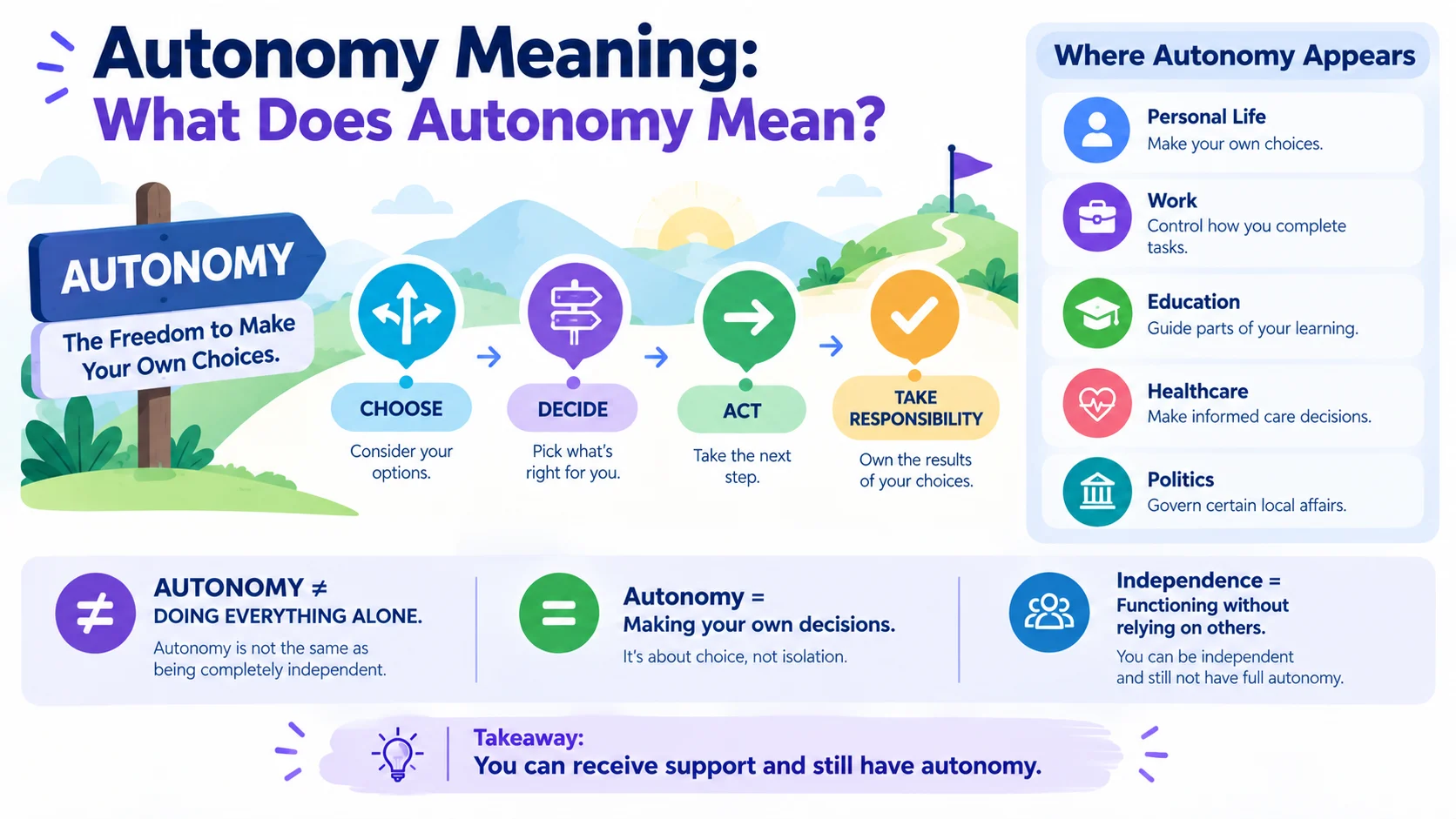
The autonomy meaning centers on the idea of self-direction and personal choice. When someone has autonomy, they can make decisions about their own life, actions, or responsibilities without unnecessary control from another person or group. In simple terms, autonomy means having the freedom to decide for yourself.
For example, an employee may have autonomy when their manager gives them a goal but lets them choose how to complete the work. Likewise, a person has personal autonomy when they can make important choices about their own life according to their values and preferences.
However, autonomy does not always mean complete independence. A person can depend on others for support while still making their own decisions. Similarly, autonomy can exist within rules, laws, relationships, schools, workplaces, and other systems.
The word also has specialized meanings. In ethics and medicine, autonomy often involves a person’s right to make informed choices about their own body or treatment. In politics, autonomy can describe a region’s ability to govern some of its own affairs.
Therefore, understanding what does autonomy mean requires looking at both personal freedom and the context in which people make decisions.
What Does Autonomy Mean?
Autonomy means having the freedom and ability to make your own decisions and direct your own actions.
It involves:
- Personal choice
- Self-direction
- Decision-making
- Freedom from unnecessary control
- Responsibility for choices
- Control over relevant parts of your life
For example, a worker who chooses how to complete an assigned project may have workplace autonomy.
Likewise, someone who makes their own decisions about education, career, relationships, or daily activities may exercise personal autonomy.
Autonomy Definition in Simple English
A simple autonomy definition is:
Autonomy is the ability and freedom to make your own choices and control your own actions.
The word emphasizes self-rule.
In other words, an autonomous person does not simply follow someone else’s wishes. Instead, they can think about their options, choose among them, and act according to their own values or goals.
However, autonomy does not remove responsibility. In fact, greater autonomy often means greater responsibility because a person has more control over the outcome.
What Is Autonomy?
Autonomy is the condition of having meaningful control over your own decisions and actions.
The term can apply to an individual, group, organization, or political region.
For instance:
- A person can have personal autonomy.
- An employee can have workplace autonomy.
- A student can have academic autonomy.
- A patient can exercise medical autonomy.
- A region can have political autonomy.
- An organization can operate with administrative autonomy.
Although the contexts differ, the central idea remains similar: the ability to direct one’s own affairs.
What Does Autonomy Mean in Everyday Life?
In everyday life, autonomy means having a reasonable degree of control over your own choices.
Consider a young adult choosing a career. If they can explore options and select a career based on their interests and goals, they are exercising autonomy.
Similarly, choosing where to live, what to study, how to spend your time, or which goals to pursue can involve autonomy.
Of course, everyday decisions often involve other people. Family members, employers, laws, finances, and social responsibilities can affect available choices.
Even so, a person can maintain autonomy when they retain meaningful control over their decisions.
Examples of Autonomy
Autonomy appears in many ordinary situations.
Choosing a Career
Someone may choose a career because it matches their interests and goals rather than simply following another person’s wishes.
That decision demonstrates personal autonomy.
Managing Your Work
An employee may receive a deadline and project goal but decide how to organize the work.
This arrangement gives the employee greater workplace autonomy.
Making Personal Decisions
A person may decide what they want to study, where they want to live, or how they want to spend their free time.
These choices can reflect personal autonomy.
Making Health Decisions
A patient who receives relevant information and makes an informed decision about treatment exercises medical autonomy.
Setting Personal Boundaries
Choosing what behavior you will accept in a relationship can also involve autonomy.
For example, someone might decide that they need personal time or that certain behavior crosses a boundary.
Personal Autonomy
Personal autonomy means having meaningful control over your own life and decisions.
It can involve choices about:
- Career
- Education
- Relationships
- Lifestyle
- Personal goals
- Daily routines
- Finances
- Values
- Health decisions
Personal autonomy does not mean that nobody can influence you.
Friends, family, teachers, and colleagues may offer advice. However, advice differs from control.
A person retains autonomy when they can consider advice and ultimately make their own choices.
Autonomy in Relationships
Autonomy plays an important role in healthy relationships.
A relationship does not require two people to make every decision together. Instead, each person can maintain individual choices while also considering the needs of the relationship.
For example, partners may have separate:
- Hobbies
- Friend groups
- Career goals
- Personal interests
- Spending preferences
- Free-time activities
This independence can support a healthy relationship.
However, autonomy does not mean ignoring a partner. Healthy autonomy balances individual choice with mutual respect and shared responsibility.
Autonomy at Work
Workplace autonomy means giving employees meaningful control over how they perform their responsibilities.
For example, a manager might say:
“Please finish the report by Friday.”
The employee then decides how to organize the research, schedule the work, and complete the report.
That approach provides more autonomy than giving detailed instructions for every small step.
Workplace autonomy can help employees feel trusted and responsible. It can also encourage initiative and problem-solving.
Nevertheless, autonomy works best when employees understand their goals, responsibilities, deadlines, and limits.
Examples of Workplace Autonomy
Workplace autonomy can include:
- Choosing how to complete a task
- Setting parts of your own schedule
- Deciding which tools to use
- Managing project priorities
- Solving problems independently
- Choosing when to take breaks when policies allow
- Developing your own work process
For example, a designer may receive a project brief but choose the visual approach independently.
Similarly, a software developer may receive a product requirement but select the technical method for completing the task.
Autonomy in Education
Students can also benefit from autonomy.
Academic autonomy means allowing students to make meaningful choices about parts of their learning.
For example, a teacher might allow students to:
- Choose a research topic
- Select a project format
- Set learning goals
- Choose books from a list
- Develop their own study strategy
These choices can encourage responsibility and engagement.
However, student autonomy does not mean removing all structure. Clear expectations can still guide learning.
Autonomy in Healthcare
In healthcare, patient autonomy refers to a patient’s right to make informed decisions about their own medical care.
This concept is especially important when healthcare professionals discuss treatment options.
A patient may receive information about:
- Possible treatments
- Benefits
- Risks
- Alternatives
- Expected outcomes
After receiving appropriate information, the patient can make an informed decision.
The principle respects the patient’s role in decisions about their own body and healthcare.
Autonomy and Informed Consent
Informed consent connects closely with medical autonomy.
A patient should generally understand relevant information before agreeing to a medical procedure or treatment.
Therefore, consent involves more than simply saying “yes.”
The person needs enough information to make a meaningful decision.
However, medical situations can become complex. Emergency circumstances, capacity concerns, legal requirements, and other factors can affect how healthcare professionals apply autonomy.
Moral Autonomy
In philosophy, moral autonomy refers to the ability to make moral decisions using one’s own reasoning rather than simply obeying external authority.
A morally autonomous person considers principles, values, consequences, and reasons when deciding what they believe is right.
For example, someone might refuse to participate in an unfair action even when a person in authority tells them to do it.
The concept therefore connects autonomy with moral responsibility.
Political Autonomy
In politics, autonomy can describe the ability of a region or group to govern some of its own affairs.
An autonomous region may have authority over certain local matters while remaining part of a larger country or political system.
Therefore, political autonomy does not always mean complete independence.
The exact meaning depends on the constitution, laws, and political structure involved.
Organizational Autonomy
An organization can also have autonomy.
For example, a university department may have authority to make certain decisions without approval from the entire institution.
Likewise, a nonprofit organization may independently manage its internal programs within legal and organizational limits.
Here, autonomy means control over relevant internal decisions.
Autonomy vs. Independence
People often use autonomy and independence as if they mean the same thing. However, they emphasize different ideas.
Autonomy focuses on the ability to make your own decisions.
Independence often focuses on functioning without relying on others.
For example, a person may need assistance with transportation but still make their own choices about where they want to go.
That person may have limited physical independence but still maintain personal autonomy.
Simple Difference
| Term | Main Focus |
|---|---|
| Autonomy | Making your own choices |
| Independence | Functioning without relying on others |
| Freedom | Having room to act without unnecessary restrictions |
| Self-determination | Choosing your own goals and direction |
Therefore, autonomy does not require complete independence.
Autonomy vs. Freedom
Freedom generally refers to the ability to act without unreasonable restrictions.
Autonomy focuses more specifically on self-direction and decision-making.
For example, you may have the freedom to choose between several jobs. Autonomy involves deciding which job fits your goals and values.
The concepts overlap, but autonomy places greater emphasis on self-governance.
Autonomy vs. Self-Determination
These terms are closely related.
Self-determination means having the ability or right to determine your own goals, choices, and direction.
Autonomy also emphasizes self-directed decision-making.
In many contexts, the terms can overlap. However, self-determination often appears in discussions about personal identity, groups, communities, and political rights.
Autonomy vs. Control
These concepts sit at opposite ends of a useful spectrum.
When a person has autonomy, they have meaningful control over their own decisions.
When another person controls them excessively, their autonomy decreases.
For example:
Autonomy: “Choose whichever method works best.”
Excessive control: “Follow these exact steps and do not make changes.”
The first statement allows self-direction. The second limits it.
Why Is Autonomy Important?
Autonomy matters because people generally need some control over their own lives.
It can support:
- Responsibility
- Confidence
- Motivation
- Personal identity
- Decision-making
- Self-respect
- Problem-solving
- Personal growth
For example, when people make meaningful choices, they can learn from the results.
Likewise, autonomy can help people understand their own values and priorities.
However, autonomy works alongside responsibility. Choices can affect other people, so personal freedom does not eliminate social obligations.
Benefits of Autonomy
Greater Responsibility
When people make their own choices, they can take greater ownership of the results.
More Motivation
Having meaningful control can make tasks feel more personally important.
Better Decision-Making
Autonomy gives people opportunities to practice evaluating choices and consequences.
Increased Confidence
Making decisions independently can strengthen confidence over time.
Personal Growth
People often learn through experience. Autonomy gives them opportunities to try, adjust, and improve.
Possible Challenges of Autonomy
Autonomy also has limits and challenges.
Too little autonomy can make people feel controlled or powerless. On the other hand, too much responsibility without adequate support can create stress.
For example, an employee may appreciate freedom but still need clear goals and resources.
Similarly, a student may want more choice but still benefit from guidance.
Therefore, effective autonomy usually requires a balance between freedom, structure, support, and responsibility.
Autonomy in Psychology
Psychology often discusses autonomy as an important human need.
People generally want to feel that their actions reflect their own choices rather than constant external pressure.
This does not mean people want to do everything alone.
Instead, a person can feel autonomous while receiving support from others.
For example, asking a friend for advice does not automatically reduce autonomy. The person can listen to the advice and still make the final decision.
How to Develop Personal Autonomy
Building autonomy can happen through small decisions.
Identify Your Values
First, think about what matters most to you.
Your values can help guide decisions when several options appear.
Make Small Decisions
Start with everyday choices.
For example, choose your schedule, priorities, hobbies, or study methods when you have the freedom to do so.
Set Boundaries
Clear boundaries can help protect your time, energy, and personal choices.
Learn From Mistakes
Autonomy includes making imperfect decisions.
Instead of expecting every choice to work perfectly, use mistakes as opportunities to learn.
Accept Responsibility
Freedom and responsibility work together.
When you make a choice, consider its possible effects and take responsibility for the outcome.
How to Encourage Autonomy in Others
You can support someone else’s autonomy without abandoning them.
For example:
- Offer choices.
- Explain expectations.
- Give useful information.
- Respect reasonable boundaries.
- Avoid unnecessary control.
- Allow people to solve appropriate problems themselves.
- Provide support when they ask for it.
Parents, teachers, managers, and partners can all encourage autonomy in different ways.
The goal is not to remove guidance. Instead, the goal is to provide enough support while allowing the other person meaningful control.
Common Misconceptions About Autonomy
“Autonomy Means Doing Everything Alone”
Not necessarily.
A person can ask for help and still make their own decisions.
“Autonomy Means No Rules”
Autonomy can exist within rules.
For example, an employee may have freedom over their work process while still following workplace policies.
“Autonomy Means Never Listening to Others”
Listening to advice does not remove autonomy.
The key issue is whether you can make your own informed decision.
“Autonomy Means Selfishness”
Personal autonomy does not require ignoring other people.
Healthy autonomy can coexist with empathy, cooperation, and responsibility.
“Independent and Autonomous Mean Exactly the Same Thing”
They overlap, but they are not identical.
Independence often concerns reliance on others. Autonomy focuses on self-directed choices.
Autonomy in a Sentence
Here are some natural examples:
- “The employee enjoys a high level of autonomy at work.”
- “Personal autonomy allows people to make important decisions about their lives.”
- “The patient wanted greater autonomy over their treatment decisions.”
- “Students often perform well when teachers give them some autonomy.”
- “The organization operates with considerable autonomy.”
- “Healthy relationships allow both partners to maintain personal autonomy.”
- “The region has political autonomy over certain local matters.”
Grammar and Usage of “Autonomy”
Autonomy is a noun.
Common phrases include:
- Personal autonomy
- Individual autonomy
- Workplace autonomy
- Patient autonomy
- Political autonomy
- Greater autonomy
- Greater personal autonomy
- Maintain autonomy
- Protect autonomy
- Respect autonomy
- Give someone autonomy
- Exercise autonomy
Example Sentences
Noun:
“Employees need some autonomy to solve problems creatively.”
With “personal”:
“Personal autonomy plays an important role in decision-making.”
With “workplace”:
“Workplace autonomy can give employees more control over their daily tasks.”
What Is the Opposite of Autonomy?
There is no single perfect opposite in every context.
Depending on the situation, possible contrasts include:
- Dependence
- Control
- Domination
- Subordination
- Coercion
- Lack of choice
For example, dependence may contrast with autonomy when someone cannot make decisions without another person’s approval.
Meanwhile, coercion presents a stronger contrast because it involves forcing someone to act against their wishes.
Synonyms for Autonomy
Common synonyms or closely related terms include:
- Independence
- Self-rule
- Self-direction
- Self-governance
- Self-determination
- Freedom
- Sovereignty
However, these words are not perfect substitutes in every sentence.
For example, sovereignty often refers to political authority, while autonomy can describe personal decision-making.
Similarly, independence often emphasizes freedom from reliance on others.
Quick Reference: Autonomy Meaning
| Question | Answer |
|---|---|
| What does autonomy mean? | The ability and freedom to make your own decisions |
| What is autonomy in simple words? | Self-direction and personal choice |
| What is personal autonomy? | Control over your own life and decisions |
| What is workplace autonomy? | Freedom to decide how to perform work responsibilities |
| What is patient autonomy? | A patient’s ability to make informed healthcare decisions |
| Does autonomy mean independence? | Not exactly |
| Does autonomy mean freedom? | They are related, but autonomy focuses more on self-directed choice |
| What is moral autonomy? | Making moral decisions through your own reasoning |
| What is political autonomy? | Self-government over certain affairs within a larger political system |
| What is the opposite of autonomy? | Depending on context, control, coercion, dependence, or subordination |
| Is autonomy a noun? | Yes |
Frequently Asked Questions
What is the basic autonomy meaning?
The basic autonomy meaning is the freedom and ability to make your own decisions and direct your own actions.
What does autonomy mean in simple terms?
Autonomy means having meaningful control over your own choices rather than allowing unnecessary control from others.
What is an example of autonomy?
An employee choosing how to complete a project within a given deadline is an example of workplace autonomy.
What is personal autonomy?
Personal autonomy means having control over important decisions about your own life, values, goals, and actions.
Is autonomy the same as independence?
No. Independence often means functioning without relying on others, while autonomy focuses on making your own decisions. A person can need assistance while still maintaining autonomy.
Is autonomy the same as freedom?
They are closely related. Freedom concerns the ability to act without unnecessary restrictions, while autonomy emphasizes self-directed decision-making.
What does autonomy mean in a relationship?
In a relationship, autonomy means that each person can maintain personal choices, boundaries, interests, and goals while still respecting the relationship.
What does autonomy mean at work?
Workplace autonomy means employees have meaningful control over how they perform their responsibilities.
What does autonomy mean in healthcare?
Patient autonomy means respecting a person’s ability to make informed decisions about their healthcare.
What is moral autonomy?
Moral autonomy is the ability to make moral judgments using one’s own reasoning rather than simply following external authority.
Can autonomy exist with rules?
Yes. Autonomy does not require unlimited freedom. A person can make meaningful choices while following reasonable rules and responsibilities.
Is asking for help the opposite of autonomy?
No. Asking for help does not automatically remove autonomy. A person can receive support while still making their own decisions.
What are some synonyms for autonomy?
Depending on context, related words include independence, self-direction, self-governance, self-rule, freedom, and self-determination.
Conclusion
The autonomy meaning centers on self-direction, personal choice, and control over one’s own decisions. Whether the subject is an individual, employee, student, patient, organization, or political region, autonomy involves some ability to direct one’s own affairs.
Importantly, autonomy does not mean doing everything alone. A person can receive advice, support, or assistance while still making their own decisions. Likewise, autonomy can exist within reasonable rules and responsibilities.
In everyday life, personal autonomy helps people choose their goals and shape their lives. At work, it can give employees more control over how they complete tasks. In healthcare, it supports informed decision-making. Meanwhile, political autonomy can give a region authority over certain local affairs.
Ultimately, autonomy is about having meaningful choice and the ability to direct your own path. It works best when freedom, responsibility, support, and respect exist together.

Jack Murphy is a language writer with a passion for word meanings, synonyms, and effective communication. He creates informative and easy to understand content to help readers enhance their vocabulary and language skills.









2 thoughts on “Autonomy Meaning| What Does Autonomy Mean? Definition, Examples & Why Personal Freedom Matters 2026”