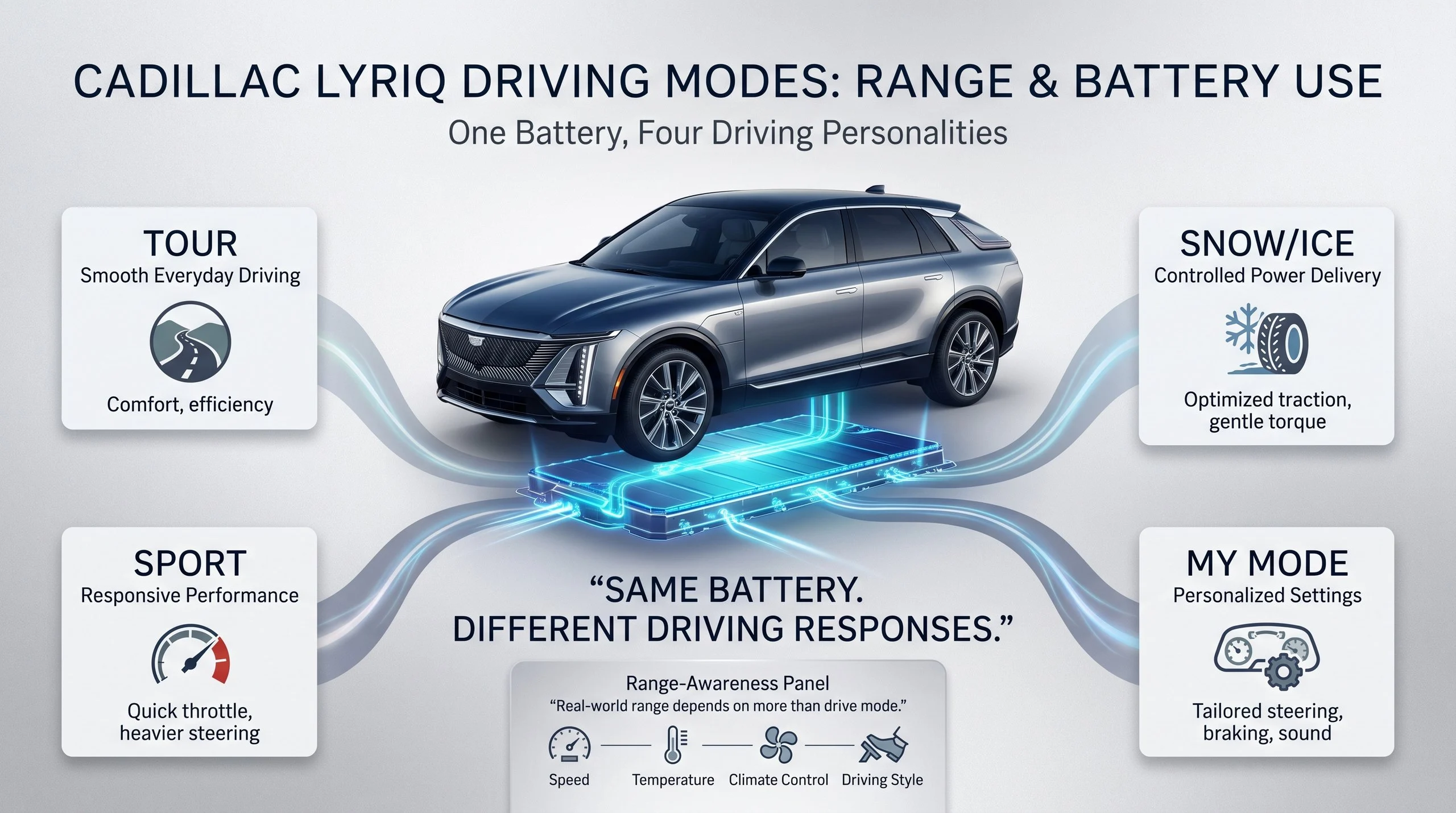
Do the driving modes in Cadillac LYRIQ offer different ranges or battery usages? Yes, they can affect real-world energy consumption and driving range, but they do not change the battery’s physical capacity. Tour generally supports smooth, efficient driving, while Sport can increase energy use if it encourages harder acceleration. Weather, speed, climate control, and driving habits also affect range.
Do the driving modes in cadillac lyriq offer different ranges or battery usages? This is an important question for electric vehicle owners who want to get the most distance from every charge. The Cadillac LYRIQ offers selectable driving modes that adjust the vehicle’s response to different driving preferences and road conditions. However, these settings do not give the battery different capacities or create separate official range ratings.
Instead, the selected mode can influence how the vehicle responds when you accelerate and drive. For example, Sport mode provides a more responsive driving experience, which may encourage stronger acceleration. As a result, you may use more electricity if you frequently accelerate hard. Tour mode, on the other hand, suits everyday driving and can help you maintain smoother driving habits.
Nevertheless, the mode alone does not determine your final range. Highway speed, outdoor temperature, elevation changes, tire pressure, passenger load, and heating or air conditioning can make a substantial difference. Regenerative braking also helps recover some energy during deceleration.
In this guide, you’ll learn how the Cadillac LYRIQ’s driving modes affect battery consumption, which setting makes sense when range matters, and how to improve efficiency without sacrificing safety or comfort. You’ll also discover why two LYRIQ owners can achieve different ranges even when they select the same driving mode.
Cadillac LYRIQ Driving Modes and Battery Usage
| Driving Mode | Main Purpose | Potential Battery Usage | Best Use |
|---|---|---|---|
| Tour | Smooth everyday driving | Often favorable when driven smoothly | Daily commuting and longer trips |
| Sport | More responsive performance | May increase consumption with aggressive acceleration | Enjoying responsive driving on suitable roads |
| Snow/Ice | Better control on slippery surfaces | Depends on conditions and driving style | Snowy, icy, or slippery roads |
| My Mode | Personalized driving settings | Depends on selected settings and driving behavior | Drivers who prefer a customized experience |
Availability and specific adjustments can vary by model year, trim, equipment, and software. Cadillac does not publish a separate official EPA range rating for each of these standard driving modes. (Cadillac LYRIQ Owner’s Manual; Cadillac Driver Mode Control Guide)
What Do the Driving Modes in Cadillac LYRIQ Actually Change?
To understand the relationship between driving modes and range, first consider what these settings do.
The Cadillac LYRIQ is a battery-electric SUV. Its electric motors draw energy from the propulsion battery to move the vehicle. Selecting a different driving mode does not change the battery’s physical capacity. Instead, the setting changes aspects of the driving experience.
Depending on the mode and vehicle configuration, these adjustments can affect accelerator response, torque delivery, steering feel, and other driving characteristics.
For example, Sport mode makes the vehicle feel more responsive. Snow/Ice mode prioritizes controlled power delivery on slippery surfaces. Meanwhile, My Mode lets drivers personalize selected characteristics.
These differences can influence how much electricity the vehicle consumes during a trip. However, the result depends on how the driver uses the vehicle.
Does Tour Mode Automatically Increase Range?
Tour is a sensible default for everyday driving because it provides a smooth, balanced experience.
When you accelerate gradually, maintain a reasonable speed, and anticipate stops, you can often achieve favorable energy efficiency in Tour mode. However, selecting Tour does not guarantee maximum range in every situation.
A driver traveling at high highway speeds in Tour may use more electricity than another driver traveling at a moderate speed in Sport. Therefore, driving behavior can matter more than the selected mode.
Does Sport Mode Drain the Battery Faster?
Sport mode can contribute to higher energy consumption, particularly when its responsive character encourages frequent, forceful acceleration.
Electric motors can deliver strong torque quickly. Although that makes the LYRIQ enjoyable to drive, repeated bursts of acceleration require energy from the battery.
Nevertheless, Sport mode does not automatically remove a fixed number of miles from the range estimate. If you drive smoothly and maintain similar speeds, the difference may be smaller than you expect.
The important distinction is between the mode’s calibration and the driver’s actual energy use.
Does Snow/Ice Mode Save Battery?
Snow/Ice mode is designed to help maintain control on slippery roads. It adjusts power delivery to reduce the likelihood of wheelspin.
Although controlled acceleration can help avoid unnecessary energy waste, Snow/Ice mode is not a dedicated range-maximizing setting. Its main purpose is traction and control.
Cold weather also affects electric vehicles. Battery performance and cabin heating demands can reduce range in winter, even when you drive carefully.
Therefore, choose Snow/Ice mode when road conditions call for it rather than using it solely to conserve electricity.
How Does My Mode Affect Energy Consumption?
My Mode lets you personalize selected aspects of the driving experience. Depending on your LYRIQ’s configuration, these settings may include accelerator feel, steering, braking characteristics, and other features.
Its effect on battery consumption depends on the settings you choose and how you drive afterward.
For instance, a personalized setup that encourages smooth acceleration may help you drive efficiently. However, a more aggressive setup may lead to higher energy consumption if you frequently request strong acceleration.
My Mode does not provide extra battery capacity. It simply allows you to tailor aspects of the driving experience.
Do Different Driving Modes Have Different Official Range Ratings?
No. Cadillac does not publish separate EPA-estimated range figures for Tour, Sport, Snow/Ice, and My Mode.
The official range rating relates to the vehicle’s tested configuration rather than a guaranteed distance for each selected mode.
Several factors distinguish one LYRIQ configuration from another, including model year, drivetrain, wheels, tires, and performance specifications. These differences can affect the vehicle’s official range.
Consequently, you should not assume that Tour has a specific mileage rating while Sport has another. Cadillac does not provide a universal mode-by-mode mileage chart.
Official Range vs. Real-World Range
These terms describe two different things.
Official EPA-estimated range is a standardized estimate used to compare electric vehicles. The specific rating depends on the vehicle configuration.
Real-world range is the distance you actually travel under your driving conditions. It varies with speed, temperature, terrain, climate control, traffic, and other factors.
For example, two drivers may start with the same battery charge and drive the same LYRIQ model. One travels through moderate weather at steady speeds, while the other drives quickly in cold weather with the cabin heater running. Their remaining ranges may differ substantially.
The selected driving mode is only one part of that picture.
Which Cadillac LYRIQ Driving Mode Is Best for Maximum Range?
If your priority is efficient everyday driving, Tour is a sensible starting point. It offers a balanced driving experience and works well for commuting, errands, and longer journeys.
However, choosing Tour alone will not guarantee the longest possible range. You should also pay attention to speed, acceleration, braking, and climate settings.
Here is how to choose a mode for different situations.
For Daily Commuting: Choose Tour
Tour is a practical option for most routine journeys.
Use smooth acceleration, leave enough space to anticipate traffic, and avoid unnecessary bursts of speed. These habits can help reduce energy consumption.
Additionally, maintain the recommended tire pressure and avoid carrying unnecessary weight. Small improvements in driving habits can add up over repeated trips.
For Performance Driving: Choose Sport When Appropriate
Sport is suitable when you want a more responsive driving experience and road conditions permit it.
Keep in mind that aggressive acceleration can increase energy demand. If you frequently accelerate hard, you may reach your next charging stop sooner than you would with a gentler driving style.
You do not need to avoid Sport entirely to protect your battery. Instead, understand that performance and efficiency can involve trade-offs.
For Slippery Roads: Choose Snow/Ice
Safety should take priority over maximizing range on snow or ice.
Snow/Ice mode helps manage power delivery when traction is limited. Drive gently, increase following distance, and adapt your speed to the conditions.
Although these precautions may also prevent unnecessary wheelspin, the mode should serve its intended safety purpose rather than function as an economy setting.
For Personalized Driving: Adjust My Mode
My Mode suits drivers who want to customize selected vehicle responses.
If efficiency matters, experiment with settings that encourage smooth driving. Then compare energy consumption across similar journeys.
Avoid drawing conclusions from a single short trip, since traffic, temperature, and elevation can distort the results.
What Factors Affect Cadillac LYRIQ Battery Usage More Than Driving Mode?
When investigating why your LYRIQ’s range changes, consider the conditions surrounding each trip.
Several factors can influence energy consumption regardless of the selected mode.
1. Driving Speed
Speed is one of the most important factors affecting highway efficiency.
As the vehicle travels faster, aerodynamic resistance increases. The motors must use more energy to overcome that resistance, which can reduce the distance available from a full charge.
For this reason, maintaining a reasonable and consistent speed can help improve range.
2. Acceleration and Braking
Frequent rapid acceleration demands more power from the battery. Hard braking can also waste energy that could otherwise be recovered through regenerative braking.
Instead, look ahead and anticipate traffic lights, turns, and congestion. Smooth changes in speed can help you use energy more efficiently.
3. Outdoor Temperature
Cold weather can reduce electric driving range because the battery operates less efficiently under certain temperature conditions and cabin heating requires additional energy.
Hot weather can also increase consumption when the air conditioning system runs frequently.
Therefore, compare trips in similar weather conditions when evaluating driving modes.
4. Heating and Air Conditioning
Cabin heating and cooling use electricity that would otherwise be available for driving.
Cadillac’s LYRIQ owner documentation explains that climate-control use can decrease electric range. It also recommends considering seat heating or ventilation, when equipped, because these features may use less energy than conditioning the entire cabin.
Comfort still matters, especially in extreme weather. Use climate controls sensibly rather than compromising visibility, alertness, or passenger safety to gain a small amount of range.
5. Road Conditions and Elevation
Hills, rough surfaces, and repeated elevation changes can increase energy consumption.
Climbing a hill requires energy. Descending may allow regenerative braking to recover some of it, but recovery is not perfect.
Similarly, driving on loose gravel or through deep snow may require more energy than traveling on a smooth, dry road.
6. Tires and Vehicle Load
Incorrect tire pressure can increase rolling resistance. Extra cargo and passenger weight can also increase the energy required to move the vehicle.
Check tire pressure according to Cadillac’s recommendations and remove unnecessary items when practical.
7. Regenerative Braking
Regenerative braking allows the electric motor to recover some energy as the vehicle slows down.
The LYRIQ also offers features such as One-Pedal Driving and Regen on Demand, depending on configuration. Cadillac’s owner documentation explains that One-Pedal Driving can recover more energy during coasting and braking than ordinary Drive mode under suitable conditions.
However, regenerative braking does not return all the energy used to accelerate. Its benefits also depend on battery charge, temperature, and operating conditions.
How to Improve Cadillac LYRIQ Range Without Changing Driving Modes
You can often improve efficiency through driving habits rather than repeatedly switching modes.
Accelerate gradually. Apply the accelerator smoothly whenever traffic conditions allow. Avoid unnecessary bursts of power.
Maintain a steady speed. On longer journeys, avoid excessive speeds and unnecessary changes in pace.
Anticipate stops. Look ahead and slow down progressively. This approach may allow regenerative braking to recover some energy.
Use regenerative braking appropriately. Learn how One-Pedal Driving and Regen on Demand work in your vehicle. Follow the owner’s manual and remain ready to use the brake pedal when needed.
Manage cabin temperature. Precondition the cabin while the vehicle is connected to a charger when practical and supported by your vehicle. Use climate controls sensibly.
Check tire pressure. Keep the tires at the recommended pressure for your vehicle.
Plan longer trips. Consider weather, terrain, charging locations, and your expected energy use before setting out.
These habits are useful in Tour and Sport alike. The key is to reduce unnecessary energy demand without compromising safe driving.
How to Compare Battery Usage Between Driving Modes
If you want to know whether Tour or Sport makes a noticeable difference in your own LYRIQ, conduct a simple comparison.
Step 1: Choose a Familiar Route
Select a route you can drive safely and legally in both modes. Ideally, use similar traffic and road conditions.
Step 2: Keep Your Driving Style Consistent
Try to maintain similar speeds and acceleration patterns. Otherwise, your driving behavior may explain the difference more than the mode itself.
Step 3: Record Energy Consumption
Use the vehicle’s available energy information and trip data to record consumption. Depending on your display and model year, you may be able to review energy use over a recent distance or since the last start.
Step 4: Repeat the Test
Repeat the comparison on several occasions. Similar conditions will make the results more useful.
Step 5: Compare the Results
Look for a consistent difference rather than relying on one trip.
If Sport consistently uses more energy under your normal driving conditions, Tour may be the better everyday choice. However, if the difference is small, your personal driving style may matter more than the mode selection.
Do not attempt to reproduce unsafe driving behavior just to test performance or efficiency.
Common Misconceptions About LYRIQ Driving Modes
Misconception 1: Tour Adds More Battery Capacity
Tour does not physically increase the battery’s capacity. It provides a driving calibration suited to everyday use.
Misconception 2: Sport Always Reduces Range by a Fixed Amount
There is no universal mileage penalty for selecting Sport. Energy use depends on the vehicle’s response, your driving behavior, and the conditions.
Misconception 3: Snow/Ice Is the Most Efficient Mode in Winter
Snow/Ice is designed to improve control on slippery surfaces. It does not guarantee better range, and cold temperatures may reduce range regardless of the selected mode.
Misconception 4: My Mode Automatically Saves Energy
My Mode depends on the settings you choose. Personalization alone does not guarantee greater efficiency.
Misconception 5: Regenerative Braking Creates Free Energy
Regenerative braking recovers some energy during deceleration. It cannot recover all the energy used to accelerate, and conversion losses still occur.
Key Takeaways
- Driving modes can influence real-world energy use, but they do not change the LYRIQ’s battery capacity.
- Cadillac does not publish separate official EPA range ratings for Tour, Sport, Snow/Ice, and My Mode.
- Tour is a sensible choice for smooth, everyday driving.
- Sport may use more energy when it encourages harder acceleration.
- Snow/Ice prioritizes control on slippery roads rather than maximum range.
- My Mode’s effect depends on its settings and your driving style.
- Speed, weather, cabin heating, terrain, and tire pressure can substantially influence range.
- Regenerative braking can recover some energy during deceleration.
- Comparing similar trips provides a more useful efficiency test than relying on a single drive.
- Safe driving should always take priority over maximizing range.
Frequently Asked Questions
Do the driving modes in Cadillac LYRIQ offer different ranges or battery usages?
Yes, driving modes can influence real-world battery consumption and range. However, they do not change the battery’s physical capacity or provide separate official EPA range ratings. Driving behavior and environmental conditions also matter.
Which LYRIQ mode gives the best range?
Tour is a sensible starting point for efficient everyday driving. Nevertheless, smooth acceleration, moderate speeds, favorable temperatures, and appropriate climate settings also affect the final result.
Does Sport mode use more battery?
Sport can increase energy consumption when its responsive character encourages frequent, hard acceleration. However, selecting Sport does not automatically trigger a fixed reduction in range.
Does Snow/Ice mode improve battery efficiency?
Snow/Ice primarily helps manage power delivery on slippery surfaces. It does not guarantee better efficiency. Use it when road conditions call for improved traction management.
Can My Mode be configured for better range?
My Mode allows you to personalize selected driving characteristics, depending on the vehicle’s configuration. Settings that encourage smooth driving may help, but the result depends on how you drive.
Does One-Pedal Driving improve LYRIQ range?
One-Pedal Driving can recover energy during coasting and braking. Cadillac’s owner documentation describes greater energy recovery than ordinary Drive mode under suitable conditions. However, the actual benefit varies with the trip and operating conditions.
Why does my LYRIQ range estimate change?
The vehicle’s estimate can respond to recent energy consumption, driving conditions, temperature, and other factors. A lower estimate does not necessarily indicate a battery fault.
Does air conditioning reduce LYRIQ range?
Yes. Heating, air conditioning, and other cabin climate functions can consume electricity and reduce the energy available for driving.
Should I use Sport mode on long trips?
You can use Sport when appropriate, but Tour is a sensible default if efficiency is your priority. Regardless of the mode, steady speeds and smooth driving can help conserve energy.
Does the driving mode affect battery health?
Selecting a normal driving mode does not change the battery’s physical capacity. However, frequent high-power driving can increase energy consumption and may create additional thermal demands. Follow Cadillac’s recommendations for charging, operation, and battery care.
Conclusion
So, do the driving modes in cadillac lyriq offer different ranges or battery usages? They can influence real-world energy consumption, but they do not change the battery’s physical capacity or create separate official range ratings.
Tour is a sensible starting point for daily driving and longer journeys when efficiency matters. Sport provides a more responsive experience, but aggressive acceleration can increase electricity use. Snow/Ice helps manage power delivery on slippery roads, while My Mode lets you personalize selected driving characteristics.
Still, the biggest efficiency gains often come from your overall driving habits. Maintaining reasonable speeds, accelerating smoothly, anticipating stops, managing cabin temperature, and using regenerative braking appropriately can all help you make better use of the available charge.
Rather than assuming one mode always delivers a specific number of extra miles, compare your own energy consumption over similar routes and conditions. That approach gives you a more realistic understanding of how each setting works in your LYRIQ.
Ultimately, the best mode is the one that suits the road, your driving needs, and your priorities. Use Tour as your everyday starting point, select other modes when their benefits matter, and let safe, smooth driving guide your efforts to maximize range.