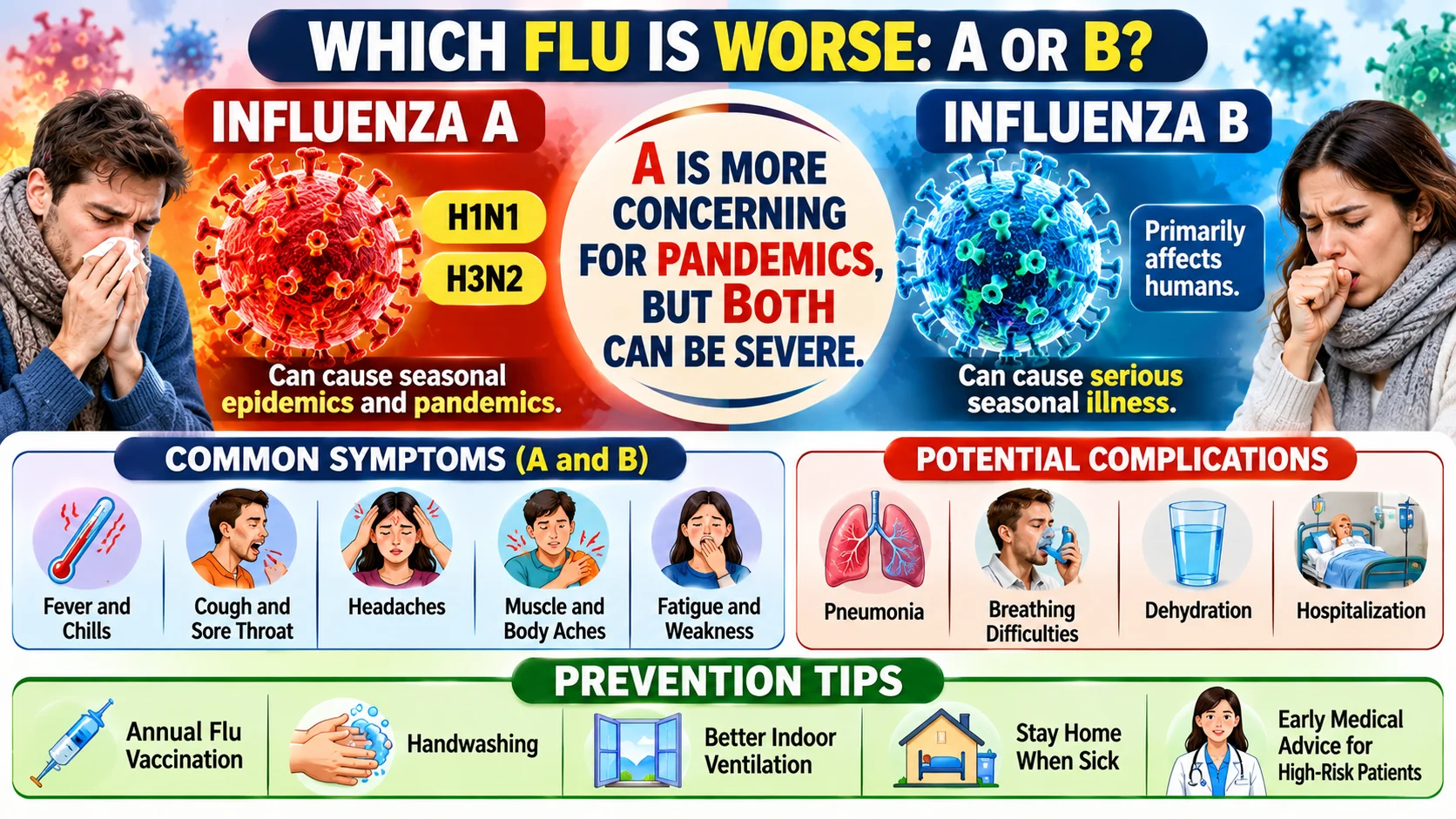
Influenza A is generally considered more concerning because it causes widespread seasonal outbreaks and is the only type known to cause flu pandemics. However, Influenza B can also cause severe illness, hospitalization, and serious complications. Neither type is always worse for every patient because severity depends on the virus strain, age, immune system, and overall health.
The question which flu is worse, A or B, is common during flu season, especially when people experience fever, coughing, body aches, and extreme tiredness. Both Influenza A and Influenza B cause seasonal flu infections, but they have some important differences. Although Influenza A is often associated with larger outbreaks and greater public health concerns, Influenza B should not be considered harmless.
In general, Influenza A receives more attention because it can infect humans and several animal species, change into new subtypes, and cause worldwide pandemics. On the other hand, Influenza B mainly circulates among humans and can still lead to serious respiratory complications. Therefore, the type of flu alone does not determine how sick someone will become.
Furthermore, symptoms of both infections can look very similar, making it difficult to identify the virus without testing. Age, pregnancy, existing medical conditions, vaccination status, and immune health can also influence the outcome.
In this guide, you’ll discover the differences between Influenza A and B, compare their symptoms and severity, understand which groups face greater risks, and learn about treatment, recovery, and prevention.
Influenza A vs. Influenza B
| Comparison | Influenza A | Influenza B |
|---|---|---|
| General severity | Can cause severe illness | Can also cause severe illness |
| Seasonal outbreaks | Yes | Yes |
| Pandemics | Can cause pandemics | Not known to cause pandemics |
| Hosts | Humans and various animals | Primarily humans |
| Classification | Subtypes such as H1N1 and H3N2 | Lineages such as Victoria |
| Symptoms | Fever, cough, fatigue, body aches | Similar symptoms |
| Complications | Pneumonia and other serious complications | Similar serious complications |
| Treatment | Antiviral medicines when appropriate | Antiviral medicines when appropriate |
| Prevention | Seasonal flu vaccination | Seasonal flu vaccination |
What Is Influenza A?
Influenza A is a type of influenza virus that infects humans and various animal species. It is one of the major causes of seasonal flu outbreaks worldwide.
Unlike Influenza B, this virus can change significantly and develop different subtypes. Scientists classify Influenza A according to two proteins found on its surface: hemagglutinin (H) and neuraminidase (N).
Common human Influenza A subtypes include:
- H1N1: A subtype that caused the 2009 flu pandemic and continues to circulate seasonally.
- H3N2: Another major seasonal subtype that can cause substantial illness, particularly among older adults.
Influenza A can spread between people through respiratory particles released when an infected person coughs, sneezes, or talks. In addition, people can become infected after touching contaminated surfaces and then touching their eyes, nose, or mouth.
One important reason Influenza A receives attention is its ability to cause pandemics. A new influenza A virus can emerge and spread internationally when people have little existing immunity against it.
Consequently, Influenza A is particularly important for public health monitoring. However, its ability to cause pandemics does not mean every Influenza A infection is more severe than every Influenza B infection.
What Is Influenza B?
Influenza B is another major type of influenza virus responsible for seasonal flu infections. Unlike Influenza A, it primarily circulates among humans.
Although it does not have the same pandemic potential as Influenza A, it can cause significant illness. Children, older adults, and people with certain medical conditions may experience serious complications.
Influenza B is classified into genetic lineages rather than the H and N subtypes used for Influenza A. The two historically recognized lineages are:
- B/Victoria: A lineage that has continued to circulate in humans.
- B/Yamagata: A historically recognized lineage that has not been confirmed in global circulation in recent years.
Influenza B can cause fever, coughing, sore throat, headaches, muscle pain, and exhaustion. Moreover, some infected people develop complications that require medical attention.
Therefore, it is incorrect to assume that Influenza B is always mild or less dangerous.
Which Flu Is More Severe: A or B?
In general, Influenza A is often associated with a greater overall public health burden. It can cause major outbreaks and is responsible for all known influenza pandemics.
However, the difference in severity is not always straightforward.
Some Influenza A infections cause mild symptoms, while certain Influenza B infections can lead to hospitalization or life-threatening complications. Research has also found that hospitalized patients with Influenza B can experience outcomes comparable to those with Influenza A.
The severity of an infection depends on several factors:
Age
Young children and older adults have a greater risk of developing serious flu complications. Consequently, either virus can be dangerous in these age groups.
Immune System
People with weakened immune systems may have difficulty fighting influenza infections. As a result, their symptoms may become more severe or last longer.
Existing Medical Conditions
Asthma, diabetes, heart disease, and chronic lung conditions can increase the risk of complications. Furthermore, influenza may worsen an existing health problem.
Virus Subtype or Strain
Different influenza viruses can produce different patterns of illness. For example, the severity of an Influenza A H1N1 infection may differ from that of an H3N2 infection.
Vaccination Status
Vaccination can reduce the risk of influenza and help protect against severe outcomes. However, protection varies depending on how well the vaccine matches the circulating viruses.
Bottom line: Influenza A is generally more concerning at the population level, but Influenza B can be equally serious for an individual patient.
Symptoms of Influenza A vs. Influenza B
Both types of flu affect the respiratory system and can produce similar symptoms. Therefore, you cannot reliably identify Influenza A or B simply by looking at how someone feels.
Common symptoms include:
- Fever or chills
- Dry or persistent cough
- Sore throat
- Runny or stuffy nose
- Headache
- Muscle and body aches
- Extreme tiredness
- Weakness
- Loss of appetite
Some children may also experience vomiting, nausea, or diarrhea.
Influenza A Symptoms
People with Influenza A may experience sudden fever, headaches, muscle pain, coughing, and significant fatigue.
However, symptoms can vary depending on the subtype and the person’s health. Some patients recover without complications, while others develop pneumonia or worsening respiratory problems.
Influenza B Symptoms
Influenza B can produce almost the same symptoms as Influenza A.
Additionally, children with Influenza B may experience gastrointestinal symptoms and other complications. Nevertheless, these symptoms do not reliably distinguish one virus type from another.
Can You Tell Which Flu You Have by Symptoms?
No. Influenza A and B cannot be reliably distinguished through symptoms alone.
A healthcare professional may recommend a rapid molecular test, PCR test, or another appropriate diagnostic test to identify the infection.
Which Flu Has Worse Symptoms?
There is no universal answer because symptoms vary from person to person.
Influenza A may produce intense fever, body aches, headaches, and fatigue. However, Influenza B can cause equally uncomfortable symptoms.
For example, one person with Influenza A may experience mild fever and coughing, while another person with Influenza B may develop high fever, severe weakness, and dehydration.
The following comparison provides a general overview:
| Symptom | Influenza A | Influenza B |
|---|---|---|
| Fever | Common | Common |
| Chills | Common | Common |
| Body aches | Common | Common |
| Headache | Common | Common |
| Cough | Common | Common |
| Sore throat | Common | Common |
| Fatigue | Common | Common |
| Vomiting | Possible | Possible |
| Diarrhea | Possible | Possible |
Importantly, the intensity of these symptoms does not confirm which virus is responsible.
Which Flu Is More Dangerous for Children?
Both Influenza A and Influenza B can cause serious illness in children.
Young children have developing immune systems, which can make them more vulnerable to influenza complications. In addition, children may experience dehydration, ear infections, breathing difficulties, and other health problems.
Influenza A can cause severe respiratory illness. Meanwhile, Influenza B can also produce serious complications, including neurological and muscle-related problems in uncommon cases.
Parents should pay particular attention to:
- Difficulty breathing
- Fast breathing
- Blue or gray lips or skin
- Dehydration
- Unusual sleepiness
- Difficulty waking up
- Seizures
- Fever or cough that improves but later returns or worsens
If a child develops these warning signs, seek urgent medical attention.
Furthermore, children younger than five years, especially those younger than two, have a higher risk of serious flu complications.
Which Flu Is Worse for Adults and Older People?
Influenza A and B can both affect adults, but the risk of complications increases with certain health conditions and age.
Older adults are particularly vulnerable because immune responses often become less effective with age. Therefore, even a seasonal flu infection can lead to pneumonia, hospitalization, or worsening of existing conditions.
Adults with asthma, diabetes, heart disease, chronic lung disease, or weakened immunity should also take influenza seriously.
For otherwise healthy adults, most flu infections improve within several days to two weeks. Nevertheless, severe symptoms should never be ignored.
People aged 65 and older should discuss appropriate flu vaccination with a healthcare professional. Higher-dose or adjuvanted flu vaccines may be recommended for this age group where available.
Can Influenza A or B Cause Pneumonia?
Yes. Both Influenza A and Influenza B can cause pneumonia.
Pneumonia is a potentially serious complication involving inflammation and infection in the lungs. It may develop directly from the influenza virus or after a secondary bacterial infection.
Symptoms can include:
- Difficulty breathing
- Chest pain
- Persistent or worsening cough
- Fever
- Low oxygen levels
- Severe weakness
In some cases, influenza-related pneumonia can cause respiratory failure or require hospitalization.
Moreover, people with weakened immune systems and chronic health conditions face a greater risk.
If breathing becomes difficult or chest pain develops, seek emergency medical care rather than waiting for symptoms to improve.
Which Flu Lasts Longer: A or B?
Neither Influenza A nor Influenza B always lasts longer.
Most people with uncomplicated influenza begin feeling better within several days and recover within approximately one week. However, tiredness and coughing may continue for two weeks or longer.
Recovery depends on several factors, including:
- Age and general health
- Severity of the infection
- Immune system function
- Presence of complications
- Access to appropriate treatment
- Rest and hydration
For example, a healthy adult may recover quickly from Influenza A, while an older person with Influenza B may need a longer recovery period.
Therefore, the virus type alone cannot predict how long an individual will remain sick.
Can You Get Influenza A and B at the Same Time?
Yes, although simultaneous infection with Influenza A and B is uncommon.
A person can become infected with more than one influenza virus during the same flu season. In rare cases, both types may be detected at the same time.
However, testing is necessary to confirm a coinfection. Symptoms alone cannot establish whether someone has one influenza type or both.
People with suspected influenza should follow medical advice, particularly if they have underlying medical conditions or develop severe symptoms.
How Are Influenza A and B Treated?
Treatment for Influenza A and B is generally similar.
Most otherwise healthy people with uncomplicated flu can recover with supportive care. However, antiviral medicines may be recommended for people at higher risk of complications or those with severe or progressive illness.
Antiviral Medicines
Healthcare professionals may prescribe antiviral medications such as:
- Oseltamivir (Tamiflu): An oral antiviral medicine used to treat influenza.
- Zanamivir (Relenza): An inhaled antiviral medicine for eligible patients.
- Peramivir (Rapivab): An antiviral medicine administered intravenously.
- Baloxavir marboxil (Xofluza): An oral antiviral medicine used for eligible patients.
These medicines work against susceptible Influenza A and B viruses.
Treatment generally provides the greatest benefit when started within 48 hours after symptoms begin. Nevertheless, treatment may still benefit hospitalized patients or people with severe illness when started later.
Antiviral medication should be selected by a healthcare professional because age, pregnancy, kidney function, medical history, and other factors can affect the choice.
Home Care
For uncomplicated flu, supportive care may include:
- Get enough rest: Allow your body time to recover.
- Drink plenty of fluids: Water, soups, and other suitable fluids can help prevent dehydration.
- Manage fever: Use appropriate fever-relieving medication according to professional advice and product instructions.
- Eat nutritious food: Choose foods that are easy to tolerate.
- Stay home: Avoid close contact with others while you are contagious.
- Monitor symptoms: Watch for breathing problems, dehydration, or worsening illness.
Importantly, antibiotics do not treat influenza because it is caused by a virus. They may be necessary only when a bacterial complication develops.
Children and teenagers with suspected or confirmed influenza should not be given aspirin unless specifically directed by a healthcare professional because of the risk of Reye syndrome.
When Should You See a Doctor?
Most people recover from influenza without medical complications. However, certain symptoms require immediate attention.
Emergency Warning Signs in Adults
Seek emergency medical care if you experience:
- Difficulty breathing or shortness of breath
- Persistent chest pain or pressure
- Confusion or inability to stay alert
- Seizures
- Severe weakness or inability to walk
- Not urinating
- Symptoms that improve but return with worsening fever or cough
Emergency Warning Signs in Children
Watch for:
- Fast or difficult breathing
- Bluish lips or face
- Severe dehydration
- No interaction or unusual drowsiness
- Seizures
- Severe muscle pain or refusal to walk
- Fever above 104°F (40°C) that is not controlled
- Any fever in an infant younger than 12 weeks
Additionally, pregnant people, older adults, young children, and people with chronic medical conditions should contact a healthcare professional promptly if they develop flu symptoms. Early evaluation can help determine whether antiviral treatment is appropriate.
How Can You Prevent Influenza A and B?
Prevention is important because both influenza types spread easily.
Fortunately, several practical steps can reduce the risk of infection.
Get an Annual Flu Vaccine
Annual influenza vaccination is one of the most effective ways to reduce the risk of flu illness and severe complications.
The seasonal vaccine is designed to protect against the influenza viruses expected to circulate. Because influenza viruses change over time, vaccine recommendations are updated regularly.
Wash Your Hands
Wash your hands with soap and water for at least 20 seconds. Alternatively, use an alcohol-based hand sanitizer when soap and water are unavailable.
Avoid Close Contact With Sick People
Maintain distance from people experiencing flu symptoms whenever possible.
Cover Coughs and Sneezes
Use a tissue or your elbow when coughing or sneezing. Additionally, dispose of used tissues properly and wash your hands.
Improve Indoor Air Quality
Open windows when practical and improve ventilation in shared indoor spaces. A well-fitted mask may also help reduce respiratory virus transmission in crowded or high-risk settings.
Stay Home When Sick
Avoid school, work, and social gatherings while you are ill. Follow current public health guidance before returning to normal activities.
Influenza A vs. Influenza B: Advantages and Disadvantages of Understanding the Difference
Although neither virus offers an advantage to someone who becomes infected, understanding their differences can help people make informed health decisions.
Why Knowing About Influenza A Helps
- It explains why certain influenza outbreaks receive increased public health attention.
- It helps people understand the importance of monitoring new influenza A subtypes.
- It encourages awareness of seasonal vaccination.
- It helps explain why influenza A has pandemic potential.
Why Knowing About Influenza B Helps
- It reminds people that Influenza B can also cause severe illness.
- It prevents the misconception that type B is always harmless.
- It encourages early medical attention when warning signs develop.
- It supports appropriate prevention and treatment decisions.
Limitations of Comparing the Two
- Symptoms overlap significantly.
- Severity varies between individual infections.
- The virus type alone cannot predict recovery time.
- Both types can cause serious complications.
- Testing is needed to identify the specific influenza type.
Common Myths About Influenza A and B
Several misconceptions make it harder to understand the differences between these infections.
Myth 1: Influenza A Is Always More Dangerous
Fact: Influenza A is more concerning from a pandemic and population-health perspective. However, Influenza B can also cause severe illness and hospitalization.
Myth 2: Influenza B Is Just a Mild Cold
Fact: Influenza B is a genuine flu infection, not simply a common cold. It can cause fever, muscle aches, exhaustion, pneumonia, and other complications.
Myth 3: You Can Identify the Flu Type by Symptoms
Fact: Both types produce similar symptoms. Therefore, laboratory testing is needed for reliable identification.
Myth 4: Antibiotics Cure the Flu
Fact: Antibiotics treat bacterial infections, not influenza viruses. Antiviral medicines may be appropriate for certain patients.
Myth 5: Getting the Flu Vaccine Guarantees You Will Never Get Flu
Fact: Vaccination does not guarantee complete protection. Nevertheless, it can reduce the risk of infection and severe outcomes.
Myth 6: You Cannot Get Flu Twice in One Season
Fact: It is possible to become infected with different influenza viruses during the same season. Previous infection does not guarantee protection against every circulating strain.
Related Comparisons: Influenza A vs. Influenza B
Understanding other respiratory illnesses can also help explain why flu testing and medical evaluation matter.
Flu A vs. Flu B
Influenza A has pandemic potential and infects humans and various animals. In contrast, Influenza B mainly circulates among humans. However, both can cause severe seasonal illness.
Flu vs. Common Cold
The flu often begins suddenly and causes fever, body aches, headaches, and significant fatigue. A common cold usually develops more gradually and tends to cause milder symptoms.
Flu vs. COVID-19
Influenza and COVID-19 are different viral respiratory infections. Both can cause fever, cough, fatigue, and breathing problems. Testing may be needed to distinguish them.
H1N1 vs. H3N2
H1N1 and H3N2 are two Influenza A subtypes. Both can cause seasonal flu, although their circulation patterns and disease severity can differ between seasons.
Exercises: Test Your Knowledge
Check your understanding of Influenza A and B with these simple questions.
1. Which influenza type is known to cause pandemics?
A. Influenza A
B. Influenza B
C. Both A and B
D. Neither
2. Can Influenza B cause serious complications?
A. No
B. Yes
C. Only in adults
D. Only in children
3. Can symptoms alone identify Influenza A or B?
A. Yes
B. No
C. Only during winter
D. Only with fever
4. What is one effective way to reduce the risk of seasonal flu?
A. Taking antibiotics
B. Avoiding all exercise
C. Getting an annual flu vaccine
D. Drinking only warm water
5. Can both Influenza A and B cause pneumonia?
A. Yes
B. No
C. Only Influenza A
D. Only Influenza B
Answers and Explanations
- A — Influenza A: It is the only influenza type known to cause pandemics.
- B — Yes: Influenza B can cause severe illness and hospitalization.
- B — No: Testing is necessary for reliable identification.
- C — Getting an annual flu vaccine: Vaccination helps reduce flu illness and severe complications.
- A — Yes: Both influenza types can lead to viral or secondary bacterial pneumonia.
Frequently Asked Questions
1. Which flu is worse, A or B?
Influenza A is generally more concerning because it can cause pandemics and widespread outbreaks. However, Influenza B can also cause severe illness, hospitalization, and serious complications.
2. Is Influenza A more contagious than Influenza B?
Both viruses spread efficiently between people through respiratory particles. However, contagiousness varies with the circulating strain, exposure, and other factors. Neither type is always more contagious.
3. Which flu has higher fever, A or B?
Both Influenza A and B can cause high fever. However, temperature varies between patients and cannot reliably identify the virus type.
4. Is Influenza B dangerous for children?
Yes. Influenza B can cause serious complications in children, including dehydration, pneumonia, and, rarely, neurological problems.
5. Can Influenza A cause death?
Yes. Severe Influenza A infections can lead to pneumonia, respiratory failure, and death, particularly among people at higher risk of complications.
6. Can Influenza B cause death?
Yes. Although it does not cause pandemics, Influenza B can cause life-threatening complications and death.
7. How long does Influenza A last?
Most uncomplicated infections improve within several days, with many people recovering within about a week. However, coughing and fatigue can last two weeks or longer.
8. How long does Influenza B last?
Influenza B usually follows a similar recovery pattern. Most people improve within a week, although some experience lingering fatigue or cough.
9. Can you get Influenza A after having Influenza B?
Yes. Infection with Influenza B does not provide complete protection against Influenza A because they are different virus types.
10. Does Tamiflu work for Influenza A and B?
Yes. Oseltamivir (Tamiflu) is an antiviral medication used against susceptible Influenza A and B viruses. A healthcare professional can determine whether it is appropriate.
11. Which flu is worse for pregnant women?
Both Influenza A and B can cause serious complications during pregnancy. Pregnant people should contact a healthcare professional promptly if they develop flu symptoms because early antiviral treatment may be recommended.
12. Can you have Influenza A without a fever?
Yes. Some people with influenza do not develop a fever, particularly older adults and people with certain health conditions.
13. Do Influenza A and B need different treatments?
Generally, no. Both types can be treated with appropriate antiviral medicines. The choice depends on the patient’s health, age, timing, and clinical condition.
14. Can you get both flu types in the same year?
Yes. A person can become infected with Influenza A and later become infected with Influenza B during the same flu season.
15. Which flu is more common, A or B?
Influenza A often accounts for a larger share of seasonal flu infections, although the proportions change from season to season and between locations.
Key Takeaways
- Influenza A and B are the two major types responsible for seasonal flu epidemics.
- Influenza A is the only type known to cause influenza pandemics.
- Influenza B can cause equally serious illness in some patients.
- Both types can cause pneumonia and other complications.
- Symptoms alone cannot reliably distinguish Influenza A from B.
- Antiviral medications can treat susceptible infections of both types.
- Annual flu vaccination helps reduce the risk of infection and severe illness.
- High-risk individuals should seek early medical advice.
Medical Disclaimer: This article provides general educational information and is not a substitute for professional medical advice, diagnosis, or treatment. Seek medical attention for severe, worsening, or concerning symptoms.
Conclusion
So, which flu is worse, A or B? Influenza A is generally more concerning because it can cause widespread outbreaks and is the only influenza type known to cause pandemics. Nevertheless, Influenza B should never be underestimated because it can also cause serious symptoms, pneumonia, hospitalization, and life-threatening complications.
Both viruses share many symptoms, including fever, coughing, headaches, muscle aches, and fatigue. Therefore, identifying the infection through symptoms alone is unreliable. Appropriate testing can help confirm the virus type when necessary.
Ultimately, your age, immune system, vaccination status, and existing health conditions matter more than the letter assigned to the virus when assessing your individual risk. Annual vaccination, good hygiene, adequate rest, and timely medical attention can help reduce the risk of serious illness.
Remember: Influenza A may be more concerning on a global scale, but both Influenza A and B deserve proper attention and care.