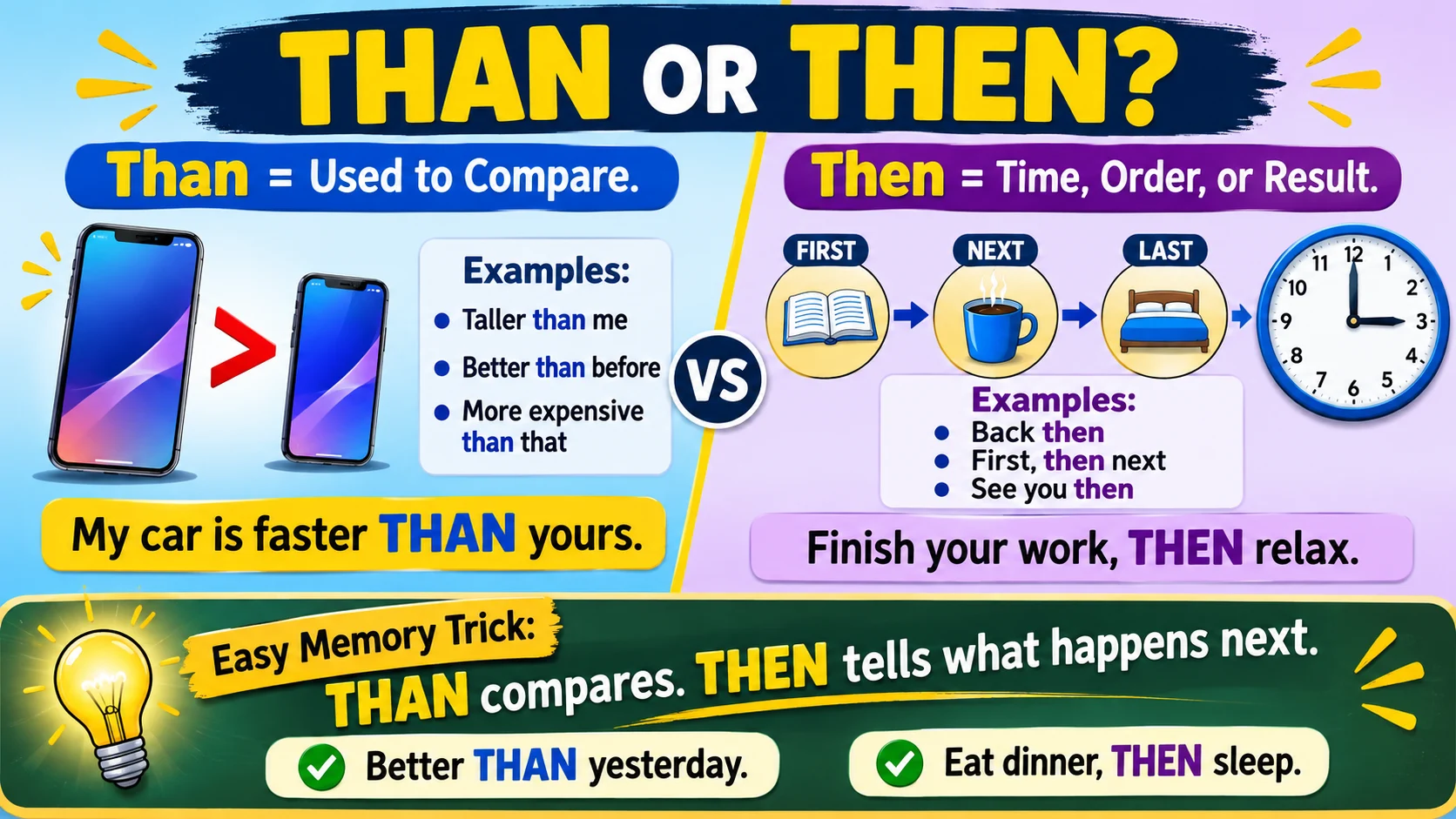
Than and then are two commonly confused English words with different meanings and uses. Than is a conjunction or preposition used to make comparisons, such as “She is taller than me.” In contrast, then is an adverb used to describe time, sequence, or a result, such as “Finish your homework, then watch TV.” Remember, use than when comparing things and then when talking about what happens next.
Have you ever stopped while writing and wondered whether to use than or then? These two words look and sound similar, but they have different meanings and grammatical functions. Although even fluent English speakers sometimes mix them up, choosing the correct word can make your writing clearer and more professional.
The main difference between than or then is simple: than is used to compare two or more things, while then usually refers to time, order, or a result. For example, you might say, “My brother is younger than me” when comparing ages. However, you would write, “We ate dinner and then watched a movie” when describing events in order.
Understanding this small grammar difference can help you avoid common spelling mistakes in emails, school assignments, social media posts, and everyday conversations. Moreover, learning a few simple rules makes it easier to remember which word belongs in each sentence. In this guide, you’ll discover their definitions, differences, examples, usage rules, common mistakes, and practical exercises to improve your English grammar.
Than vs. Then
| Meaning | Context | Primary Platforms | Example | Tone |
|---|---|---|---|---|
| Than: Used for comparison | Comparing people, things, or situations | Writing, conversations, education | She is smarter than her brother. | Comparative |
| Then: Refers to time | Describing when something happens | Stories, conversations, writing | I was younger then. | Temporal |
| Then: Shows sequence | Explaining the order of events | Instructions, storytelling | First eat, then sleep. | Sequential |
| Then: Shows a result | Expressing a consequence | Conversations, formal writing | If you’re ready, then let’s begin. | Logical |
| Then: Refers to a particular time | Talking about a past or future moment | Everyday English | See you then! | Conversational |
What Does Than Mean?
Than is a word used to compare two or more people, objects, qualities, amounts, or situations. It commonly appears after comparative adjectives and adverbs, helping readers understand how one thing differs from another.
For example:
- My house is bigger than yours.
- Sarah runs faster than her brother.
- This book is more interesting than the previous one.
- Today is warmer than yesterday.
- I would rather read than watch television.
In each example, than introduces the second part of a comparison.
Moreover, the word frequently appears with comparative expressions such as:
- Better than
- Worse than
- More than
- Less than
- Older than
- Younger than
- Taller than
- Faster than
- Rather than
- Other than
Simple definition: Than means “in comparison with” or “as compared with” something else.
When Should You Use Than?
Use than whenever you compare two different things or express a preference between alternatives.
Here are some common situations:
1. Comparing People
- My sister is taller than me.
- John is older than his cousin.
- She is more confident than her classmates.
2. Comparing Objects
- This phone is cheaper than that one.
- My new laptop is faster than my old computer.
- The blue dress is prettier than the black one.
3. Comparing Amounts
- I have more books than you.
- There are fewer students than last year.
- He earns more money than his brother.
4. Expressing Preferences
- I would rather walk than drive.
- She prefers reading than watching television.
Note: In standard grammar, the last sentence is better written as “She prefers reading to watching television.” However, than is correct in the construction “would rather … than.”
5. Making Comparisons in Opinions
- This movie is better than I expected.
- The situation is more complicated than it appears.
- Learning English is easier than many people think.
As you can see, than connects a comparison with the thing, person, or situation being compared.
What Does Then Mean?
Then is an adverb that usually refers to time, sequence, or a consequence. It helps explain when something happened, what comes next, or what follows from a particular condition.
For example:
- I finished my homework, then went outside.
- We lived in New York back then.
- First, wash your hands. Then prepare the food.
- If you don’t want to come, then stay home.
Unlike than, this word does not introduce a comparison. Instead, it provides information about time, order, or logical results.
Simple definition: Then means “at that time,” “next,” “after that,” or “in that case,” depending on the sentence.
When Should You Use Then?
There are several common situations in which then is the correct choice.
1. Talking About Time
Use then to describe a particular time in the past or future.
Examples:
- I was living in California then.
- She was a student back then.
- Things were different back then.
- We can discuss the problem then.
2. Showing the Order of Events
Use then when explaining what happens next.
Examples:
- First, complete your assignment, then submit it.
- She woke up, brushed her teeth, and then made breakfast.
- Mix the ingredients, then bake the cake.
- We visited the museum and then went shopping.
3. Showing a Result or Consequence
Use then to introduce a conclusion or result.
Examples:
- If you are tired, then take a break.
- If the weather improves, then we can go outside.
- You have completed the work, so then you can relax.
- If nobody objects, then we will continue.
4. Giving Instructions
The word is useful when explaining steps in a process.
Examples:
- Open the application, then enter your password.
- Turn off the computer, then unplug the cable.
- Add the flour, then stir the mixture.
- Read the instructions first, then begin the exercise.
5. Referring to a Particular Moment
Use then when referring to an agreed or previously mentioned time.
Examples:
- See you then!
- Let’s meet at 5 p.m. and discuss everything then.
- If Friday works for you, I’ll see you then.
Therefore, then is especially useful when describing time, order, and consequences.
Than or Then: What Is the Main Difference?
Although these words look almost identical, their meanings are completely different.
The easiest way to understand the difference is to remember that than compares, while then connects events or ideas in time and logic.
Consider these examples:
- My car is faster than yours.
- I finished work and then went home.
The first sentence compares two cars. Therefore, than is correct.
On the other hand, the second sentence explains the order of two events. Consequently, then is the correct choice.
Comparison Table
| Feature | Than | Then |
|---|---|---|
| Main function | Makes comparisons | Describes time, order, or results |
| Grammatical role | Conjunction or preposition | Adverb |
| Common meaning | In comparison with | At that time or next |
| Common expressions | Better than, more than | Since then, back then |
| Used with comparisons | Yes | No |
| Used with sequences | No | Yes |
| Example | She is taller than me. | She arrived and then left. |
Easy Tricks to Remember Than vs. Then
If you frequently confuse these words, a few simple memory tricks can help you choose correctly.
1. Remember: Than = Comparison
Think of than whenever you compare two things.
For example:
- Bigger than
- Smaller than
- Better than
- More expensive than
- Less difficult than
If your sentence answers a question such as “Which is bigger?” or “Who is faster?” you probably need than.
2. Remember: Then = Time
Think of then when discussing what happened before, after, or at a particular moment.
For example:
- First eat, then sleep.
- I was happy back then.
- We met in 2020 and stayed friends since then.
If your sentence answers “When?” or “What happened next?” you probably need then.
3. Use the Replacement Test
Another helpful technique is to replace the word with a similar expression.
For than, try:
- In comparison with
- Compared with
For then, try:
- Next
- After that
- At that time
- In that case
Examples:
“She is taller than her brother.”
Replacement: She is taller compared with her brother.
“She finished dinner and then went outside.”
Replacement: She finished dinner and after that went outside.
If the replacement makes sense, you have probably selected the correct word.
4. Look at the Sentence Structure
Comparative adjectives often provide a clue that you need than.
Examples:
- Stronger than
- Faster than
- More beautiful than
- More useful than
Meanwhile, words such as first, next, and afterward often appear in sentences where then is appropriate.
However, these are helpful clues rather than strict rules. Always consider the intended meaning.
Than vs. Then in Everyday Conversations
Both words appear regularly in everyday English. However, their uses depend on what the speaker wants to communicate.
Here are some natural conversational examples.
Conversation 1: Comparing Prices
Alex: “Is this laptop cheaper than the other one?”
Sam: “Yes, it costs about $100 less.”
Conversation 2: Talking About Plans
Alex: “What should we do after dinner?”
Sam: “Let’s watch a movie then.”
Conversation 3: Comparing Skills
Alex: “Who is better at basketball, Mike or John?”
Sam: “Mike is better than John.”
Conversation 4: Describing the Past
Alex: “Were you living here in 2015?”
Sam: “Yes, I was studying here then.”
Conversation 5: Making a Decision
Alex: “Should we leave now?”
Sam: “If everyone is ready, then let’s go.”
These examples demonstrate how context determines which word belongs in a sentence.
Common Expressions With Than
Several familiar English expressions use than to establish comparisons or preferences.
| Expression | Meaning | Example |
|---|---|---|
| Better than | Superior to something | This option is better than the last one. |
| More than | A greater amount or degree | She has more experience than I do. |
| Less than | A smaller amount or degree | It took less than an hour. |
| Rather than | Instead of | I prefer tea rather than coffee. |
| Other than | Apart from or except | Nobody other than Sarah knew. |
| More important than | Having greater importance | Health is more important than money. |
| Easier than | Requiring less effort | This task is easier than the previous one. |
| Worse than | More negative or unpleasant | The weather is worse than yesterday. |
Notice that these expressions generally compare qualities, quantities, choices, or situations.
Common Expressions With Then
The word then also appears in many everyday expressions.
| Expression | Meaning | Example |
|---|---|---|
| Back then | At a time in the past | Life was simpler back then. |
| Since then | From that time until now | I haven’t seen him since then. |
| Until then | Up to a particular time | I’ll wait until then. |
| Every now and then | Occasionally | We visit our grandparents every now and then. |
| Just then | At that exact moment | Just then, the phone rang. |
| Then again | Introducing another possibility | Then again, we could stay home. |
| Now and then | Occasionally | She calls me now and then. |
| First, then | Showing sequence | First, study; then take the test. |
These expressions are useful in both spoken and written English.
Than or Then: Common Grammar Mistakes
Even though the difference is straightforward, people often use the wrong word because of similar pronunciation and spelling.
Here are some frequent mistakes and their corrections.
Mistake 1: Using Then for Comparisons
Incorrect: My brother is taller then me.
Correct: My brother is taller than me.
Explanation: The sentence compares two people’s heights. Therefore, than is necessary.
Mistake 2: Using Than for Sequences
Incorrect: I finished my homework than watched TV.
Correct: I finished my homework then watched TV.
Explanation: The sentence describes two events in order. Therefore, then is correct.
Mistake 3: Confusing Than and Then in Questions
Incorrect: Is your new phone better then the old one?
Correct: Is your new phone better than the old one?
Explanation: The word better introduces a comparison, so use than.
Mistake 4: Using Than When Referring to the Past
Incorrect: Things were different than.
Correct: Things were different back then.
Explanation: The speaker is referring to a particular time in the past, not making a comparison.
Mistake 5: Using Then in Comparative Sentences
Incorrect: She has more experience then her manager.
Correct: She has more experience than her manager.
Explanation: The sentence compares two people’s experience levels.
Mistake 6: Using Than to Describe What Happens Next
Incorrect: Wash the vegetables, than cut them.
Correct: Wash the vegetables, then cut them.
Explanation: The second action follows the first one, so then is appropriate.
Than or Then in Different Types of Writing
Choosing the right word matters in many forms of communication.
1. Academic Writing
Students frequently use than when comparing theories, research findings, historical events, and ideas.
Examples:
- The second experiment produced better results than the first.
- Online learning can be more flexible than traditional classroom instruction.
- The new method is less expensive than the previous approach.
Meanwhile, then helps explain the order of events or stages in an argument.
Example:
- Researchers collected the data and then analyzed the results.
2. Professional Emails
Both words are useful in workplace communication.
Examples with than:
- This proposal is more detailed than the previous version.
- The project may take longer than expected.
Examples with then:
- Please review the document and then send your feedback.
- We can schedule a meeting next week and discuss the details then.
3. Social Media Posts
People use these words in captions, comments, and online conversations.
Examples with than:
- Nothing is better than spending time with family.
- Coffee is more important than sleep today!
Examples with then:
- First coffee, then everything else.
- Life was different back then.
4. Storytelling
In stories, than helps compare characters, places, and situations.
Example:
- The village was much quieter than the city.
However, then helps readers follow the order of events.
Example:
- She opened the door, looked around, and then entered the room.
Is It More Than or More Then?
The correct expression is more than when you are comparing quantities, amounts, or degrees.
Examples:
- I have more than 100 books.
- She earns more than her brother.
- The journey took more than three hours.
- He is more than capable of completing the task.
More then is generally incorrect when expressing a greater amount or degree.
However, then can appear after more when it has a separate grammatical function.
For example:
- Nothing more, then we can leave.
Here, then refers to what happens next rather than completing the expression more than.
Is It Better Than or Better Then?
The correct expression is better than when comparing two people, things, or situations.
Examples:
- This restaurant is better than the one we visited yesterday.
- She is better at mathematics than her brother.
- Walking is better than sitting all day.
In contrast, better then is not the standard expression for making comparisons.
Remember this simple rule: If you are describing something as superior to another thing, use better than.
Than or Then: Which Is Correct in These Sentences?
Let’s look at some additional examples to make the difference easier to understand.
- I would rather stay home than go outside.
- We had dinner and then watched television.
- My new job is better than my previous one.
- She was living in London back then.
- This exercise is harder than the last one.
- Complete the first step, then move to the next.
- He has more experience than his colleague.
- I met her in 2022 and haven’t seen her since then.
- The weather is colder than yesterday.
- If you’re ready, then let’s begin.
Each sentence uses the word that matches its intended meaning.
Related Comparisons: Than vs. Then vs. That
Although than and then are the main focus, some people also confuse them with that.
These three words have different grammatical functions.
| Word | Main Use | Example |
|---|---|---|
| Than | Comparison | She is older than me. |
| Then | Time or sequence | She arrived, then called me. |
| That | Identifying or referring to something | That is my favorite book. |
Than compares two things, whereas then describes time or sequence. On the other hand, that points to a person, object, or idea, or introduces certain clauses.
Examples:
- I like this dress more than that one.
- I bought the dress and then went home.
- That dress looks beautiful.
Understanding these differences can prevent several common writing mistakes.
Advantages and Disadvantages of Learning the Difference
Understanding the difference between than and then may seem like a small grammar lesson. Nevertheless, it can improve your overall communication.
Advantages
- Clearer Writing: Using the correct word makes your sentences easier to understand.
- Better Grammar: You can avoid common spelling and word-choice mistakes.
- Professional Communication: Correct usage makes emails, reports, and assignments look more polished.
- Improved Reading: Recognizing these words helps you understand comparisons and sequences.
- Greater Confidence: You can write and communicate without constantly questioning your word choice.
Disadvantages or Challenges
- Similar Pronunciation: Both words sound very similar in many English accents.
- Frequent Confusion: Their spelling differs by only one letter, making typing mistakes easy.
- Context Matters: You must understand the sentence to select the correct word.
- Habitual Errors: People who frequently use the wrong word may need practice to change their habits.
Overall, the benefits of learning this distinction far outweigh the small effort required.
Practice Exercises: Than or Then
Now that you understand the difference, test your knowledge with these exercises. Choose the correct word in each sentence.
Exercise 1: Fill in the Blanks
- My sister is taller _____ me.
- We went shopping and _____ had lunch.
- This book is more interesting _____ that one.
- I was living in New York back _____.
- Finish your work, _____ take a break.
- She is smarter _____ her classmates.
- First, wash the dishes, _____ clean the kitchen.
- This road is shorter _____ the other one.
- I haven’t spoken to him since _____.
- He would rather walk _____ drive.
Exercise 2: Correct the Mistakes
Find and correct the incorrect word in each sentence.
- My phone is newer then yours.
- We watched a movie than went to bed.
- She is more confident then before.
- I was very young than.
- Complete the assignment, than submit it.
- This restaurant is better then the previous one.
- He arrived late and than apologized.
- I have more books then my brother.
- Life was easier than.
- First, read the question, than write your answer.
Exercise 3: Choose the Correct Sentence
1. Which sentence is correct?
A. She is taller then me.
B. She is taller than me.
2. Which sentence is correct?
A. We ate dinner and then watched TV.
B. We ate dinner and than watched TV.
3. Which sentence is correct?
A. This car is faster than mine.
B. This car is faster then mine.
4. Which sentence is correct?
A. I remember those days back then.
B. I remember those days back than.
5. Which sentence is correct?
A. First, study, than take the exam.
B. First, study, then take the exam.
Exercise Answers
Exercise 1: Fill in the Blanks
- Than
- Then
- Than
- Then
- Then
- Than
- Then
- Than
- Then
- Than
Exercise 2: Correct the Mistakes
- My phone is newer than yours.
- We watched a movie and then went to bed.
- She is more confident than before.
- I was very young back then.
- Complete the assignment, then submit it.
- This restaurant is better than the previous one.
- He arrived late and then apologized.
- I have more books than my brother.
- Life was easier back then.
- First, read the question, then write your answer.
Exercise 3: Choose the Correct Sentence
- B
- A
- A
- A
- B
How Did You Do?
- 13–15 correct: Excellent! You understand the difference very well.
- 10–12 correct: Great work! A little more practice will strengthen your skills.
- 7–9 correct: Good effort! Review the examples and grammar rules.
- Below 7: Don’t worry. Practice the comparison and sequence rules again.
Key Takeaways and Summary
Here are the most important points to remember about than or then:
- Than is used to compare people, objects, qualities, amounts, and situations.
- Then refers to time, sequence, or a logical result.
- Use than after comparative expressions such as better, faster, older, and more.
- Use then when explaining what happens next or referring to a particular time.
- “Better than” is correct when comparing two things.
- “Back then” is correct when referring to the past.
- A simple memory trick is to remember: than compares, then continues.
Most importantly, always consider the meaning of your sentence before choosing either word.
Frequently Asked Questions (FAQs)
1. What is the difference between than and then?
Than is used to compare two or more things, while then refers to time, sequence, or a result. For example, “She is taller than me” uses than for comparison. In contrast, “She arrived and then left” uses then to show the order of events.
2. When should I use than?
Use than when comparing people, objects, amounts, qualities, or situations. It commonly follows comparative words such as better, faster, older, younger, more, and less.
Example: My new laptop is faster than my old one.
3. When should I use then?
Use then when referring to a particular time, describing a sequence of events, or expressing a consequence.
Example: First, finish your homework, then watch television.
4. Is it better than or better then?
Better than is the correct expression when comparing two things or people.
Example: This restaurant is better than the one we visited yesterday.
5. Is it more than or more then?
More than is correct when expressing a greater amount, number, or degree.
Example: She has more than 50 books.
6. Can then mean at that time?
Yes. Then can refer to a particular moment in the past or future.
Example: I was working in London then.
7. Is than a conjunction or a preposition?
Than can function as a conjunction or a preposition, depending on the sentence structure. For example, it introduces a comparison in “She is taller than I am” and acts as a preposition in “She is taller than me.”
8. Is then an adverb?
Yes. Then is commonly used as an adverb to describe time, sequence, or a result.
Example: We finished dinner and then went home.
9. How can I remember than vs. then?
Remember this simple rule: Than = Comparison; Then = Time or Next. If you are comparing two things, choose than. If you are describing what happens afterward or referring to a particular time, choose then.
10. Is it correct to say “see you then”?
Yes. “See you then” is a correct and common expression used when referring to an agreed meeting time or previously discussed occasion.
Example: “Let’s meet on Saturday.” “Great, see you then!”
11. Can than and then be used in the same sentence?
Yes. Both words can appear in the same sentence because they have different grammatical functions.
Example: “She is smarter than her brother, and then she helped him with his homework.”
Here, than makes a comparison, while then describes what happened next.
12. Why do people confuse than and then?
People often confuse these words because their spelling and pronunciation are very similar. Additionally, typing quickly can lead to accidental mistakes. However, understanding their meanings and grammatical functions makes the difference much easier to recognize.
13. What is another word for than?
Depending on the context, alternatives to than include “compared with,” “in comparison with,” and “rather than.” However, these expressions are not interchangeable in every sentence.
14. What is another word for then?
Depending on the sentence, alternatives to then include “next,” “afterward,” “subsequently,” “at that time,” and “in that case.”
15. Which word is correct: “I was younger than” or “I was younger then”?
“I was younger then” is correct when referring to a particular time in the past.
For example: “I was younger then, so I had more energy.”
However, “I was younger than my brother” is also correct because it makes a comparison.
16. Is then used for cause and effect?
Then can introduce a result or consequence, particularly in conditional sentences.
Example: “If you finish your work, then you can go outside.”
It helps connect a condition with what follows from it.
17. What is the difference between than and then in American English?
The meanings and grammatical rules are the same in American and British English. Both varieties use than for comparisons and then for time, sequence, and results.
18. Is “rather than” correct?
Yes. Rather than is a standard English expression that shows preference or an alternative.
Example: “I would rather stay home than go outside.”
It communicates a preference for one option over another.
Conclusion
Understanding the difference between than or then is easier when you focus on their individual purposes. Although these words look and sound similar, they serve different functions in English grammar. Than is used for comparisons, while then describes time, sequence, or a result.
For example, you would write, “My new phone is better than my old one” when comparing two devices. However, if you want to describe what happened afterward, you would say, “I bought a new phone and then transferred my data.”
With these simple rules, practical examples, and exercises, you can avoid common mistakes and improve your everyday writing. Therefore, remember this easy trick: use than to compare and then to show what happens next. A little practice will help you use both words naturally and confidently.