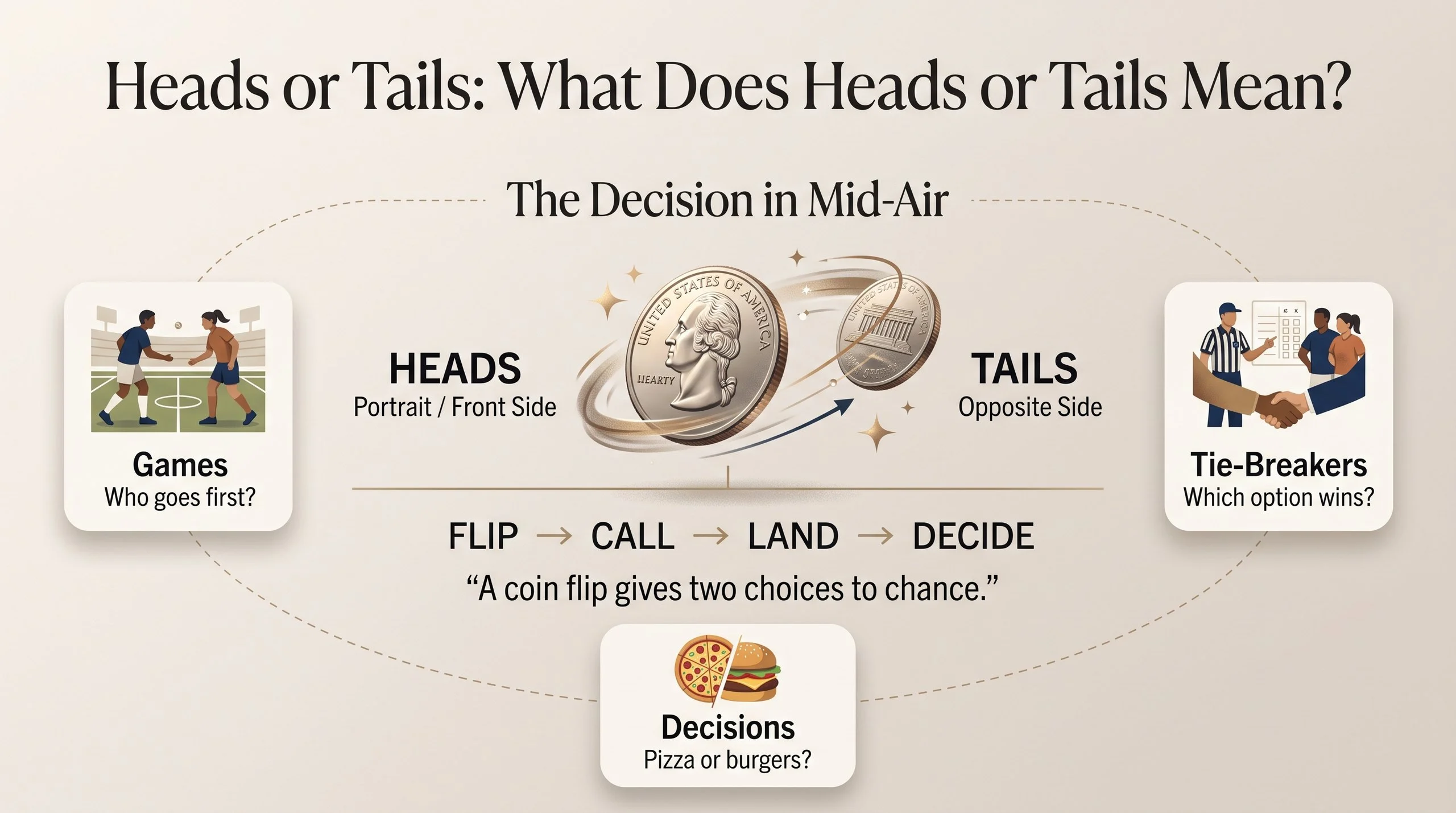
Heads or tails is a simple coin-flipping choice between the two sides of a coin. “Heads” refers to the side with a portrait or head, while “tails” refers to the opposite side. People use it to make quick decisions, settle ties, play games, or leave an outcome to chance.
Heads or tails is one of the simplest ways to make a random choice. You flip a coin, call one side before it lands, and accept whichever side appears. Because the process is quick and easy, people use it in games, sports, everyday decisions, and friendly challenges.
The phrase has a straightforward literal meaning. However, it also carries a broader idea: letting chance decide between two options. For example, someone might say, “Let’s do heads or tails” when two friends cannot agree on what to do next. Instead of continuing the argument, they let the coin make the choice.
In everyday American English, the expression can also describe a situation where only two possible outcomes exist. The choice usually feels neutral because neither person controls the result. As a result, coin flipping can provide a simple way to settle disagreements without choosing a side personally.
Although the method looks almost too simple to matter, it has remained popular for centuries. Today, people still flip coins before games, use virtual coin-flip tools online, and casually ask friends to call a side. The phrase also appears in jokes, challenges, sports traditions, and decision-making conversations.
This guide explains the meaning, history, rules, examples, common uses, misconceptions, and modern digital uses of this familiar expression.
Quick Answer
| Meaning | Context | Primary Platforms | Example | Tone |
|---|---|---|---|---|
| Choosing between two sides of a coin | Decisions, games, contests | Sports, texting, social media, everyday conversation | “Heads or tails?” | Casual |
| Using a coin flip to decide an outcome | Ties or disagreements | In-person conversations and games | “Let’s flip for it.” | Neutral |
| Leaving a two-option choice to chance | Informal decisions | Texting, group chats, gaming | “Call it: heads or tails.” | Playful |
What Does Heads or Tails Mean?
The phrase heads or tails refers to the two sides of a coin and, by extension, to the act of using a coin flip to make a random decision.
The heads side normally displays a portrait, profile, or symbolic head. The tails side is the opposite face. When someone flips a coin, they usually call one side before the coin lands.
For example:
“Heads or tails?”
You might answer:
“Heads.”
The person flips the coin. If the heads side lands face up, you win or your chosen option becomes the result. If the tails side appears, the opposite outcome applies.
The expression can therefore have two closely related meanings:
- Literal meaning: The two sides of a physical coin.
- Decision-making meaning: A coin flip used to choose between two possibilities.
The second meaning is especially common in casual conversation.
What Does “Heads” Mean?
“Heads” means the side of the coin that traditionally shows a person’s head or portrait.
On many coins, this side includes an important national figure, monarch, president, or symbolic person. However, the exact design depends on the country and currency.
In a coin-flipping game, “heads” is simply one of the two possible outcomes.
What Does “Tails” Mean?
“Tails” means the opposite side of the coin from heads.
The tails side may contain a national symbol, building, animal, number, emblem, or other design. It does not necessarily contain an actual “tail.” The term comes from the traditional contrast between the head and the opposite side.
In a coin flip, tails represents the second possible outcome.
Why Do People Flip Coins?
People flip coins because the process provides a fast and relatively impartial way to choose between two options.
Instead of debating, participants agree to accept the result. That makes the method useful when:
- Two people disagree.
- Two teams need to choose an option.
- A game needs a starting decision.
- Someone wants a random choice.
- A group needs to break a tie.
- The decision is not important enough for lengthy discussion.
The key idea is chance.
How Does a Heads or Tails Coin Flip Work?
A basic coin flip requires only a coin and two possible outcomes.
The process usually follows these steps:
1. Choose the Options
First, decide what each side represents.
For example:
- Heads = pizza
- Tails = burgers
The participants should agree on the meaning before the flip.
2. Call a Side
One person calls heads or tails before the coin lands.
For example:
“Tails!”
The caller cannot normally change the choice after seeing the result.
3. Flip the Coin
The person tosses the coin into the air.
A traditional flip involves sending the coin upward while allowing it to rotate.
4. Let It Land
The coin may land on a hand, a table, the ground, or another agreed surface.
If the coin lands normally with one side facing upward, that side determines the result.
5. Accept the Outcome
If the chosen side appears, that person wins or their selected option becomes the decision.
For example, if you called tails and the coin lands tails-up, you get the result assigned to tails.
Heads or Tails in Everyday Decisions
Coin flipping is often used for small decisions because it removes the pressure of choosing.
Imagine two friends arguing about where to eat. One wants tacos, while the other wants pizza. Neither person wants to compromise.
One friend might say:
“Let’s flip a coin.”
They assign tacos to heads and pizza to tails. The coin then determines the restaurant.
This method does not necessarily produce the “best” decision. Instead, it produces a clear decision.
That distinction matters.
A coin flip works best when both choices are acceptable. If one option could seriously affect someone’s health, finances, safety, education, or future, relying on a random coin toss may not be appropriate.
Common Everyday Uses
People may use coin flips to decide:
- Who goes first.
- Which movie to watch.
- Who gets the last slice.
- Which team starts.
- Which friend chooses the restaurant.
- Whether to take one of two casual options.
- Who performs a small task.
- Which side of a friendly bet wins.
The simplicity makes the method appealing.
Heads or Tails in Sports
Sports have one of the most recognizable uses of coin flipping.
Before some competitions, a coin toss helps determine which team gets an advantage at the beginning of play. Depending on the sport and its rules, the winning team may choose between options such as starting possession, direction, or another opening advantage.
The exact rules differ by sport and competition.
For casual games, however, the process can be much simpler:
“Heads starts.”
Someone flips the coin, and the result determines which player begins.
This approach is especially useful because it avoids arguments. Neither player needs to decide who deserves to go first.
Why Sports Use Coin Flips
A coin toss provides three practical benefits:
Speed: The result takes only a few seconds.
Simplicity: Everyone can understand the process.
Neutrality: The outcome does not depend on skill or personal preference.
That combination makes coin flipping useful before games and competitions.
Heads or Tails as a Tie-Breaker
Another common use is breaking a tie.
Suppose two people have equal claims to something. Rather than asking someone to choose a winner, they can agree to a coin flip.
For instance:
“You both want the last seat. Call it.”
One person chooses heads. The other chooses tails. The coin decides.
This approach works because both sides receive an equal opportunity under normal conditions.
Still, fairness depends on the coin flip being conducted honestly. A weighted coin, manipulated toss, or deceptive technique could undermine the process.
The Psychology Behind Coin Flipping
Coin flipping can do more than produce a random result. It can also reveal what someone actually wants.
Consider a person who cannot decide between two restaurants. They flip a coin and secretly hope for pizza. If the coin lands on burgers, they suddenly feel disappointed.
That reaction provides useful information.
The person may realize:
“Actually, I wanted pizza.”
In this situation, the coin did not need to make the final decision. It helped the person discover their preference.
Why This Happens
Indecision can sometimes hide a preference.
When someone sees a random outcome, they may immediately feel relief, excitement, or disappointment. That emotional reaction can reveal which option matters more to them.
Therefore, a coin flip can function as a psychological prompt rather than merely a randomizer.
Contextual Dynamics & Nuances of the Term
The meaning of heads or tails remains stable, but the tone changes depending on the situation.
Casual Context
Among friends, the phrase often sounds playful.
“Heads or tails? Loser buys coffee.”
Here, the coin flip becomes part of a friendly challenge.
Competitive Context
In a competition, the expression can sound more serious.
“Call it. Heads or tails?”
The participants expect the result to determine an official outcome.
Decision-Making Context
Someone may use the phrase when they are tired of debating.
“We’ve been talking about this for ten minutes. Heads or tails?”
The phrase then communicates impatience with indecision.
Humorous Context
People can also use coin flips as jokes.
“I have absolutely no idea what to order. Heads or tails?”
The humor comes from treating a trivial choice as though it requires an official decision-making system.
Symbolic Context
Sometimes, a coin flip represents uncertainty itself.
A writer might describe someone as leaving their future to a coin toss. In that context, the expression suggests risk, unpredictability, or surrendering control.
Real-Life Conversation Examples Using Heads or Tails
1. Choosing Dinner
Alex: “Pizza or burgers?”
Sam: “I can’t decide.”
Alex: “Okay. Heads or tails?”
Sam: “Heads.”
Alex: “Heads is pizza.”
Sam: “Perfect.”
This example shows a casual decision between two equally acceptable options.
2. Choosing Who Goes First
- Player 1: “You want to start?”
- Player 2: “Sure, but you can choose.”
- Player 1: “No, let’s make it fair.”
- Player 2: “Heads or tails?”
- Player 1: “Tails.”
Here, the coin removes personal preference from the decision.
3. Settling a Friendly Argument
Maya: “You said we should watch the comedy.”
Jordan: “And you said the thriller.”
Maya: “Fine. Heads or tails?”
Jordan: “Heads.”
Maya: “Comedy it is.”
The coin provides a quick tie-breaker.
4. Choosing Between Two Activities
Chris: “Beach or hiking?”
Taylor: “Both sound good.”
Chris: “Let’s flip.”
Taylor: “Okay. Heads.”
Chris: “Beach wins.”
The method works because neither person strongly prefers one option.
5. A Playful Challenge
A: “Who has to bring snacks?”
B: “Not me.”
A: “Then call it.”
B: “Tails.”
A: “Heads. Looks like you’re bringing snacks.”
This example gives the coin flip a humorous role.
Platform-Specific Breakdown
Although coin flipping traditionally happens face-to-face, the idea now appears across digital platforms.
How It Is Used on Snapchat
On Snapchat, friends may mention coin flips while making quick decisions in chats.
A user might send:
“Heads or tails?”
Another person can answer with one side. The participants can then use a physical coin or a digital randomizer.
The phrase usually feels casual and playful on Snapchat. It may appear during conversations about plans, games, challenges, or small disagreements.
Because Snapchat conversations often move quickly, a coin flip can provide an easy way to settle a choice without a long discussion.
The Role of Heads or Tails on TikTok
TikTok can turn simple coin flips into entertainment.
Creators may use coin-flipping challenges, decision games, audience polls, or random-choice videos. The expression can also appear in captions and comments when viewers are asked to choose between two options.
For example:
“Heads = option one. Tails = option two.”
The phrase works particularly well in short-form content because viewers immediately understand the two-option structure.
However, TikTok content can use coin flipping creatively rather than literally. A creator might ask viewers to choose a side before revealing an outcome.
Instagram and Texting Dynamics
Instagram Stories, direct messages, and group chats can also use the idea.
Someone might write:
“I can’t choose. Heads or tails?”
A friend can respond with a choice. The sender then flips a coin.
In group chats, several people may participate. For example, the group could assign one side to each option and let the coin settle the debate.
Digital conversations make the phrase more flexible because people can combine it with polls, randomizers, emojis, or screenshots.
Gaming Communities
Gaming groups frequently need quick decisions.
Players may use a coin flip to determine:
- Who chooses a character first.
- Which player starts.
- Which map gets selected.
- Who receives an item.
- Which team gets an advantage.
The exact use depends on the game and its rules. In casual settings, however, the phrase remains a simple way to avoid arguments.
Alternative Meanings & NLP Variations of the Phrase
The phrase has several related expressions.
| Expression | Meaning |
|---|---|
| Flip a coin | Make a random two-option choice |
| Call it | Choose heads or tails before the result |
| Coin toss | The act of tossing a coin |
| Coin flip | A random decision using a coin |
| Heads-up | A completely different expression meaning a warning or notice |
| Fifty-fifty | An informal way to describe two roughly equal possibilities |
| Leave it to chance | Let randomness determine the outcome |
| Toss a coin | Another way to describe flipping a coin |
These expressions overlap, but they are not always interchangeable.
For example, “call it” refers specifically to choosing a side before the result. Meanwhile, “leave it to chance” can involve many types of random outcomes, not just a coin.
Is Heads or Tails Truly Fifty-Fifty?
People often describe a standard coin flip as a fifty-fifty event.
In a simplified model, a fair coin has two possible outcomes:
- Heads
- Tails
Each outcome is treated as having approximately equal probability.
However, real-world coin flips are more complicated. Factors such as the coin’s physical properties, starting position, flipping technique, air movement, and landing surface can influence the result.
For ordinary casual decisions, these differences usually do not matter.
The important point is that a normal coin flip is designed to provide two reasonably balanced outcomes.
Common Misconceptions About Heads or Tails
Misconception 1: Tails Always Means the Coin Shows a Tail
Not necessarily.
“Tails” is simply the traditional name for the side opposite heads. The design may show an animal, building, emblem, number, or other symbol.
Misconception 2: Calling Heads Gives You Control
Calling a side does not normally control the outcome.
The caller chooses the prediction before the coin lands. The result remains uncertain.
Misconception 3: A Coin Must Be Caught in the Hand
Not always.
People may catch the coin, slap it onto the back of the other hand, or let it land on a table or other surface. The agreed method determines how the result is read.
Misconception 4: A Coin Flip Solves Every Decision
A coin flip works best for low-stakes choices.
Important decisions require more thoughtful analysis. Randomness can be useful for choosing between equally acceptable options, but it should not replace informed judgment when the consequences matter.
Misconception 5: The Previous Result Changes the Next Flip
If a coin lands heads several times in a row, that does not automatically mean tails is “due” on the next flip.
This is a common example of the gambler’s fallacy.
Each individual flip should be treated as a new event under normal assumptions.
When NOT to Use Heads or Tails
A coin flip is not appropriate for every situation.
Avoid relying on randomness when the decision involves serious consequences, such as:
- Medical treatment.
- Legal matters.
- Major financial decisions.
- Safety concerns.
- Important career choices.
- Academic planning.
- Relationship decisions involving significant consequences.
Instead, consider relevant facts, risks, preferences, and long-term effects.
The method is most useful when both options are reasonable and the primary problem is simply choosing between them.
How to Respond in Chat Comfortably
If someone asks you, “Heads or tails?” you can simply choose one.
Straight Answer
“Heads.”
Playful Answer
“Tails. Let’s see what happens.”
Random Answer
“Heads. I’m trusting the coin.”
Hesitant Answer
“Tails, but I have a feeling I’m going to regret this.”
Refusing the Coin Flip
“Neither. I actually have a preference, so I’ll choose directly.”
Your response depends on the context. In casual conversations, a short answer usually works best.
Heads or Tails vs. Other Random Choices
Coin flipping is only one way to make a random choice.
| Method | Best For | Number of Options |
|---|---|---|
| Coin flip | Simple decisions | 2 |
| Dice roll | Multiple choices | 2–6 or more |
| Random number generator | Digital decisions | Flexible |
| Drawing lots | Group decisions | Flexible |
| Wheel spinner | Visual online choices | Flexible |
| Rock-paper-scissors | Friendly competitions | 3 |
The coin has one major advantage: almost everyone understands it immediately.
There is no complicated setup. You only need a coin and two possible outcomes.
Advantages of Using a Coin Flip
Fast
A coin flip can settle a decision within seconds.
Simple
Everyone understands the basic rules.
Accessible
A physical coin is inexpensive and widely available.
Neutral
The method removes personal control from the final outcome.
Fun
The uncertainty can make a simple choice more entertaining.
Useful for Ties
A coin can provide an immediate tie-breaker when both sides have equal claims.
Disadvantages of Using a Coin Flip
It Ignores Important Factors
Random selection does not consider evidence, quality, or long-term consequences.
It Only Works Naturally for Two Options
You need additional rules when more than two choices exist.
It Can Create Disagreement
Participants may argue if they do not agree on how the flip should happen.
It Can Be Manipulated
An unfair coin or dishonest technique can affect the outcome.
It May Oversimplify Decisions
Some choices deserve careful reasoning instead of random selection.
How to Make a Coin Flip Fair
If fairness matters, agree on the rules before flipping.
For example:
- Use a normal, recognizable coin.
- Decide what each side represents.
- Make sure everyone understands the rules.
- Call the side before the coin lands.
- Use a consistent flipping method.
- Agree on what happens if the coin lands on its edge.
- Accept the result.
The edge case is particularly important.
Although rare, a coin can sometimes land upright or become stuck against an object. Participants should decide beforehand whether that means a re-flip.
Fun Ways to Use a Coin Flip
You can turn a simple coin toss into a small game.
Dinner Decision
Heads = restaurant A
Tails = restaurant B
Movie Night
Heads = comedy
Tails = action
Weekend Plans
Heads = stay home
Tails = go out
Game Night
Heads = Player 1 starts
Tails = Player 2 starts
Chores
Heads = one person handles the task
Tails = the other person does it
The goal is not to make important life decisions randomly. Instead, these examples show how coin flips can make ordinary choices more engaging.
Quick Examples You Can Use
Here are several natural ways to use the phrase:
- “Heads or tails?”
- “Call heads or tails.”
- “Let’s flip a coin.”
- “You call it.”
- “Heads means we go.”
- “Tails means we stay.”
- “We’ll leave it to the coin.”
- “Let’s use a coin toss to settle it.”
- “Call it before I flip.”
- “The coin decided for us.”
These examples work because the expression is short, familiar, and easy to understand.
Related Expressions
Several expressions communicate a similar idea.
Flip a coin: Use a coin to make a random choice.
Coin toss: The act or result of tossing a coin.
Leave it to chance: Allow randomness to determine an outcome.
Let fate decide: A more dramatic way to surrender a choice to circumstances.
Call it: Select heads or tails before the coin lands.
Fifty-fifty: Describe two possibilities that appear roughly equal.
Take a chance: Accept uncertainty and proceed anyway.
These expressions can overlap, but their tone varies. “Flip a coin” sounds practical, while “let fate decide” sounds more dramatic or literary.
Key Takeaways
- Heads or tails refers to the two sides of a coin.
- “Heads” usually represents the side with a portrait or head.
- “Tails” represents the opposite side.
- People often use a coin flip to make quick decisions.
- Coin flips are common in games, sports, contests, and casual conversations.
- The method works best when two options are equally acceptable.
- A coin flip can also reveal hidden preferences by showing how someone reacts to the result.
- Important life decisions should not rely solely on random chance.
- A fair process requires agreed rules and an honest flip.
- Digital platforms have made coin-flip decisions easy to recreate online.
FAQs
What does heads or tails mean?
Heads or tails means choosing between the two sides of a coin. It can also refer to using a coin flip to make a random decision between two options.
Is heads or tails a game?
It can be used as a simple game, but it is more broadly a coin-flipping method. People use it for games, tie-breakers, contests, and everyday decisions.
Which side is heads on a coin?
The heads side is traditionally the side featuring a person’s head, portrait, or similar representation. The exact design depends on the coin and country.
Which side is tails?
Tails is the side opposite the heads side. Its design can include symbols, animals, buildings, numbers, or other images.
Why do people say “call it”?
“Call it” means choosing heads or tails before the coin lands. The person makes their selection without knowing the result.
Is a coin flip really random?
A physical coin flip is not perfectly random in a scientific sense because physical conditions can influence the result. However, ordinary coin flips are generally treated as sufficiently unpredictable for casual decisions.
Can you use a coin flip to settle an argument?
Yes, if everyone agrees to accept the result. It works especially well when both choices are acceptable and the disagreement is relatively minor.
What does flipping a coin symbolize?
Flipping a coin can symbolize chance, uncertainty, impartiality, risk, or surrendering control over a decision.
Is heads always the winning side?
No. Either side can win. The rules determine which outcome corresponds to each option.
What happens if a coin lands on its edge?
There is no universal rule. In most casual situations, participants simply agree to flip again. Official competitions may have specific rules.
Conclusion
Heads or tails remains popular because it solves a simple problem with an equally simple method: when two choices seem acceptable, let chance choose one.
The phrase refers literally to the two sides of a coin. Yet, in everyday language, it often means much more. It can represent a quick decision, a fair tie-breaker, a playful challenge, or even a moment of uncertainty.
Its usefulness comes from its simplicity. You do not need special equipment, complicated rules, or a long discussion. A coin, two options, and an agreed process can settle a minor disagreement almost instantly.
At the same time, the method has limits. Randomness cannot replace thoughtful judgment when a decision carries serious consequences. For important choices, facts and careful reasoning should come first. For low-stakes choices, however, a coin flip can remove unnecessary hesitation.
That balance explains why this expression has stayed familiar across generations. Whether it appears in a sports competition, a group chat, a friendly game, or a simple conversation about dinner, the idea remains easy to understand.
When someone asks, “Heads or tails?” they are usually offering two possibilities and asking you to trust chance for the final answer. Sometimes the coin decides. Other times, your reaction to the result tells you what you really wanted all along.