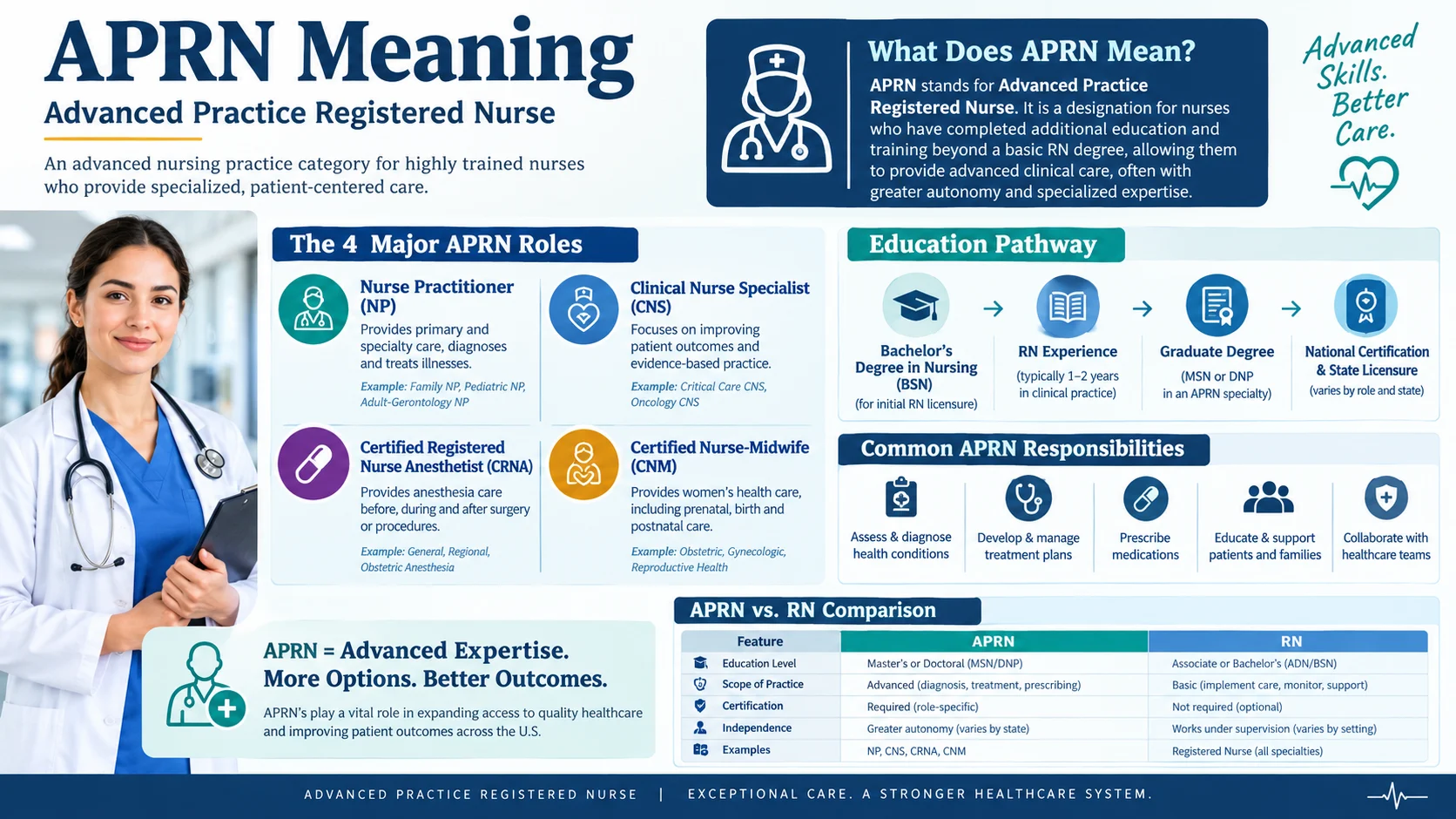
APRN Meaning refers to Advanced Practice Registered Nurse. An APRN is a registered nurse with advanced education, clinical preparation, certification, and legal authority to provide expanded patient care within a recognized APRN role.
Apron meaning is important for anyone trying to understand modern nursing, healthcare credentials, or medical job titles in the United States. The abbreviation appears in hospital records, job listings, insurance documents, nursing programs, and professional profiles.
However, APRN is more than another nursing abbreviation. It identifies registered nurses who have completed advanced preparation for specialized clinical practice. Depending on the role and state laws, these professionals may assess patients, diagnose conditions, order or interpret tests, prescribe medications, manage treatment, and provide advanced nursing care.
The term can also create confusion because APRN practice varies by specialty and state. For example, a nurse practitioner and a nurse anesthetist are both APRNs, but their daily responsibilities can look very different.
Furthermore, people sometimes use APRN and NP as if they mean exactly the same thing. They do not. NP is one APRN role, while APRN is the broader professional category.
Understanding the distinction makes medical conversations easier. It also helps patients, students, employers, and healthcare professionals interpret credentials correctly.
Quick Answer Box
| Category | Answer |
| Meaning | Advanced Practice Registered Nurse |
| Context | Advanced nursing and healthcare |
| Primary Platforms | Medical records, healthcare websites, job listings, education, professional profiles |
| Example | “The patient was evaluated by an APRN.” |
| Tone | Professional, clinical, formal |
What Does aprn Mean?
In American healthcare, APRN stands for Advanced Practice Registered Nurse. The term describes a registered nurse who has advanced education and preparation for a specialized level of nursing practice.
An APRN does not simply have more experience than a standard registered nurse. Advanced practice generally involves graduate level education, specialized clinical preparation, professional certification, and authorization to perform advanced functions under applicable law.
The exact scope depends on the APRN role and the state where the professional practices.
Breaking Down the Acronym
| Letter | Word | Meaning |
| A | Advanced | Indicates preparation beyond basic registered nursing education |
| P | Practice | Refers to professional clinical practice |
| R | Registered | Identifies the professional as a registered nurse |
| N | Nurse | Identifies the underlying nursing profession |
The phrase therefore describes a professional category rather than one specific job.
For example, an APRN may work in primary care, acute care, anesthesia, mental health, women’s health, pediatrics, or another specialized setting.
The term is especially common in the United States. State licensing rules determine what an individual APRN can legally do.
Is APRN the Same as Nurse Practitioner?
No. A nurse practitioner, commonly abbreviated NP, represents one major APRN role.
The broader APRN category includes four commonly recognized roles:
| APRN Role | Common Abbreviation | Main Focus |
| Certified Nurse Practitioner | NP | Assessment, diagnosis, treatment, and ongoing care |
| Certified Nurse Midwife | CNM | Pregnancy, childbirth, postpartum, and reproductive care |
| Clinical Nurse Specialist | CNS | Advanced specialty nursing, education, consultation, and clinical improvement |
| Certified Registered Nurse Anesthetist | CRNA | Anesthesia and related advanced care |
Consequently, saying every APRN is a nurse practitioner would be inaccurate.
A better explanation is simple: every nurse practitioner is an APRN, but not every APRN is a nurse practitioner.
What Education Does an APRN Need?
Advanced practice nursing requires education beyond the basic preparation needed for registered nursing.
Modern APRN preparation commonly includes graduate level nursing education and substantial clinical training. Certification requirements also apply to specific roles and specialties.
However, exact educational and licensing requirements can change according to professional role and state regulation.
For students, this distinction matters. Someone considering an advanced nursing career should review the requirements for the specific APRN role they want to pursue.
What Can an APRN Do?
An APRN may perform advanced clinical functions depending on credentials, specialty, employer policies, and state law.
| Function | May an APRN Perform It? |
| Patient assessment | Commonly yes |
| Health history | Commonly yes |
| Physical examination | Commonly yes |
| Diagnosis | Depending on role and state authority |
| Treatment planning | Commonly yes |
| Ordering tests | Depending on role and state authority |
| Prescribing medication | Depending on role and state authority |
| Patient education | Yes |
| Chronic disease management | Commonly yes |
| Specialty care | Yes, within appropriate preparation |
The phrase “depending on state law” is especially important.
Healthcare authority is not identical across the country. State regulations can affect prescribing authority, practice requirements, collaboration rules, supervision requirements, and other aspects of professional practice.
Contextual Dynamics and Nuances of the Term
The meaning of an abbreviation can change slightly depending on where you encounter it.
In a hospital, APRN may identify the professional responsible for part of a patient’s advanced clinical care. In a university setting, it may describe a nursing student or professional pursuing advanced practice preparation.
Meanwhile, on a job board, the abbreviation often appears beside specialty information, certification requirements, or salary details.
APRN in Medical Conversations
A physician might write about an APRN when describing the healthcare team. A patient may encounter the abbreviation while reviewing an appointment description.
For example, a clinic could describe an appointment as being with an APRN. In that setting, the abbreviation communicates the professional’s credential category.
The abbreviation does not automatically identify the person’s exact specialty.
APRN in Job Listings
Healthcare employers frequently use APRN when discussing advanced nursing positions.
A listing may seek an APRN with experience in family medicine, emergency care, psychiatry, oncology, cardiology, or another field.
However, job descriptions often specify the actual credential required. Therefore, applicants should not assume that every APRN position accepts every type of APRN.
For example, a position requiring anesthesia expertise would have very different requirements from a psychiatric nurse practitioner position.
APRN in Education
Nursing schools use APRN terminology when discussing advanced practice pathways.
Students may encounter terms such as graduate nursing education, specialty certification, clinical hours, licensure, and national certification.
Therefore, understanding the abbreviation early can make nursing program information easier to interpret.
APRN in Professional Profiles
Healthcare professionals may include APRN in biographies, email signatures, credential listings, or online profiles.
The abbreviation communicates advanced nursing preparation without necessarily explaining the person’s specialty.
A complete professional profile may therefore include several credentials.
For example, someone could identify their nursing role, specialty certification, state licensure, and professional designation separately.
Real Life Conversation Examples Using aprn meaning
People rarely discuss medical abbreviations in isolation. Usually, the term appears inside a practical conversation.
The following examples show how the abbreviation can naturally appear.
Example 1: Patient Appointment
Patient: “Who will I see at my appointment?”
Clinic Staff: “You will see an APRN who specializes in family healthcare.”
Patient: “So they are an advanced practice nurse?”
Clinic Staff: “Exactly. They are trained to provide advanced nursing care within their role and legal scope.”
Meaning: Here, APRN identifies the professional category of the clinician seeing the patient.
Example 2: Nursing Student
Student: “I keep seeing APRN in graduate nursing programs. What does it mean?”
Advisor: “It means Advanced Practice Registered Nurse. Several advanced nursing roles fall within that category.”
Student: “So becoming an NP is one APRN pathway?”
Advisor: “Correct.”
Meaning: This conversation uses the abbreviation in an educational and career planning context.
Example 3: Workplace Conversation
Employee: “The job posting says APRN is required. Does that automatically mean nurse practitioner?”
Recruiter: “Not necessarily. Check the specific credential and specialty listed in the requirements.”
Employee: “That makes sense.”
Meaning: The conversation highlights why APRN should not automatically be treated as a synonym for NP.
Example 4: Medical Record
Patient: “My paperwork says APRN next to the provider’s name. Is that a doctor?”
Staff Member: “APRN means Advanced Practice Registered Nurse. It does not mean physician.”
Patient: “So they are a different type of healthcare professional?”
Staff Member: “Yes, although they may have substantial clinical responsibilities.”
Meaning: The abbreviation distinguishes an advanced nursing professional from a physician.
Example 5: Family Conversation
Family Member: “The clinic told me an APRN can manage my follow up care.”
Friend: “APRN means Advanced Practice Registered Nurse. The exact services they provide depend on their specialty and state rules.”
Family Member: “Got it. So I should check their specific role.”
Meaning: This example shows a simple, accurate way to explain the abbreviation without making assumptions about scope.
Platform Specific Breakdown
Although APRN is primarily a healthcare term, people increasingly encounter professional abbreviations online.
Search engines, social networks, messaging apps, professional websites, and job platforms can all display the abbreviation.
How It Is Used on Snapchat
Snapchat is primarily informal, so APRN is not typical everyday slang.
Still, someone studying nursing or working in healthcare may mention the abbreviation in a profile, story, caption, or private message.
For example, a nursing student might post about beginning an advanced nursing program. A healthcare professional might use the abbreviation when describing a new role.
The important point is context.
If someone sends “APRN” in a Snapchat conversation, the abbreviation usually relates to healthcare rather than internet slang.
The Role of aprn meaning on TikTok
TikTok has made healthcare abbreviations more visible to general audiences.
Nurses and healthcare creators often explain professional terminology through short videos. As a result, viewers may encounter APRN without having a nursing background.
A video might discuss advanced nursing careers, graduate education, salaries, clinical responsibilities, or differences between healthcare professions.
However, short videos can simplify complicated regulatory topics. State laws and professional roles involve details that cannot always fit into a short clip.
Therefore, viewers should treat social media explanations as educational content rather than automatically assuming they describe every state.
Instagram and Texting Dynamics
Instagram can use APRN in professional bios, educational posts, career content, and healthcare discussions.
Text messages can also contain the abbreviation when patients communicate with clinics or when healthcare workers communicate professionally.
Unlike casual internet abbreviations such as “LOL” or “BRB,” APRN is a professional credential abbreviation.
Its tone therefore depends heavily on the setting.
| Setting | Typical Tone | Likely Purpose |
| Instagram bio | Professional | Identify healthcare credentials |
| TikTok video | Educational | Explain nursing careers or healthcare |
| Text message | Practical | Identify a healthcare professional |
| Hospital communication | Clinical | Identify an advanced nursing provider |
| Job platform | Professional | Describe qualifications |
| Nursing school website | Academic | Explain advanced practice pathways |
Alternative Meanings
The abbreviation itself has a stable healthcare meaning, but people use several related phrases when searching for information.
Common variations include:
| Search Phrase | Likely Intent |
| aprn meaning | Basic definition |
| what does APRN stand for | Acronym expansion |
| what is an APRN | Professional explanation |
| APRN nurse meaning | Credential clarification |
| APRN vs NP | Role comparison |
| APRN vs RN | Education and scope comparison |
| APRN credentials | Qualification research |
| APRN roles | Career exploration |
| APRN salary | Employment research |
| APRN license | Regulatory research |
| APRN certification | Credential research |
| APRN provider | Healthcare terminology |
These variations show that users often want more than a dictionary definition.
Someone searching the abbreviation may actually be asking whether an APRN can prescribe medication, whether an APRN is a doctor, or how an APRN differs from a registered nurse.
Related Healthcare Terms
Several terms frequently appear beside APRN.
| Term | General Meaning |
| RN | Registered Nurse |
| NP | Nurse Practitioner |
| CNS | Clinical Nurse Specialist |
| CNM | Certified Nurse Midwife |
| CRNA | Certified Registered Nurse Anesthetist |
| MD | Doctor of Medicine |
| DO | Doctor of Osteopathic Medicine |
| PA | Physician Associate or Physician Assistant, depending on usage and jurisdiction |
These credentials should not be treated as interchangeable.
Each represents a distinct professional pathway, education model, certification structure, and scope of practice.
APRN Versus RN
An RN is a registered nurse. An APRN has advanced preparation and practices in an advanced nursing role.
The difference is therefore not simply a matter of job title.
| Feature | RN | APRN |
| Registered nursing license | Yes | Yes |
| Advanced nursing preparation | Not necessarily | Yes |
| Specialized advanced role | Not necessarily | Yes |
| Graduate education | Not always required | Commonly required |
| Advanced clinical authority | Varies | Depends on role and state |
The exact legal distinction depends on jurisdiction and professional role.
APRN Versus Physician
An APRN and physician are different healthcare professions.
Physicians complete medical education and residency training. APRNs follow an advanced nursing education and certification pathway.
Both can play major roles in patient care, but their education, licensing systems, professional frameworks, and legal scopes differ.
Consequently, calling an APRN a physician would be inaccurate.
Misinterpretations: When NOT to Use aprn meaning
Understanding a professional abbreviation also means knowing when assumptions become misleading.
The most common mistake is treating APRN as one specific job.
It is a broader category.
Do Not Assume APRN Means Nurse Practitioner
NP is one APRN role. However, other APRN roles exist.
Therefore, if a document says someone is an APRN, check the person’s specific credential before describing them as an NP.
Do Not Assume Every APRN Has Identical Authority
State laws vary.
One state’s practice environment may differ from another state’s environment. Prescribing rules, collaboration requirements, supervision structures, and other legal details can vary.
Therefore, a general explanation should avoid claiming that every APRN can perform exactly the same functions everywhere.
Do Not Use APRN as a Casual Slang Term
APRN is not normally internet slang.
It belongs to professional and healthcare vocabulary.
Using it as a joke or random abbreviation could confuse readers because many people recognize it as a medical credential.
Do Not Treat APRN and RN as Identical
Every APRN builds on registered nursing preparation, but advanced practice involves additional preparation and professional responsibilities.
Therefore, replacing one term with the other can remove important information.
Do Not Treat APRN and Doctor as Synonyms
An APRN may provide advanced clinical services, but APRN does not mean physician.
When explaining healthcare credentials, accurate terminology matters.
How to Respond in Chat Comfortably
If someone asks you what APRN means, the easiest answer is direct and simple.
You do not need to give a full nursing lecture unless they want more detail.
Simple Response
“APRN stands for Advanced Practice Registered Nurse.”
This works in almost any casual conversation.
Slightly More Detailed Response
“APRN means Advanced Practice Registered Nurse. It refers to registered nurses with advanced education and clinical preparation.”
This works well when someone wants context.
If Someone Asks Whether an APRN Is a Doctor
You can say:
“Not exactly. APRN is an advanced nursing credential, while physician is a separate healthcare profession.”
That answer avoids unnecessary complexity.
If Someone Asks Whether an APRN Is an NP
A useful response is:
“An NP is one type of APRN, but APRN is the broader category.”
This distinction is especially useful for nursing students and patients.
If Someone Asks About Prescribing
A careful response would be:
“Prescribing authority depends on the APRN role, state law, and applicable regulations.”
This is safer and more accurate than saying every APRN can prescribe.
If Someone Uses the Abbreviation in a Message
You can respond naturally:
“Got it. APRN means Advanced Practice Registered Nurse, right?”
This works when you want confirmation without pretending to know the exact context.
FAQs
What is aprn meaning in healthcare?
apron meaning refers to Advanced Practice Registered Nurse. The term describes a registered nurse with advanced preparation for a specialized nursing practice role.
What does APRN stand for?
APRN stands for Advanced Practice Registered Nurse. It is a professional abbreviation used primarily in American healthcare, nursing education, licensing, employment, and clinical communication.
Is an APRN a doctor?
No. An APRN is an advanced practice nursing professional, while a physician is a separate healthcare profession. Both may provide patient care, but their educational and professional pathways differ.
Is an APRN the same as an RN?
No. APRNs are registered nurses with advanced preparation for specialized practice. The APRN category involves additional education, clinical preparation, certification, and applicable legal authorization.
Is a nurse practitioner an APRN?
Yes. A nurse practitioner is one recognized type of APRN. Other APRN roles include certified nurse midwives, clinical nurse specialists, and certified registered nurse anesthetists.
Can an APRN prescribe medication?
Prescribing authority depends on the professional role and the laws of the state where the APRN practices. Therefore, the answer is not identical across every jurisdiction.
What are the four APRN roles?
The four commonly recognized APRN roles are nurse practitioner, certified nurse midwife, clinical nurse specialist, and certified registered nurse anesthetist.
Where might I see the abbreviation?
You may see APRN in hospital records, clinic websites, provider biographies, nursing school materials, job descriptions, professional profiles, insurance documentation, and healthcare communications.
Why does APRN sometimes appear next to a provider’s name?
The abbreviation identifies an advanced practice registered nurse credential or professional category. It helps distinguish the provider’s nursing qualification from other healthcare credentials.
Why do people search for an apron meaning online?
People commonly search for the term after seeing it beside a healthcare provider’s name, in a medical document, on a job listing, or in nursing education materials. They may also want to understand the difference between APRNs, RNs, NPs, and physicians.
Conclusion
Although APRN may appear in online searches, social media profiles, and text messages, it is not ordinary internet slang. It is a professional healthcare abbreviation with a specific meaning.
Understanding aprn meaning starts with one simple definition: Advanced Practice Registered Nurse. From there, the important distinction is that APRN describes a broader category rather than one single occupation.
Nurse practitioners, certified nurse midwives, clinical nurse specialists, and certified registered nurse anesthetists can fall within the APRN framework. However, their responsibilities differ according to role, preparation, certification, and applicable state law.
Therefore, when you see APRN beside a healthcare professional’s name, look at the person’s specific credential before making assumptions.
That small distinction can make medical documents, career information, provider profiles, and everyday healthcare conversations much easier to understand.