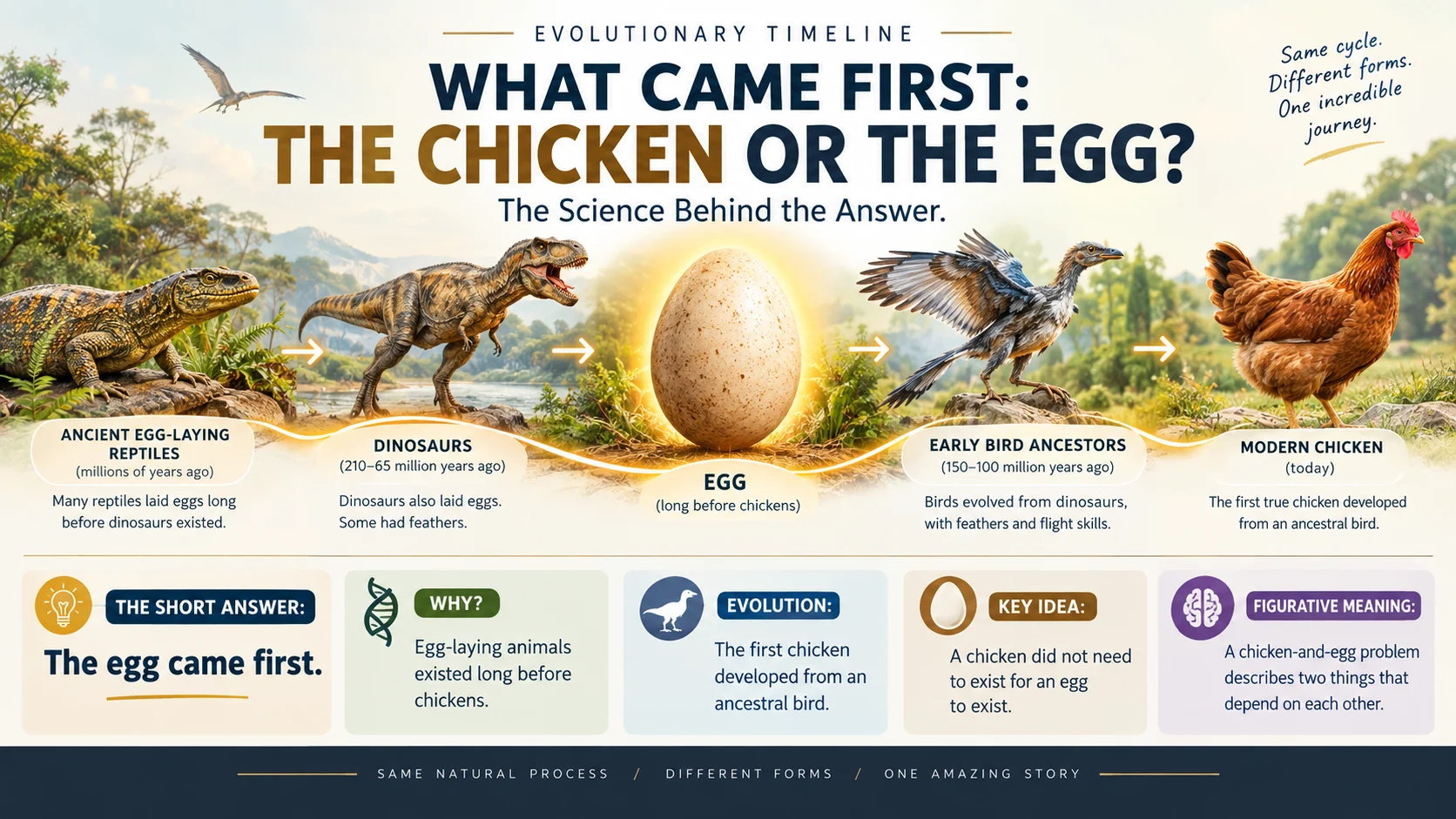
What came first the chicken or the egg? From a scientific perspective, the egg came first. Eggs existed hundreds of millions of years before chickens evolved, and the first true chicken likely developed from a bird that laid an egg containing genetic changes that produced the first chicken. Therefore, while the question is often used as a philosophical puzzle, evolutionary biology provides a clear answer: the egg came first.
The question what came first the chicken or the egg is one of the most famous questions in everyday language, science, and philosophy. At first, the question seems impossible to answer because chickens come from eggs, while eggs come from chickens. As a result, each side appears to depend on the other.
However, the answer becomes clearer when we look at evolution rather than only at modern chickens. Eggs existed long before chickens appeared on Earth. In fact, many animals, including ancient reptiles, fish, amphibians, and dinosaurs, reproduced by laying eggs millions of years before the first chickens evolved.
Moreover, the question has a deeper meaning beyond biology. People often use it when two events appear to depend on each other, making it difficult to identify which one started the chain. For example, someone might ask whether success creates confidence or confidence creates success. Similarly, businesses can wonder whether customers create popularity or popularity attracts customers.
Therefore, understanding what came first the chicken or the egg involves more than choosing one of two objects. It also introduces an interesting lesson about evolution, cause and effect, circular reasoning, and how a seemingly simple question can have several interpretations.
What Does “What Came First the Chicken or the Egg?” Mean?
The phrase what came first the chicken or the egg asks which of two related things existed or happened before the other.
In its literal sense, the question asks whether the chicken existed before the egg or whether an egg existed before the chicken. Because chickens hatch from eggs and chickens lay eggs, the relationship appears circular.
However, the phrase is also commonly used figuratively.
When people describe a situation as a “chicken-and-egg problem,” they usually mean that two things depend on each other, so identifying the original cause is difficult.
For example:
“Which came first: the demand for the product or the popularity of the product?”
Here, the speaker is not asking about birds. Instead, the speaker is describing a situation in which cause and effect seem connected in both directions.
Consequently, the phrase can refer to:
- A biological question
- A philosophical puzzle
- A cause-and-effect problem
- A circular argument
- A difficult business decision
- A dependency between two events
- A situation with no obvious starting point
The Simple Answer: The Egg Came First
From a scientific perspective, the egg came first.
That answer might sound surprising at first. After all, if we specifically mean a chicken egg, it seems reasonable to argue that a chicken must exist before it can lay one.
Nevertheless, evolution changes the way we look at the problem.
Egg-laying animals existed long before chickens. Dinosaurs, reptiles, fish, and other animals reproduced through eggs millions of years before modern chickens appeared.
Therefore, an egg does not require a chicken.
Instead, chickens are the result of a very long evolutionary process involving earlier birds and their ancestors.
The first animal that could reasonably be called a chicken would have developed from parents that were extremely similar to chickens but were not exactly the same species. At some point, genetic changes accumulated until an embryo inside an egg developed into what we would recognize as the first true chicken.
Thus, the egg containing that first chicken came before the chicken itself.
Why the Egg Came Before the Chicken
The strongest scientific explanation comes from evolution and genetics.
Species do not normally appear suddenly without ancestors. Instead, populations gradually change across many generations.
Ancient bird-like animals reproduced in much the same way as their descendants. Two parent birds that were almost, but not quite, modern chickens could have produced an egg containing genetic changes.
That embryo could then develop into the first animal that met the biological definition of a chicken.
In simplified terms:
Ancient bird-like ancestors → genetic changes → egg → first chicken
Therefore, the egg existed before the first chicken.
The important point is that the egg itself did not need to be laid by a modern chicken. An earlier bird could have laid it.
How Evolution Explains the Answer
Evolution helps explain why the question is easier to answer scientifically than it first appears.
Species change gradually over enormous periods. Consequently, there was not necessarily a single dramatic moment when a non-chicken suddenly became a chicken.
Instead, populations of ancestral birds gradually developed characteristics associated with modern chickens.
Genetic variation occurs naturally within populations. Furthermore, mutations can introduce differences in DNA. Natural selection and other evolutionary processes can then influence which traits become more common over generations.
Eventually, the lineage that produced modern chickens became sufficiently different from its ancestors to be classified as a separate species.
This means the phrase “first chicken” is partly a matter of how scientists define the boundary between one population and another.
Even so, the basic conclusion remains straightforward: the reproductive egg came before the modern chicken.
Were Eggs Around Before Chickens?
Yes.
Eggs are vastly older than chickens.
Animals were laying eggs hundreds of millions of years before modern chickens evolved. Fossil evidence shows that egg-laying reproduction existed among ancient animals long before birds appeared in their modern form.
For instance, reptiles and other vertebrates developed different forms of egg-based reproduction during Earth’s long evolutionary history.
Later, dinosaurs also laid eggs. Birds evolved from theropod dinosaurs, so the reproductive strategy that produced eggs was already established in the evolutionary lineage leading toward modern birds.
As a result, the egg has an enormous evolutionary history.
The chicken, by comparison, is a relatively recent product of that history.
What About the First Chicken Egg?
This is where the question becomes more interesting.
Suppose we define a chicken egg as an egg that contains a chicken embryo.
In that case, the first chicken egg would have been produced by a bird that was extremely close to being a chicken but was not quite a modern chicken itself.
That bird could have carried genetic characteristics that differed slightly from its offspring.
Inside the egg, those inherited traits combined with genetic variation to produce the first organism that we would classify as a chicken.
Therefore:
A nearly-chicken parent → chicken egg → first chicken
This explanation resolves the apparent circular problem.
The parent did not have to be a modern chicken for it to produce the egg containing the first chicken.
What Does the Chicken-and-Egg Problem Mean Philosophically?
Although science provides an answer, philosophers have discussed the chicken-and-egg question for centuries.
The puzzle is interesting because it challenges our understanding of cause and effect.
If the chicken produces the egg and the egg produces the chicken, which one deserves to be considered the beginning?
This creates a seemingly endless loop:
Chicken → egg → chicken → egg → chicken
Without additional information, the cycle appears impossible to break.
Philosophical discussions about the problem have therefore explored questions about time, causation, beginnings, and whether everything must have a first cause.
Ancient philosophers, including Aristotle, considered versions of the problem. Their discussions were not based on modern evolutionary biology because evolutionary science did not yet exist.
Instead, they were interested in whether the world and its natural processes had a beginning.
The Chicken-and-Egg Problem in Everyday Life
Today, people frequently use the expression to describe situations involving mutual dependence.
For example, imagine a new social media platform.
The platform needs users to become popular. However, users may not want to join until the platform becomes popular.
That creates a chicken-and-egg problem:
More users → more popularity → more users
Neither side seems like an obvious starting point.
Similarly, a new business may need customers to build credibility. At the same time, potential customers may want credibility before becoming customers.
Therefore, the phrase has become a useful way to describe situations where two factors reinforce each other.
Real-Life Examples of a Chicken-and-Egg Problem
1. Business
A new company needs reviews to attract customers. Yet it needs customers before it can collect reviews.
This creates a classic chicken-and-egg situation.
2. Social Media
A creator needs followers to increase visibility. However, gaining followers may require visibility first.
Therefore, growth can feel circular.
3. Employment
A recent graduate may need work experience to get a job. At the same time, they need a job to gain professional experience.
That is another common chicken-and-egg problem.
4. Technology
A new technology may need a large user base before developers create applications for it. However, users may avoid it because there are not enough applications.
Again, both sides depend on the other.
5. Personal Development
Someone may wonder whether confidence creates success or whether success creates confidence.
In reality, both can reinforce each other.
Chicken or Egg: Scientific vs. Literal Interpretation
The answer changes slightly depending on what the question means by “egg.”
| Interpretation | Answer | Why |
|---|---|---|
| Any egg in evolutionary history | Egg | Egg-laying animals existed long before chickens |
| Egg containing the first chicken | Egg | An ancestral bird laid the egg containing the first chicken |
| Chicken before any egg | Chicken | This would only work under a very narrow assumption |
| Philosophical cycle | No simple beginning | The question focuses on mutual dependence |
| Everyday idiom | Depends | It describes situations where causes are difficult to separate |
Therefore, context matters.
If someone asks the question scientifically, the strongest answer is egg. If they use it as a philosophical puzzle, however, the purpose may be to explore circular causation rather than identify a biological winner.
Why People Still Ask This Question
Even though science gives us a reasonable answer, people continue to ask what came first the chicken or the egg because the question is simple, memorable, and surprisingly deep.
First, it challenges intuition. Most people understand that chickens come from eggs and that chickens lay eggs. Therefore, the relationship immediately feels circular.
Second, it introduces a larger question about beginnings. People naturally want to know where a chain of events started.
Third, the question is easy to adapt to everyday problems. Once someone understands the original puzzle, they can apply the same idea to business, relationships, technology, education, and many other subjects.
Finally, it is an excellent conversation starter.
Is “Chicken or Egg” a Logical Fallacy?
Not necessarily.
The question itself is not automatically a logical fallacy. Instead, it can expose a problem involving circular reasoning if someone assumes that each answer must depend entirely on the other.
For example, saying:
“The chicken came first because chickens lay eggs.”
does not fully answer the question because it ignores where the first chicken came from.
Likewise, saying:
“The egg came first because chickens hatch from eggs.”
does not explain where the first egg in the evolutionary lineage came from.
Scientific reasoning solves the problem by expanding the time frame.
Instead of looking only at modern chickens, we examine their ancestors and the evolutionary history of egg-laying animals.
Common Misunderstandings About the Question
Mistake 1: Assuming Every Egg Comes From a Chicken
That is incorrect.
Many animals lay eggs, including birds, reptiles, amphibians, fish, insects, and several other animal groups.
Therefore, an egg does not automatically imply the existence of a chicken.
Mistake 2: Assuming Species Appear Instantly
Evolution generally occurs across generations.
Consequently, the first chicken was not necessarily created in a single dramatic transformation.
Instead, its lineage developed gradually.
Mistake 3: Treating “Chicken Egg” and “Egg” as Identical
The terms are not necessarily interchangeable.
An egg is a broad biological category, while a chicken egg refers specifically to an egg associated with chickens or a chicken embryo.
This distinction makes the scientific answer easier to understand.
Mistake 4: Ignoring Evolution
If we only compare today’s chicken with today’s chicken egg, the question looks circular.
However, once evolutionary history enters the discussion, the cycle becomes easier to explain.
Is the Answer Always the Egg?
For the scientific version of the question, yes, the egg is the stronger answer.
However, the exact reasoning depends on how the word “egg” is defined.
If “egg” means any egg, the answer is overwhelmingly clear because eggs existed long before chickens.
If “egg” means specifically an egg laid by a modern chicken, then the wording creates a different problem. A modern chicken would need to exist before it could lay such an egg.
Nevertheless, when the question asks about the origin of chickens, evolutionary biology points toward an egg laid by a chicken ancestor.
Thus, the broader scientific answer remains egg first.
What Came First the Chicken or the Egg in Simple Terms?
Here is the easiest way to remember the answer:
The egg came first because animals were laying eggs long before chickens evolved. The first chicken developed inside an egg laid by a bird that was almost, but not quite, a modern chicken.
That explanation resolves the puzzle without requiring a chicken to appear before its egg.
Fly or Die vs. Chicken or Egg
These expressions can both describe difficult situations, but their meanings are different.
Fly or die usually suggests an all-or-nothing challenge where someone must succeed or face failure.
Chicken or egg describes uncertainty about which of two connected things came first.
For example:
- “Starting this business is fly or die.” → High stakes.
- “Which came first, the customers or the popularity?” → Chicken-and-egg problem.
Therefore, one expression emphasizes risk, while the other emphasizes causation and dependency.
Chicken or Egg vs. Cause and Effect
The chicken-and-egg question is closely connected to the broader idea of cause and effect.
A cause produces or influences an outcome. However, in some systems, the outcome can later influence the original cause.
For example:
Advertising → more customers → more revenue → more advertising
Here, the relationship can become cyclical.
Similarly:
Success → confidence → better performance → more success
Therefore, some real-world systems do not have a simple one-way relationship.
Understanding this distinction can help explain why the chicken-and-egg metaphor remains useful.
How to Use “Chicken and Egg” in a Sentence
The expression is usually used informally.
Here are several natural examples:
- “It’s a chicken-and-egg problem because we need customers before we can attract investors.”
- “Which came first, the demand or the product? It’s a classic chicken-and-egg question.”
- “The company faced a chicken-and-egg situation with its new platform.”
- “We are stuck in a chicken-and-egg cycle.”
- “It’s difficult to tell whether popularity created demand or demand created popularity.”
These examples show that the expression works well when two factors appear to depend on each other.
Examples of the Literal Question
You can also use the full question in ordinary conversation.
Example 1
Person A: “What came first the chicken or the egg?”
Person B: “Scientifically, the egg. Egg-laying animals existed before chickens.”
Example 2
Student: “I thought the chicken had to come first because it lays the egg.”
Teacher: “Not necessarily. An ancestral bird could have laid the egg containing the first chicken.”
Example 3
Friend: “This question is impossible!”
You: “It sounds impossible until you consider evolution.”
These examples demonstrate how the question can lead to a broader discussion.
Why the Question Is a Great Teaching Example
Teachers often use what came first the chicken or the egg as an introduction to complex ideas.
For science students, it can introduce:
- Evolution
- Genetics
- Natural selection
- Species formation
- Reproduction
- Fossil history
For philosophy students, it can introduce:
- Causation
- Circular reasoning
- Time
- Origins
- First causes
- Logical analysis
For business students, it can introduce:
- Network effects
- Customer acquisition
- Market adoption
- Supply and demand
- Growth loops
Consequently, one short question can open the door to several academic subjects.
The Role of Genetics
Genetics provides another important part of the scientific explanation.
Parents pass genetic information to their offspring. However, offspring are not always genetically identical to their parents.
Mutations and genetic recombination can create differences.
Over many generations, those differences can accumulate within a population.
Therefore, the transition from an ancestral bird to a modern chicken did not require one parent to suddenly produce a completely unrelated animal. Instead, gradual genetic change occurred across many generations.
At some point, the lineage reached the characteristics that scientists would recognize as belonging to modern chickens.
That process supports the idea that the egg containing the first chicken could have been laid by an animal that was not yet classified as a modern chicken.
Does Evolution Give Us a Single “First Chicken”?
Not necessarily in the simple way people imagine.
Species boundaries can be complicated because evolution works gradually.
There may not have been one dramatic moment when an animal suddenly changed from “not chicken” to “chicken.” Instead, populations changed over generations.
Scientists use biological characteristics and genetic relationships to classify organisms.
Therefore, asking for the exact first chicken can oversimplify how speciation works.
Nevertheless, this does not undermine the answer. The broader evolutionary lineage still establishes that eggs existed before chickens.
What the Question Teaches Us About Cause and Effect
The most valuable lesson from what came first the chicken or the egg may not actually involve chickens.
Instead, it teaches us to examine assumptions.
When two things are closely connected, we may assume that one must clearly come first. However, real systems can contain feedback loops.
For example:
Knowledge → better decisions → better results → more opportunities to gain knowledge
Here, each part can influence the next.
Likewise:
Popularity → visibility → followers → greater popularity
Because these relationships reinforce themselves, identifying one permanent starting point can be difficult.
Therefore, the chicken-and-egg metaphor encourages us to look beyond simple explanations.
Advantages and Disadvantages of Using the Phrase
Advantages
The phrase is:
- Easy to understand
- Memorable
- Conversational
- Useful for explaining circular problems
- Effective as a metaphor
- Suitable for educational discussions
- Commonly recognized
Furthermore, it can simplify complicated relationships without requiring technical language.
Disadvantages
However, the phrase can sometimes oversimplify a complex situation.
For example, two factors may influence each other without actually being equally responsible for the outcome.
Likewise, calling something a “chicken-and-egg problem” can sometimes stop the analysis instead of solving it.
Therefore, the expression works best as a starting point for investigation rather than a final explanation.
Related Phrases
Several English expressions are related to the idea behind what came first the chicken or the egg.
Chicken-and-Egg Problem
A situation in which two things depend on each other and it is difficult to determine which came first.
Cause and Effect
The relationship between an event and the result it produces.
Circular Reasoning
An argument that uses its conclusion as part of its own justification.
Catch-22
A difficult situation in which contradictory conditions prevent someone from making progress.
Vicious Cycle
A negative cycle in which one problem causes another, which then makes the original problem worse.
Feedback Loop
A process in which an outcome influences the process that produced it.
These phrases overlap in some situations, but they are not identical.
Frequently Asked Questions
What came first the chicken or the egg?
The egg came first from a scientific and evolutionary perspective. Eggs existed long before chickens, and the first chicken likely developed inside an egg laid by an ancestral bird.
Why did the egg come before the chicken?
Egg-laying animals existed millions of years before chickens evolved. Therefore, eggs were already part of Earth’s biological history long before modern chickens appeared.
Did dinosaurs lay eggs?
Yes. Many dinosaur species reproduced by laying eggs. Birds evolved from theropod dinosaurs, making dinosaur reproduction an important part of the evolutionary history leading to modern birds.
Was the first chicken born from an egg?
Yes. Under the evolutionary explanation, the first organism that can reasonably be classified as a chicken developed inside an egg.
Did a chicken lay the first chicken egg?
Not necessarily. The first chicken egg could have been laid by an ancestral bird that was extremely similar to a chicken but was not itself a modern chicken.
Is the chicken-and-egg question philosophical?
Yes, it can be. Philosophers have used versions of the question to explore causation, origins, time, and whether there must be a first cause.
What does “chicken-and-egg problem” mean?
It describes a situation where two things depend on each other, making it difficult to determine which one caused or came before the other.
Is the phrase “chicken or egg” used in business?
Yes. Businesses often use the phrase to describe problems involving customers, products, platforms, investors, or network effects.
Is “what came first the chicken or the egg” a trick question?
It can be used as a trick question in casual conversation. However, modern evolutionary biology provides a reasonable scientific answer: the egg came first.
Why is this question so famous?
The question is famous because it combines a simple everyday observation with a deeper problem involving origins and causation. It is also easy to understand, making it useful in science, philosophy, education, and conversation.
Exercises: Test Your Understanding
Exercise 1: Choose the Correct Answer
1. What came first according to evolutionary biology?
A. The modern chicken
B. The egg
C. Both at the same time
D. Neither
Answer: B. The egg.
2. Why did eggs exist before chickens?
A. Chickens evolved from eggs
B. Eggs were invented by humans
C. Egg-laying animals existed before chickens
D. Chickens cannot lay eggs
Answer: C. Egg-laying animals existed before chickens.
3. What does a chicken-and-egg problem describe?
A. A farming technique
B. A cooking method
C. A situation involving mutual dependence
D. A type of bird
Answer: C. A situation involving mutual dependence.
4. What scientific concept helps explain the answer?
A. Gravity
B. Evolution
C. Photosynthesis
D. Weather
Answer: B. Evolution.
5. What can “fly or die” and “chicken or egg” both describe?
A. Food preparation
B. Difficult situations
C. Bird species
D. Weather patterns
Answer: B. Difficult situations.
Exercise 2: Complete the Sentences
1. The scientific answer is that the ______ came first.
Answer: egg
2. Eggs existed long before modern ______ evolved.
Answer: chickens
3. A chicken-and-egg problem involves two things that appear to ______ on each other.
Answer: depend
4. Evolution occurs across many ______.
Answer: generations
5. The phrase can be used as a metaphor for a problem involving ______ and effect.
Answer: cause
Key Takeaway & Summary
The central answer to what came first the chicken or the egg is simple: the egg came first.
Scientifically, this conclusion makes sense because eggs existed long before chickens. Ancient animals laid eggs millions of years before modern chickens evolved. Furthermore, the first chicken would have developed from an ancestral bird through gradual evolutionary change.
At the same time, the question has a broader meaning. The chicken-and-egg problem describes situations where two things depend on each other, making it difficult to identify a clear starting point.
Therefore, the phrase works on two levels. Biologically, it has a scientific answer. Philosophically and figuratively, however, it represents a much deeper question about beginnings, causation, and circular relationships.
Conclusion
The question what came first the chicken or the egg sounds like an unsolvable puzzle, but science provides a clear explanation. The egg came first because eggs existed long before chickens evolved.
More importantly, the first chicken did not need to come from a modern chicken. Instead, an ancestral bird that was extremely close to a chicken could have laid an egg containing the embryo that developed into the first chicken.
Furthermore, the question has survived because it represents more than biology. It is a powerful metaphor for situations in which two things depend on each other, creating uncertainty about the original cause.
So, if someone asks you what came first the chicken or the egg, the scientific answer is simple: the egg. If they are asking philosophically, however, the question opens a much bigger discussion about beginnings, causation, and circular relationships.
In the end, the famous puzzle teaches an important lesson: sometimes the best way to solve a seemingly impossible question is to step outside the original assumptions and look at the bigger picture.