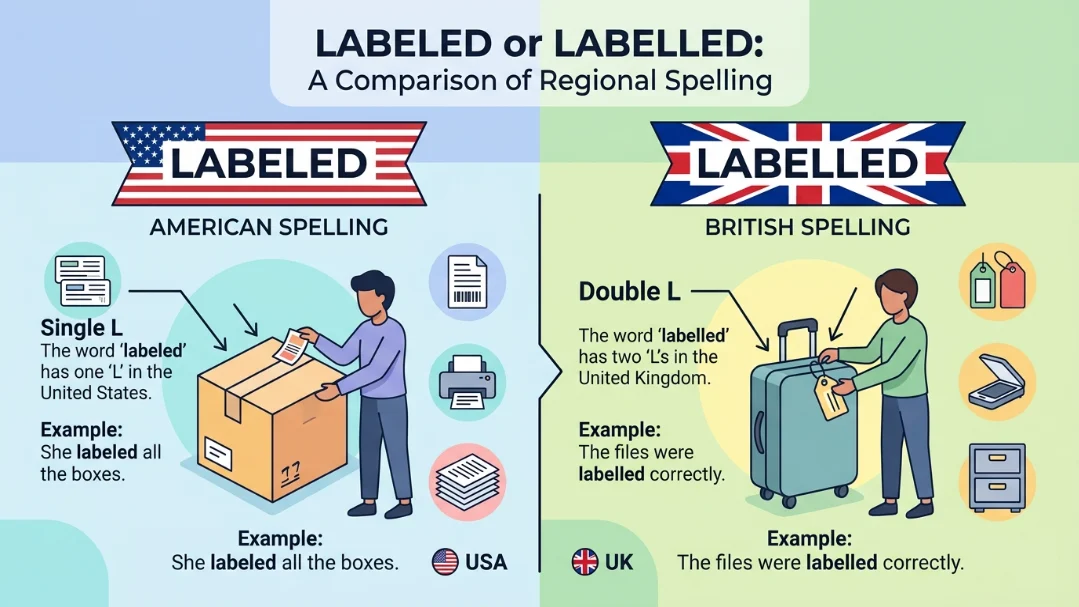
The difference between labelled and labeled is purely regional. Labelled with two “l”s is the preferred spelling in British English and other Commonwealth countries. Labeled with one “l” is the standard spelling in American English. Both spellings are correct and mean the same thing.
Have you ever stared at the word “labelled” and wondered if you should delete one of the “l”s? This small spelling difference confuses writers around the world. You might see both versions in books, articles, and websites. The uncertainty can make you second-guess your writing, especially when you are trying to sound professional.
This confusion matters because English has two main spelling systems. British English and American English often spell words differently. Words like colour and color, centre and center, and labelled and labeled all follow this pattern. Choosing the wrong version for your audience can make your writing look inconsistent or out of place.
The problem becomes more complicated when you write for an international audience. Which spelling should you choose? Does it even matter? Many people worry that using the wrong spelling will make them look careless or uneducated. Fortunately, the answer is simpler than you might think.
This article clears up the confusion around labelled or labeled once and for all. You will learn the rules, see real examples, and discover which spelling fits your needs. By the end, you will choose the right version with confidence every time.
The main takeaway is that both labelled and labeled are correct spellings. Your choice depends on your audience and the version of English you use. American English prefers labeled with one “l.” British English, Australian English, and other Commonwealth varieties prefer labelled with two “l”s. Neither spelling is wrong, but consistency matters more than which one you pick.
Definitions and Explanations
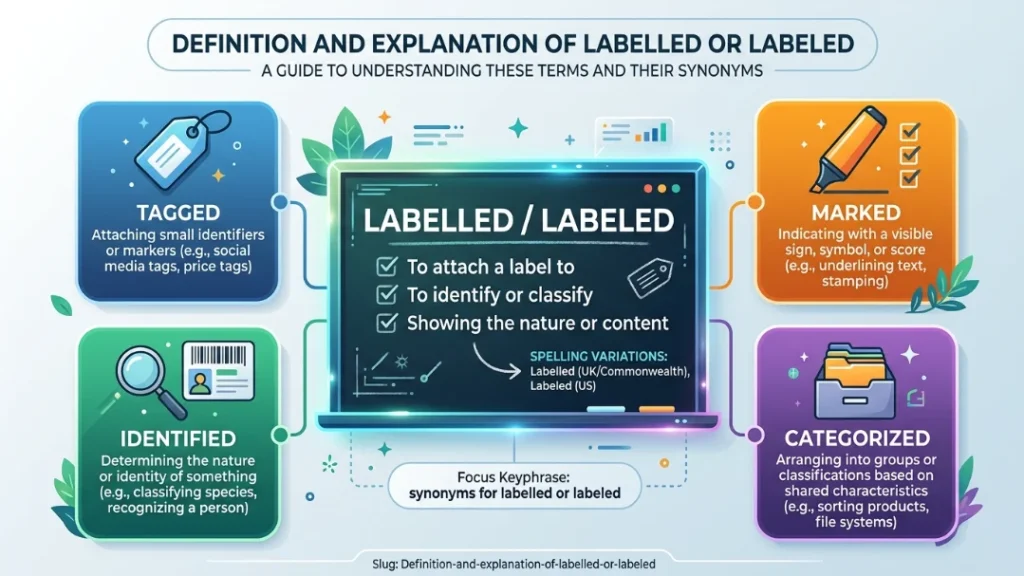
What Does “Labelled” Mean?
Labelled is the past tense and past participle of the verb label. It describes the action of attaching a label to something or categorizing someone or something. For example, “The boxes were labelled with the shipping address.” The word means the same as labeled.
The double “l” spelling follows British English conventions. This rule applies to many verbs ending in a vowel plus “l.” In British English, you double the final consonant before adding suffixes like “-ed” and “-ing.” This is why British writers spell it labelled and cancelled.
What Does “Labeled” Mean?
Labeled is also the past tense and past participle of the verb label. It has the exact same meaning as labelled. For example, “The boxes were labeled with the shipping address.” The meaning does not change.
The single “l” spelling follows American English conventions. In American English, the final “l” is not doubled unless the stress falls on the final syllable. Since label has stress on the first syllable, Americans do not double the “l.” This is why American writers spell it labeled and canceled.
The Pronunciation of Both Spellings
Both spellings are pronounced the same way. The pronunciation is “LAY-buhld.” The number of “l”s does not affect how you say the word. This consistency helps because you will not sound different depending on which spelling you choose.
| Spelling | Region | Example |
| Labelled | British, Australian, Canadian, UK | “She labelled the folders carefully.” |
| Labeled | American | “She labeled the folders carefully.” |
The Etymology of “Label”
The word label comes from the Old French word label or labbe, meaning a ribbon or a strip of cloth. It entered English in the 14th century. The verb form appeared later, meaning to attach a label to something. Over time, the spelling rules for adding suffixes diverged between American and British English, leading to the two versions we have today.
Advantages and Disadvantages
This section explores the advantages and disadvantages of choosing one spelling over the other.
Advantages of Using British Spelling (Labelled)
Using labelled offers certain benefits depending on your location and audience.
- Regional Correctness: If you live in the UK, Australia, Canada, or other Commonwealth countries, labelled is the standard spelling. Using it shows that you follow local conventions.
- Academic Consistency: British academic institutions often require British spelling. Using labelled in these contexts keeps your work consistent.
- Traditional Appeal: The double “l” feels more traditional to many readers. It matches the older spelling patterns of English.
Disadvantages of British Spelling
There are also drawbacks to using labelled.
- American Confusion: American readers might think labelled is a typo. They expect the single “l” version.
- Spellchecker Issues: Many digital tools default to American English. Your spellchecker might flag labelled as incorrect, which can be annoying.
- Inconsistency: Using labelled while writing with other American spellings can look inconsistent. For example, “colour” with “labelled” is fine, but “color” with “labelled” looks odd.
Advantages of Using American Spelling (Labeled)
Using labeled also has its benefits.
- American Standard: If you write for an American audience, labeled is the expected spelling. It follows standard American English conventions.
- Spellchecker Compatibility: Most spellcheckers and software default to American English. This means labeled will rarely be flagged as an error.
- Simplicity: Some people find the single “l” simpler and easier to type. It has one fewer letter, which adds up over time.
Disadvantages of American Spelling
There are also some disadvantages to using labeled.
- British Confusion: British readers might expect the double “l” version. They could see labeled as a mistake.
- Regional Inconsistency: If you are writing for a British audience but using other American spellings, your work might still look inconsistent. For example, “centre” with “labeled” would be a mismatch.
| Audience | Recommended Spelling | Reason |
| American | Labeled | Follows US spelling rules |
| British, Australian, Canadian | Labelled | Follows UK/Commonwealth spelling rules |
| International | Either | Choose one and stay consistent |
Real-World Examples
Seeing these spellings used correctly in real-world contexts helps solidify the difference.
Examples of “Labelled” in Action (British English)
- “The scientist labelled the test tubes with different chemical names.” This example shows the British spelling in a scientific context.
- “All the merchandise was clearly labelled with prices.” This describes a retail setting.
- “The police officer labelled the evidence bags for the investigation.” This example shows the word in a legal context.
- “She labelled each chapter of her dissertation for easy reference.” This demonstrates use in academic writing.
- “The moving boxes were labelled with the room names.” This is a common everyday use.
Examples of “Labeled” in Action (American English)
- “The scientist labeled the test tubes with different chemical names.” This is the American version of the same scientific context.
- “All the merchandise was clearly labeled with prices.” This is the American retail version.
- “The police officer labeled the evidence bags for the investigation.” This is the American legal version.
- “She labeled each chapter of her dissertation for easy reference.” This is the American academic version.
- “The moving boxes were labeled with the room names.” This is the American everyday version.
Common Usage in Sentences
| British English | American English |
| “The products were labelled incorrectly.” | “The products were labeled incorrectly.” |
| “He labelled the file as ‘urgent.'” | “He labeled the file as ‘urgent.'” |
| “The samples were labelled with codes.” | “The samples were labeled with codes.” |
| “We labelled the boxes for storage.” | “We labeled the boxes for storage.” |
Regional and Global Usage
The choice between labelled and labeled depends heavily on where you are writing.
British English (UK, Australia, New Zealand, South Africa)
In British English, labelled with two “l”s is the standard spelling. This rule applies to all countries that follow UK spelling conventions. Australia, New Zealand, and South Africa all use labelled. The rule also applies to other verbs ending in “l,” such as cancelled, travelled, and counselled. If you are writing for a British audience, labelled is the correct choice.
American English (United States)
In American English, labeled with one “l” is the standard spelling. This rule applies to all forms of writing in the United States. The single “l” rule also applies to other verbs ending in “l,” such as canceled, traveled, and counseled. If you are writing for an American audience, labeled is the correct choice.
Canadian English
Canadian English is interesting because it often blends British and American spellings. For the word labelled or labeled, Canada tends to follow British conventions. However, some Canadian publications use the American version. The general rule is that labelled is more common in Canada, but labeled also appears. This flexibility makes Canadian English unique.
International English
For international audiences, either spelling is acceptable. The key is to choose one version and use it consistently throughout your document. Inconsistent spelling can look unprofessional. Pick the version that matches your primary audience or the English variant you typically use.
| Country/Region | Preferred Spelling | Notes |
| United States | Labeled | Standard American spelling |
| United Kingdom | Labelled | Standard British spelling |
| Australia | Labelled | Follows UK conventions |
| Canada | Labelled (usually) | Sometimes uses American |
| New Zealand | Labelled | Follows UK conventions |
| South Africa | Labelled | Follows UK conventions |
Common Mistakes
This section highlights the most frequent errors people make with these spellings.
Mistake 1: Inconsistent Spelling Within One Document
The most common mistake is mixing labelled and labeled in the same document. This inconsistency looks unprofessional and can confuse readers. Always choose one spelling and stick with it. If you use labelled, use it everywhere. If you use labeled, use it consistently.
Correction: Decide on your preferred spelling before you start writing. Use a spellchecker set to your chosen English variant. Proofread carefully to catch any inconsistencies.
Mistake 2: Using the Wrong Spelling for Your Audience
Another common mistake is using labeled for a British audience or labelled for an American audience. While neither is wrong, using the local spelling makes your writing feel more natural. It shows that you understand your audience’s preferences.
Correction: Consider your audience before you write. If you are writing for a British publication, use labelled. If you are writing for an American publication, use labeled. For international audiences, choose one and stay consistent.
Mistake 3: Confusing “Label” with “Lable”
Some people misspell the base word itself as lable. This is a different mistake entirely. The correct spelling of the base word is label. There is no “lable” in standard English. This error is separate from the labelled or labeled debate.
Correction: Always spell the base word as label. Then add the suffix according to your preferred spelling rules. The base word never changes, only the suffix does.
Mistake 4: Misapplying the Rule to Other Words
Some people think that all British spellings double the “l.” This is not true. The rule only applies to verbs where the stress falls on the first syllable. For words like compel, the stress falls on the second syllable, so the “l” is doubled in both American and British English (compelled).
Correction: Learn the specific rules for each word. Do not assume that all words follow the same pattern. When in doubt, consult a dictionary.
Exercises
Test your knowledge with these exercises.
Exercise 1: Choose the Correct Spelling
Decide whether to use labelled or labeled based on the context.
- The report was carefully (labelled/labeled) for the British audience.
- All the files were (labelled/labeled) with the American spelling convention.
- The Canadian writer used (labelled/labeled) in her manuscript.
- The American editor changed the spelling to (labelled/labeled).
- For the international conference, we (labelled/labeled) all the materials consistently.
Exercise 2: Identify and Correct the Error
Each sentence has a spelling mistake or inconsistency. Identify the error and correct it.
- “The boxes were labeled, but the containers were labelled.” (Assume consistent spelling is needed)
- “She labelled the files using American English conventions.”
- “The scientist labeled the samples in her British journal article.”
- “All items were labelled, and we used the same spelling throughout.”
Exercise 3: Fill in the Blank
Choose labelled or labeled to complete the sentences below.
- The teacher _________ the maps with country names for the geography lesson.
- The products were _________ with expiration dates for safety reasons.
- The librarian _________ each book with a unique identification number.
- The conference badges were _________ with the attendees’ names.
- The laboratory samples were _________ with barcodes for tracking.
Answer Key
Answers, Exercise 1:
- Labelled (British audience)
- Labeled (American convention)
- Labelled (Canadian often uses British)
- Labeled (American editor)
- Either (as long as it is consistent)
Exercise 2 Corrections:
- “The boxes were labeled, and the containers were labeled.” (Or use labelled for both)
- “She labeled the files using American English conventions.”
- “The scientist labelled the samples in her British journal article.”
- “All items were labeled, and we used the same spelling throughout.” (Or use labelled for both)
Exercise 3 Answers:
- Labelled or Labeled (depends on the chosen variant)
- Labelled or Labeled (depends on the chosen variant)
- Labelled or Labeled (depends on the chosen variant)
- Labelled or Labeled (depends on the chosen variant)
- Labelled or Labeled (depends on the chosen variant)
Related Concepts and Comparisons
Understanding how this spelling difference relates to other words helps build a complete picture.
The “L” Doubling Rule in British and American English
The rule for doubling the final “l” is part of a larger pattern. In British English, you double the final “l” when adding suffixes like “-ed” or “-ing” if the stress falls on the first syllable. In American English, you do not double the “l” under these conditions. This rule applies to many common words.
| Base Word | British Spelling | American Spelling |
| Label | Labelled | Labeled |
| Cancel | Cancelled | Canceled |
| Travel | Travelled | Traveled |
| Counsel | Counselled | Counseled |
| Enrol | Enrolled | Enrolled (both) |
| Compel | Compelled | Compelled (both) |
Labelled vs. Labeling
The same rule applies to the present participle. In British English, you double the “l” to spell labelling. In American English, you do not double the “l” to spell labeling. The pronunciation remains the same.
| Form | British | American |
| Past tense | Labelled | Labeled |
| Present participle | Labelling | Labeling |
| Noun | Labelling | Labeling |
Other Common Spelling Differences
The labelled or labeled distinction is part of a broader pattern of British-American spelling differences. Understanding these patterns can help you choose the right spelling for your audience.
| British | American |
| Colour | Color |
| Centre | Center |
| Fulfil | Fulfill |
| Enrol | Enroll |
| Traveller | Traveler |
| Organise | Organize |
FAQs
Is it labelled or labeled in the UK?
In the UK, the correct spelling is labelled with two “l”s. This follows British English spelling conventions. All UK publications and official documents use this spelling.
Is it labelled or labeled in Canada?
In Canada, labelled is more common, but labeled also appears. Canadian English often blends British and American spellings. The general tendency is toward the British version.
Is it labelled or labeled in the US?
In the US, the correct spelling is labeled with one “l.” This follows American English spelling conventions. All US publications and official documents use this spelling.
Why do British spell it labelled?
British English doubles the final “l” when adding suffixes like “-ed” to words ending in “l.” This rule applies to many verbs, including label, cancel, and travel. The British rule is different from the American rule.
Why do Americans spell it labeled?
American English does not double the final “l” unless the stress falls on the final syllable. Since the stress in label falls on the first syllable, the “l” remains single. This rule applies to many verbs, including label, cancel, and travel.
Are both labelled and labeled correct?
Yes, both spellings are correct. The choice depends on the version of English you are using. Labelled is correct in British English. Labeled is correct in American English. Neither spelling is grammatically wrong.
Which spelling should I use for international audiences?
For international audiences, choose one spelling and use it consistently. Either labelled or labeled is acceptable. The key is consistency. Mixed spelling looks unprofessional.
Do they pronounce labelled and labeled differently?
No, both spellings are pronounced the same way. The pronunciation is “LAY-buhld.” The number of “l”s does not change the pronunciation. This consistency makes the choice less confusing.
How do I remember the difference?
Think about where you live or who your audience is. If you write for the US, think “American = one ‘l’.” If you write for the UK, think “British = two ‘l’s.” This simple memory trick works well.
Can I use both in the same document?
No, you should not use both spellings in the same document. Inconsistent spelling looks unprofessional. Choose one version and use it throughout your entire piece of writing.
Conclusion
This guide has clarified the difference between labelled and labeled. The distinction is regional, not grammatical. British English uses labelled with two “l”s. American English uses labeled with one “l.” Both spellings are correct and mean the same thing. The key is to choose the version that matches your audience and stick with it.
The best practical advice is to consider who will read your writing. American English uses labeled as the standard spelling. British and Commonwealth English prefer labelled. For international content, select one version and remain consistent across the entire piece. Use a spellchecker set to your chosen variant to catch errors.
Good writing depends on consistency and clarity. Now you have the knowledge to choose the right spelling every time. Whether you prefer labelled or labeled, you can write with confidence. Use this guide as a reference whenever you are unsure.