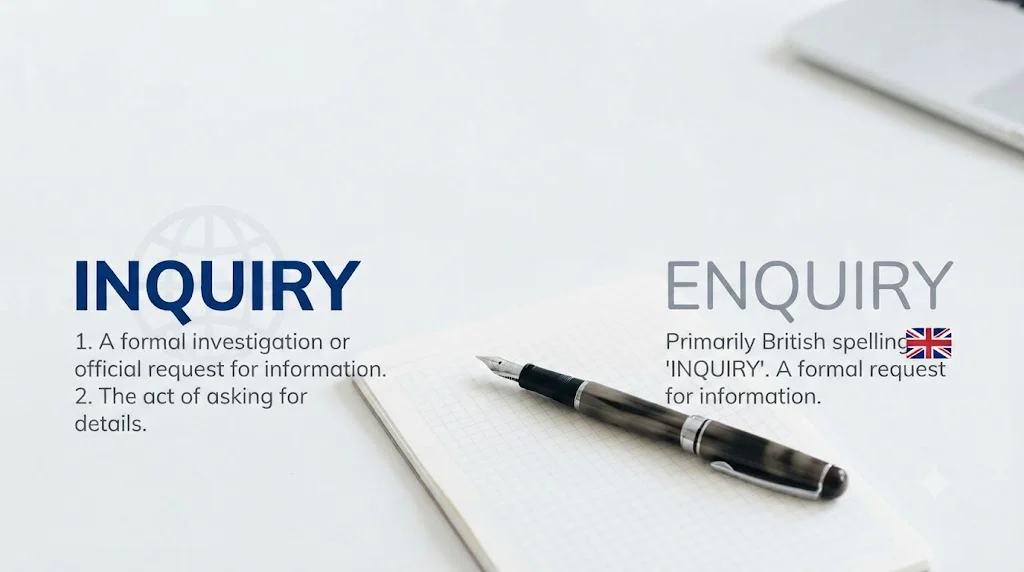
The words “inquiry” and “enquiry” both refer to an act of asking for information. Generally, inquiry is the standard spelling in American English for both formal and informal questions, while enquiry is frequently used in British English to denote a general request, often reserving “inquiry” for formal investigations.
Have you ever stared at a blank screen, wondering if you should type “inquiry” or “enquiry”? You are not alone in this confusion. Many people struggle with these two words because they sound exactly the same. They also mean the same thing in most cases. Choosing the wrong one might feel like a big mistake, but it is usually just a matter of where you live.
This guide helps you understand the subtle differences between these two spellings. We will look at how people use them in the United States and the United Kingdom. You will learn simple rules to help you pick the right word every time. Whether you write a formal email or a business report, this article makes the choice easy. Let us clear up this common spelling puzzle once and for all.
The primary distinction between these two terms is geographical. American English overwhelmingly prefers the spelling inquiry. In contrast, British English often makes a distinction between the two, using enquiry for general requests and inquiry for formal investigations.
If you are writing for an international audience or a neutral publication, “inquiry” is generally the safer and more widely recognized choice. Understanding these regional preferences allows you to tailor your writing to your specific audience effectively.
Definition and Explanation
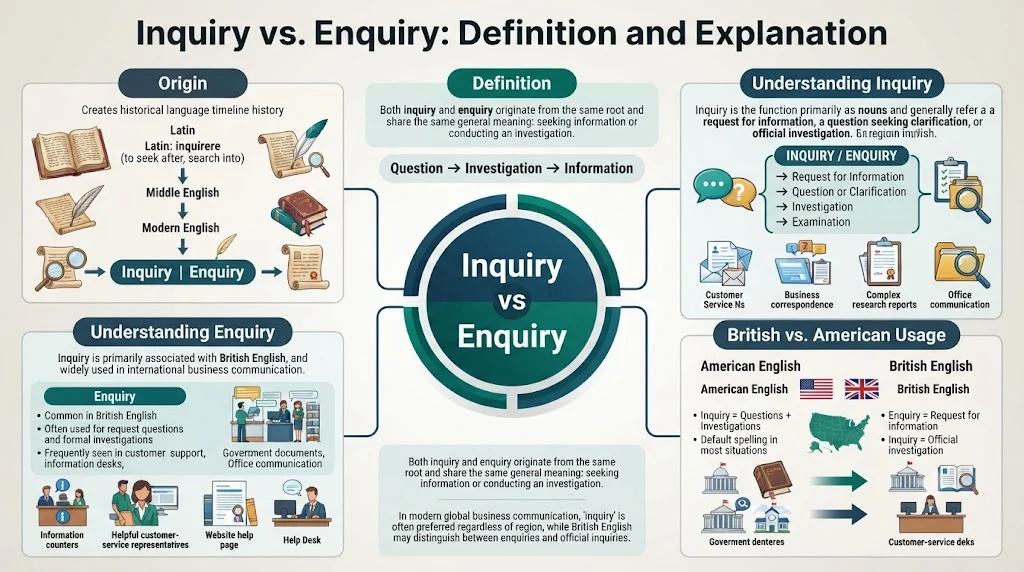
Both words derive from the Latin inquirere, which means “to seek after” or “to search into.” In modern English, both terms serve as nouns representing a request for information or an official investigation.
Understanding Inquiry
Inquiry serves as the default spelling in American English. It covers every context, from asking a simple question about a product to conducting a high-level government investigation. Because it is the standard in global business communication, many style guides recommend “inquiry” as the preferred spelling regardless of context.
Understanding Enquiry
Enquiry functions primarily within British English. While it can be used interchangeably with inquiry, British writers often use it to denote a “request for information” or an “inquiry” in the sense of a casual question. When an official, legal, or systemic investigation occurs, British writers typically switch to the “inquiry” spelling to signify the seriousness of the process.
Regional and Global Usage
Language evolves differently across borders. Recognizing these trends helps you communicate more professionally.
| Region | Primary Preference | Secondary Preference |
| United States | Inquiry | Rarely used |
| United Kingdom | Enquiry | Inquiry (for investigations) |
| Canada | Inquiry | Varies (often follows US) |
| Australia | Enquiry | Inquiry (for investigations) |
North American Perspective
In the United States and Canada, “inquiry” is the standard. Using “enquiry” might appear as a typo or an affectation to a native American speaker. Professional documents, academic papers, and technical manuals in these regions almost exclusively utilize the “i” spelling.
British and Commonwealth Perspective
In the United Kingdom, Ireland, and Australia, the distinction remains more active. Many British style guides suggest that an “enquiry” is a simple question, while an “inquiry” implies a formal, systematic examination. For example, a business would handle “customer enquiries,” but the government would launch an “official inquiry.”
Advantages and Disadvantages
Deciding which term to use involves balancing regional norms against organizational style guides.
Pros of Using Inquiry
- Universal Recognition: It is the standard spelling in the United States, which represents the largest English-speaking market.
- Consistency: Using one spelling for all contexts reduces confusion and formatting errors.
- Search Engine Optimization: Most users search for “inquiry” rather than “enquiry,” making it better for web content.
Pros of Using Enquiry
- Nuanced Clarity: In British settings, it helps distinguish between a casual question and a formal investigation.
- Cultural Alignment: It demonstrates a sophisticated grasp of British English conventions.
Cons
- Potential for Errors: Using “enquiry” in a US-based firm may lead clients to believe you have made a spelling error.
- Redundancy: Maintaining two spellings for the same concept can unnecessarily complicate internal style guides.
Real-World Examples
Seeing how these words function in sentences helps clarify their usage.
1. Business Context
- American style: “We received an inquiry regarding our new software update.”
- British style: “We received an enquiry regarding our new software update.”
2. Formal Investigation
- Global usage: “The government launched a formal inquiry into the financial collapse.” (Note: Even in the UK, “inquiry” is preferred here because it is a formal investigation).
3. Customer Service
- US: “Please direct your inquiries to our support team.”
- UK: “Please direct your enquiries to our support team.”
Common Mistakes
Writers often lose track of these rules when they move between global teams.
The Over-Correction Trap
Some writers use “enquiry” because they think it sounds “more British” or “more professional,” even when writing for an American audience. This can backfire and make the text seem inconsistent.
Forgetting the Context
The most common mistake involves using “enquiry” for a very serious legal matter in British English. Always remember: if the event is a formal, state-led investigation, stick to “inquiry” regardless of your location.
Misusing as a Verb
Neither word is a verb. The verb form is “inquire” or “enquire.” If you write “I am enquiry about the job,” you have made a grammatical error. Instead, write “I am inquiring about the job.”
Exercises with Answers
Test your knowledge with these quick exercises to solidify your understanding.
Exercise 1: Choose the best word for an American business email.
“Thank you for your ______ regarding our shipping policies.”
Exercise 2: Choose the best word for a British news report about a parliamentary investigation.
“The committee began an ______ into the incident.”
Exercise 3: Identify the error in this sentence: “He decided to enquiry about the package.”
Answers
- Inquiry (American English uses “inquiry” for all contexts).
- Inquiry (Formal investigations use “inquiry” even in British English).
- The word should be inquire (The verb form is needed here, not the noun).
Related Concepts and Comparisons
Understanding these terms often requires looking at how they relate to other vocabulary choices.
Inquire vs. Enquire
Just like the nouns, these verbs follow similar regional patterns. “Inquire” is the standard American choice. “Enquire” is the standard British choice for general questions. However, “inquire” is accepted in the UK for formal questions as well.
Investigation vs. Inquiry
While “inquiry” can mean an investigation, an “investigation” is always a deep, rigorous process. An “inquiry” might simply be a request for information. Use “investigation” when you want to emphasize the depth of the search.
| Term | Typical Use Case |
| Inquiry | General request or formal investigation |
| Enquiry | General request (British English only) |
| Investigation | Deep, systematic search or analysis |
| Research | Academic or data-driven exploration |
FAQs
Is there a difference in meaning between inquiry and enquiry?
In most contexts, there is no difference in meaning. They both refer to asking for information or investigating a matter.
Should I use inquiry or enquiry for my website?
You should use inquiry for your website. It is the global standard and performs better in search engine results.
Does the US use the word enquiry at all?
It is very rare. You will almost never see “enquiry” in American professional or academic writing.
Which spelling is better for a formal letter?
Use inquiry. It is universally understood and preferred in formal, professional documentation.
Why do some people say enquiry is more formal?
This is a common misconception. In British English, “inquiry” is actually considered more formal than “enquiry,” as it is reserved for official investigations.
Can I use both interchangeably?
If you are writing for an international audience, you can, but it is better to pick one and remain consistent throughout your document.
Are there any legal implications for the spelling?
In some specific jurisdictions, statutes may use a specific spelling. Always check local legal style guides if you are drafting contracts.
What is the verb form of these words?
The verbs are inquire and enquire. Use them instead of the noun forms when describing an action.
Is one spelling easier to pronounce?
No, they are pronounced identically. The difference is purely orthographic.
How do I decide which one to use in a mixed-audience email?
Default to inquiry. It is professional, widely accepted, and eliminates any risk of being seen as “incorrect” by American readers.
Conclusion
Navigating the choice between “inquiry” and “enquiry” does not have to be difficult. By understanding that “inquiry” serves as the global standard and “enquiry” acts as a regional British variation, you can write with confidence. When in doubt, prioritize consistency and your primary audience’s location.
For most professional scenarios, inquiry is the safest, most effective choice. It ensures your writing remains polished, clear, and globally accessible. Remember to avoid using these nouns as verbs; choose “inquire” or “enquire” to keep your grammar sharp.
By mastering these small details, you improve your overall professional communication. Language is a tool, and knowing exactly when to use each spelling allows you to wield that tool with greater precision. Keep practicing, stay consistent in your documents, and you will never have to worry about this spelling puzzle again.

Charlotte Wilson is a language writer passionate about word meanings, synonyms, and clear communication. She creates accurate and engaging content to help readers expand their vocabulary and language skills.


Hello,
I came across your website, http://synonymsgalaxy.com, and noticed there may be opportunities to improve its visibility in Google search results. If you’re looking to attract more qualified visitors, generate more leads, and increase organic traffic, we’d be happy to help.
We specialize in customized SEO strategies designed to improve search rankings and drive long-term results for businesses like yours.
If this sounds interesting, please let me know, and I’ll be happy to send you our SEO strategies and package details for your review.
Looking forward to hearing from you.
Best regards,
Anaya
Thank you for your visiting my site. i really appreciate your comments and interest. Unfortunately we don’t need any SEO agent right now.