
The main difference between filled and filed comes down to whether an object or space was made full, or whether a document was formally submitted and organized. You use filled when making something full, completing a form, or occupying a role. Conversely, you use filed when submitting official paperwork, organizing records in a system, or taking formal legal action.
Choosing between filled or filed creates confusion for many writers because a single letter changes the entire meaning of a sentence. Furthermore, both words appear constantly in office communications, legal contracts, healthcare records, and everyday conversations. Consequently, typing the wrong word can cause serious misunderstandings in professional documentation.
For instance, telling a colleague that you filled a lawsuit means something completely different from telling them that you filed a lawsuit. Similarly, saying a pharmacist filed a prescription implies record-keeping, whereas saying they filled a prescription means they actually prepared the medication. Because these terms carry specific legal and administrative weight, using them accurately is essential for clear communication.
Fortunately, mastering the distinction between filled or filed is straightforward once you understand their root verbs and common contexts. This comprehensive guide breaks down definitions, grammar rules, industry usages, and real-world examples. Additionally, you will find practical exercises and FAQs to help you eliminate errors permanently.
Before diving into deep explanations, reviewing a quick comparison helps clarify how these terms function in everyday sentences. Specifically, each word connects to a distinct set of actions and prepositions.
| Feature / Aspect | Filled | Filed |
| Root Verb | Fill | File |
| Primary Meaning | Made full, occupied, or completed | Submitted, organized, or recorded formally |
| Common Contexts | Containers, job openings, forms, prescriptions | Lawsuits, tax returns, paperwork, physical folders |
| Key Prepositions | Filled with, filled out, filled in, filled by | Filed for, filed with, filed under, filed away |
| Action Type | Physical or spatial completion | Administrative or legal submission |
| Example Sentence | She filled the water bottle before leaving. | He filed his taxes before the deadline. |
Definition and Core Explanation
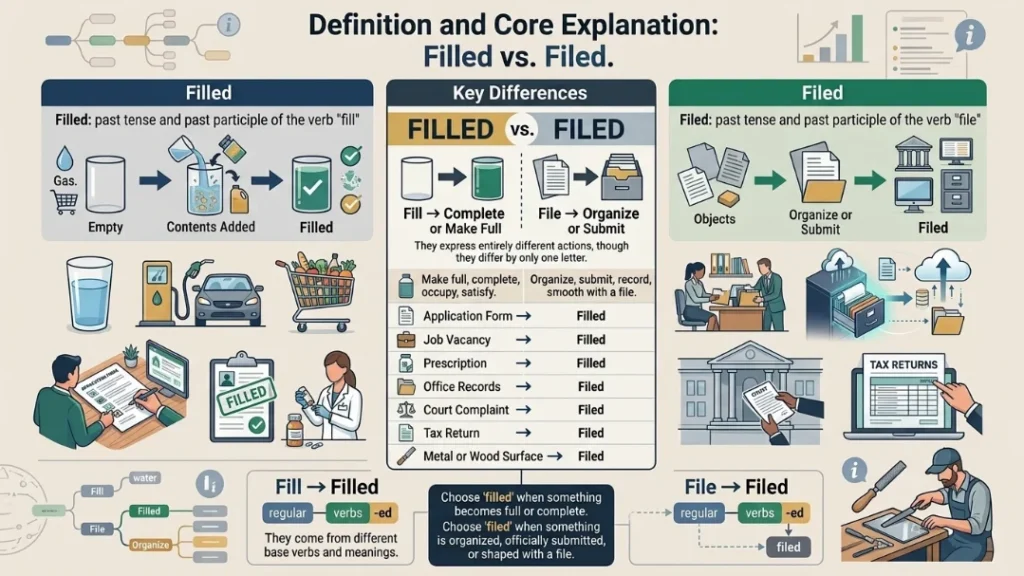
Understanding the exact definition of each verb provides a solid foundation for choosing the correct word in any context. Although both words act as past-tense verbs and past participles, their underlying mechanics differ significantly.
What Does Filled Mean?
The word filled is the past tense and past participle of the regular verb fill. Primary definitions of this word include:
- Making a space, container, or area full so that it holds no more.
- Completing a document by adding requested information into blank spaces.
- Occupying an open job position, vacancy, or organizational role.
- Satisfying or supplying a order, prescription, or customer request.
For example, when a glass contains liquid up to its brim, you say it has been filled. Similarly, when an applicant writes their name and address on an application form, they have filled out the form.
What Does Filed Mean?
The word filed is the past tense and past participle of the regular verb file. Core definitions of this word include:
- Placing documents, records, or items into an organized cabinet or digital system.
- Submitting official documents or applications to a legal, government, or corporate authority.
- Initiating formal legal proceedings, such as a claim, grievance, or lawsuit.
- Smoothing, shaping, or reducing an object using a abrasive tool.
For instance, when a legal team submits court papers to a judge, they have filed a complaint. In addition, when an administrative worker places invoices into marked folders, those papers are safely filed.
Deep Grammar Analysis and Phonetics
A deeper grammatical examination reveals why people frequently mistake these two terms in written and spoken English.
Spelling and Pronunciation Differences
While the spelling difference relies on the placement of the letter e, the pronunciation difference involves distinct vowel sounds.
- Filled uses a short vowel sound:
/fɪld/(rhymes with build and chilled). - Filed uses a long diphthong vowel sound:
/faɪld/(rhymes with child and smiled).
Because typing quickly often leads to minor spelling slips, autocorrect software might fail to catch an error between filled or filed because both are legitimate English words. Therefore, proofreading requires careful attention to the intended meaning rather than relying solely on automated spellcheckers.
Verb Tenses and Conjugation Patterns
Both verbs follow standard regular conjugation rules in English grammar.
| Base Verb | Past Simple | Past Participle | Present Participle |
|---|---|---|---|
| Fill | Filled | Filled | Filling |
| File | Filed | Filed | Filing |
Consequently, active and passive voice constructions maintain identical structure patterns for both words:
- Active Voice: “The receptionist filed the documents.”
- Passive Voice: “The documents were filed by the receptionist.”
- Active Voice: “The technician filled the fuel tank.”
- Passive Voice: “The fuel tank was filled by the technician.”
Prepositions and Phrasal Verbs
Prepositions drastically alter how both filled and filed operate within sentences. As a result, mastering these phrasal variations ensures precise communication.
FILLED (Completion & Fullness)
- Filled with → Emotion or contents
- Filled out → Entire document completed
- Filled in → Blank spaces completed
- Filled up → Capacity reached
FILED (Submission & Organization)
- Filed for → Legal application
- Filed with → Official submission
- Filed under → Classification
- Filed away → Long-term storage
Common Phrasal Combinations for Filled
- Filled with: Expresses contents or internal emotional states.
- Example: The classroom was filled with eager students.
- Filled out: Describes completing a questionnaire, form, or document.
- Example: Mark filled out the employment application yesterday.
- Filled in: Means adding specific details into empty spaces or substituting temporarily for a colleague.
- Example: Sarah filled in for the manager while he was on leave.
- Filled up: Indicates filling a container to its absolute limit.
- Example: He filled up his car with gas before the long drive.
Common Phrasal Combinations for Filed
- Filed for: Indicates starting a formal legal or regulatory request.
- Example: The corporation filed for trademark protection last month.
- Filed with: Specifies the institution or person receiving official paperwork.
- Example: We filed the annual tax returns with the Internal Revenue Service.
- Filed under: Describes how information is cataloged or indexed.
- Example: These receipts should be filed under office expenses.
- Filed away: Refers to long-term storage of physical or digital items.
- Example: Archives from last decade were filed away in the basement.
Contextual Usage Across Industries
Different industries treat the words filled or filed with specific professional meanings. Understanding these contexts prevents awkward phrasing in specialized environments.
Legal Industry Usage
In legal contexts, accuracy between filled or filed is paramount. Specifically, attorneys and paralegals deal with legal filings daily.
- Filed: Used when submitting motions, claims, briefs, or complaints to courts.
- Correct: The attorney filed the motion to dismiss on Friday.
- Filled: Used when completing template forms or satisfying legal requirements.
- Correct: The paralegal filled the blanks in the standard contract template.
Legal Terminology
✅ Correct
└── Filed a lawsuit
→ Officially submitted a legal case to a court.
❌ Incorrect
└── Filled a lawsuit
→ Not an accepted English phrase.
Medical and Healthcare Usage
Healthcare professionals encounter both terms, especially in medical administrative tasks and pharmacy operations.
- Filled: Pharmacists prepare and distribute prescriptions to patients.
- Correct: The pharmacist filled my prescription in twenty minutes.
- Filed: Medical billing specialists and nurses archive patient charts and insurance claims.
- Correct: The clinic filed the medical claim with the insurance provider.
Business and Human Resources Usage
Human Resource departments regularly manage job openings, applications, and personnel records.
- Filled: Refers to hiring an employee to occupy an open position.
- Correct: Our HR team successfully filled the software engineering vacancy.
- Filed: Refers to storing applicant resumes, contracts, or tax documents.
- Correct: The recruiter filed the candidate’s resume in the database.
Real-World Usage Comparison Table
To illustrate how contexts dictate word choice, review the comparative table below.
| Industry / Scenario | Sentence using “Filled” | Sentence using “Filed” | Meaning Difference |
| Tax Season | I filled out my tax forms carefully. | I filed my taxes online yesterday. | “Filled” means answering questions on the form; “filed” means sending the finished tax return to the government. |
| Legal Disputes | She filled the legal document with facts. | She filed the lawsuit against the company. | “Filled” refers to placing information inside the document; “filed” refers to launching legal action. |
| Pharmacy | The chemist filled the order for antibiotics. | The chemist filed the doctor’s note in the archive. | “Filled” means preparing medication; “filed” means storing the physical prescription note. |
| Corporate HR | We filled three managerial roles this week. | We filed the new employees’ tax documents. | Filled” means hiring people for jobs; “filed” means organizing their onboarding paperwork. |
| Office Administration | The worker filled the ink cartridge. | The worker filed the invoices in the drawer. | “Filled” involves loading liquid/substance; “filed” involves physical document organization. |
Regional and Global Language Patterns
English usage across global regions reveals slight variations in how phrasal verbs with filled and filed operate, although core meanings remain identical worldwide.
American English vs. British and Commonwealth English
While both American English (US) and British English (UK) use filled and filed for their core definitions, preference for phrasal forms varies slightly when dealing with documents:
- American English: Speakers heavily prefer filled out when completing a form (e.g., “I filled out the form”).
- British / Commonwealth English: Speakers frequently use filled in alongside filled out (e.g., “I filled in the form”).
- Global Standard: Both dialects use filed identically when submitting documents to institutions (e.g., “filed a claim”).
Document Completion Styles
📝 Fill Out → American English
📝 Fill In → British/Commonwealth English
📂 File → Official submission or record-keeping
Common Mistakes and How to Avoid Them
Mix-ups between filled or filed usually stem from typing slips or confusion surrounding document processing. Examining common mistakes helps prevent future writing errors.
1: Saying “Filed Out a Form”
- Incorrect: I filed out the job application form.
- Correct: I filled out the job application form.
- Explanation: You fill out or fill in a form by adding writing to blank spaces. You do not “file out” a document.
2: Saying “Filled a Lawsuit”
- Incorrect: The injured customer filled a lawsuit against the store.
- Correct: The injured customer filed a lawsuit against the store.
- Explanation: Lawsuits are submitted to judicial systems, which means they are filed.
3: Confusing Prescription Processing
- Incorrect: The doctor filed my medicine at the local drug store.
- Correct: The doctor sent the order, and the pharmacist filled my prescription.
- Explanation: Preparing medicine is called filling a prescription. Storing the medical record afterward is called filing.
4: Misusing “Filed With” vs. “Filled With”
- Incorrect: The room was filed with smoke.
- Correct: The room was filled with smoke.
- Explanation: When an area contains a substance, noise, or emotion, use filled with.
Visualizing Process Workflows
Understanding how a document moves from creation to archival clarifies where filled and filed fit in a administrative workflow.
Create
↓
Fill Out
↓
Submit (Filed)
↓
Archive (Filed Away)
As illustrated above, filling out happens during the completion phase, whereas filing occurs during the submission and archiving phase.
Related Concepts and Word Pair Comparisons
To avoid broader vocabulary confusion, comparing filled or filed against other similar terms clarifies their distinct usage rules.
Filled vs. Fulfilled
While filled means making something full or supplying an order, fulfilled carries broader emotional, moral, or procedural weight.
- Filled: Used for concrete tasks, containers, and job vacancies.
- Example: He filled the glass with water.
- Fulfilled: Used for promises, duties, desires, and life goals.
- Example: She fulfilled her lifelong dream of becoming a doctor.
Filed vs. Logged
While filed implies storing or submitting structured records, logged refers specifically to recording chronological events or operational entries.
- Filed: Placing documents into categorized systems.
- Example: We filed the contracts in the vendor binder.
- Logged: Recording time-stamped entries into a system or register.
- Example: The security guard logged every visitor’s entry time.
Exercises and Practice Worksheets
Practicing with targeted exercises reinforces correct usage. Test your understanding of filled or filed by completing the sentences below, then check your answers in the key that follows.
Fill-in-the-Blank Exercise
Choose the correct word (filled or filed) for each sentence:
- After reviewing the tax documents, Susan ________ her return electronically.
- The server ________ our water glasses as soon as we sat down.
- HR announced that the software engineer position has finally been ________.
- The attorney ________ a formal objection with the county judge.
- Make sure you have ________ out all required fields on the intake form.
- All client folders were neatly ________ in the metal cabinet.
- Grief ________ his heart after hearing the unfortunate news.
- The mechanic ________ the tire with air to reach the proper pressure.
- Yesterday, the tenant ________ an official complaint with the housing authority.
- The chemist carefully ________ the prescription for the patient.
Answer Key and Detailed Explanations
- filed — Submitting official tax returns to an authority requires filed.
- filled — Adding water to a container or glass requires filled.
- filled — Occupying a job vacancy requires filled.
- filed — Submitting legal papers or objections to court requires filed.
- filled — Completing blank lines on a document requires filled out.
- filed — Organizing folders inside physical or digital storage requires filed.
- filled — Experiencing an internal emotional state requires filled with.
- filled — Adding air or liquid into an object requires filled.
- filed — Submitting formal complaints to regulatory boards requires filed.
- filled — Preparing and dispensing medication orders requires filled.
Frequently Asked Questions
What is the primary difference between filled and filed?
The primary difference is that filled means making something full, occupying a space, or completing a form, whereas filed means submitting official paperwork or organizing documents within a filing system.
Do you say filled out a form or filed out a form?
You should always say filled out a form. The expression “filed out” is grammatically incorrect because fill relates to completing empty fields, whereas file relates to submitting completed documents.
What is the correct phrase for filing taxes?
The correct phrase for submitting tax returns to the government is filed taxes. However, during the preparation stage before submission, you can correctly say you filled out your tax paperwork.
Is it filled a prescription or filed a prescription?
It is filled a prescription when referring to a pharmacist preparing and dispensing medication. Conversely, if an administrative worker stores the physical prescription paper in an archive cabinet, that paper has been filed.
Can you use filled and filed in the same sentence?
Yes, you can use both words in a single sentence if you are describing sequential actions. For example: “After I filled out the application form, I filed it with the clerk’s office.”
What does filed for bankruptcy mean?
The phrase filed for bankruptcy means submitting a legal petition to a court asking for legal protection from debts under insolvency laws.
Is filled in correct in American English?
While American English strongly prefers filled out for forms, filled in is widely understood and frequently used when talking about replacing a colleague temporarily or filling specific blank spots on a page.
What does filed away mean in office settings?
In office settings, filed away means organizing physical or digital documents into long-term storage folders, cabinets, or databases so they can be retrieved easily later.
Why do spellcheckers fail to catch errors between filled or filed?
Spellcheckers fail to catch errors between filled or filed because both options are correctly spelled, valid words in English dictionaries. As a result, automated tools cannot always determine which meaning you intended without contextual analysis.
What is the past participle of file?
The past participle of the verb file is filed. Similarly, the past participle of the verb fill is filled.
Conclusion
Distinguishing between filled or filed is essential for maintaining clarity across business, legal, medical, and personal communications. Although a single letter separates these terms, their functions remain entirely distinct. Specifically, filled centers on making containers full, occupying vacancies, dispensing prescriptions, and completing form fields. In contrast, filed focuses on submitting formal paperwork, starting legal proceedings, and organizing records in archival systems.
To ensure your writing remains error-free, always double-check the underlying action you want to convey. If your action involves adding content to make something complete, select filled. Conversely, if your action involves submitting or storing documentation formally, select filed. By applying the explanations, industry scenarios, and grammar rules provided in this guide, you can confidently communicate with accuracy in every professional setting.

Charlotte Wilson is a language writer passionate about word meanings, synonyms, and clear communication. She creates accurate and engaging content to help readers expand their vocabulary and language skills.








11 thoughts on “Filled or Filed| Key Differences, Grammar Rules and Examples”