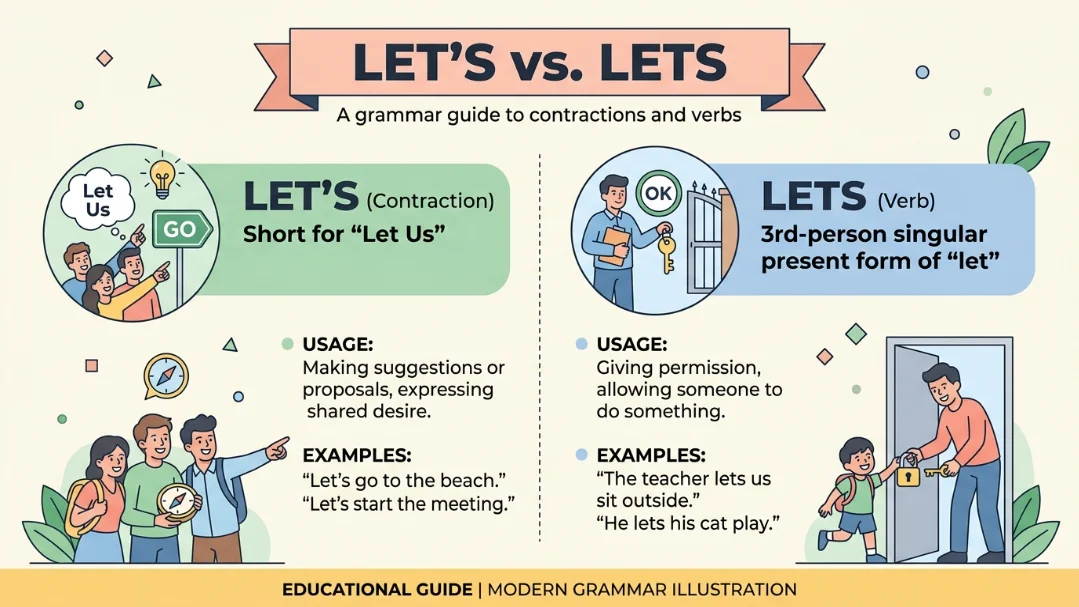
The difference between lets and let’s is simple. Lets means “allows” or “permits” and is a verb. Let’s is a contraction of “let us” and means “we should” or “we need to.” Use lets when someone gives permission and let’s when making a suggestion or proposal.
Have you ever typed a sentence and frozen, unsure whether to write lets or let’s? This tiny apostrophe creates massive confusion for writers of all levels. The two forms look almost identical, but they serve completely different purposes. Getting them wrong can make your writing look careless and unprofessional.
This confusion matters more than you might think. English speakers use these words constantly in everyday communication. You will need them in emails, text messages, reports, and social media posts. Using the correct form shows attention to detail and respect for your readers. It also helps you communicate clearly without causing confusion.
The challenge comes from the apostrophe. Many people know that apostrophes show possession or contractions. However, they are not always sure which rule applies to lets versus let’s. Some people also struggle because they do not understand the grammar behind these forms. The good news is that the rule is simple once you understand it.
This article clears up the confusion once and for all. You will learn the definitions, see real examples, and discover easy memory tricks to choose correctly every time. By the end, you will never second-guess this choice again. Good writing depends on these small but important distinctions.
The main takeaway is that lets is a verb meaning “allows,” while let’s is a contraction meaning “let us.” If you mean “allows,” use lets without an apostrophe. If you mean “let us,” use let’s with an apostrophe. This simple rule works every time. Remember that the apostrophe in let’s stands for the missing letter “u” in “us.”
Definitions and Explanations
What Does “Lets” Mean?
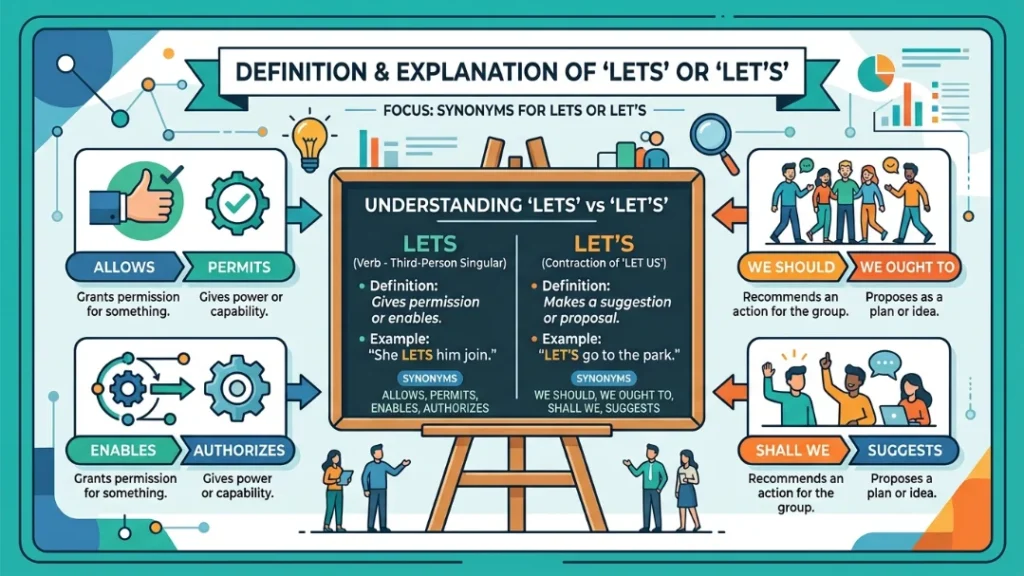
Lets is the third-person singular present tense form of the verb let. It means “allows,” “permits,” or “gives permission to.” You use lets when talking about one person, one thing, or a singular subject that allows something to happen.
For example, “My boss lets me leave early on Fridays” means my boss allows me to leave early. The app lets you track your expenses” means the app allows you to track your expenses. In both cases, lets means “allows” or “permits.” It is a simple verb that describes permission.
The word lets does not contain an apostrophe. It is a standard verb form that follows regular English grammar rules. You will use it in sentences where the subject gives permission to someone or something else.
What Does “Let’s” Mean?
Let’s is a contraction of the words let and us. The apostrophe takes the place of the missing letter “u” in “us.” Therefore, let’s literally means “let us.” It is a way to make a suggestion or proposal to a group that includes the speaker.
When you say “Let’s go to the park,” you mean “Let us go to the park.” You are suggesting that you and the people you are speaking to should go to the park. Let’s eat dinner” means “Let us eat dinner.” It is a proposal that includes both the speaker and the listeners.
People use let’s constantly in everyday speech. It is informal and friendly. It creates a sense of shared action and teamwork. However, it is also perfectly acceptable in many professional contexts when making suggestions to colleagues or teams.
| Form | Meaning | Part of Speech | Apostrophe? |
| Lets | Allows or permits | Verb | No |
| Let’s | Let us (suggestion) | Contraction | Yes |
The Core Difference Explained
The difference between lets and let’s is all about meaning and function.
- Lets is a verb. It describes what someone or something does. It is the action of allowing.
- Let’s is a contraction. It combines two words into one. It is a suggestion to a group.
A good test is to replace the word with “allows” or “let us.” If “allows” fits, use lets. If “let us” fits, use let’s. This simple test works in almost every situation. For example, “She ___ me borrow her car.” If you say “allows,” it is “She lets me borrow her car.” If you say “let us,” it is “Let’s borrow her car.” The meaning changes completely based on your choice.
The Verb “Let” and Its Forms
Understanding the base verb let helps you master its forms. Let is an irregular verb. Its forms are:
- Base form: let
- Past tense: let
- Past participle: let
- Present participle: letting
- Third-person singular present: lets
| Base Form | Past Tense | Past Participle | Present Participle | Third-Person Singular |
| let | let | let | letting | lets |
Advantages and Disadvantages
Using the correct form offers several advantages, while getting it wrong creates problems. This section explores both sides.
Advantages of Using the Correct Form
Using the right form improves your writing in several ways.
- Clarity: Your readers will understand exactly what you mean. There is no confusion about whether you are giving permission or making a suggestion.
- Professionalism: Correct grammar builds trust with your readers. It shows that you care about your writing and respect your audience. This is especially important in business and academic settings.
- Credibility: Mistakes can make you look less educated or careless. Using the correct form helps you maintain your credibility as a writer.
- Confidence: Knowing the rule gives you confidence in your writing. You will not have to pause and second-guess yourself every time you type these words.
Disadvantages of Using the Wrong Form
Using the wrong form can create problems for your communication.
- Confusion: Your reader might not know what you mean. For example, “She lets go” means she releases something. “Let’s go” means we should leave. These are very different messages.
- Unprofessionalism: Simple grammar errors can make you appear careless. This can harm your reputation in professional settings.
- Misunderstanding: In some cases, the wrong word might change your sentence’s meaning entirely. “Lets eat” means someone allows eating. “Let’s eat” means we should eat. One gives permission; the other makes a suggestion.
- Embarrassment: Making this mistake in public can be embarrassing and undermine your confidence.
Real-World Examples
Seeing these words used correctly in real-world contexts helps solidify the difference.
Examples of “Lets” in Action
- “My manager lets me work from home on Wednesdays.” This describes permission.
- “The new software lets users create custom reports.” This describes a feature or function.
- “She lets her children play outside after school.” This describes allowing an activity.
- “The door lets in a lot of light.” This describes a physical allowance.
- “This program lets you edit photos quickly.” This describes a capability.
- “He never lets anyone borrow his car.” This describes a refusal of permission.
Examples of “Let’s” in Action
- “Let’s go to the movies tonight.” This is a suggestion to a group.
- “Let’s finish this project by Friday.” This is a proposal for a deadline.
- “Let’s not argue about this anymore.” This is a suggestion to stop arguing.
- “Let’s take a break and get some coffee.” This is a proposal for a pause.
- “Let’s make the most of our time together.” This is a suggestion for action.
- “Let’s be honest about our situation.” This is a proposal for honesty.
Contrasting Examples
Seeing these words side by side shows the difference clearly.
| Sentence with “Lets” | Meaning | Sentence with “Let’s” | Meaning |
| “She lets him drive her car.” | She allows him to drive. | “Let’s drive to the beach.” | We should drive to the beach. |
| “The teacher lets students leave early.” | The teacher allows it. | “Let’s leave early today.” | We should leave early. |
| “The recipe lets you use substitutes.” | The recipe allows it. | “Let’s use substitutes.” | We should use substitutes. |
Common Mistakes
This section highlights the most frequent errors people make with these words. Learning about them will help you avoid them.
Mistake 1: Using “Let’s” Instead of “Lets”
This is the most common error. People use let’s when they mean “allows.” For example, “The app let’s you track your spending” is incorrect. It should be “The app lets you track your spending.” The app is not saying “let us”; it is allowing something. The apostrophe is wrong here.
Correction: If you can replace the word with “allows,” use lets without an apostrophe. Do not add an apostrophe just because you see one in let’s.
Mistake 2: Using “Lets” Instead of “Let’s”
This error is less common but still happens. People use lets when they mean “let us.” For example, “Lets go to the store” is incorrect. It should be “Let’s go to the store.” The sentence is making a suggestion, not describing an allowance.
Correction: If you can replace the word with “let us,” use let’s with an apostrophe. The apostrophe represents the missing “u” from “us.”
Mistake 3: Forgetting the Apostrophe in “Let’s”
Many people simply forget to include the apostrophe. They type “Lets go” when they mean “Let’s go.” This is usually a typing error rather than a grammar error. However, it still affects the professionalism of your writing.
Correction: Always proofread your work. Check for missing apostrophes, especially in common contractions like let’s, can’t, and won’t.
Regional and Global Usage
The distinction between lets and let’s is the same in all English-speaking regions. However, there are some interesting patterns.
Global Consistency
English speakers worldwide follow the same rule. Whether you are writing for an American, British, Australian, or Canadian audience, the distinction is identical. Lets means “allows,” and let’s means “let us.” There is no regional variation in this rule.
Formal vs. Informal Usage
Let’s is generally considered informal and conversational. It appears frequently in spoken English and casual writing. However, it is also acceptable in many professional contexts, especially when making suggestions to colleagues. Lets is neutral and appears in all forms of writing.
| Context | Preferred Form | Example |
| Formal business writing | Lets | “The policy lets employees take breaks.” |
| Informal conversation | Let’s | “Let’s grab lunch together.” |
| Academic writing | Lets | “The data lets researchers draw conclusions.” |
| Social media | Let’s | “Let’s all meet at the park.” |
Related Concepts and Comparisons
Understanding how these words relate to other concepts helps build a complete picture.
Contractions in English
Contractions combine two words into one using an apostrophe. Common examples include:
- Cannot → Can’t
- Do not → Don’t
- Will not → Won’t
- It is → It’s
- Let us → Let’s
The apostrophe always takes the place of missing letters. In let’s, the apostrophe replaces the “u” in “us.” Understanding this pattern helps you remember the rule.
Possessive vs. Contraction Apostrophes
Apostrophes can show possession or contraction. This confusion often leads to errors with lets and let’s.
- Contraction: The apostrophe replaces missing letters. For example, let’s = let us.
- Possession: The apostrophe shows ownership. For example, “the woman’s car.”
| Purpose | Example | Meaning |
| Contraction | Let’s | Let us |
| Contraction | It’s | It is |
| Possession | The woman’s car | The car belongs to the woman |
| Possession | The students’ books | The books belong to the students |
Its vs. It’s
The confusion between lets and let’s is similar to the confusion between its and it’s. In both cases, one form is a possessive and the other is a contraction.
- Its = possessive form of “it.” No apostrophe.
- It’s = contraction of “it is.” Apostrophe replaces missing letters.
This parallel can help you remember the rule for lets and let’s. Just as its is possessive and it’s is a contraction, lets is a verb and let’s is a contraction.
Exercises
Test your knowledge with these exercises.
Exercise 1: Fill in the Blank
Choose lets or let’s to complete each sentence.
- The teacher _________ students use calculators during the test.
- _________ go to the park this afternoon.
- This software _________ you create professional designs.
- _________ not forget to bring our tickets.
- My father never _________ me borrow his tools.
- _________ make a plan for the weekend.
- The new policy _________ employees work flexible hours.
- _________ be honest with each other.
Exercise 2: Identify the Error
Each sentence has a mistake. Identify the incorrect word and correct it.
- “The app let’s you track your daily calories.”
- “Lets meet at the coffee shop at 3 PM.”
- “She let’s her children stay up late on weekends.”
- “Let’s the dog out before we go to bed.”
Exercise 3: Choose the Correct Form
Select the correct form to complete each sentence.
- “______ go to the store” (Lets/Let’s)
- “The coach ______ players rest after practice” (lets/let’s)
- “______ not make any assumptions” (Lets/Let’s)
- “The recipe ______ you substitute ingredients” (lets/let’s)
Answer Key
Answers Exercise 1:
- Lets (allows)
- Let’s (let us)
- Lets (allows)
- Let’s (let us)
- Lets (allows)
- Let’s (let us)
- Lets (allows)
- Let’s (let us)
Exercise 2 Corrections:
- “The app lets you track your daily calories.” (Remove apostrophe)
- “Let’s meet at the coffee shop at 3 PM.” (Add apostrophe)
- “She lets her children stay up late on weekends.” (Remove apostrophe)
- “Let’s let the dog out before we go to bed.” (Add apostrophe to “Lets”)
Exercise 3 Answers:
- Let’s (let us)
- lets (allows)
- Let’s (let us)
- lets (allows)
FAQs
What is the difference between lets and let’s?
The difference is simple. Lets means “allows” or “permits.” Let’s is a contraction of “let us” and means “we should.” Use lets for permission and let’s for suggestions.
Is it lets or let’s go?
It depends on what you mean. If you are making a suggestion to leave, use let’s go. If you are saying someone allows others to go, use lets go. For example, “Let’s go to the store” means we should go. “She lets go of the rope” means she releases it.
When should I use lets?
Use lets when you mean “allows” or “permits.” Use it with a singular subject. For example, “The program lets you save files” means the program allows you to save files.
When should I use let’s?
Use let’s when you mean “let us.” Use it to make suggestions or proposals that include the speaker. For example, “Let’s eat dinner” means we should eat dinner.
Is let’s grammatically correct?
Yes, let’s is grammatically correct. It is a standard contraction of “let us.” It is widely used in both spoken and written English. However, it is considered informal and conversational.
Can let’s be used in formal writing?
Yes, let’s can be used in formal writing, but with caution. It is acceptable in business emails, reports, and presentations when making suggestions. However, in very formal academic writing, it might be better to use “let us” instead.
What does let’s mean in texting?
In texting, let’s means “let us.” It is a way to suggest an action to a group. For example, “Let’s go out tonight” suggests going out to the people you are texting.
What does lets mean in a sentence?
Lets means “allows” or “permits” in a sentence. It describes what someone or something allows. For example, “The system lets users log in quickly” means the system allows users to log in quickly.
How do you use lets in a sentence?
Use lets when the subject gives permission. The subject is usually a person, thing, or organization. For example, “My boss lets me leave early,” or “The software lets you edit videos.”
What is the plural of let?
The plural of let depends on the subject. Use lets with third-person singular subjects. In contrast, use let with plural subjects. For example, write “He lets” for a singular subject and “They let” for a plural subject. This is the same as other verbs like “run” and “walk.”
Conclusion
This guide has clarified the simple but important difference between lets and let’s. Lets means “allows” or “permits.” Let’s is a contraction of “let us” and means “we should.” The apostrophe makes all the difference. Use lets without an apostrophe for permission. Use let’s with an apostrophe for suggestions.
The best practical advice is to use the replacement test. If you can replace the word with “allows,” use lets. If you can replace it with “let us,” use let’s. This simple test works in almost every situation. Take a moment to think about your sentence before you type. With practice, this distinction will become automatic.
Good writing depends on these small but important details. Getting them right shows respect for your readers and attention to your craft. Now you have the knowledge to choose the correct word every time. Use this guide as a reference whenever you are unsure. Over time, the correct usage will become second nature to you.