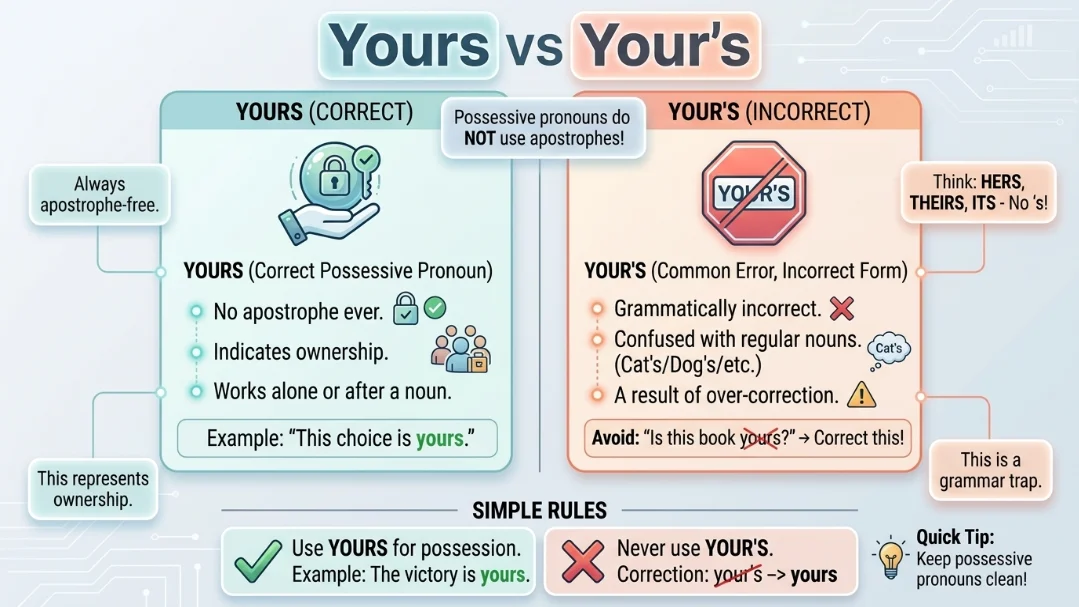
The fundamental difference between “yours” and “your’s” lies in grammatical correctness. “Yours” is the correct, standard possessive pronoun used to indicate ownership without an apostrophe, whereas “your’s” is a common spelling error that does not exist in standard English.
Many writers confuse the possessive pronoun “yours” with incorrect spellings. People often add an apostrophe because they think ownership requires one. However, English possessive pronouns never use apostrophes. This simple grammar rule trips up students and professionals alike every single day. Master this distinction today to write cleaner, more professional messages.
Writers must always remember that “yours” stands alone as a complete possessive pronoun. You should never write “your’s” because that spelling is entirely incorrect. Possessive pronouns like “yours,” “mine,” and “hers” show ownership naturally. Therefore, leaving out the apostrophe keeps your writing grammatically sound and professional.
Definition and Explanation
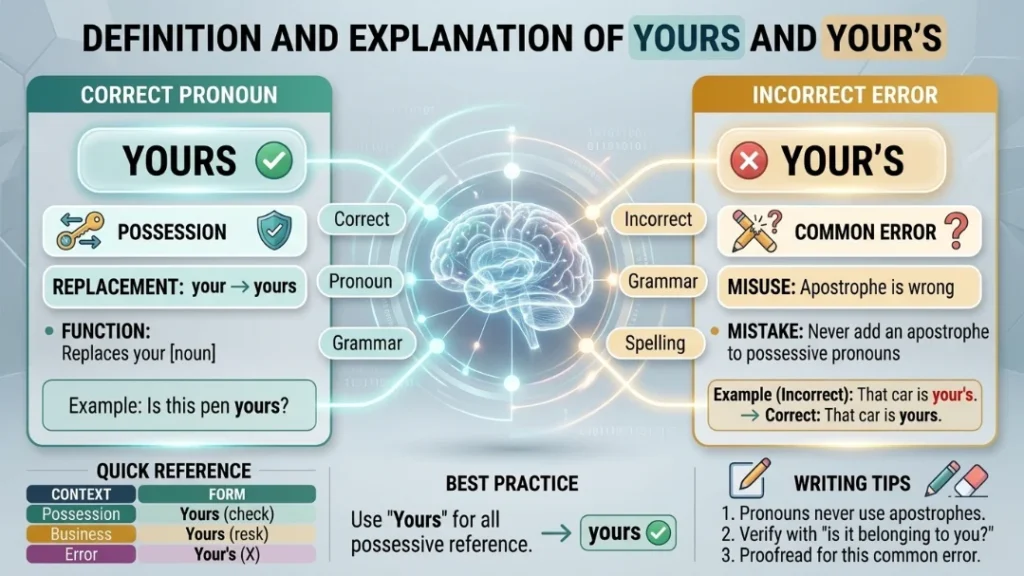
The word “yours” functions as a possessive pronoun in English grammar. Grammarians define possessive pronouns as words that replace nouns while showing who owns something. Because “yours” already contains the concept of possession, adding an apostrophe “s” creates a redundant and incorrect form.
Understanding Possessive Determiners Versus Pronouns
Possessive determiners modify nouns directly, while possessive pronouns replace them entirely. For example, people use “your” before a noun, as in “your book.” Conversely, people use “yours” independently, as in “that book is yours.”
Advantages and Disadvantages
| Feature | Correct Form (Yours) | Incorrect Form (Your’s) |
| Grammatical Status | Fully correct standard English | Non-standard spelling error |
| Professional Appeal | Enhances credibility and trust | Lowers perceived writing quality |
| Spell Check Recognition | Accepted by all major checkers | Flagged immediately as a typo |
| Usage Frequency | Extremely high in daily writing | Zero acceptable instances |
Real-World Examples
Professional correspondence requires flawless grammar to maintain credibility with clients. Business leaders notice minor typographical errors on proposals and emails.
Email Sign-Offs
Corporate communications frequently conclude with polite closing phrases. Writers should always sign off with “Yours sincerely” or “Yours faithfully” rather than incorrect variants.
Casual Conversations
Friends chat online and share personal items frequently. One might ask, “Is this jacket yours?” instead of making spelling mistakes.
Regional and Global Usage
English speakers worldwide follow the exact same rule regarding possessive pronouns. Whether you write in American, British, Australian, or Canadian English, the spelling remains identical. Educational institutions globally teach that “yours” never contains an apostrophe. International business standards demand adherence to this universal grammar rule across all English-speaking markets.
Common Mistakes
Many writers apply apostrophes automatically when they want to show possession. This habit stems from noun possessives like “Sarah’s car” or “the dog’s toy.” Writers mistakenly transfer this rule to pronouns. Consequently, they write “your’s,” “her’s,” or “our’s.” Each of these variations is grammatically incorrect. Pronouns possess inherent ownership properties without requiring punctuation marks.
Exercises with Answers
Practice tests help reinforce correct grammar habits effectively. Complete the following sentences using the proper form.
Exercise One
Choose the correct word: Is this pen (your’s / yours)?
Exercise Two
Identify the error in this sentence: The final decision is entirely your’s.
Exercise Three
Fill in the blank with the appropriate closing: Best regards, truly [______].
Answers to Exercises
- Answer One: The correct choice is “yours” because possessive pronouns never require apostrophes.
- Answer Two: The incorrect word is “your’s,” which should be replaced with “yours.”
- Answer Three: The correct closing phrase is “yours,” following standard letter-writing conventions.
Related Concepts or Comparisons
English grammar includes several other pronouns that frequently cause spelling confusion. Understanding these parallel cases strengthens overall writing skills significantly.
Its Versus It’s
People frequently confuse “its” and “it’s” for similar reasons. “Its” indicates possession, while “it’s” is a contraction for “it is.”
Whose Versus Who’s
Another common pair involves “whose” and “who’s.” “Whose” shows possession, whereas “who’s” expands to “who is” or “who has.”
Frequently Asked Questions
Is your’s ever acceptable in formal writing?
No, “your’s” is never acceptable in any form of formal or informal writing.
Why do people mistakenly write your’s?
Writers add apostrophes because they associate them with noun possession like “John’s book.”
How can I remember the correct spelling of yours?
Remember that pronouns like “mine,” “yours,” and “ours” never take apostrophes.
Does Microsoft Word flag your’s as an error?
Yes, modern word processors automatically flag “your’s” with a spelling red underline.
What is the grammatical category of yours?
The word functions as an independent possessive pronoun replacing a noun phrase.
Can yours appear at the beginning of a sentence?
Yes, sentences can begin with phrases like “Yours is a great idea.”
Are there other pronouns with similar spelling traps?
Words like “hers” and “ours” also face similar confusion regarding apostrophes.
How does proper pronoun use improve credibility?
Clean writing demonstrates attention to detail and professional competence to readers.
Conclusion
Mastering simple grammar rules elevates your overall communication effectiveness. Writers who eliminate errors like “your’s” project greater confidence and professionalism. Practice active proofreading before sending emails or publishing documents. Consistent attention to these details ensures your writing remains polished and impactful.