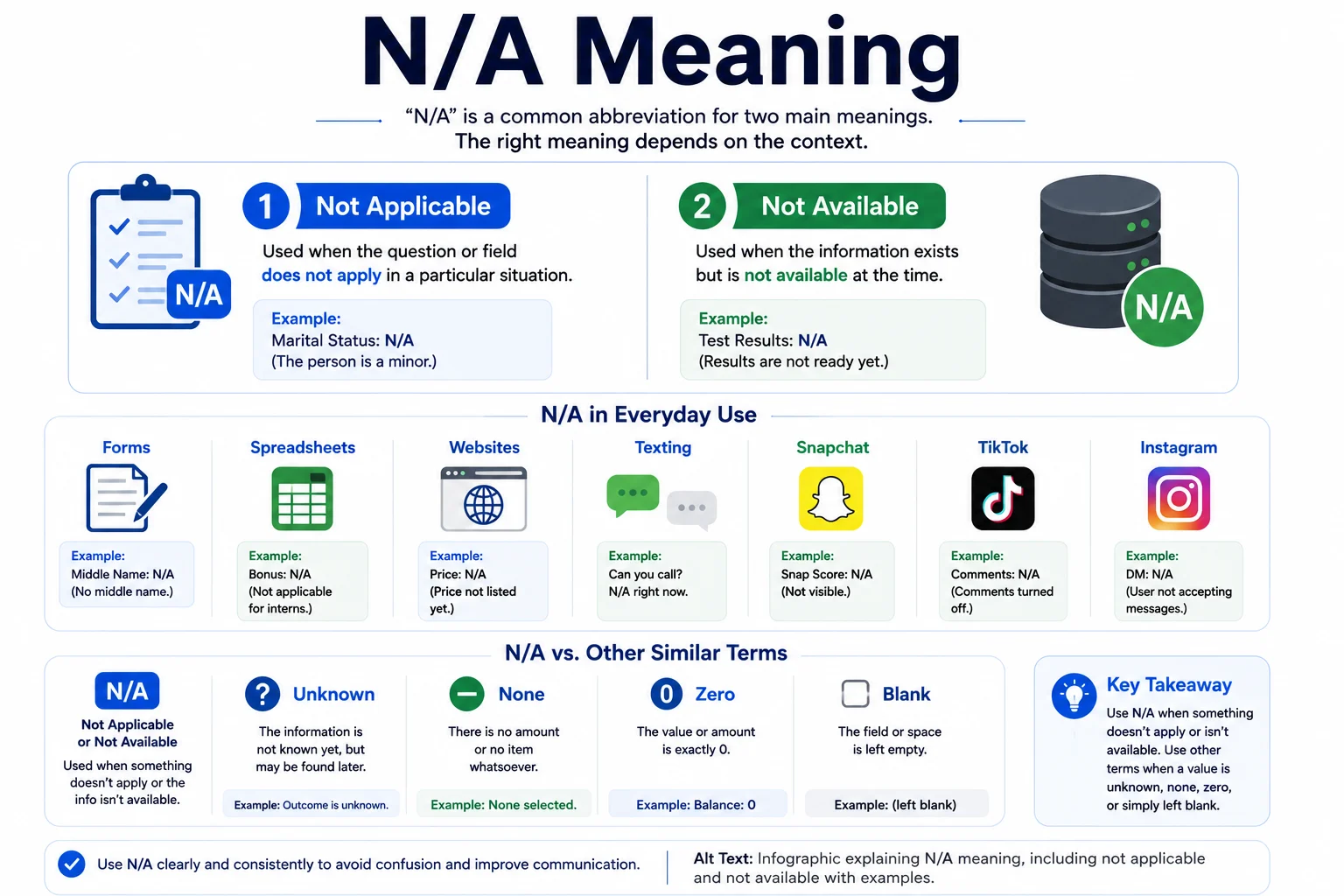
N/A usually means “not applicable” or “not available.” It appears when a question, field, option, or piece of information does not apply to a person or situation, or when the requested information cannot be provided.
what does n/a mean is a common question when people see the abbreviation on forms, websites, spreadsheets, messages, profiles, or social media. In most cases, N/A means “not applicable” or “not available.” However, the intended meaning depends on the surrounding context.
For example, a form may ask for a middle name. If someone does not have one, they might enter “N/A.” Similarly, a product page might display “N/A” when a specification has not been provided.
The abbreviation also appears in casual digital communication. Someone might answer “N/A” when a question does not relate to them. Therefore, understanding the context matters more than memorizing a single definition.
The term is not normally considered internet slang. Instead, it is a widely used abbreviation that works across professional, academic, administrative, and online settings.
Quick Answer Box
| Meaning | Context | Primary Platforms | Example | Tone |
| Not applicable | A question does not relate to the person or situation | Forms, documents, websites | “Apartment number: N/A” | Neutral |
| Not available | Information cannot currently be provided | Websites, databases, reports | “Price: N/A” | Neutral |
| No relevant answer | Casual digital communication | Texting, social media, chats | “Favorite team: N/A” | Casual |
| Information missing | A field has no usable data | Spreadsheets, records | “Phone extension: N/A” | Professional |
What Does what does n/a mean?
The abbreviation N/A has two common interpretations: not applicable and not available. Both meanings communicate that an ordinary answer cannot be supplied.
N/A meaning “not applicable”
“Not applicable” means the question or field does not relate to the person, object, or situation.
Consider a job application that asks:
Previous military service: N/A
The applicant uses N/A because the question does not apply to their circumstances.
Likewise, a form may ask for a spouse’s name. A person who is unmarried could use “N/A” if the form provides no other suitable option.
This meaning focuses on relevance. The information itself may exist, but the question does not apply.
N/A meaning “not available”
“Not available” has a different emphasis. The information may be relevant, but it cannot currently be supplied.
For example:
Product release date: N/A
This could mean the company has not announced the date.
Similarly:
Current inventory: N/A
could indicate that the website does not have usable inventory information.
This meaning focuses on availability rather than relevance.
Why the same abbreviation has two meanings
Language often compresses longer phrases into short forms. N/A became useful because both “not applicable” and “not available” communicate the same broad idea: there is no usable answer for this field right now.
Therefore, readers usually determine the precise meaning from context.
In formal documents, however, clarity matters. If there is enough space, writing “not applicable” or “not available” can prevent confusion.
N/A versus NA
You may also see NA, N/A, or n/a. These forms generally communicate the same idea.
However, formatting varies by organization. A company may require “N/A” on an application. Another system may automatically display “NA.”
The slash does not necessarily create a different meaning. It often reflects the conventional written abbreviation.
Contextual Dynamics & Nuances of the Term
The meaning changes slightly depending on where you encounter the abbreviation. Consequently, you should read the surrounding words before interpreting it.
On forms and applications
Forms commonly use N/A when a field does not apply.
For example:
| Form Field | Possible Entry | Why |
| Apartment number | N/A | The person lives in a house |
| Middle name | N/A | The person has no middle name |
| Previous employer | N/A | The applicant has never worked |
| Spouse name | N/A | The person is unmarried |
However, do not automatically enter N/A when you simply do not know an answer.
A form may distinguish between “unknown,” “not applicable,” and “not available.” Use the option that accurately describes the situation.
In spreadsheets
Businesses frequently use N/A in spreadsheets and reports.
For example, a sales report may contain a metric that only applies to certain products. Instead of leaving the cell blank, the analyst may enter N/A.
That distinction helps readers understand that the value was intentionally excluded.
A blank cell can mean many things. It might indicate missing data, an accidental omission, or a value that has not been entered.
N/A provides more information.
On websites
Websites often display N/A when a database lacks a relevant value.
For instance, a technology specification page might show:
| Specification | Value |
| Weight | 1.2 kg |
| Battery life | 12 hours |
| Removable battery | N/A |
| Warranty | 2 years |
Here, the missing value could mean the specification does not apply. The exact interpretation depends on the website’s conventions.
In academic work
Students and researchers may encounter N/A in tables, surveys, datasets, and questionnaires.
For example, a survey might ask respondents about a service they never used. Those respondents could select an option equivalent to “not applicable.”
However, researchers should define their data codes clearly. A dataset should not use the same code for “not applicable,” “unknown,” and “missing.”
That distinction improves data quality.
In everyday communication
People sometimes use N/A in text messages when they want a short answer.
For example:
Alex: What is your favorite baseball team?
Jordan: N/A. I don’t follow baseball.
The response is understandable, but it can sound more formal than natural conversation.
In casual texting, people may instead say:
“I don’t have one.”
or
“Not really applicable.”
Therefore, N/A works best when brevity matters.
Real-Life Conversation Examples Using what does n/a mean
The abbreviation can feel different depending on the conversation. Here are five realistic examples.
Example 1: A job application
Maya: Did you put something under “previous employer”?
Chris: Yes. I entered N/A.
Maya: Because this is your first job?
Chris: Exactly.
Here, N/A means not applicable.
Example 2: A product question
Sam: Do you know the price of the older model?
Ryan: The website says N/A.
Sam: So they don’t list it anymore?
Ryan: That’s what it looks like.
Here, N/A most likely means not available.
Example 3: A school form
Teacher: Please complete every field before submitting the form.
Student: What should I enter for “second language” if I don’t speak another language?
Teacher: Use N/A if the instructions allow it.
Here, the field does not apply.
Example 4: Casual texting
Lena: What’s your favorite celebrity?
Noah: N/A 😂
Lena: Seriously? You don’t have one?
Noah: Nope. I don’t really follow celebrities.
The abbreviation creates a short, slightly humorous response.
Example 5: Workplace chat
Manager: Do we have a confirmed delivery date?
Employee: N/A at the moment. The supplier hasn’t confirmed one yet.
Manager: Okay. Please update the sheet when they respond.
Here, N/A means the information is currently unavailable.
These examples show why context matters. The same abbreviation can describe an irrelevant question or unavailable information.
Platform-Specific Breakdown
Digital platforms use abbreviations differently. However, N/A keeps its basic meaning across most services.
How It Is Used on Snapchat
Snapchat conversations tend to favor short, informal messages. Therefore, users may use N/A when they want to answer quickly.
For example:
Friend: Relationship status?
User: N/A lol.
That response could mean the question does not apply, or the person simply does not want to provide an answer.
However, N/A is not uniquely associated with Snapchat. It does not function as a special Snapchat code or secret feature.
Context remains the key.
A profile, survey, filter, or form may also use N/A in its ordinary informational sense.
The Role of what does n/a mean on TikTok
TikTok comments and captions often use abbreviations because users prefer concise communication. Still, N/A does not have one exclusive TikTok definition.
A creator might write:
Favorite song: N/A
That could mean they do not have a favorite.
A commenter might write:
N/A 😂
to avoid giving a conventional answer.
However, readers should not assume that every occurrence represents slang. Sometimes the abbreviation simply comes from a template, form, spreadsheet, or informational graphic.
Instagram and Texting Dynamics
Instagram users may encounter N/A in captions, direct messages, bios, polls, and informational posts.
For example:
Person A: What’s your favorite movie?
Person B: N/A. I’m terrible at choosing favorites.
The abbreviation works, but “I don’t have one” sounds more conversational.
Texting follows the same pattern. N/A is useful when people want to save time, especially when answering lists of questions.
However, tone matters.
“N/A” can sound professional or detached. “No idea” sounds casual. “I don’t have one” sounds conversational. “Not applicable” sounds formal.
Therefore, the best choice depends on your relationship with the person and the purpose of the conversation.
Alternative Meanings & NLP Variations of the Phrase
Understanding related expressions makes the abbreviation easier to interpret.
| Expression | Typical Meaning | Common Context |
| N/A | Not applicable or not available | Forms, reports, chats |
| NA | Same general abbreviation | Databases, spreadsheets |
| Not applicable | The question does not relate | Forms, applications |
| Not available | Information cannot be provided | Websites, reports |
| Unknown | The answer exists but is not known | Records, research |
| None | There is no item or value | Forms, lists |
| Not provided | Someone did not supply information | Profiles, databases |
| No answer | The question received no response | Surveys, conversations |
These phrases are related, but they are not interchangeable in every situation.
For example, unknown means someone does not know the answer. Not applicable means there is no relevant answer for that situation.
Consider this example:
“Number of children: N/A”
This could mean the question does not apply because the person has no children.
But:
“Number of children: Unknown”
means the information has not been established.
That difference becomes important in business records and research.
Semantic variations in search queries
People may search for the abbreviation using several phrases.
Common variations include:
- what does n/a mean
- what does N/A stand for
- N/A meaning
- meaning of N/A
- what is N/A
- N/A definition
- N/A in texting
- N/A meaning in forms
- N/A meaning on social media
- does N/A mean not applicable
- does N/A mean not available
These queries usually point toward the same underlying concept. Search intent then determines which explanation is most useful.
Misinterpretations: When NOT to Use what does n/a mean
Although N/A is convenient, it does not fit every situation.
Do not use N/A when you simply do not know
Suppose a form asks:
Emergency contact phone number: ______
If you have an emergency contact but do not remember the number, N/A would be misleading.
A better response may be “unknown” or “will provide later,” if the form permits it.
Do not use it when the field requires a specific value
Some applications require a valid number, date, address, or identification value.
Entering N/A may cause validation errors.
Therefore, follow the instructions instead of assuming that every blank field accepts the abbreviation.
Do not confuse N/A with zero
Zero means there is a quantity of zero.
N/A means there is no applicable or available value.
For example:
Number of pets: 0
means the person has no pets.
By contrast:
Pet insurance cost: N/A
could mean the question does not apply.
Those values communicate different information.
Do not confuse N/A with “none”
“None” means something is absent.
N/A means the question or value does not apply or cannot be supplied.
For example:
Allergies: None
means the person has no allergies.
A completely unrelated field could instead require N/A.
Do not overuse it in casual conversations
N/A can sound robotic when a natural sentence would be clearer.
Instead of:
Favorite food: N/A
you might say:
“I don’t have a favorite.”
That response feels warmer and more conversational.
How to Respond in Chat Comfortably
If someone sends N/A in a message, you usually do not need to overthink it. First, look at the question they answered. If the:
original question does not apply to them, interpret it as not applicable.
question asks for information they cannot provide, interpret it as not available.
context remains unclear, ask a simple follow-up.
For example:
You: What’s your current job title?
Them: N/A.
You could respond:
“Do you mean you don’t currently have one?”
That approach avoids making an incorrect assumption.
Casual responses
If the conversation is relaxed, try:
“Gotcha.”
“Fair enough 😂”
“No worries.”
“Makes sense.”
These responses work when the meaning is already obvious.
Clarifying responses
When the meaning is uncertain, ask:
“Do you mean not applicable?”
or:
“Do you mean it’s not available right now?”
This keeps the conversation clear.
Professional responses
In workplace communication, clarity matters more than brevity.
You could say:
“Understood. I’ll mark that field as not applicable.”
Or:
“Thanks. I’ll leave it as unavailable until we receive the information.”
This style prevents confusion in records and reports.
When someone uses N/A to avoid answering
Sometimes a person may use the abbreviation because they do not want to discuss a topic.
For example:
Person A: Are you dating anyone?
Person B: N/A.
The abbreviation might mean the question does not apply. It could also politely signal that the person does not want to answer.
Therefore, avoid pressing for personal details. A simple response such as “No problem” is usually appropriate.
FAQs
What does n/a mean in texting?
In texting, N/A usually means not applicable or not available. The exact interpretation depends on the question and surrounding conversation.
What does N/A mean on a form?
On a form, N/A usually indicates that a field does not apply to the person or situation. However, always follow the form’s specific instructions.
Does N/A mean not available?
Yes, it can mean not available. For example, a website may display N/A when it does not currently provide a price, date, specification, or other relevant detail.
Does N/A mean not applicable?
Yes. Not applicable is one of the most common meanings. It indicates that a particular question, field, rule, or category does not relate to the current situation.
Is N/A considered slang?
Usually, no. N/A is better described as a general abbreviation. People use it in professional documents, databases, forms, academic materials, websites, and casual messages.
What is the difference between N/A and NA?
Usually, there is no major difference in meaning. Both can represent “not applicable” or “not available.” Formatting depends on the organization, platform, or style guide.
Can I use N/A in a professional email?
Yes, when the context supports it. However, writing “not applicable” or “not available” may provide more clarity in formal communication.
Is N/A rude in a text?
Not necessarily. It can sound brief or formal, but it is not inherently rude. Tone depends on the conversation, relationship, and reason for using it.
Should I use N/A instead of leaving a field blank?
Only when the field genuinely does not apply or the instructions permit it. A blank can mean missing information, while N/A communicates a specific reason for the missing value.
What should I say instead of N/A in casual conversation?
You can say “I don’t have one,” “not really,” “doesn’t apply to me,” “I don’t know,” or “not available right now.” Choose the phrase that accurately describes your situation.
Conclusion
N/A is a small abbreviation with a surprisingly broad range of uses. Most importantly, it usually communicates either not applicable or not available.
The difference becomes clear when you examine the context. If a question does not relate to someone, “not applicable” is usually the better interpretation. If the information matters but cannot currently be provided, “not available” makes more sense.
The abbreviation appears across forms, spreadsheets, databases, websites, academic documents, workplace communication, texting, and social platforms. Consequently, it is not limited to internet culture.
It also differs from terms such as “unknown,” “none,” “zero,” and “blank.” Those distinctions matter because each expression communicates a different type of missing or absent information.
In casual conversation, people often replace N/A with more natural phrases. For example, “I don’t have one” may sound friendlier than a short abbreviation. However, N/A remains useful when people need a compact response.
Ultimately, context determines meaning. Once you understand that principle, interpreting N/A becomes simple across forms, websites, messages, and everyday digital communication.

Harry Edwards is a language writer specializing in word meanings, synonyms, and language usage. He creates clear, accurate, and engaging content to help readers improve their vocabulary and communication skills.