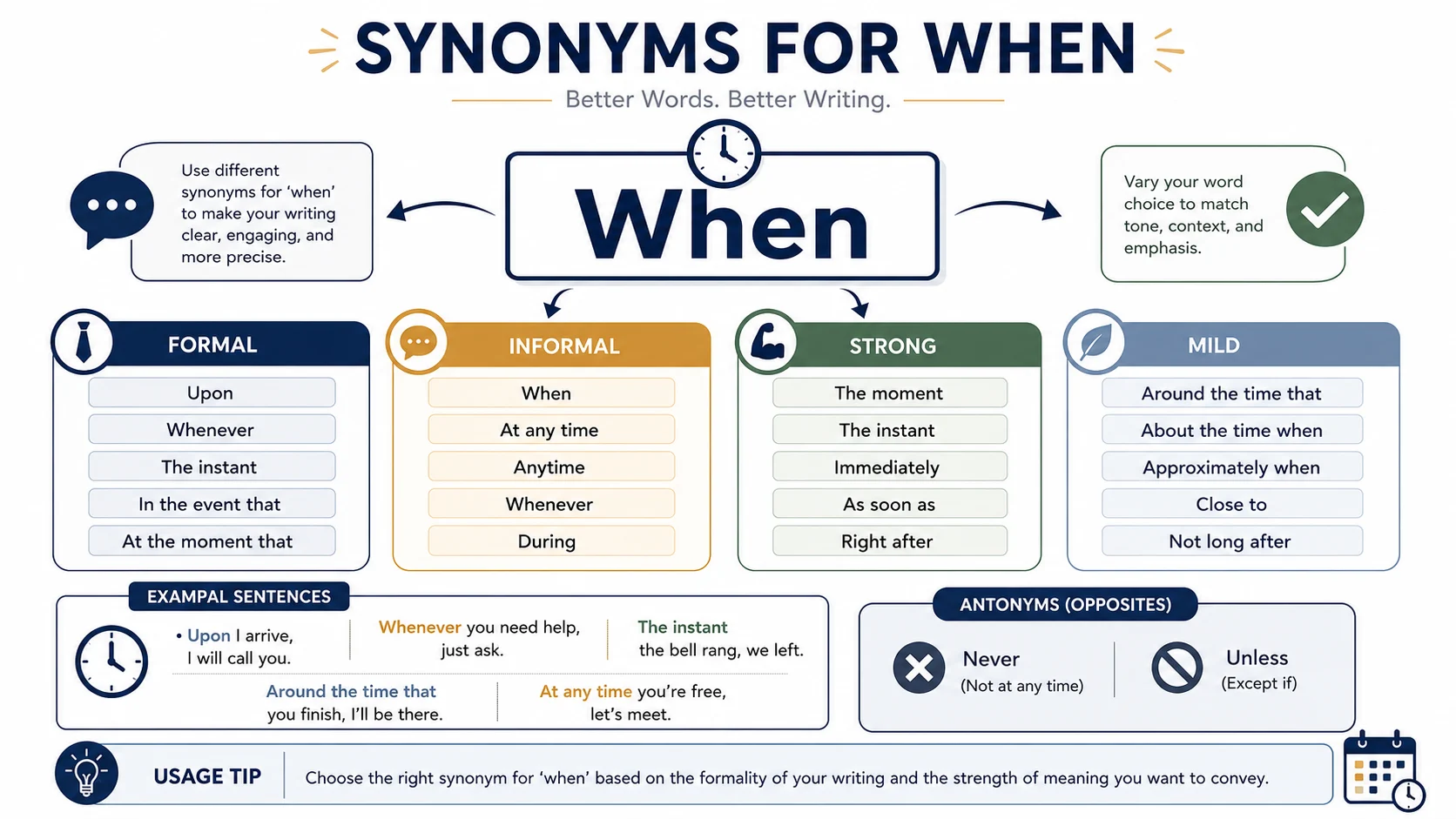
Finding the right word at the right moment can make all the difference in your writing. If you have ever stared at a sentence and realized you have used the word “when” too many times, you already know why synonyms for “when” matter. The best alternative depends entirely on what you are trying to say, the tone you want to set, and the context of your sentence.
Whether you are writing a formal report, crafting a story, or sending a casual message, having a solid list of synonyms for “when” at your disposal will make your writing stronger and more varied. This guide covers everything from the meaning of “when” to the best alternatives for every situation.
Best Synonyms for When
The best synonyms for “when” depend on your specific use case. For most situations, as soon as, while, after, before, and whenever work well. If you need something more formal, try upon, at which time, or in the event that. For casual writing, once, anytime, and the moment are excellent choices. The right word depends on whether you are expressing time, a condition, or a cause-and-effect relationship.
What Does When Mean?
At its core, “when” functions as an adverb or conjunction that connects two ideas based on time or circumstance.
- Simple definition: At or during the time that something happens; at any time; or in a situation where something occurs.
- Part of speech: Adverb, conjunction, and sometimes a pronoun.
- Core idea: “When” establishes a relationship between two events, actions, or conditions based on timing or specific conditions.
Example sentences:
- She called me when I was leaving work.
- When you finish your homework, you can go outside.
- I remember when we first met.
Core Meaning of When
The word “when” serves as a bridge between actions, events, or conditions. It tells the reader or listener that something happens at the same time as something else, immediately after something else, or in a situation where a condition is met.
Think of “when” as a temporal or conditional connector. It answers the question “at what time?” or “under what circumstances?” This versatility makes “when” incredibly useful but also easy to overuse.
Example contexts:
- Time-based: “I arrived when the meeting started.”
- Conditional: “When you press the button, the light turns on.”
- Causal: “When it rains, the ground gets wet.”
Understanding this core meaning is essential because not every synonym for “when” works in every situation. Some synonyms emphasize time, while others emphasize conditions or immediate action.
Grammar and Usage Notes
Part of Speech
“When” can function in three ways:
- Conjunction: Connects two clauses. Example: “I left when the movie ended.”
- Adverb: Modifies a verb. Example: “When did you arrive?”
- Pronoun: Refers to a time. Example: “Since when have you been here?”
Common Sentence Patterns
- Time clause + main clause: When [event A happens], [event B happens].
- Main clause + time clause: [Event B happens] when [event A happens].
- Question form: When [auxiliary verb] [subject] [main verb]?
Common Collocations with “When”
- “Even when” – introduces contrast. Example: “Even when I am tired, I exercise.”
- “Only when” – emphasizes exclusivity. Example: “Only when you apologize will I forgive you.”
- “When and if” – expresses uncertainty. Example: “We will discuss this when and if the time comes.”
- “When necessary” – indicates condition. Example: “Take breaks when necessary.”
When “When” Sounds Natural
“You should use ‘when’ when the timing or condition is the main point of your sentence. It works best in straightforward statements about time, cause and effect, or clear conditions.”
When a Synonym May Work Better
Overusing “when” makes writing repetitive and dull. If you find yourself using “when” multiple times in a paragraph or multiple sentences in a row, swap it out for a synonym. Synonyms also help you express more specific meanings. For example, “as soon as” is stronger than “when” for immediate action, while “while” is better for overlapping actions.
Best Synonyms for When
| Synonym | Meaning | Tone | Best Use Case | Example Sentence |
|---|---|---|---|---|
| As soon as | Immediately after or at the moment something happens | Neutral to slightly formal | Emphasizing immediate action | Call me as soon as you get home. |
| While | During the time that something else happens | Neutral | Expressing overlapping actions | I read while I waited. |
| After | Following a specific time or event | Neutral | Showing sequence | We went home after the concert ended. |
| Before | At an earlier time than something else | Neutral | Showing sequence | Finish your breakfast before you leave. |
| Whenever | At any time or every time something happens | Casual | Expressing repeated or unspecified times | Come over whenever you are free. |
| Upon | At the moment or immediately after | Formal | Professional or academic writing | Upon receiving your application, we will contact you. |
| Once | As soon as or after something happens | Neutral to informal | Emphasizing a condition or trigger | Once you try it, you will love it. |
| At which time | At that specific moment | Very formal | Legal, business, or formal writing | We will review your case, at which time we will inform you of our decision. |
| In the event that | If or when a specific situation occurs | Formal | Conditional situations | In the event that we cannot reach an agreement, we will proceed with arbitration. |
| The moment | Exactly at the instant something happens | Neutral to emphatic | Emphasizing precision or immediacy | The moment he walked in, I knew something was wrong. |
Common Synonyms for When
As Soon As
Meaning: Immediately after something happens.
Best context: Everyday conversation, instructions, and events requiring quick action.
Example: “I will send the email as soon as I finish writing it.”
While
Meaning: At the same time as something else.
Best context: Describing simultaneous actions.
Example: “She listened to music while she worked out.”
After
Meaning: Following a specific time or event.
Best context: Showing clear sequence in storytelling or instructions.
Example: “After the movie ended, we went for a walk.”
Before
Meaning: At an earlier time than something else.
Best context: Establishing order or priority.
Example: “Please call me before you leave.”
Whenever
Meaning: At any time or every time.
Best context: Casual or repeated situations.
Example: “You can come over whenever you want.”
Once
Meaning: As soon as or after something happens.
Best context: Emphasizing a condition that triggers another action.
Example: “Once you start the project, you cannot stop.”
Formal Synonyms for When
Upon
Meaning: Immediately after or at the moment of.
Best context: Formal writing, business correspondence, and official documents.
Example: “Upon signing the contract, you will receive a confirmation.”
At Which Time
Meaning: At that specific moment.
Best context: Legal documents, reports, and formal communications.
Example: “The board will convene at 9 AM, at which time we will discuss the budget.”
In the Event That
Meaning: If or when a specific situation happens.
Best context: Conditional statements in formal or legal contexts.
Example: “In the event that we encounter technical difficulties, please contact IT support.”
Subsequent To
Meaning: Following or after something.
Best context: Very formal writing, legal, and academic contexts.
Example: “Subsequent to the initial review, we will conduct a full investigation.”
At The Time That
Meaning: Exactly when something occurs.
Best context: Formal reports, historical accounts, and academic writing.
Example: “At the time that the data was collected, the population had not yet recovered.”
Informal Synonyms for When
Anytime
Meaning: At any time; whenever.
Best context: Casual conversation, friendly messages.
Example: “Feel free to call me anytime you need help.”
The Second
Meaning: Immediately at that exact moment.
Best context: Everyday speech, storytelling, emphasizing speed.
Example: “The second I saw her face, I knew she was lying.”
Any Time That
Meaning: Whenever; on any occasion.
Best context: Casual communication.
Example: “You can borrow my car any time that you need it.”
Right When
Meaning: Exactly at that moment.
Best context: Emphasis on precise timing in conversation.
Example: “I was about to leave right when you showed up.”
At That Point
Meaning: At that specific moment or stage.
Best context: Storytelling, explaining sequences.
Example: “I was frustrated, and at that point, I decided to quit.”
Strong Synonyms for When
Immediately After
Meaning: Right after something happens.
Best context: Emphasizing urgency or quick action.
Example: “Immediately after the alarm sounds, evacuate the building.”
The Instant
Meaning: Exactly at that moment.
Best context: Adding drama or emphasis to timing.
Example: “The instant she touched the glass, it shattered.”
Directly Upon
Meaning: Immediately after.
Best context: Formal writing emphasizing urgency.
Example: “Directly upon completing the assessment, notify the supervisor.”
No Sooner Than
Meaning: Almost immediately after something.
Best context: Emphasizing minimal delay.
Example: “No sooner than I sat down, the phone started ringing.”
When to use strong synonyms: Strong alternatives work well when timing is critical, when you want to create drama or urgency, or when you need to emphasize how quickly one event followed another. Overusing them can make your writing feel dramatic or forced.
Mild Synonyms for When
Around The Time That
Meaning: Approximately when something happens.
Best context: When timing is approximate.
Example: “Around the time that you left, the package arrived.”
In Cases Where
Meaning: Under specific circumstances.
Best context: Conditional statements with less urgency.
Example: “In cases where you cannot attend, please send a representative.”
On Occasions When
Meaning: Sometimes or occasionally.
Best context: Describing repeated but infrequent events.
Example: “On occasions when we travel together, we always have a good time.”
In Situations Where
Meaning: Under specific circumstances.
Best context: Explaining conditions or rules.
Example: “In situations where communication breaks down, we recommend mediation.”
When mild wording works better: Mild synonyms are useful when you do not want to sound overly dramatic or when the timing is not exact. They also work well for rules, guidelines, and general statements where precision is unnecessary.
Synonyms for When by Context
Everyday Conversation
For daily speech, as soon as, once, while, and whenever are your best bets. These words flow naturally and do not sound forced.
Example: “I will call you as soon as I get home.”
Professional Writing
In emails, reports, and professional correspondence, upon, once, and as soon as are the strongest choices. Avoid overly casual words like “anytime.”
Example: “Upon completion of the proposal, we will submit it for review.”
Academic Writing
Academic writing requires precision. Upon, at which time, subsequent to, and in the event that work well. Avoid informal contractions and casual phrasing.
Example: “Subsequent to the data collection phase, the researchers analyzed the results.”
Creative Writing
Creative writing thrives on variety. Use the moment, the instant, as, while, and once to add rhythm and emotional weight.
Example: “The moment she stepped off the train, she knew everything had changed.”
Marketing Copy
Marketing writing needs to be clear and persuasive. Use once, whenever, and as soon as to encourage action.
Example: “Once you try our product, you will never go back.”
Technical Writing
Technical documents need clarity above all. Upon, at which time, and in cases where are strong choices.
Example: “In cases where the system fails, restart the device.”
Another Word for When in a Sentence
Here are realistic examples showing how to use different synonyms for “when” in natural sentences:
- As soon as I finish this coffee, we can leave.
- She fell asleep while she was reading.
- Once you understand the instructions, the rest is easy.
- Upon arriving at the station, he realized he had left his ticket at home.
- I will text you the moment I hear anything.
- Whenever you feel stressed, take a few deep breaths.
- After the storm passed, everyone came outside to check the damage.
- Before you make a decision, consider all your options.
- In the event that the meeting is canceled, we will send an email update.
- We will review your application, at which time we will let you know our decision.
- Right when I was about to give up, I found the solution.
- No sooner than I sat down, the fire alarm went off.
- Around the time that you called, I was already on my way.
- On occasions when we disagree, we always find a way to compromise.
- At that point, I realized I had made a huge mistake.
When Synonyms Compared
| Synonym | Meaning | Tone | Intensity | Formality | Best Use |
|---|---|---|---|---|---|
| As soon as | Immediately after | Neutral | Strong | Neutral | Emphasizing quick action |
| Once | After or as soon as | Neutral | Medium | Neutral | Conditions and triggers |
| While | At the same time | Neutral | Mild | Neutral | Overlapping actions |
| Upon | At the moment of | Formal | Strong | Formal | Professional writing |
| Whenever | Any time | Casual | Mild | Informal | Repeated events |
| The moment | Exact instant | Emphatic | Very strong | Neutral | Dramatic emphasis |
| In the event that | Under a condition | Formal | Medium | Very formal | Legal or official writing |
| After | Following | Neutral | Mild | Neutral | Simple sequence |
Key differences:
- As soon as implies speed; once implies a condition has been met.
- While describes simultaneous action; after describes sequential action.
- Upon is formal; whenever is casual.
- The moment is emphatic; in the event that is conditional and legalistic.
Words Similar to When
These words are related to “when” but do not always work as direct replacements. Understanding the differences prevents awkward phrasing.
Whenever
Why it is related: It shares the same time-based meaning but implies repeated or unspecified time.
Why it is not always a direct replacement: “Whenever” does not work for a single, specific event.
When to use it: For repeated actions or open invitations.
Example: “Come over whenever you want.” (Not: “Come over whenever you called yesterday.”)
While
Why it is related: It describes time and connects actions.
Why it is not always a direct replacement: “While” specifically describes overlapping actions, not sequential ones.
When to use it: For simultaneous actions.
Example: “I read while she cooked.” (Not: “I called while I arrived.”)
Since
Why it is related: It connects a starting point to the present.
Why it is not always a direct replacement: “Since” focuses on duration or cause, not a single point in time.
When to use it: For duration-based statements.
Example: “I have been happy since I moved here.” (Not: “I left since the movie ended.”)
Once
Why it is related: It expresses a condition or trigger.
Why it is not always a direct replacement: “Once” implies finality or a one-time trigger.
When to use it: For actions that happen after a condition is met.
Example: “Once you finish, we can leave.” (Not: “Once I was tired, I slept.”)
Anytime
Why it is related: It shares the temporal meaning of “when.”
Why it is not always a direct replacement: “Anytime” is casual and implies no specific time.
When to use it: For open invitations or casual permission.
Example: “You can call anytime.” (Not: “Anytime I arrived, she left.”)
Antonyms of When
| Antonym | Meaning | Example Sentence |
|---|---|---|
| Never | At no time; not ever | I never expected to see you again. |
| Not | At no time or under no condition | I will not go, not even if you beg. |
| Unless | Except if something happens | I will not go unless you come with me. |
| Except when | Excluding a specific time | I am always busy except when I am on vacation. |
| After | Following in time | We will discuss this after the meeting. |
| Before | Prior to something in time | Finish your work before you leave. |
How to Choose the Right Synonym for When
Choosing the best synonym requires thinking about your sentence’s purpose, tone, and audience.
1. Match the context
Formal writing requires formal synonyms. Casual writing allows casual choices.
2. Match the tone
If you want to sound dramatic, use “the moment” or “the instant.” For neutral statements, use “once” or “as soon as.”
3. Check the intensity
Strong synonyms like “immediately after” add urgency. Mild synonyms like “around the time that” soften the statement.
4. Consider your reader
Your reader’s expectations matter. Academic readers expect formal language. Social media audiences expect casual phrasing.
5. Determine whether the synonym is exact or related
Some words like “while” and “whenever” are related but may not fit every situation. Always test your synonym in the sentence.
6. Keep the sentence natural
If the synonym sounds unnatural or changes the meaning, choose a different word. Natural writing always wins.
7. Use simple words when clarity matters
If you are unsure, choose a simpler synonym. Clarity is more important than variety.
Common Mistakes When Using Synonyms for When
Mistake 1: Choosing a word with the wrong tone
Using “upon” in a text message sounds odd. Using “anytime” in an academic paper sounds unprofessional.
Mistake 2: Using a synonym that is too strong
“The instant” creates dramatic emphasis. Overusing it makes your writing feel exaggerated.
Mistake 3: Using a formal word in casual writing
“At which time” fits legal documents but feels stiff in everyday writing.
Mistake 4: Using a casual word in professional writing
“Anytime” and “the second” do not belong in business reports.
Mistake 5: Replacing “when” without checking meaning
“If” and “when” are not interchangeable. “If” expresses uncertainty; “when” implies certainty.
Mistake 6: Treating related words as exact synonyms
“While” does not mean “after,” and “whenever” does not mean “when” in a single-time context.
Mistake 7: Making the sentence sound unnatural
If your synonym makes the sentence awkward, use a different word or stick with “when.”
Quick Synonym List for When
Common Synonyms
- As soon as
- While
- After
- Before
- Once
Formal Synonyms
- Upon
- At which time
- In the event that
- Subsequent to
- At the time that
Informal Synonyms
- Anytime
- The second
- Right when
- At that point
Strong Synonyms
- Immediately after
- The instant
- Directly upon
- No sooner than
Mild Synonyms
- Around the time that
- In cases where
- On occasions when
- In situations where
Related Words
- Whenever
- Since
- If
- As
- Just as
FAQs
What is the best synonym for when?
The best synonym depends on your context. For most everyday situations, as soon as, once, and while are excellent choices. For formal writing, use upon or at which time. For casual speech, try whenever or anytime.
What is another word for when in formal writing?
In formal writing, the best alternatives include upon, at which time, in the event that, and subsequent to. These words fit academic, legal, and business contexts well. Avoid casual synonyms like “anytime” or “the second” in formal documents.
What is an informal synonym for when?
Informal synonyms for “when” include anytime, the second, right when, and once. These words work well in casual conversation, text messages, and friendly emails. They create a relaxed tone but should not be used in formal writing.
What is a stronger word for when?
Stronger synonyms include immediately after, the instant, directly upon, and no sooner than. These words emphasize speed and urgency. Use them when you want to highlight how quickly one action followed another.
What is a milder word for when?
Milder alternatives include around the time that, in cases where, on occasions when, and in situations where. These words soften your statement and work well when timing is approximate or when you want to sound less forceful.
What words are similar to when?
Words related to “when” include while, whenever, once, since, and as. These words share time-based or conditional meanings but are not always direct replacements. Always check whether the related word fits your exact meaning.
What is the opposite of when?
The opposite of “when” depends on context. Never is the strongest opposite. Unless and except when express conditions that prevent something from happening. Before and after are opposites in terms of time sequence.
How do I choose the right synonym for when?
Start by considering your context, tone, and audience. Match the formality of your writing, check the intensity you need, and test whether the synonym sounds natural in your sentence. If in doubt, “once” and “as soon as” are safe choices for most situations.
Conclusion
Having a strong set of synonyms for “when” gives you more control over your writing. Whether you need a formal alternative for a business report, a casual word for a text message, or a stronger word to emphasize timing, the right synonym exists.
The key is matching your word to your context, tone, and audience. Use formal synonyms like “upon” for professional writing, casual synonyms like “anytime” for conversation, and strong synonyms like “the instant” for dramatic moments. Avoid forcing synonyms where they do not fit, and always test whether your chosen word sounds natural.
With the list of synonyms, example sentences, and usage tips above, you now have everything you need to replace “when” confidently and improve your writing variety.

Charlotte Wilson is a language writer passionate about word meanings, synonyms, and clear communication. She creates accurate and engaging content to help readers expand their vocabulary and language skills.

3 thoughts on “Synonyms for When| Meaning, Examples and Better Word Choices For 2026”