The greater than or equal to sign (≥) means that one value is greater than another value or exactly equal to it. For example, x ≥ 10 means that x can be 10 or any number greater than 10.
The greater than or equal to sign is one of the most common symbols used in mathematics. Written as ≥, it tells you that one value can be greater than another value or exactly the same as it. This makes the symbol especially useful when a condition allows a minimum value.
For example, x ≥ 10 means that x can be 10, 11, 12, 20, 100, or any other number greater than 10. The important point is that 10 itself is also allowed.
You may see this symbol in math problems, algebra, inequalities, statistics, graphs, spreadsheets, computer programming, and technical documents. Understanding it becomes much easier once you separate its two parts: the greater-than symbol (>) and the equal sign (=).
This guide explains the greater than or equal to sign in simple terms. You will learn what it means, how to read it, how to type it, how to use it in equations and inequalities, and how it differs from similar mathematical symbols.
| Meaning | Context | Primary Platforms | Example | Tone |
|---|---|---|---|---|
| Greater than or equal to | Mathematics, inequalities, comparisons | Schoolwork, calculators, spreadsheets, coding, documents | x ≥ 5 | Mathematical, precise |
What Is the Greater Than or Equal To Sign?
The greater than or equal to sign is:
≥
It compares two values and means:
“Greater than or equal to.”
For example:
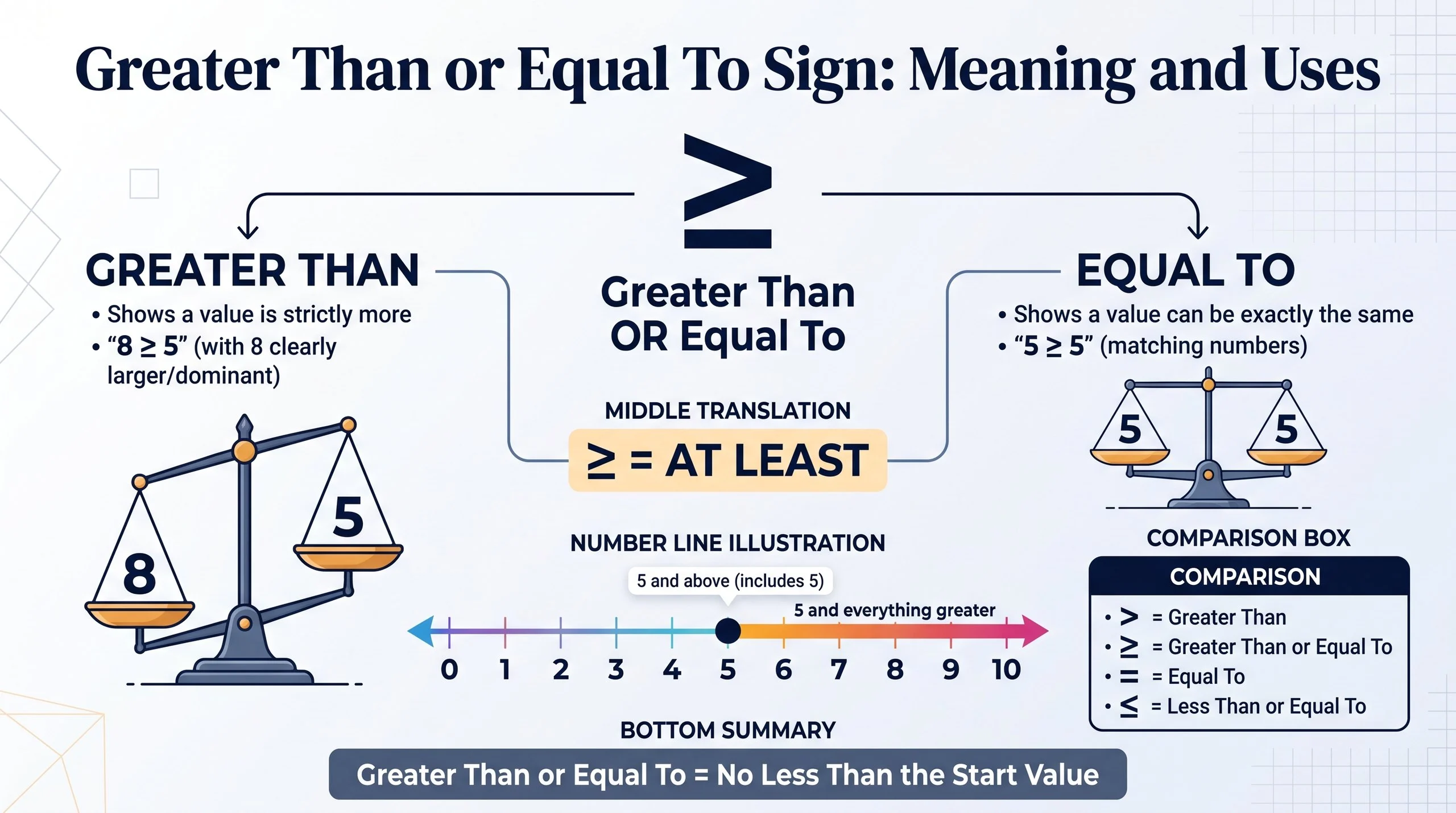
8 ≥ 5
This statement is true because 8 is greater than 5.
Another example is:
5 ≥ 5
This statement is also true because the two numbers are equal.
Therefore, the symbol allows two possibilities:
- The number on the left is greater.
- The two numbers are equal.
What Does ≥ Mean?
The symbol ≥ means that the value on the left side is greater than or equal to the value on the right side.
Consider:
x ≥ 7
This means:
x is 7 or greater.
Possible values include:
- 7
- 8
- 9
- 10
- 15
- 100
Values below 7 do not satisfy the condition.
For example:
6 ≥ 7
is false.
However:
7 ≥ 7
is true.
And:
12 ≥ 7
is also true.
How to Read the ≥ Symbol
You can read ≥ in several ways.
Standard Reading
“Greater than or equal to.”
Example:
x ≥ 4
Read it as:
“x is greater than or equal to 4.”
Simple Reading
You can also say:
“x is at least 4.”
This is often the easiest way to understand the symbol.
So:
x ≥ 4
means:
“x is at least 4.”
Everyday Interpretation
If a rule says:
Age ≥ 18
it means:
“The age must be 18 or older.”
The person can be 18, 19, 20, 21, and so on.
Why Does ≥ Have Two Parts?
The greater than or equal to sign combines two mathematical ideas.
The first part is:
>
This means greater than.
The second part is:
=
This means equal to.
Together:
≥
means:
greater than OR equal to.
That is why the symbol allows the two values to be equal.
Examples of the Greater Than or Equal To Sign
Example 1
10 ≥ 5
True.
10 is greater than 5.
Example 2
5 ≥ 5
True.
Both values are equal.
Example 3
3 ≥ 8
False.
3 is neither greater than nor equal to 8.
Example 4
20 ≥ 20
True.
The values are equal.
Example 5
25 ≥ 10
True.
25 is greater than 10.
Greater Than or Equal To in Algebra
The symbol becomes especially important in algebra.
Consider:
x ≥ 10
This is an inequality.
It does not give x one exact value. Instead, it describes a range of possible values.
The solution includes every value that is 10 or greater.
For whole numbers:
x = 10, 11, 12, 13, …
For real numbers, the solution also includes decimals and fractions:
10, 10.1, 10.5, 10.75, 11, 12.25, …
So the symbol creates a boundary at 10 while allowing values on the greater side.
Greater Than or Equal To vs. Greater Than
These symbols look similar:
> = greater than
≥ = greater than or equal to
The difference is important.
Greater Than
x > 5
This means x must be more than 5.
Therefore:
- 6 works.
- 7 works.
- 10 works.
- 5 does not work.
Greater Than or Equal To
x ≥ 5
This means x can be 5 or more.
Therefore:
- 5 works.
- 6 works.
- 7 works.
- 10 works.
The key difference is that ≥ includes the boundary value.
Greater Than or Equal To vs. Equal To
The equal sign is:
=
It means the two values are exactly the same.
For example:
x = 5
means x must be 5.
By contrast:
x ≥ 5
means x can be 5 or anything greater.
Therefore:
x = 5 → one exact value
x ≥ 5 → a range of values
Greater Than or Equal To vs. Less Than or Equal To
These symbols are opposites:
≥ = greater than or equal to
≤ = less than or equal to
For example:
x ≥ 10
means:
x is 10 or greater.
Meanwhile:
x ≤ 10
means:
x is 10 or less.
Both symbols include 10.
The difference is the direction of the comparison.
How to Remember ≥ and ≤
A simple trick is to focus on the direction of the open side.
The wide side faces the larger value.
For example:
10 ≥ 5
The wider part of the symbol faces 10.
Likewise:
5 ≤ 10
The wider part faces 10 again.
Another helpful method is to remember that the small point faces the smaller number.
Greater Than or Equal To on a Number Line
Inequalities can be shown visually on a number line.
Consider:
x ≥ 3
Place a closed dot at 3.
Then shade the line toward the right.
Why?
Because 3 is included, and every number greater than 3 is also included.
The closed dot is important because the condition allows equality.
Compare this with:
x > 3
That inequality uses an open dot at 3 because 3 itself is not included.
Number Line Rule
≥ → closed dot + shade right
> → open dot + shade right
≤ → closed dot + shade left
< → open dot + shade left
Greater Than or Equal To in Real Life
The symbol is not limited to classroom math.
You can use it whenever a rule sets a minimum requirement.
For example:
Age ≥ 18
means the minimum age is 18.
Another example:
Score ≥ 70
means the required score is 70 or higher.
A temperature requirement could be:
Temperature ≥ 20°C
This means the temperature must be 20°C or above.
A payment condition might be:
Purchase ≥ $50
This means the purchase must be at least $50.
Greater Than or Equal To in Age Requirements
Age requirements provide an easy real-world example.
Suppose an event has this rule:
Age ≥ 18
The following ages qualify:
- 18
- 19
- 20
- 21
- 25
- 40
A person who is 17 does not qualify.
The symbol therefore communicates the same idea as:
“18 or older.”
Greater Than or Equal To in Scores
Suppose a student needs at least 60 points to pass.
You could write:
Score ≥ 60
That means:
- 60 → passes
- 61 → passes
- 70 → passes
- 90 → passes
- 59 → does not meet the condition
The phrase “at least 60” is often a useful translation of ≥ 60.
Greater Than or Equal To in Money
Imagine a store offers free shipping for orders of $75 or more.
Mathematically:
Order total ≥ $75
An order of:
- $75 qualifies.
- $80 qualifies.
- $100 qualifies.
- $74.99 does not qualify.
The equality part matters because exactly $75 is enough.
Greater Than or Equal To in Statistics
The symbol also appears frequently in statistics.
For example:
x ≥ 100
could describe values that are 100 or higher.
A statistical statement might say that researchers examined participants who were:
Age ≥ 65
This means the group included people aged 65 and older.
Greater Than or Equal To in Geometry
Geometry can also use inequalities.
For example, a statement about a measurement might be:
Length ≥ 10 cm
This means the length is at least 10 centimeters.
You may also encounter inequalities involving angles, distances, or dimensions.
Greater Than or Equal To in Programming
The concept appears in computer programming as well.
However, programming languages usually do not use the single ≥ character.
Instead, many languages represent it as:
>=
For example:
age >= 18
This means the same thing as:
age ≥ 18
The two-character form is common because programming syntax traditionally uses keyboard characters.
Greater Than or Equal To in Spreadsheets
Spreadsheet software can also use the >= form in formulas and conditions.
For example, a rule might check whether a score is at least 70:
>=70
That condition means:
70 or higher.
The exact formula depends on the spreadsheet function being used, but the comparison concept stays the same.
How to Type the Greater Than or Equal To Sign
The symbol ≥ is not always printed directly on a standard keyboard.
However, you can use several methods to enter it.
Copy and Paste
The easiest option is:
≥
You can copy the symbol directly.
Windows
On Windows, methods can vary depending on the application, keyboard layout, and Unicode support.
In Microsoft Word, you can use the equation tools or insert-symbol features to find ≥.
Microsoft Word
You can insert the symbol through Word’s symbol or equation features.
For mathematical writing, the equation editor is often the easiest choice.
Google Docs
Google Docs includes an option for inserting special characters. Search for greater than or equal to and select ≥.
HTML
The HTML entity is:
≥
It renders as:
≥
Another Unicode-based HTML representation can also be used:
≥
Unicode
The Unicode code point for ≥ is:
U+2265
This is useful for software, websites, documents, and technical applications.
How to Type ≥ on a Phone
On many smartphones, the symbol may not appear directly on the main keyboard.
You can usually find mathematical symbols through the symbols or numbers section of the keyboard.
If you cannot find it, the simplest option is to copy:
≥
For frequent use, you can also create a text replacement or shortcut if your keyboard supports that feature.
How to Use the Greater Than or Equal To Sign Correctly
The basic structure is:
A ≥ B
Read it as:
“A is greater than or equal to B.”
Examples:
15 ≥ 10
20 ≥ 20
x ≥ 4
y ≥ -2
The left value is the one being compared with the right value.
Common Mistakes
Mistake 1: Forgetting the Equal Part
Some people read:
x ≥ 5
as “x is greater than 5.”
That is incomplete.
It means:
x is greater than OR equal to 5.
Therefore, 5 is included.
Mistake 2: Confusing ≥ With >
These symbols are not identical.
x > 5 excludes 5.
x ≥ 5 includes 5.
Mistake 3: Reversing the Direction
Consider:
5 ≥ 10
This is false.
The correct statement for “5 is less than or equal to 10” is:
5 ≤ 10
Mistake 4: Using an Open Circle on a Graph
When graphing:
x ≥ 5
the point at 5 should be closed because 5 is included.
Mistake 5: Assuming Only Whole Numbers Count
An inequality such as:
x ≥ 5
can include decimals and fractions unless the problem specifically restricts x to whole numbers or integers.
For example:
5.5 ≥ 5
is true.
Advantages of Using the ≥ Symbol
The symbol is useful because it communicates a complicated idea very quickly.
1. It Is Concise
Instead of writing:
“greater than or equal to”
you can simply write:
≥
2. It Shows a Range
The symbol can describe many possible values with one expression.
3. It Works Across Mathematical Fields
You can find it in:
- Algebra
- Statistics
- Geometry
- Calculus
- Economics
- Physics
- Computer science
- Engineering
4. It Makes Conditions Clear
A requirement such as:
Score ≥ 80
is immediately understandable to someone familiar with mathematical notation.
Practice Questions
Question 1
What does x ≥ 10 mean?
Answer: x is greater than or equal to 10.
Question 2
Is 7 ≥ 7 true?
Answer: Yes. Both values are equal.
Question 3
Is 8 ≥ 10 true?
Answer: No. 8 is less than 10.
Question 4
Does x ≥ 5 include 5?
Answer: Yes.
Question 5
Does x > 5 include 5?
Answer: No.
Question 6
Which symbol means “less than or equal to”?
Answer: ≤
Question 7
What does “at least 25” mean mathematically?
Answer: ≥ 25
Quick Comparison of Mathematical Symbols
| Symbol | Meaning | Example | Interpretation |
|---|---|---|---|
| > | Greater than | 8 > 5 | 8 is larger |
| < | Less than | 5 < 8 | 5 is smaller |
| ≥ | Greater than or equal to | 8 ≥ 5 | 8 is larger or equal |
| ≤ | Less than or equal to | 5 ≤ 8 | 5 is smaller or equal |
| = | Equal to | 5 = 5 | Both are the same |
| ≠ | Not equal to | 5 ≠ 8 | Values are different |
Frequently Asked Questions
What is the greater than or equal to sign?
The greater than or equal to sign is ≥. It means that one value is greater than another value or equal to it.
What does ≥ mean in math?
≥ means greater than or equal to. For example, x ≥ 10 means x can be 10 or any value greater than 10.
What does ≥ mean in simple words?
It means “at least” or “greater than or equal to.”
Does ≥ include the number after it?
Yes. In x ≥ 5, the value 5 is included.
What is the difference between > and ≥?
> means greater than and does not include equality. ≥ means greater than or equal to and does include equality.
What is the opposite of ≥?
The opposite comparison symbol is ≤, which means less than or equal to.
How do you read ≥?
You can read ≥ as “greater than or equal to.” In many everyday situations, “at least” is also a useful way to say it.
What does x ≥ 10 mean?
It means x is 10 or greater.
Is 10 ≥ 10 true?
Yes. The two numbers are equal, so the statement satisfies the “equal to” part of the symbol.
How do you type ≥?
You can copy ≥, use a symbol or equation tool in a document editor, or use the appropriate Unicode or HTML representation.
What is the Unicode for ≥?
The Unicode code point for the greater than or equal to sign is U+2265.
What is the keyboard version of ≥ in programming?
Many programming languages represent it as >= rather than the single mathematical symbol ≥.
Key Takeaway & Summary
The greater than or equal to sign (≥) means that a value is larger than or exactly equal to another value. It combines the meanings of greater than (>) and equal to (=).
For example:
x ≥ 5
means:
x is 5 or greater.
The value 5 is included because of the equality part. Values such as 6, 10, and 100 also satisfy the condition.
Remember the simple phrase:
≥ = at least
Once you understand that idea, inequalities, number lines, age requirements, scores, measurements, and other mathematical conditions become much easier to read.
Conclusion
The greater than or equal to sign is a simple but important mathematical symbol. Written as ≥, it allows a value to be either larger than another value or exactly equal to it.
The easiest way to remember its meaning is “at least.” So, when you see x ≥ 10, think “x is at least 10.”
Unlike the greater-than symbol >, the ≥ symbol includes the boundary value. Therefore, 10 ≥ 10 is true, while 10 > 10 is false.
You will encounter this symbol in algebra, statistics, geometry, science, spreadsheets, programming, and everyday numerical conditions. Once you recognize that the symbol combines greater than and equal to, its meaning becomes straightforward.