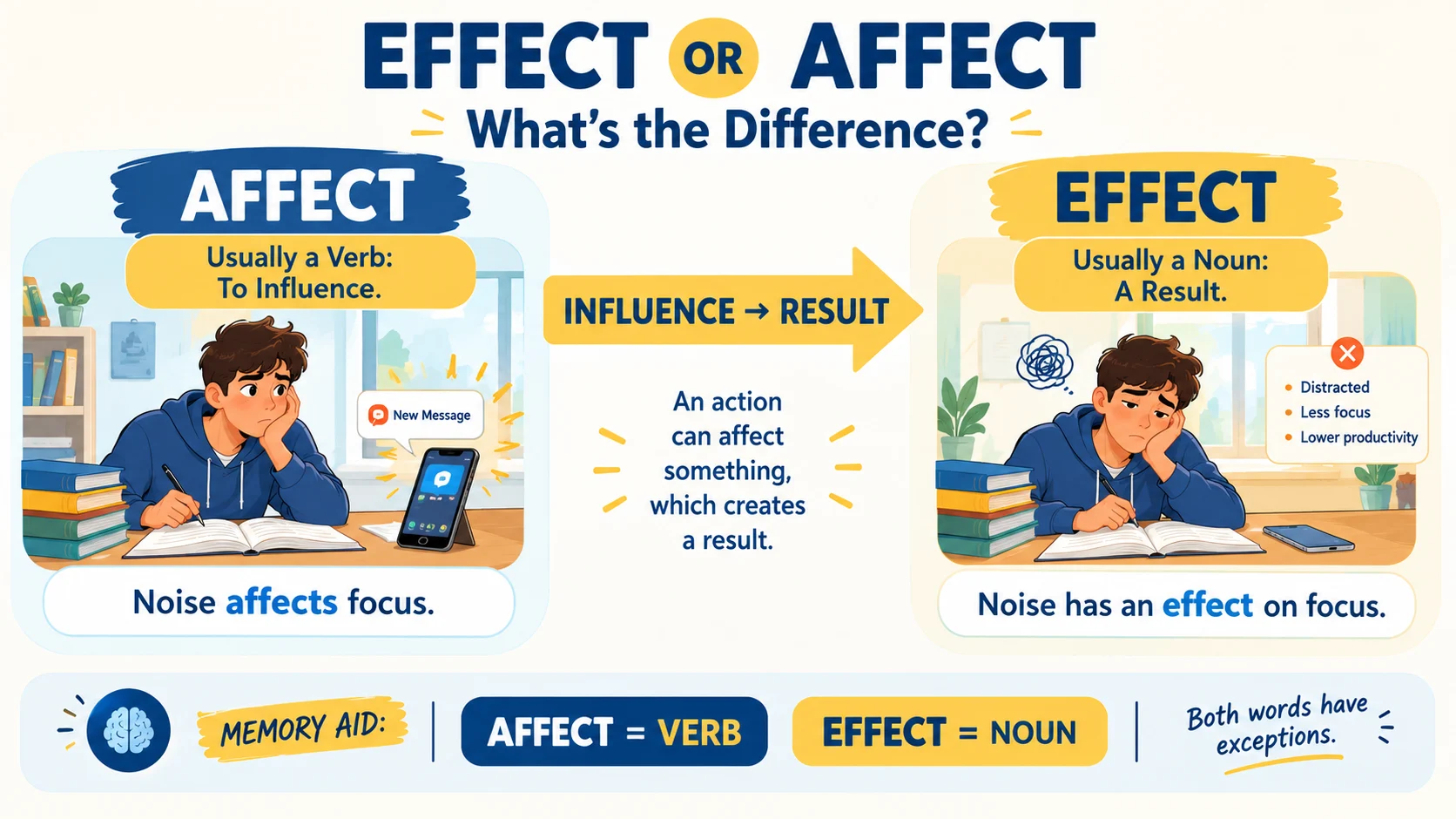
Effect is usually a noun meaning the result or outcome of something, while affect is usually a verb meaning to influence or change something. For example, “The rain affected our plans” uses affect to describe an action, whereas “The rain had an effect on our plans” uses effect to describe a result.
Effect or affect is one of the most common word-choice questions in English. The two words look and sound similar, but they usually perform different jobs in a sentence.
In most everyday writing, affect works as a verb, while effect works as a noun. For example, you might say, “Lack of sleep can affect your mood.” However, you would say, “Lack of sleep can have an effect on your mood.”
That basic rule solves many situations. Still, English has a few exceptions that can make the difference confusing. Affect can sometimes function as a noun, while effect can also function as a verb.
Fortunately, you don’t need to memorize dozens of complicated grammar rules. Once you understand the core difference between an action or influence and a result or outcome, choosing the right word becomes much easier.
This guide explains effect or affect in simple terms. You’ll also find examples, memory tricks, common mistakes, comparison tables, and practical tips for using both words correctly.
Effect or Affect?
| Word | Most Common Role | Basic Meaning | Example |
|---|---|---|---|
| Affect | Verb | To influence something | Stress can affect your sleep. |
| Effect | Noun | A result or outcome | Stress can have an effect on sleep. |
The easiest rule
Affect = influence
Effect = result
Think about the role of the word before choosing it.
If you’re describing something influencing or changing something else, you usually need affect.
If you’re describing the result produced by that influence, you usually need effect.
Example: Lack of sleep can affect your concentration. The effect may include slower thinking.
That simple distinction works in most everyday situations.
What Does Affect Mean?
Affect most commonly means to influence, change, or have an impact on something.
Because it usually describes an action, affect normally functions as a verb.
For example:
- Loud noise can affect your ability to concentrate.
- Weather can affect travel plans.
- Exercise can affect your energy levels.
- Stress can affect your sleep.
- Social media can affect how people communicate.
In each sentence, something is influencing something else.
Affect as a Verb
When you use affect as a verb, ask yourself:
“Is something influencing or changing something?”
If the answer is yes, affect is usually the correct choice.
Consider this sentence:
The criticism affected her confidence.
The criticism influenced her confidence. Therefore, affected works as the verb.
Similarly:
The new schedule affected everyone’s routine.
The schedule changed or influenced the routine. Again, affected is correct.
Affect Can Describe Positive or Negative Influence
Affect doesn’t automatically mean something bad.
For example:
Regular exercise can affect your mood positively.
Likewise:
A supportive environment can affect employee motivation.
The influence can be helpful, harmful, neutral, or simply noticeable.
Therefore, don’t associate affect only with negative situations.
What Does Effect Mean?
Effect most commonly means a result, consequence, or outcome produced by something.
Unlike affect, effect usually functions as a noun.
For example:
- The medicine had a strong effect.
- The storm caused significant effects on transportation.
- The new policy had an unexpected effect.
- Lack of sleep can have a negative effect on memory.
- The change had little effect on sales.
In each example, effect identifies the result.
Effect as a Noun
When you’re unsure whether to use effect, ask:
“Am I talking about the result?”
If you’re naming an outcome or consequence, effect is usually correct.
For example:
The heat had an effect on the equipment.
Here, the sentence discusses the result of the heat.
Another example:
One effect of stress is poor sleep.
The sentence identifies poor sleep as a result of stress.
Common Phrases With Effect
Several common expressions use effect as a noun.
These include:
- have an effect
- cause an effect
- side effect
- negative effect
- positive effect
- long-term effect
- short-term effect
- direct effect
- indirect effect
- ripple effect
For example:
The medication caused a temporary side effect.
Similarly:
The decision could have a long-term effect.
These familiar phrases can help you recognize when effect is the correct word.
Affect vs Effect: The Main Difference
The easiest way to understand affect vs effect is to think about action versus result.
| Affect | Effect |
|---|---|
| Usually a verb | Usually a noun |
| Means influence | Means result |
| Describes an action | Describes an outcome |
| Usually comes before an object | Often follows words such as “the,” “an,” or “its” |
| “The news affected him.” | “The news had an effect on him.” |
Compare These Sentences
The weather affected our plans.
The weather influenced the plans.
The weather had an effect on our plans.
The sentence now focuses on the result or influence produced by the weather.
Both sentences communicate a similar idea, but they use different grammatical structures.
Another Simple Comparison
Lack of sleep affects concentration.
Here, lack of sleep influences concentration.
Lack of sleep has an effect on concentration.
Now, effect names the result or influence.
The meaning remains closely related. The grammatical role changes.
Effect or Affect: A Simple Memory Trick
A useful memory trick is:
Affect = Action
Both affect and action begin with A.
When something acts on or influences something else, think affect.
Noise can affect your concentration.
Effect = End Result
Think of effect as the end result.
Poor concentration is an effect of lack of sleep.
This isn’t a complete rule for every rare usage, but it works extremely well for everyday English.
Another Memory Trick
Try this phrase:
Affect = Alter
Both words start with A.
If something alters or influences another thing, use affect.
Effect = End result
If you’re talking about what happened afterward, use effect.
For most everyday writing, these shortcuts make the distinction much easier.
How to Know Whether Affect Is Correct
Start by looking at the sentence structure.
If the word describes something doing something to something else, affect is likely correct.
For example:
Lack of sleep can affect your memory.
Here, lack of sleep performs the influence.
Another example:
The delay affected our plans.
The delay changed the plans.
Likewise:
Her attitude affected the team’s performance.
Her attitude influenced the team’s performance.
Questions to Ask
Before writing affect, ask:
- Is the word describing an influence?
- Is it functioning as a verb?
- Can I replace it with “influence”?
If the answer is yes, affect probably fits.
For example:
Stress can affect your health.
Replace affect with influence:
Stress can influence your health.
The sentence still works. Therefore, affect is appropriate.
How to Know Whether Effect Is Correct
Now try the same method with effect.
Ask:
- Am I naming a result?
- Is the word functioning as a noun?
- Can I replace it with “result” or “consequence”?
Consider:
The new rule had a major effect on attendance.
You could say:
The new rule had a major result on attendance.
That replacement isn’t always grammatically natural, but the underlying idea is still the outcome or consequence.
A better example is:
One effect of the new rule was lower attendance.
Here, effect clearly means a result.
Look for Helpful Determiners
Words such as an, the, its, and this often appear before the noun effect.
For example:
- an effect
- the effect
- its effect
- this effect
- the side effect
- a long-term effect
That pattern can provide a useful clue.
Effect or Affect Examples
Seeing the two words in real sentences can make the distinction clearer.
Examples With Affect
- Lack of sleep can affect your mood.
- Stress may affect your concentration.
- The rain affected our travel plans.
- Music can affect your emotions.
- Exercise can affect your energy levels.
- The announcement affected employee morale.
- Technology has affected how we communicate.
- Your choices can affect your future.
- Noise can affect your ability to focus.
- The experience affected his confidence.
In every example, affect describes influence or change.
Examples With Effect
- Lack of sleep can have an effect on your mood.
- Stress had a noticeable effect on her concentration.
- The rain had little effect on our plans.
- Music can have a powerful effect on emotions.
- Exercise has a positive effect on energy levels.
- The announcement had an immediate effect on morale.
- Technology has had a major effect on communication.
- Your choices can have a lasting effect on your future.
- Noise had a negative effect on his concentration.
- The experience had a lasting effect on his confidence.
Here, effect identifies a result or consequence.
Affect or Effect in the Same Sentence
Sometimes you can use both words in one sentence.
Consider:
Stress can affect your sleep, and poor sleep can have a negative effect on your health.
The first word describes an influence.
The second word identifies a result.
Another example:
The weather affected our plans, and the effect was a delayed departure.
Again, the distinction becomes clear:
Affect = what influences
Effect = what results
More Examples
Social media can affect your attention span, and one possible effect is reduced concentration.
The new policy affected employees, and its effects became noticeable within weeks.
Exercise can affect your mood, while improved mood can be one effect of regular activity.
This is one of the best ways to learn the difference because you can see both words performing separate grammatical jobs.
Common Mistakes With Affect and Effect
Even experienced writers sometimes confuse these words.
Mistake 1: “The Weather Effected Our Plans”
This is usually incorrect.
The correct sentence is:
The weather affected our plans.
Why? The weather influenced the plans.
Mistake 2: “The New Rule Affected a Positive Effect”
This sentence mixes the two words incorrectly.
A better version is:
The new rule had a positive effect.
Or:
The new rule positively affected the situation.
The first version uses effect as a noun. The second uses affected as a verb.
Mistake 3: “The Effect of Stress Affects Sleep”
This sentence can actually be grammatically correct.
However, it can sound awkward because both words appear close together.
A clearer alternative might be:
Stress affects sleep.
Or:
Stress has an effect on sleep.
The best choice depends on the sentence structure you want.
Mistake 4: Assuming Effect Always Means Influence
In everyday English, effect often means result.
However, effect can also function as a verb in certain contexts. That less common usage creates confusion.
We’ll cover that exception below.
When Effect Is a Verb
Although effect usually functions as a noun, it can also be a verb.
As a verb, effect means to bring about, cause, or make something happen.
This usage appears more often in formal, business, legal, or academic writing.
For example:
The organization hopes to effect meaningful change.
Here, effect means to bring about change.
Another example:
The new policy could effect major improvements.
The meaning is not simply “influence.” It suggests actively bringing about the desired result.
Effect vs Affect as Verbs
This distinction is important.
Affect means to influence something.
Effect means to bring something about.
Compare:
The campaign affected public opinion.
The campaign influenced public opinion.
The campaign effected a major change in policy.
The campaign brought about the policy change.
Therefore, the two words can both appear as verbs, but they communicate different ideas.
Why This Exception Matters
You don’t need to use effect as a verb frequently in everyday writing.
In fact, affect will usually be the correct verb when you mean “influence.”
However, recognizing the difference helps you understand formal writing and prevents you from assuming that effect can never be a verb.
When Affect Is a Noun
There is another less common exception.
Affect can function as a noun in psychology and psychiatry.
In that context, affect refers to the observable expression of emotion.
For example:
The patient displayed a flat affect.
Here, affect doesn’t mean influence. It refers to outward emotional expression.
This specialized use is different from the everyday verb affect.
Affect vs Effect in Psychology
The distinction can become particularly confusing in mental-health and medical writing.
In simple terms:
- Affect can describe observable emotional expression.
- Effect still refers to a result or consequence.
For general writing, however, you will usually encounter affect as a verb and effect as a noun.
Therefore, don’t let this specialized exception make the basic rule seem more complicated than it needs to be.
Effect or Affect in Academic Writing
Academic writing uses both words frequently.
Researchers often discuss how one variable influences another and then describe the resulting outcome.
For example:
Sleep deprivation can affect memory performance.
Then:
The effect of sleep deprivation on memory performance was significant.
The first sentence focuses on influence.
The second sentence names the resulting effect.
Academic Writing Tip
Pay attention to the grammatical role of the word rather than relying on how it sounds.
Academic sentences can become long and complicated. As a result, it can be harder to identify whether you’re describing an action or an outcome.
Break the sentence down first.
Ask:
What is doing the influencing?
Then ask:
What is the resulting outcome?
That approach usually reveals the correct word.
Effect or Affect in Professional Writing
Business emails, reports, presentations, and workplace documents also use these words often.
For example:
The schedule change affected productivity.
Or:
The schedule change had an effect on productivity.
Both sentences can work.
However, the first one is often more direct because affected acts as the main verb.
Choose the Clearer Structure
Instead of writing:
The changes had an effect on productivity.
You might write:
The changes affected productivity.
The second sentence is shorter and more direct.
However, don’t force affect into every sentence. Sometimes effect creates the clearer structure.
For example:
The long-term effects of the policy remain uncertain.
Here, effects clearly identifies the outcomes.
Effect or Affect in Everyday Conversation
In casual conversation, people often use affect and effect without thinking about grammar.
You might hear:
“That really affected me.”
This means the experience influenced the speaker emotionally.
You might also hear:
“What effect did that have?”
Here, the speaker asks about the result.
Both words are common in everyday English, even though their grammatical roles differ.
Common Conversational Examples
“Does caffeine affect your sleep?”
“What effect does caffeine have on sleep?”
“That movie really affected me.”
“The movie had a lasting effect on me.”
The meaning remains connected, but the sentence structure changes.
Affect vs Effect Pronunciation
The words also have slightly different pronunciation patterns.
In common American English:
- Affect as a verb is usually pronounced roughly like uh-FEKT.
- Effect as a noun is usually pronounced roughly like ih-FEKT.
The final sound is similar, which contributes to the confusion.
However, listening for pronunciation alone isn’t the safest way to choose between them. Context and grammatical role provide stronger clues.
Effect or Affect: A Quick Decision Method
When you’re writing and suddenly wonder which word you need, use this three-step method.
Step 1: Identify the Meaning
Ask what you’re trying to say.
Does the word mean influence?
Choose affect.
Does it mean result?
Choose effect.
Step 2: Check the Grammar
Ask whether you’re using the word as a verb or noun.
If it’s a verb meaning “influence,” use affect.
If it’s a noun meaning “result,” use effect.
Step 3: Test a Replacement
Replace affect with influence.
If the sentence still makes sense, affect probably works.
Replace effect with result.
If you’re clearly talking about an outcome, effect probably works.
Effect or Affect Cheat Sheet
| If You Mean… | Use |
|---|---|
| Influence | Affect |
| Change something | Affect |
| Have an impact on | Affect |
| Result | Effect |
| Outcome | Effect |
| Consequence | Effect |
| Side result | Effect |
| Bring about something | Effect as a verb |
| Observable emotional expression | Affect as a specialized noun |
The One-Line Rule
Affect usually acts; effect usually results.
That sentence is worth remembering whenever you face the choice.
Practice: Choose Affect or Effect
Try completing these sentences before looking at the answers.
Exercise 1
Lack of sleep can ______ your concentration.
Answer: affect
Lack of sleep can affect your concentration.
The word means influence.
Exercise 2
The medicine had a positive ______ on his symptoms.
Answer: effect
The medicine had a positive effect on his symptoms.
Here, the word identifies the result.
Exercise 3
How will the decision ______ the company?
Answer: affect
The decision will affect the company.
The decision will influence the company.
Exercise 4
The new rule had little ______ on employees.
Answer: effect
The sentence refers to the result or impact of the rule.
Exercise 5
The loud music ______ my ability to concentrate.
Answer: affected
The music influenced the speaker’s concentration.
Exercise 6
One ______ of excessive screen time may be poor sleep.
Answer: effect
Poor sleep is presented as a result.
Exercise 7
The policy could ______ significant changes.
Answer: effect
Here, effect is a verb meaning to bring about.
Exercise 8
The experience deeply ______ her.
Answer: affected
The experience influenced her emotionally.
Common Phrases to Remember
Learning common word combinations can make correct usage easier.
Phrases With Affect
- affect someone’s mood
- affect performance
- affect behavior
- affect health
- affect sleep
- affect concentration
- affect decision-making
- affect productivity
- affect emotions
- affect the outcome
Phrases With Effect
- have an effect
- have a positive effect
- have a negative effect
- have a lasting effect
- cause an effect
- side effect
- long-term effect
- short-term effect
- ripple effect
- direct effect
These combinations don’t replace grammar rules. Still, they give you useful patterns to recognize while reading and writing.
Effect or Affect: Which One Is More Common?
In everyday English, both words are common.
However, affect appears frequently when writers describe how something influences people, situations, or outcomes.
Effect appears frequently when writers discuss results, consequences, and outcomes.
For example, articles about health might say:
Stress can affect sleep.
Later, the same article might say:
One effect of chronic stress is poor sleep.
Therefore, both words can appear repeatedly in the same topic without being interchangeable.
Why Are Affect and Effect So Confusing?
The confusion comes from several factors.
First, the words look almost identical.
Second, they sound similar in many forms.
Third, both can relate to the idea of influence or impact.
Finally, both words have less common grammatical uses.
Fortunately, everyday writing doesn’t require you to memorize every exception.
Start with the core rule:
Affect = influence.
Effect = result.
Once that becomes automatic, the less common uses become much easier to understand.
Effect or Affect: Final Comparison
| Feature | Affect | Effect |
|---|---|---|
| Most common part of speech | Verb | Noun |
| Main meaning | Influence | Result |
| Example | Stress affects sleep. | Stress has an effect on sleep. |
| Memory word | Action | End result |
| Common phrase | Affect behavior | Have an effect |
| Less common use | Noun in psychology | Verb meaning bring about |
The important point is that neither word is “better.” Each one serves a different grammatical purpose.
When you’re unsure, focus on what you’re trying to communicate rather than how the words sound.
Frequently Asked Questions
What is the easiest way to remember affect vs effect?
Remember Affect = Action and Effect = End result. In most everyday sentences, affect means to influence, while effect means a result.
Is affect a verb or noun?
Affect is most commonly a verb meaning “to influence.” It can also function as a specialized noun in psychology, where it refers to observable emotional expression.
Is effect a verb or noun?
Effect is most commonly a noun meaning a result or consequence. It can also function as a verb meaning to bring about or cause something.
Is it “affect my life” or “effect my life”?
Usually, the correct phrase is “affect my life.”
For example:
This decision could affect my life.
Here, “affect” means influence.
Is it “positive affect” or “positive effect”?
It depends on the meaning.
Positive effect usually means a beneficial result.
Positive affect can refer to positive emotional expression in psychological contexts.
For ordinary writing, positive effect is usually what you want when discussing a beneficial result.
Is it “side affect” or “side effect”?
The correct phrase is side effect.
For example:
The medication may cause a mild side effect.
Is “effected” ever correct?
Yes. Effected can be correct when effect is used as a verb meaning “brought about” or “caused.”
For example:
The new policy effected major changes.
However, this use is less common than affected.
Is “affected by” correct?
Yes.
She was deeply affected by the experience.
Here, affected means influenced emotionally.
Can affect and effect appear together?
Absolutely.
For example:
Stress can affect your sleep, and poor sleep can have a negative effect on your health.
The first word means influence. The second identifies the result.
What is the difference between impact, affect, and effect?
Impact can function as a noun or verb and generally refers to a strong influence or result. Affect usually works as a verb meaning influence, while effect usually works as a noun meaning result.
For simple writing, remember:
Affect = influence.
Effect = result.
Conclusion
Understanding effect or affect becomes much easier when you stop treating the words as interchangeable.
In most everyday sentences, affect is the verb that means to influence. Meanwhile, effect is the noun that means a result or consequence.
Think of the relationship this way: something affects something else, and the resulting change is an effect.
For example:
Lack of sleep can affect your concentration.
Then:
Poor concentration can be an effect of lack of sleep.
There are exceptions, of course. Effect can work as a verb meaning “bring about,” and affect can work as a specialized noun in psychology. Nevertheless, those uses are less common in everyday writing.
So, when you’re stuck, use the simple test:
Does it mean influence? Choose affect.
Does it mean result? Choose effect.
With that distinction in mind, you’ll be able to choose the correct word confidently in emails, essays, articles, schoolwork, professional writing, and everyday communication.