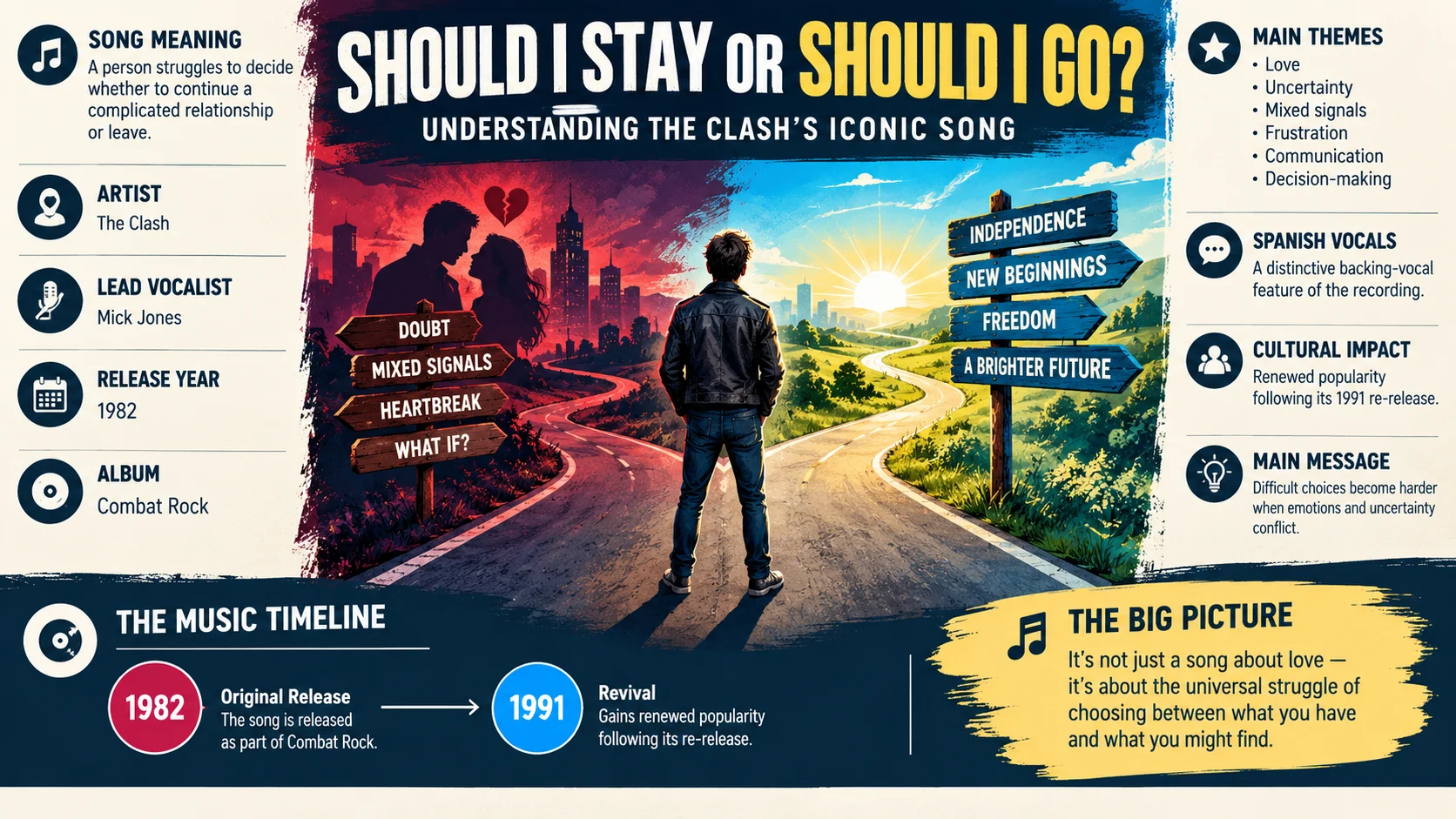
Should I Stay or Should I Go is a popular rock song by the English band The Clash, released in 1982. Its lyrics explore relationship uncertainty, emotional frustration, and the difficult decision to stay with someone or walk away. Sung by Mick Jones, the song captures the confusion of a person who wants a clear answer about where a relationship is heading.
Have you ever felt uncertain about whether to continue a relationship or walk away from someone you love? The Should I Stay or Should I Go lyrics explore this familiar emotional struggle through a catchy rock melody and a direct, unforgettable question. Performed by the English punk rock band The Clash, the song describes someone caught between staying in a complicated relationship and leaving to find peace.
Released in 1982, this track became one of the band’s best-known songs. Its energetic guitar sound, memorable chorus, and Spanish backing vocals helped it stand out among other rock songs of its era. Moreover, its simple but powerful question connects with listeners who have experienced mixed feelings, arguments, or uncertainty in relationships.
Although the song sounds playful and energetic, its message carries emotional tension. The narrator wants clarity from a partner but struggles with the possibility that either decision could create more problems. In this article, you’ll discover the song’s meaning, background, lyrical interpretation, major themes, musical style, and lasting popularity. You’ll also learn why its central question remains relatable to listeners today.
WHAT IS SHOULD I STAY OR SHOULD I GO ABOUT?
| Detail | Information |
|---|---|
| Song Title | Should I Stay or Should I Go |
| Artist | The Clash |
| Original Release | 1982 |
| Album | Combat Rock |
| Lead Vocalist | Mick Jones |
| Genre | Punk Rock and Rock |
| Main Theme | Relationship uncertainty |
| Language | English with Spanish backing vocals |
| Song Mood | Energetic, frustrated, and playful |
| Main Message | Seeking clarity when deciding whether to stay or leave |
WHAT DOES SHOULD I STAY OR SHOULD I GO MEAN?
The phrase should I stay or should I go expresses uncertainty about whether someone should continue a situation or leave it behind. In the song, it represents a person who feels confused about a romantic relationship.
The narrator seems emotionally invested in the relationship. However, the partner’s unpredictable behavior creates frustration and doubt. Sometimes things appear positive, while at other times the relationship becomes difficult.
As a result, the narrator wants a straightforward answer. Should the relationship continue, or would leaving be the better choice?
The question reflects a common emotional conflict. People sometimes remain in relationships because they still care about someone, even when the situation makes them unhappy. On the other hand, leaving can feel equally difficult because it involves uncertainty and possible regret.
Therefore, the song explores more than a simple breakup decision. It highlights the emotional pressure of waiting for someone to communicate clearly.
WHAT ARE THE SHOULD I STAY OR SHOULD I GO LYRICS ABOUT?
The song describes a relationship filled with mixed signals, frustration, and indecision. The narrator appears to be dealing with a partner whose behavior changes from one moment to another.
At first, the narrator wants reassurance and commitment. However, the relationship does not seem stable enough to provide that security.
The central conflict becomes increasingly clear: staying may lead to more emotional difficulties, but leaving could create another set of problems.
This situation creates a feeling of being trapped between two uncomfortable choices.
Rather than presenting a perfect romantic relationship, The Clash explores the confusion that can develop when two people struggle to understand each other.
The song also uses humor and energetic delivery to make an emotionally complicated subject sound entertaining. Consequently, listeners can enjoy the music while recognizing the frustration behind its message.
SHOULD I STAY OR SHOULD I GO LYRICS MEANING EXPLAINED
The song’s message becomes clearer when its major lyrical ideas are examined separately. Although the lyrics use simple language, they communicate several recognizable relationship experiences.
The Need for a Clear Answer
One of the strongest ideas in the song is the narrator’s desire for honesty.
The narrator does not want to continue guessing about the partner’s feelings. Instead, he wants to know whether the other person genuinely wants the relationship to continue.
This situation reflects a common relationship problem: unclear communication.
For example, imagine someone whose partner behaves affectionately one day but becomes distant the next. That person may struggle to understand whether the relationship is healthy or worth continuing.
Similarly, the narrator wants the uncertainty to end.
Mixed Signals and Emotional Confusion
Another important theme is inconsistent behavior.
The relationship seems to move between positive and negative experiences. Consequently, the narrator cannot confidently decide what to do.
Mixed signals can make relationships emotionally exhausting. One person may receive affection and reassurance before experiencing distance, criticism, or rejection.
As a result, even a simple decision can become difficult.
The song captures this emotional back-and-forth through its energetic rhythm and repeated question.
The Fear of Leaving
Leaving a relationship does not always feel like an easy solution.
The narrator understands that walking away could create conflict or emotional consequences. Therefore, the decision becomes more complicated than simply choosing happiness.
People often hesitate to leave because they fear loneliness, regret, arguments, or losing someone important.
Likewise, the song presents leaving as a choice that may bring its own difficulties.
The Frustration of Staying
Staying can also create problems when a relationship lacks stability.
The narrator recognizes that continuing the same situation may increase his frustration. However, he still appears uncertain about whether ending the relationship would be better.
This conflict highlights an important emotional reality: sometimes people know that something is wrong but struggle to decide what to do next.
The Desire to Be Accepted
The song also touches on identity and acceptance.
The narrator seems frustrated by the feeling that his partner does not fully accept him. Even personal choices, such as clothing and self-expression, become part of the disagreement.
Consequently, the song raises a broader question about relationships: should someone change themselves to keep another person happy?
A healthy relationship generally requires mutual respect rather than constant pressure to become someone else.
WHO SANG SHOULD I STAY OR SHOULD I GO?
The song was performed by <escape>The Clash</escape>, an influential English rock band associated with the British punk movement.
Mick Jones sings the lead vocals. His energetic delivery gives the song its recognizable character, while the other band members contribute to its distinctive instrumental sound.
The classic lineup featured:
- Mick Jones: Lead vocals and guitar
- Joe Strummer: Guitar and backing vocals
- Paul Simonon: Bass guitar
- Topper Headon: Drums
The combination of strong guitar work, rhythmic bass, and powerful drumming creates the song’s lively rock sound.
WHEN WAS SHOULD I STAY OR SHOULD I GO RELEASED?
The Clash originally released Should I Stay or Should I Go on September 17, 1982.
The track appeared on the band’s fifth studio album, Combat Rock, released on May 14, 1982. It was issued as a double A-side single alongside another Clash song, Straight to Hell.
Although the track received attention after its original release, it experienced another major wave of popularity in 1991.
A Levi’s television advertisement helped introduce the song to a wider audience. Subsequently, its re-release reached number one on the UK Singles Chart.
This renewed success introduced the song to a new generation of listeners and strengthened its place in popular rock music.
WHY DOES THE SONG INCLUDE SPANISH VOCALS?
One distinctive feature of Should I Stay or Should I Go is its Spanish backing vocals.
The Spanish parts add an unusual musical character to the recording. They also create a playful contrast with Mick Jones’s English lead vocals.
The idea developed during the recording process. Joe Strummer and Joe Ely performed the Spanish backing vocals, with help from a Spanish translation arranged through a friend of the band.
Interestingly, the Spanish wording was not always a direct, word-for-word translation. Instead, the playful approach became part of the song’s distinctive personality.
Therefore, these vocals are more than a decorative musical detail. They help make the recording recognizable and give it an international flavor.
WAS SHOULD I STAY OR SHOULD I GO ABOUT MICK JONES LEAVING THE CLASH?
Some listeners have connected the song’s relationship uncertainty with internal tensions within The Clash.
This interpretation became popular partly because Mick Jones eventually left the band in 1983. Since the song was released shortly before that departure, listeners naturally began searching for a connection.
However, Jones explained in a 1991 interview that the song was not specifically about his departure from The Clash or any particular person.
He described it as an attempt to write a classic, enjoyable rock song.
Therefore, although the lyrics can support several personal interpretations, it is important to distinguish fan theories from the songwriter’s explanation.
The song’s relationship theme remains meaningful without assuming that it directly describes the band’s internal conflicts.
MAJOR THEMES IN SHOULD I STAY OR SHOULD I GO
Several themes make the song relatable even decades after its release.
Love and Uncertainty
The narrator appears to care about the relationship but cannot understand where it is heading. This tension reflects the complicated nature of romantic attachment.
Communication Problems
The song highlights the importance of expressing feelings clearly. Without honest communication, even small disagreements can become significant problems.
Emotional Frustration
The narrator’s repeated request for an answer communicates impatience. However, the lively music makes this frustration sound entertaining rather than entirely sad.
Commitment and Freedom
Staying suggests continuing the relationship, while leaving represents independence and the possibility of a fresh start.
Decision-Making
Ultimately, the song explores how difficult decisions become when every available option seems to carry consequences.
WHY IS SHOULD I STAY OR SHOULD I GO SO POPULAR?
The song remains popular because it combines an uncomplicated question with a memorable musical arrangement.
First, its central theme is universal. Almost everyone has faced a situation where they were unsure whether to continue or walk away.
Moreover, its chorus is catchy and easy to remember. The energetic guitars and rhythmic arrangement make it enjoyable even for people who do not pay close attention to the lyrics.
The Spanish backing vocals also give it a distinctive identity.
Additionally, its use in advertising during the early 1990s helped revive public interest. Later appearances in popular culture introduced the song to younger audiences.
Together, these qualities explain why the track continues to attract listeners across generations.
WHAT GENRE IS SHOULD I STAY OR SHOULD I GO?
The song is generally classified as punk rock and rock.
However, its musical arrangement also features elements of power pop and garage rock.
Its main musical characteristics include:
- Energetic electric guitars
- A strong and repetitive rhythm
- Memorable vocal hooks
- A driving bass line
- Powerful drum patterns
- Playful backing vocals
Unlike some politically focused songs by The Clash, this track places greater emphasis on a personal relationship dilemma.
Nevertheless, it maintains the band’s energetic musical personality.
SHOULD I STAY OR SHOULD I GO: SONG MOOD AND EMOTIONAL TONE
The song combines several emotions rather than expressing only sadness or anger.
| Emotion | How It Appears in the Song |
|---|---|
| Frustration | The narrator wants a definite answer |
| Confusion | The relationship feels unpredictable |
| Humor | The delivery makes the situation playful |
| Confidence | The music sounds bold and energetic |
| Anxiety | The narrator worries about either decision |
| Determination | The narrator wants the uncertainty resolved |
This combination makes the song interesting. Although its subject is emotionally complicated, its musical energy encourages listeners to sing along.
REAL-LIFE SITUATIONS THAT RELATE TO THE SONG
The message of the song can apply to several everyday situations.
Relationship uncertainty: Someone may wonder whether to continue dating a partner when communication becomes difficult.
Career decisions: An employee might struggle to decide whether to remain in an unsatisfying job or pursue another opportunity.
Friendship problems: A person may question whether a friendship is worth maintaining after repeated disagreements.
Moving to another city: Someone might feel uncertain about leaving familiar surroundings for a new opportunity.
Personal growth: A person may need to leave an uncomfortable situation to build a better future.
In each case, the central conflict involves choosing between continuing the current situation and accepting the uncertainty of change.
SHOULD I STAY OR SHOULD I GO VS. OTHER SIMILAR EXPRESSIONS
Several English expressions communicate a similar decision-making conflict.
| Expression | Meaning | Main Context |
|---|---|---|
| Should I stay or should I go? | Whether to continue or leave | Relationships and decisions |
| Do or die | A situation requiring complete commitment | Competition and challenges |
| Make or break | A moment that determines success or failure | Work and opportunities |
| Stay or leave | Choosing between remaining and departing | Everyday situations |
| Sink or swim | Succeed independently or fail | Difficult challenges |
| All or nothing | A situation with no middle ground | Risks and decisions |
Although these expressions share some similarities, they are not always interchangeable.
For example, should I stay or should I go emphasizes uncertainty about a choice, while do or die describes a situation with extremely high stakes.
COMMON MISUNDERSTANDINGS ABOUT THE SONG
Readers sometimes misunderstand the song because its title sounds like a general motivational statement.
Here are some important distinctions.
Misunderstanding: The song is only about breaking up.
Correction: The relationship theme is central, but listeners can also interpret its message more broadly as a struggle with difficult decisions.
Misunderstanding: The song is definitely about Mick Jones leaving The Clash.
Correction: Although fans have discussed this interpretation, Jones explained that it was not specifically about his departure from the band.
Misunderstanding: The Spanish vocals are unrelated to the song.
Correction: They are part of the original recording’s backing-vocal arrangement and contribute to its distinctive sound.
Misunderstanding: The song is entirely sad.
Correction: Its subject involves frustration and uncertainty, but the musical arrangement is lively, catchy, and playful.
Misunderstanding: The title is a direct instruction to leave a relationship.
Correction: The title presents a question rather than giving a definite answer.
HOW TO USE SHOULD I STAY OR SHOULD I GO AS A SOCIAL MEDIA CAPTION
The title has become a recognizable expression for situations involving uncertainty, choices, and mixed feelings.
You can use it as a playful caption when you cannot decide what to do.
Here are some original caption ideas:
- Should I stay or should I go? Decisions, decisions.
- When both choices feel complicated.
- Stuck between holding on and moving forward.
- Sometimes the hardest answer is choosing.
- One question, a thousand thoughts.
- Stay for the memories or leave for the future?
- When your heart and mind disagree.
- Not every decision comes with an easy answer.
These captions capture the song’s central theme without reproducing its copyrighted lyrics.
LESSONS FROM SHOULD I STAY OR SHOULD I GO
Beyond its entertainment value, the song offers several ideas worth considering.
Communication matters: Clear conversations can prevent misunderstandings and unnecessary frustration.
Uncertainty can be exhausting: Constantly guessing another person’s feelings can make a relationship difficult.
Personal identity deserves respect: People should not have to abandon their individuality to receive acceptance.
Every choice has consequences: Staying and leaving can both involve challenges, so decisions require careful thought.
Honesty creates clarity: Sometimes a direct conversation is more useful than repeatedly trying to interpret mixed signals.
The song does not provide a perfect solution to relationship problems. Instead, it captures the emotional experience of facing a difficult choice.
EXERCISES WITH ANSWERS
Test your understanding of the song’s meaning with these questions.
Question: Who originally performed Should I Stay or Should I Go?
Answer: The Clash.
Question: When was the song originally released?
Answer: 1982.
Question: Which band member sings the lead vocals?
Answer: Mick Jones.
Question: Which album features the song?
Answer: Combat Rock.
Question: What is the central theme of the song?
Answer: Relationship uncertainty and the decision to stay or leave.
Question: Why are Spanish backing vocals included?
Answer: They add a distinctive and playful element to the recording.
Question: When did the song reach number one in the UK?
Answer: After its 1991 re-release.
Question: Is the song specifically about Mick Jones leaving The Clash?
Answer: Jones explained that it was not specifically about his departure.
FREQUENTLY ASKED QUESTIONS
What are Should I Stay or Should I Go lyrics about?
The song explores a relationship in which one person feels confused by mixed signals and wants a clear answer about whether to continue or leave.
Who wrote Should I Stay or Should I Go?
The song is credited to The Clash, with Mick Jones serving as its principal musical and lyrical creator.
Who sings Should I Stay or Should I Go?
Mick Jones performs the lead vocals, while other members of The Clash contribute backing vocals and instrumentation.
What album is Should I Stay or Should I Go on?
The song appears on Combat Rock, The Clash’s fifth studio album, released in 1982.
When did Should I Stay or Should I Go come out?
The song was originally released as a single on September 17, 1982.
Why is Should I Stay or Should I Go so famous?
Its catchy chorus, energetic rock arrangement, relatable relationship theme, and renewed popularity following a 1991 advertising campaign helped make it one of The Clash’s best-known songs.
What does the title Should I Stay or Should I Go mean?
It expresses uncertainty about whether someone should remain in a relationship or leave to avoid further emotional difficulties.
Is Should I Stay or Should I Go a breakup song?
It can be interpreted as a relationship or potential breakup song because it explores frustration, mixed feelings, and uncertainty about continuing a romantic connection.
Why does the song have Spanish lyrics?
The recording includes Spanish backing vocals that were added during the studio process. Joe Strummer and Joe Ely performed these parts with help from a Spanish translation.
Did Should I Stay or Should I Go reach number one?
Yes. Following its 1991 re-release, the song reached number one on the UK Singles Chart.
Was Should I Stay or Should I Go written about Mick Jones leaving the band?
Mick Jones explained that the song was not specifically about leaving The Clash. Although listeners have developed different interpretations, the songwriter described it as an attempt to create a classic rock song.
What is the main message of Should I Stay or Should I Go?
The main message concerns the difficulty of making decisions when emotions, uncertainty, and possible consequences pull someone in different directions.
CONCLUSION
The Should I Stay or Should I Go lyrics capture the emotional confusion of someone who cannot decide whether to continue a complicated relationship or walk away. Through its memorable chorus, energetic guitar arrangement, and distinctive Spanish backing vocals, The Clash turned a familiar relationship dilemma into an unforgettable rock song.
Although the track was originally released in 1982, its message remains relatable. People still experience mixed signals, communication problems, emotional uncertainty, and difficult decisions in their personal lives. Furthermore, its 1991 revival helped introduce the song to a wider audience.
Ultimately, the song does not tell listeners whether they should stay or leave. Instead, it highlights the frustration of wanting clarity when neither option feels completely easy. That timeless emotional conflict is one reason the song continues to connect with music fans across generations.