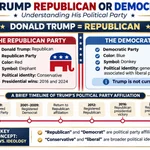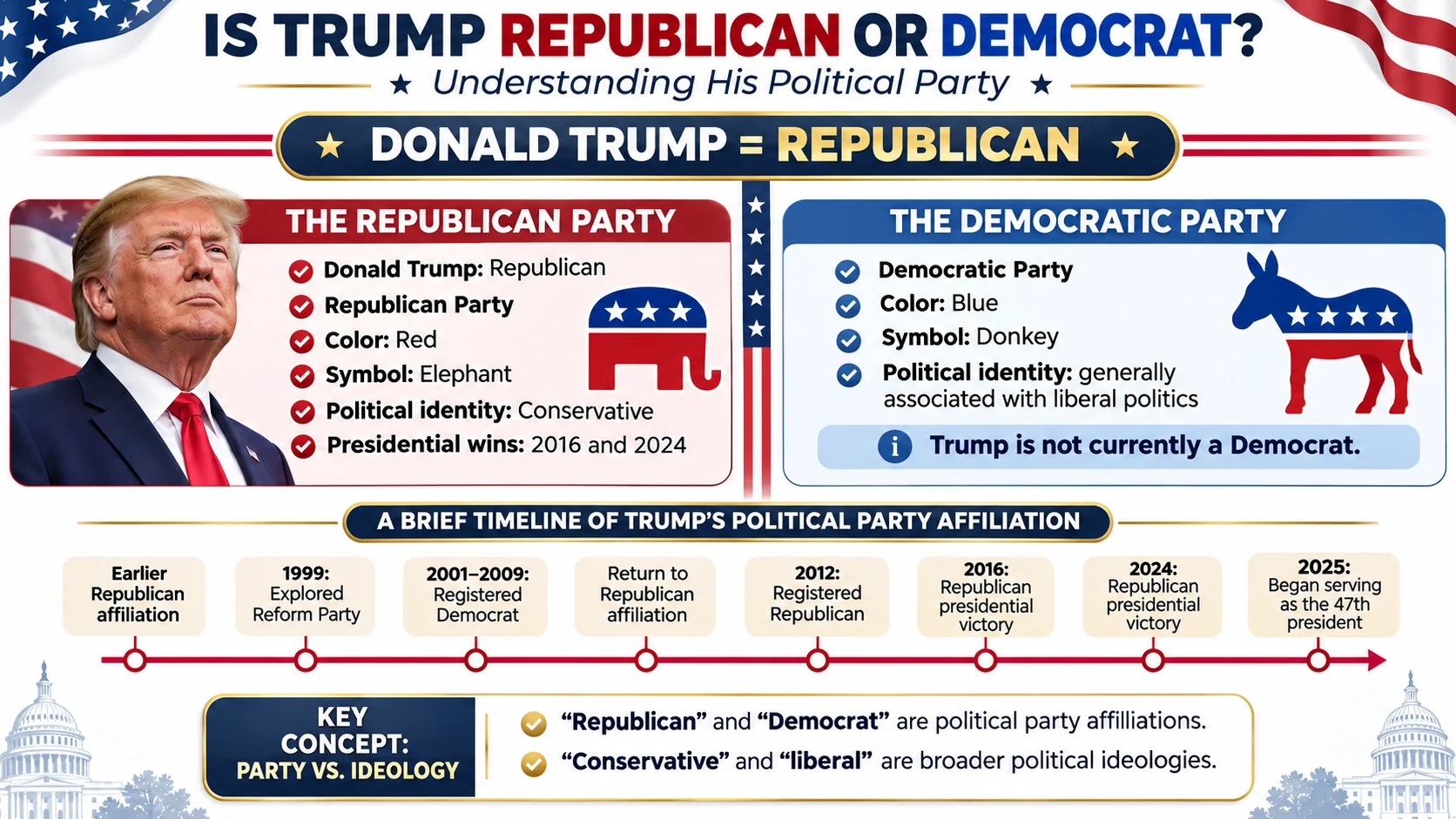
Donald Trump is a Republican, not a Democrat. He is a member of the Republican Party and has served as the 45th and 47th president of the United States. Although he previously identified with the Democratic Party and the Reform Party at different points in his political history, he has been affiliated with the Republican Party since 2012.
Is Trump Republican or Democrat? Donald Trump is a Republican and one of the most influential figures in the modern Republican Party. As the 45th and 47th president of the United States, he has played a major role in shaping American conservative politics, national elections, and public debates. His political identity is closely associated with the Republican Party, which is commonly represented by the color red and the elephant symbol.
However, Trump’s political history is more complicated than simply being a Republican throughout his entire life. Before becoming a major political figure, he expressed interest in different political parties and changed his party registration several times. In fact, he was registered as a Democrat for part of his earlier political life. Eventually, he returned to the Republican Party and became its presidential nominee in 2016.
Understanding his political affiliation helps explain his campaigns, policy positions, and relationship with American voters. Moreover, learning the differences between Republicans and Democrats makes it easier to understand why political parties matter in the United States. In this guide, you’ll discover Trump’s current political party, his previous affiliations, his Republican positions, and how the two major American political parties differ.
What Political Party Does Donald Trump Belong To?
Donald Trump belongs to the Republican Party, one of the two major political parties in the United States.
The Republican Party is also known as the GOP, which stands for Grand Old Party. Its members are commonly called Republicans. The party generally supports conservative policies, although individual Republicans can disagree on particular issues.
Trump became the Republican presidential nominee in 2016. Subsequently, he won the presidential election against Democratic candidate Hillary Clinton and became the 45th president in January 2017.
After losing the 2020 election to Democrat Joe Biden, Trump remained an influential Republican political figure. He later won the Republican nomination again in 2024 and defeated Democratic candidate Kamala Harris.
On January 20, 2025, he began his second presidential term as the 47th president of the United States.
Therefore, the answer to is Trump Republican or Democrat is straightforward: he is a Republican and currently represents the Republican Party in the presidency.
Is Donald Trump a Republican or a Democrat?
Donald Trump is a Republican. However, his political history includes periods of Democratic and Reform Party affiliation.
Although many people associate Trump exclusively with the Republican Party, he did not maintain the same party registration throughout his entire adult life.
His political affiliations changed several times as his public political interests developed. For example, he was registered as a Democrat between 2001 and 2009. He also explored a presidential campaign under the Reform Party in 1999.
Nevertheless, he returned to Republican affiliation and registered as a Republican in 2012.
This history explains why people sometimes become confused about his political identity. However, his presidential campaigns, nominations, and current political position are firmly associated with the Republican Party.
Donald Trump’s Political Party History
Donald Trump’s political journey includes several changes in party affiliation. Understanding these changes provides useful context for his political career.
Early Republican Affiliation
Trump was affiliated with the Republican Party during an earlier period of his life. His political registration changed over the following decades, reflecting his evolving political interests.
Reform Party
In 1999, Trump explored a presidential campaign through the Reform Party.
The Reform Party was established by supporters of independent presidential candidate Ross Perot. It attracted voters interested in challenging the traditional political establishment.
However, Trump eventually withdrew from the potential campaign in 2000.
Democratic Party
From 2001 to 2009, Trump was registered as a Democrat.
During this period, he sometimes expressed support for Democratic political figures and discussed positions that did not always match traditional Republican views.
However, party registration does not necessarily mean that someone agrees with every policy or political position associated with that party.
Return to the Republican Party
Trump returned to Republican affiliation in 2009, although he changed his registration again before registering as a Republican in April 2012.
After that, he became increasingly involved in Republican politics.
In 2015, he officially announced his presidential campaign as a Republican candidate. The following year, he secured the Republican nomination and won the presidency.
His political journey demonstrates that party affiliations can change over time.
Why Is Donald Trump a Republican?
Donald Trump identifies with the Republican Party because his political platform and presidential campaigns have been built around many positions associated with modern Republican politics.
Although Republican voters do not all share identical beliefs, several themes have played important roles in Trump’s political campaigns.
Immigration and Border Security
Immigration has been one of Trump’s most prominent political issues.
He has supported stronger border enforcement, stricter immigration policies, and expanded efforts to control unauthorized immigration.
During his presidential campaigns, he presented border security as an important national priority.
Tax Policy
Trump has supported tax reductions for individuals and businesses.
Republican economic policies often emphasize lower taxes, business investment, and reducing certain government regulations.
Similarly, tax cuts have been a major part of Trump’s economic agenda.
Business and Economic Growth
Trump frequently presents himself as a businessman who understands investment, employment, and economic competition.
His political approach emphasizes American business growth, domestic manufacturing, and policies intended to strengthen the national economy.
Additionally, he has supported tariffs as a tool for influencing international trade.
Conservative Judicial Appointments
Trump has appointed conservative judges to federal courts, including three justices of the U.S. Supreme Court during his first presidential term.
These appointments became an important part of his political legacy.
National Security
Trump has emphasized military strength, border protection, and an America-first approach to foreign policy.
His supporters often view these positions as important parts of his Republican identity.
What Does Republican Mean in American Politics?
A Republican is a member or supporter of the Republican Party, one of the two largest political parties in the United States.
The Republican Party was founded in 1854. Over time, it developed into a major national political organization.
Today, the party is generally associated with conservative political ideas, although its members hold different opinions on economic, social, and foreign policy issues.
Common Republican priorities include:
- Lower taxes and limited government spending.
- Strong national defense.
- Stricter immigration enforcement.
- Support for private businesses and free enterprise.
- Conservative approaches to certain social issues.
- Greater emphasis on state and local government authority.
- Reduced federal regulation in many industries.
However, these are broad political tendencies rather than rules that every Republican follows.
Trump’s political leadership has also influenced the party’s priorities, particularly regarding immigration, trade, nationalism, and executive leadership.
What Does Democrat Mean in American Politics?
A Democrat is a member or supporter of the Democratic Party, the other major political party in the United States.
The Democratic Party generally supports a more active federal government in addressing economic inequality, healthcare access, education, environmental protection, and social welfare.
Common Democratic priorities include:
- Expanding access to affordable healthcare.
- Protecting workers’ rights.
- Supporting environmental regulations.
- Investing in public education.
- Increasing taxes on some high-income individuals and corporations.
- Protecting civil rights and voting access.
- Supporting certain government-funded social programs.
Nevertheless, Democrats do not all agree on every issue. The party includes moderates, progressives, liberals, and other political viewpoints.
Republican vs. Democrat: What Is the Difference?
Republicans and Democrats are the two major political parties in the United States. Although both participate in elections and democratic government, they often support different approaches to public policy.
| Comparison | Republicans | Democrats |
|---|---|---|
| Common political orientation | Conservative | Liberal or center-left |
| Party color | Red | Blue |
| Party symbol | Elephant | Donkey |
| Tax policy | Generally favor lower taxes | Often support higher taxes on some high-income groups |
| Government role | Generally favor a more limited federal role | Generally support a more active federal role |
| Healthcare | Often favor market-based approaches | Often support greater government involvement |
| Immigration | Generally emphasize stronger border enforcement | Often emphasize a combination of enforcement and immigration reform |
| Environmental policy | Often prioritize energy production and regulatory flexibility | Often prioritize climate action and environmental regulation |
| Business policy | Generally favor deregulation and lower business taxes | Often support stronger worker and consumer protections |
| Social policy | Generally more conservative | Generally more progressive |
These descriptions represent broad tendencies, not universal positions. Both parties contain different viewpoints, and their policies can change over time.
Is Trump a Conservative Republican?
Yes. Trump is generally identified as a conservative Republican, although his political approach does not fit every traditional conservative position.
For example, he has promoted conservative judicial appointments, stricter immigration enforcement, and tax reductions.
At the same time, his support for tariffs and certain government interventions in trade differs from the traditional free-trade positions held by some Republicans.
His political movement is frequently described as Trumpism or the America First movement.
This approach emphasizes national sovereignty, immigration control, economic nationalism, stronger border security, and a more assertive approach to international relations.
Consequently, Trump has influenced the direction and public identity of the Republican Party.
What Is the Difference Between Trump and Traditional Republicans?
Although Trump is a Republican, not every Republican agrees with his political approach.
The Republican Party includes different groups, ranging from traditional conservatives to libertarian-leaning voters and supporters of Trump’s political movement.
Here are some important differences.
Trade and Tariffs
Traditional free-market Republicans have often supported international trade agreements and lower trade barriers.
However, Trump has strongly promoted tariffs to protect American industries and influence international trade relationships.
Political Leadership
Traditional Republican leaders have often emphasized established party institutions and conventional political practices.
In contrast, Trump’s political style is more personal, populist, and confrontational.
Foreign Policy
Some traditional Republicans have supported a strong international leadership role for the United States through long-standing alliances.
Trump has often emphasized an America First approach and questioned whether certain international commitments provide sufficient benefits to the United States.
Party Identity
Trump has reshaped the Republican Party’s political messaging and priorities.
As a result, his supporters often identify strongly with his leadership, while other Republicans prefer a more traditional conservative approach.
Is Trump the President of the Republican Party?
No. Trump is not officially the president of the Republican Party as an organization.
He is the president of the United States and a prominent leader within the Republican Party.
The Republican National Committee (RNC) is the party’s national governing organization. It manages important party activities, including national conventions, fundraising, and election-related operations.
Although Trump has enormous influence over Republican politics, the presidency of the United States and the leadership of the Republican National Committee are different positions.
Therefore, calling Trump the Republican president is accurate, but describing him as the official president of the Republican Party is not.
What Is Trump’s Political Symbol and Color?
The Republican Party is commonly represented by a red color and an elephant symbol.
Trump is strongly associated with both because he represents the Republican Party.
Republican Color: Red
Red is widely used to represent Republican candidates, states, and election results in American political maps.
For example, a state that votes Republican in a presidential election is commonly called a red state.
Republican Symbol: Elephant
The elephant is the traditional symbol of the Republican Party.
It became associated with the party through political cartoons created by Thomas Nast in the nineteenth century.
Similarly, the Democratic Party is represented by a donkey and the color blue.
Did Trump Run for President as a Democrat?
No. Trump did not run in a U.S. presidential general election as the Democratic Party’s presidential nominee.
Although he was registered as a Democrat from 2001 to 2009, his successful presidential campaigns were conducted as a Republican.
In 2016, he won the Republican nomination and defeated Hillary Clinton.
Likewise, in 2024, he secured the Republican nomination and defeated Kamala Harris.
This distinction is important because political registration, party nomination, and election candidacy are related but different concepts.
Was Trump Always a Republican?
No. Donald Trump was not always a Republican.
His party registration changed several times during his political history.
He was affiliated with the Republican Party during certain earlier periods, explored the Reform Party in 1999, registered as a Democrat from 2001 to 2009, and later returned to Republican affiliation.
In April 2012, he registered as a Republican.
Since then, his major presidential campaigns and political leadership have been associated with the Republican Party.
Therefore, although his political history includes different affiliations, his current political identity is Republican.
Why Do People Ask Whether Trump Is Republican or Democrat?
Several reasons explain why this question is common among American and international readers.
His Previous Democratic Registration
Many people know that Trump was once registered as a Democrat. This creates confusion about his present political affiliation.
His Changing Political Views
Trump has expressed different opinions on economic, social, and international issues over the years.
Consequently, people sometimes compare his earlier statements with his current political positions.
His Influence on American Politics
Trump is one of the most recognizable figures in modern American politics.
His statements, campaigns, and policies regularly generate discussions about the Republican and Democratic parties.
Confusion About American Political Parties
People outside the United States may not fully understand the differences between Republicans and Democrats.
Therefore, learning Trump’s political affiliation also provides a useful introduction to the American political system.
Examples of How to Use Republican and Democrat in Sentences
Here are some simple examples to help readers understand these political terms.
- Donald Trump is a Republican politician.
- Joe Biden is a member of the Democratic Party.
- Republicans and Democrats often disagree about government policies.
- Trump won the 2016 presidential election as a Republican.
- The Republican Party is commonly represented by the color red.
- The Democratic Party is commonly represented by the color blue.
- Some American voters support Republicans, while others prefer Democrats.
- Trump became the Republican presidential nominee in 2016 and 2024.
- American elections often receive significant attention from both political parties.
- A person’s political affiliation can change over time.
Common Mistakes About Trump’s Political Affiliation
Several misunderstandings can lead to incorrect statements about Trump’s political identity.
Mistake: Trump Is a Democrat
Correction: Trump is currently a Republican. Although he was registered as a Democrat for part of his earlier political life, he returned to Republican affiliation.
Mistake: Trump Has Always Been a Republican
Correction: His political registration changed several times. His history includes Republican, Reform Party, Democratic, and independent affiliations.
Mistake: Every Republican Supports Trump
Correction: Not all Republicans agree with Trump. Some support his leadership, while others disagree with his policies or political approach.
Mistake: Republicans and Democrats Have Exactly the Same Beliefs
Correction: Both parties contain diverse viewpoints. However, they generally differ in their approaches to taxes, government spending, healthcare, immigration, and social policy.
Mistake: Republican and Conservative Always Mean the Same Thing
Correction: Republican refers to membership or support for a political party, while conservative describes a political ideology. Although many Republicans are conservative, the terms are not interchangeable.
Why Understanding Trump’s Party Matters
Knowing whether Trump is Republican or Democrat helps readers understand American political discussions.
For example, party affiliation provides context for presidential elections, congressional debates, policy decisions, and political campaigns.
Furthermore, understanding the Republican and Democratic parties makes it easier to follow news about American government.
Trump’s political history also demonstrates that a politician’s party registration can change over time. Therefore, it is useful to distinguish between someone’s past affiliations and their current political identity.
Frequently Asked Questions
Is Donald Trump Republican or Democrat?
Donald Trump is a Republican. He belongs to the Republican Party and has served as its presidential nominee in 2016 and 2024.
Is Trump a Republican president?
Yes. Trump is a Republican president and represents the Republican Party in the White House.
Was Donald Trump ever a Democrat?
Yes. Trump was registered as a Democrat from 2001 to 2009. However, he later returned to Republican affiliation.
When did Trump become a Republican again?
Trump returned to Republican affiliation in 2009 and registered as a Republican in April 2012.
Did Trump run for president as a Democrat?
No. His successful presidential campaigns in 2016 and 2024 were conducted as a Republican.
Is Trump a conservative?
Yes. Trump is generally described as a conservative Republican, although some of his economic and political positions differ from traditional conservative approaches.
What political party is Donald Trump in 2026?
As of November 2026, Donald Trump belongs to the Republican Party and serves as the 47th president of the United States.
Is the Republican Party red or blue?
The Republican Party is represented by red. In contrast, the Democratic Party is represented by blue.
What is the Republican Party’s symbol?
The elephant is the traditional symbol of the Republican Party. The Democratic Party is commonly represented by a donkey.
Who was Trump’s opponent in the 2024 election?
Kamala Harris was Trump’s Democratic opponent in the 2024 presidential election. Trump won the election and began his second presidential term in January 2025.
Is Trump the leader of the Republican Party?
Trump is a highly influential Republican leader, but he is not the official president of the Republican National Committee. He serves as president of the United States.
Can someone change from Democrat to Republican?
Yes. American citizens can change their political party registration according to their state’s election rules. Trump’s political history provides an example of changing party affiliation.
Key Takeaways
- Donald Trump is a Republican, not a Democrat.
- He is the 47th president of the United States.
- He previously served as the 45th president from 2017 to 2021.
- His political history includes Democratic and Reform Party affiliations.
- He registered as a Republican in April 2012.
- He won the Republican presidential nomination in 2016 and 2024.
- The Republican Party is commonly represented by red and an elephant.
- The Democratic Party is commonly represented by blue and a donkey.
- Not every Republican agrees with Trump’s political views.
- Republican and Democrat describe political parties, while conservative and liberal describe broader political ideologies.
Conclusion
So, is Trump Republican or Democrat? The answer is Republican. Donald Trump belongs to the Republican Party and has become one of its most influential political figures. He won the presidency in 2016 and returned to the White House in 2025 after winning the 2024 election.
However, his political journey includes several changes in party affiliation. He was previously registered as a Democrat and explored the Reform Party before returning to Republican politics. Therefore, his past affiliations should not be confused with his current political identity.
Ultimately, understanding Trump’s party affiliation also helps explain the differences between Republicans and Democrats in American politics. Although both parties influence the country’s government and elections, they often approach important political issues differently.