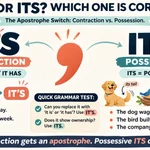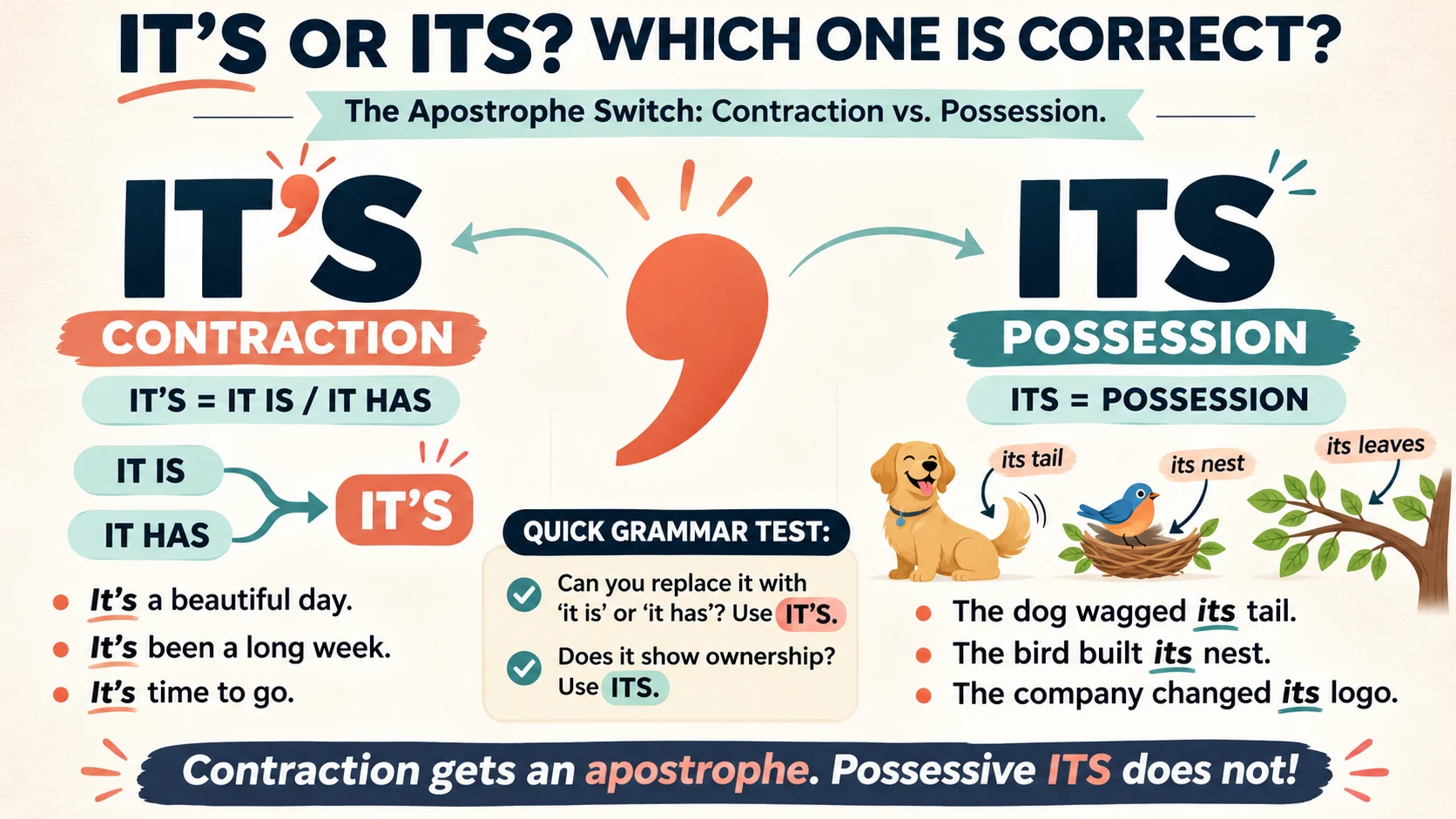
It’s and its are two English words with different meanings and uses. It’s is a contraction of “it is” or “it has,” while its is a possessive pronoun that shows ownership. For example, “It’s raining outside” uses a contraction, whereas “The dog wagged its tail” uses a possessive pronoun. Remember, if you can replace the word with “it is” or “it has,” use it’s; otherwise, its is usually correct.
Have you ever stopped while writing an email, text message, or social media post because you weren’t sure whether to use it’s or its? You’re not alone. These two words confuse many English speakers because they sound exactly alike, yet their meanings and grammatical functions are different. Even experienced writers sometimes mix them up.
The main difference is simple: it’s is a shortened form of “it is” or “it has,” whereas its shows possession or ownership. However, the apostrophe makes a significant difference in meaning. For instance, “It’s a beautiful day” means “It is a beautiful day,” while “The bird spread its wings” shows that the wings belong to the bird.
Understanding this small grammar rule can make your writing clearer and more professional. Moreover, using the correct form helps you avoid common spelling mistakes in school assignments, workplace communication, blog posts, and everyday conversations.
In this guide, you’ll learn the meanings of both words, their grammatical differences, simple rules, real-life examples, common mistakes, and practical exercises to help you remember when to use it’s and its correctly.
What Does It’s Mean?
It’s is a contraction that combines the pronoun “it” with either “is” or “has.” The apostrophe replaces the missing letters, making the expression shorter and easier to use.
Writers commonly use it’s in everyday conversations, informal writing, emails, messages, and even professional communication when a conversational tone is appropriate.
There are two main meanings of this contraction.
It’s Meaning “It Is”
The most common use of it’s is as a shortened form of “it is.”
For example:
- It’s a beautiful morning. (It is a beautiful morning.)
- It’s getting colder outside. (It is getting colder outside.)
- It’s difficult to understand this lesson. (It is difficult to understand this lesson.)
- It’s my favorite movie. (It is my favorite movie.)
- It’s important to practice every day. (It is important to practice every day.)
In each example, you can replace “it’s” with “it is” without changing the basic meaning of the sentence.
It’s Meaning “It Has”
The word it’s can also represent “it has.” This usage commonly appears in sentences involving the present perfect tense.
For example:
- It’s been a long day. (It has been a long day.)
- It’s already started raining. (It has already started raining.)
- It’s been three years since we met. (It has been three years since we met.)
- It’s changed significantly over time. (It has changed significantly over time.)
- It’s become more popular recently. (It has become more popular recently.)
Therefore, whenever it’s means “it has,” the apostrophe is still necessary.
However, remember that “it has” is not always interchangeable with “it’s” in every grammatical structure. For example, “It has a red cover” is normally not shortened to “It’s a red cover.”
What Does Its Mean?
Its is a possessive pronoun that shows ownership, association, or belonging. It tells readers that something belongs to or is connected with an animal, object, organization, place, or other thing represented by “it.”
Unlike it’s, the possessive form does not contain an apostrophe.
For example:
- The dog wagged its tail.
- The company changed its policy.
- The tree lost its leaves.
- The smartphone has its own unique features.
- The school updated its schedule.
In these sentences, “its” indicates a relationship between something and the object or feature associated with it.
Its as a Possessive Pronoun
Possessive pronouns indicate ownership or possession. Words such as “his,” “hers,” “ours,” and “theirs” work in similar ways.
For instance:
- The cat cleaned its paws.
- The country celebrated its independence.
- The restaurant changed its menu.
- The computer lost its connection.
- The flower opened its petals.
Notice that none of these examples needs an apostrophe because the word already functions as a possessive pronoun.
It’s vs Its: What Is the Difference?
The biggest difference between it’s and its is their grammatical purpose.
It’s is a contraction of “it is” or “it has,” while its is a possessive pronoun that indicates ownership.
Although they sound identical, their spelling and meanings are different.
| Comparison | It’s | Its |
|---|---|---|
| Meaning | It is or it has | Belonging to it |
| Grammar | Contraction | Possessive pronoun |
| Apostrophe | Yes | No |
| Purpose | Shortens two words | Shows possession |
| Example | It’s raining. | The dog lost its toy. |
| Replacement | It is / It has | Belonging to it |
For example, consider these two sentences:
- It’s a beautiful house.
- The house has its own garden.
The first sentence uses it’s because it means “it is.” Meanwhile, the second uses its because the garden belongs to the house.
Consequently, the apostrophe is not a decorative mark. It changes the grammatical meaning of the word.
Simple Rules for Using It’s and Its
Learning a few straightforward rules can help you choose the correct word without hesitation.
Use It’s When You Mean It Is
Whenever the sentence makes sense with “it is,” use it’s.
Examples:
- It’s too late to leave.
- It’s a wonderful opportunity.
- It’s raining heavily today.
- It’s not my responsibility.
Use It’s When You Mean It Has
Similarly, use it’s when the intended meaning is “it has.”
Examples:
- It’s been a difficult week.
- It’s already happened.
- It’s taken several hours.
- It’s become a popular destination.
Use Its to Show Ownership
When you want to show that something belongs to or is associated with an object, animal, organization, or place, use its.
Examples:
- The bird built its nest.
- The company announced its results.
- The car needs its tires replaced.
- The restaurant is famous for its desserts.
Avoid Adding an Apostrophe to Possessive Its
One of the most common mistakes is writing “it’s” when the sentence requires the possessive form.
Incorrect: The dog chased it’s tail.
Correct: The dog chased its tail.
The tail belongs to the dog, so the sentence needs the possessive pronoun its.
How to Remember the Difference Between It’s and Its
If you frequently confuse these words, try the following simple techniques.
The It Is Test
Replace it’s with “it is.” If the sentence still makes sense, the contraction is correct.
Example:
“It’s a sunny day.”
Replacement:
“It is a sunny day.”
The sentence makes sense, so it’s is correct.
The It Has Test
You can also replace it’s with “it has.”
Example:
“It’s been an amazing experience.”
Replacement:
“It has been an amazing experience.”
Because the replacement works, the apostrophe is correct.
The Ownership Test
If you are describing something that belongs to an animal, object, or organization, use its.
Example:
“The company changed its logo.”
The logo belongs to the company. Therefore, its is correct.
Remember Other Possessive Pronouns
Think about words such as “his,” “hers,” “ours,” and “theirs.”
These possessive pronouns do not need apostrophes. Likewise, its does not need one.
Examples of It’s in Sentences
Here are natural examples showing how to use it’s correctly in different situations.
Everyday Conversation
- It’s getting late, so we should go home.
- It’s a lovely day for a walk.
- It’s not as difficult as it looks.
- It’s time to prepare dinner.
- It’s always nice to see you.
School and Education
- It’s important to complete your homework.
- It’s easier to learn with regular practice.
- It’s a challenging subject.
- It’s necessary to review the lesson.
- It’s been a productive school year.
Workplace and Business
- It’s time to discuss the new project.
- It’s important to meet the deadline.
- It’s been a successful quarter.
- It’s a great opportunity for our team.
- It’s already included in the report.
Social Media and Texting
- It’s finally Friday!
- It’s giving summer vibes.
- It’s my favorite trend right now.
- It’s been a chaotic week.
- It’s so good to be back!
Examples of Its in Sentences
The following examples demonstrate how its indicates possession or association.
Animals and Nature
- The dog followed its owner.
- The cat stretched its legs.
- The bird returned to its nest.
- The tree dropped its leaves.
- The flower opened its petals.
Technology
- The phone lost its signal.
- The laptop needs its battery replaced.
- The application updated its features.
- The computer restarted its operating system.
- The website changed its design.
Business and Organizations
- The company announced its expansion plans.
- The organization revised its guidelines.
- The restaurant updated its menu.
- The brand introduced its latest collection.
- The university changed its admission policy.
Everyday Situations
- The house has its own parking space.
- The car needs its engine checked.
- The book has its original cover.
- The city is famous for its historic buildings.
- The school celebrated its anniversary.
It’s or Its: Common Grammar Mistakes
Even though the difference is straightforward, several mistakes frequently appear in everyday writing.
Using It’s to Show Possession
Incorrect: The company changed it’s name.
Correct: The company changed its name.
Why? The name belongs to the company. Therefore, the possessive pronoun its is necessary.
Using Its Instead of It Is
Incorrect: Its going to rain tomorrow.
Correct: It’s going to rain tomorrow.
Why? The intended meaning is “It is going to rain tomorrow.” Thus, the contraction needs an apostrophe.
Using Its Instead of It Has
Incorrect: Its been a wonderful experience.
Correct: It’s been a wonderful experience.
Why? The sentence means “It has been a wonderful experience.”
Adding an Apostrophe to Its for Ownership
Incorrect: The bird spread it’s wings.
Correct: The bird spread its wings.
Why? The wings belong to the bird, so the possessive form is required.
Confusing It’s With Other Possessive Words
Some writers assume that every possessive word needs an apostrophe. However, this is not true.
For example, “his,” “hers,” “ours,” and “theirs” do not use apostrophes. Similarly, its shows possession without an apostrophe.
Why Does Its Have No Apostrophe?
This question confuses many English learners because most possessive nouns use apostrophes.
For example:
- The girl’s bag.
- The dog’s collar.
- The teacher’s desk.
These examples use apostrophes to show possession. However, possessive pronouns follow a different grammatical pattern.
Words such as “his,” “hers,” “ours,” and “theirs” do not use apostrophes. Likewise, its is already a possessive form, so adding an apostrophe would be incorrect.
Compare:
- The dog’s toy.
- Its toy.
Both examples show ownership, but they use different grammatical structures.
Therefore, remember that possessive nouns and possessive pronouns do not always follow the same spelling rules.
Can It’s and Its Be Used in the Same Sentence?
Yes! Both words can appear in the same sentence because they perform different grammatical functions.
For example:
- It’s important to protect the environment because of its impact on human life.
- It’s a beautiful city known for its historic architecture.
- It’s amazing how the company maintains its reputation.
- It’s a smart device with its own operating system.
- It’s difficult to understand the machine without reading its instructions.
In these sentences, it’s introduces “it is,” while its indicates possession or association.
Using both forms correctly can make your writing more precise and grammatically accurate.
Is It’s or Its More Common?
Both words are common in everyday English, but their frequency depends on the context.
It’s frequently appears in conversations, informal writing, social media, and sentences using “it is” or “it has.”
On the other hand, its appears whenever writers need to indicate possession or association.
Neither form is more correct than the other. The right choice depends entirely on the meaning of your sentence.
Advantages and Disadvantages of Using Contractions
Contractions such as it’s make English communication more natural and conversational. However, they may not always suit every writing situation.
Advantages
- Natural communication: Contractions make everyday conversations sound more relaxed.
- Concise writing: They reduce the number of words in a sentence.
- Better readability: Informal writing often feels smoother with contractions.
- Common usage: Native English speakers regularly use contractions in speech and writing.
Disadvantages
- Formal restrictions: Some academic or professional writing styles prefer full forms.
- Possible confusion: Readers may confuse contractions with possessive forms.
- Grammar mistakes: Incorrect apostrophe placement can change the intended meaning.
Nevertheless, contractions are perfectly acceptable in many professional and academic contexts when the required style permits them.
Related Comparisons: It’s vs Other Confusing Words
English contains several word pairs that sound similar or have closely related meanings. Understanding their differences can improve your grammar.
Its vs Their
Its indicates possession by one thing or entity, while their indicates possession by multiple people or entities or by someone whose gender is unspecified.
Examples:
- The dog wagged its tail.
- The students submitted their assignments.
It’s vs Its’
It’s is the correct contraction of “it is” or “it has.” Meanwhile, “its'” is not a standard English possessive form.
For example:
Correct: The company changed its policy.
Incorrect: The company changed its’ policy.
Your vs You’re
Your shows possession, while you’re means “you are.”
Examples:
- Your phone is ringing.
- You’re going to enjoy this movie.
They’re vs Their vs There
These three words sound alike but have different meanings.
- They’re: A contraction of “they are.”
- Their: A possessive pronoun.
- There: Refers to a place or introduces a statement.
Examples:
- They’re coming home.
- Their house is beautiful.
- Put the bag over there.
Whose vs Who’s
Whose indicates possession, whereas who’s means “who is” or “who has.”
Examples:
- Whose book is this?
- Who’s coming to the party?
When Should You Avoid Using It’s?
Although it’s is grammatically correct in many situations, certain writing styles may prefer the complete forms “it is” and “it has.”
For example, formal academic papers, legal documents, and some professional reports may require fewer contractions.
However, this depends on the publication’s style guide. Many modern professional publications accept contractions because they create a more approachable tone.
On the other hand, you should never replace its with “it’s” simply because the latter looks more familiar.
Always choose the form that matches your intended meaning.
Practice Exercises: It’s or Its
Test your understanding by selecting the correct word in each sentence.
Fill in the Blanks
Choose it’s or its to complete each sentence.
- The dog wagged _____ tail happily.
- _____ going to be a wonderful evening.
- The company announced _____ new policy.
- _____ been a long time since we met.
- The bird returned to _____ nest.
- _____ important to get enough sleep.
- The restaurant changed _____ menu.
- _____ already started raining.
- The computer lost _____ internet connection.
- _____ difficult to solve this problem.
- The country celebrated _____ independence day.
- _____ been an unforgettable experience.
- The cat cleaned _____ paws.
- _____ time to leave for school.
- The website updated _____ homepage.
Answers and Explanations
- Its — The tail belongs to the dog.
- It’s — It means “It is going to be.”
- Its — The policy belongs to the company.
- It’s — It means “It has been.”
- Its — The nest belongs to the bird.
- It’s — It means “It is important.”
- Its — The menu belongs to the restaurant.
- It’s — It means “It has already started.”
- Its — The connection belongs to the computer.
- It’s — It means “It is difficult.”
- Its — The independence day is associated with the country.
- It’s — It means “It has been.”
- Its — The paws belong to the cat.
- It’s — It means “It is time.”
- Its — The homepage belongs to the website.
Frequently Asked Questions
Which Is Correct: It’s or Its?
Both it’s and its are correct English words, but they have different meanings. Use it’s as a contraction of “it is” or “it has.” In contrast, use its to show possession or association.
What Is the Difference Between It’s and Its?
The difference is grammatical. It’s is a contraction, while its is a possessive pronoun. For example, “It’s cold outside” means “It is cold outside,” whereas “The dog lost its ball” shows ownership.
Does Its Need an Apostrophe?
No, its does not need an apostrophe when showing possession. It already functions as a possessive pronoun. Therefore, “The cat licked its paw” is correct.
When Should I Use It’s?
Use it’s when you mean “it is” or “it has.” For example, “It’s a beautiful day” means “It is a beautiful day.” Similarly, “It’s been a busy week” means “It has been a busy week.”
When Should I Use Its?
Use its when something belongs to or is associated with an animal, object, place, or organization. For example, “The company updated its website” shows that the website belongs to the company.
Why Is It’s Possessive Sometimes Written Without an Apostrophe?
Actually, it’s is not the possessive form. The word its shows possession without an apostrophe. This follows the same pattern as other possessive pronouns, including “his,” “hers,” and “theirs.”
Is Its a Real Word?
Yes, its is a standard English possessive pronoun. It indicates that something belongs to or is associated with something else.
Can I Use It’s in Formal Writing?
Yes, although some academic, legal, and professional writing styles prefer “it is” or “it has.” Always follow the specific style guide or instructions for your document.
Is It’s Short for It Has?
Yes. It’s can mean “it has” in sentences such as “It’s been a great experience.” However, it can also mean “it is,” depending on the sentence.
What Is the Easiest Way to Remember It’s and Its?
Use the replacement test. If you can replace the word with “it is” or “it has,” write it’s. If the sentence shows ownership, write its.
Key Takeaways
Understanding it’s or its becomes easy when you remember their different grammatical functions.
Here are the most important points:
- It’s means “it is” or “it has.”
- Its is a possessive pronoun.
- It’s always contains an apostrophe.
- Its never needs an apostrophe when showing possession.
- Use the replacement test to identify the correct form.
- Both words sound alike but have different meanings.
- You can use both words in the same sentence when the context requires them.
Ultimately, the best way to master this grammar rule is through regular reading and writing practice. Once you understand the difference, choosing the correct word will become much easier.
Conclusion
The difference between it’s and its may seem small, but using the correct form makes a big difference in clear and professional writing. Remember, it’s is a contraction of “it is” or “it has,” while its indicates ownership or association.
Whenever you feel confused, try replacing it’s with “it is” or “it has.” If the sentence makes sense, the apostrophe belongs there. Otherwise, if you’re showing possession, use its without an apostrophe.
Although these words sound identical, their grammatical purposes are easy to distinguish with a little practice. Keep these simple rules in mind, and you’ll avoid one of the most common mistakes in English grammar.