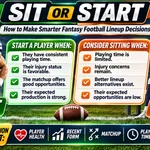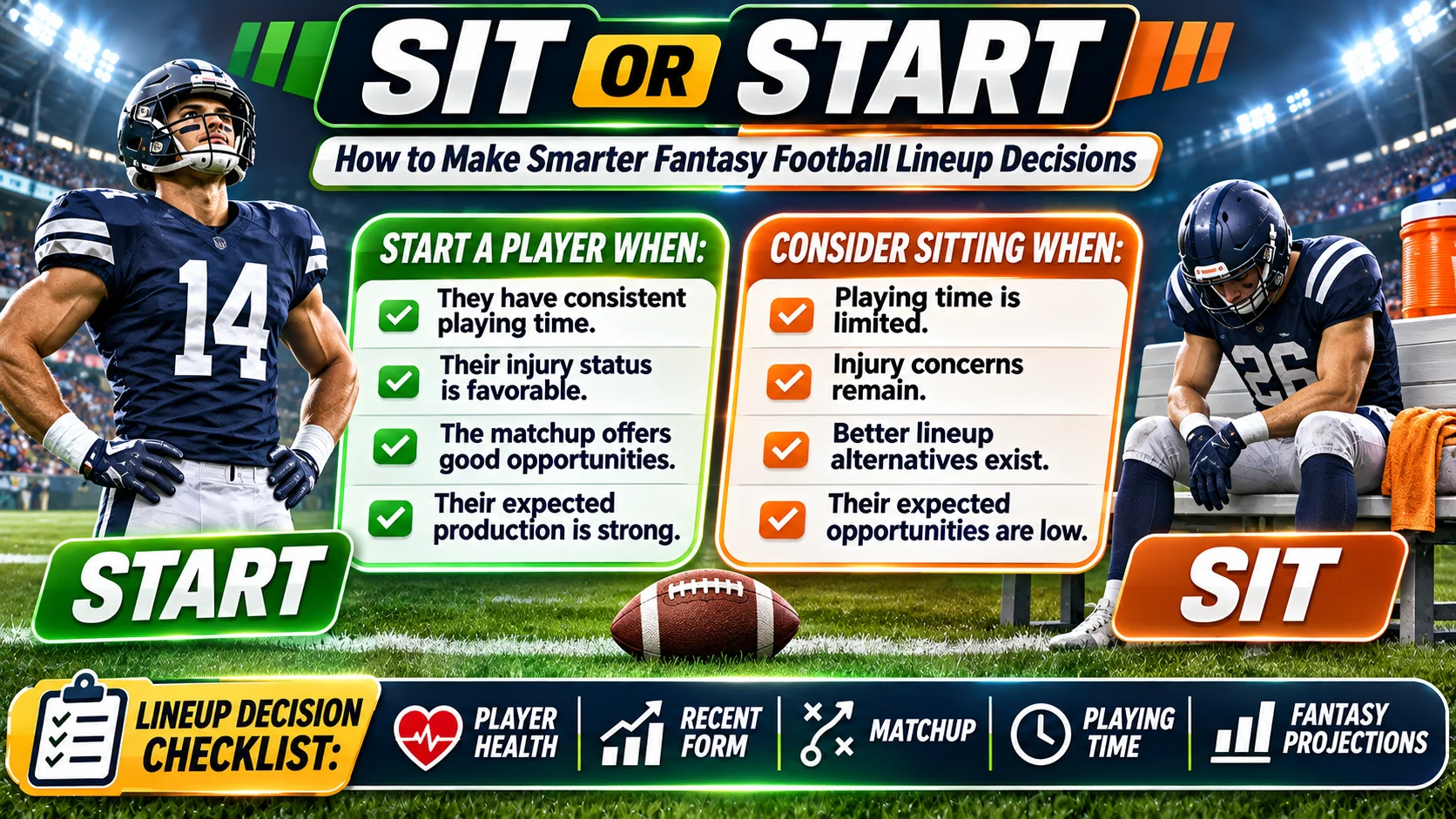
Sit or start refers to the decision of whether to place a player in your active fantasy football lineup or leave them on the bench for a particular game week. Starting a player allows their performance to contribute to your fantasy score, while sitting them generally means their points do not count toward your weekly total. Managers consider matchups, injuries, playing time, and recent performance before deciding.
Ever found yourself wondering whether to sit or start a player before an important fantasy football matchup? You’re not alone. Every week, fantasy football managers face difficult lineup choices that can influence their chances of winning. Although choosing the strongest player might seem simple, injuries, defensive matchups, playing time, and unexpected performances can make the decision surprisingly complicated.
In fantasy football, selecting the right starters is just as important as drafting talented players. For example, a highly rated wide receiver might struggle against an elite defense, while a less popular player could deliver excellent results against a weaker opponent. Therefore, understanding how lineup decisions work can help managers evaluate their options more confidently.
Moreover, fantasy football involves more than simply following player rankings. Successful lineup management requires attention to recent performance, team strategies, injury updates, and league scoring settings. Consequently, learning how to compare players can reduce avoidable mistakes throughout the season.
In this guide, you’ll discover what sit or start means, how fantasy football lineup decisions work, which factors matter most, and what common mistakes to avoid. Additionally, you’ll explore practical examples, useful tools, and frequently asked questions to help you make more informed choices.
What Does Sit or Start Mean?
The expression sit or start is commonly used in fantasy football to describe a choice between placing a player in the starting lineup or keeping that player on the bench.
Although the more traditional wording is “start or sit,” both expressions communicate the same basic idea.
When you start a player, their eligible statistics contribute to your fantasy team’s score. Conversely, when you sit a player, their performance usually does not contribute to that week’s score.
For example, imagine that your fantasy roster includes two quarterbacks:
- Quarterback A has a favorable matchup against a struggling defense.
- Quarterback B faces a strong defensive team and has recently struggled.
If your league allows only one starting quarterback, you must decide which player offers the better opportunity to earn points.
Therefore, you might start Quarterback A and leave Quarterback B on the bench.
However, the decision isn’t always straightforward. A talented player can perform well against a difficult opponent, while a favorable matchup does not guarantee success.
Sit vs. Start: What’s the Difference?
Understanding the difference between sitting and starting a player is essential for beginners.
| Feature | Start | Sit |
|---|---|---|
| Meaning | Place a player in the active lineup | Keep a player on the bench |
| Fantasy points | Count toward the weekly score | Usually do not count |
| Main purpose | Use the player’s expected production | Reserve the player for another week |
| Important factors | Matchup, health, opportunity | Risk, alternatives, limited playing time |
| Example | Starting a healthy running back | Benching an injured or limited receiver |
The distinction may appear simple. Nevertheless, choosing correctly can significantly influence weekly results.
How Does Sit or Start Work in Fantasy Football?
Fantasy football managers build rosters consisting of real NFL players. Each week, they select eligible starters according to their league’s lineup requirements.
These players earn fantasy points based on real-game statistics, such as passing yards, rushing touchdowns, receptions, and other scoring categories.
Meanwhile, bench players remain part of the roster but generally do not contribute points to the weekly matchup.
Understanding Starting Positions
Most traditional fantasy football leagues include several common positions:
- Quarterback (QB): Earns points through passing, rushing, and touchdowns.
- Running Back (RB): Earns points through rushing yards, receptions, and touchdowns.
- Wide Receiver (WR): Earns points primarily through catches, receiving yards, and touchdowns.
- Tight End (TE): Contributes through receiving statistics and touchdowns.
- Flex Position: Usually allows an eligible running back, wide receiver, or tight end.
- Kicker (K): Earns points through field goals and extra points.
- Defense/Special Teams (D/ST): Earns points through defensive and special teams performance.
However, lineup structures vary by league. Some formats include superflex positions, additional receivers, or different scoring rules.
Therefore, checking your league settings is essential before making weekly decisions.
Understanding the Bench
The bench allows managers to keep additional players without placing them in the active lineup.
For example, you might bench a running back who has a difficult matchup while starting another player with a stronger opportunity.
Similarly, injured players, players on bye weeks, and uncertain starters may remain on the bench.
However, benching a player does not mean removing them from your fantasy roster.
Why Are Start or Sit Decisions Important?
Weekly lineup choices can determine whether a fantasy team wins or loses.
Even a strong roster can struggle when productive players remain on the bench. Conversely, thoughtful decisions can help a manager outperform an opponent with a more talented roster.
Several factors make these choices important.
Maximizing Fantasy Points
The primary goal is to select players who are likely to generate strong fantasy scores.
For example, a running back receiving consistent carries may offer greater reliability than a backup with limited opportunities.
Therefore, managers should consider expected playing time and offensive involvement instead of relying only on reputation.
Managing Injuries
Injuries can significantly affect player performance.
A receiver dealing with a hamstring problem might play fewer snaps than usual. Meanwhile, a healthy replacement could receive additional opportunities.
As a result, monitoring injury reports becomes an important part of lineup preparation.
Taking Advantage of Matchups
Certain defenses perform better against particular offensive positions.
For instance, a defense might be effective at limiting rushing yards but vulnerable to passing attacks.
Consequently, comparing opposing defenses can help managers identify potentially favorable situations.
Reducing Unnecessary Risk
Some players offer consistent production, while others produce unpredictable results.
Although high-risk players may deliver impressive performances, they can also disappoint.
Therefore, your preferred choice may depend on whether you need reliable points or a higher potential score.
Important Factors to Consider Before Starting a Player
Making smart lineup decisions requires evaluating multiple factors rather than following one statistic.
Recent Player Performance
Recent performances can reveal changes in a player’s role or opportunities.
For example, a wide receiver receiving more targets over several games might be becoming a larger part of the offense.
However, one outstanding performance doesn’t necessarily indicate a lasting improvement.
Instead, examine trends across multiple games and consider whether the player’s workload is sustainable.
Defensive Matchups
A player’s opponent can influence their expected performance.
Some defenses allow significant passing production, whereas others are more vulnerable against the run.
Additionally, defensive injuries may create new opportunities for opposing players.
Therefore, matchup analysis should consider both season-long statistics and recent changes.
Player Injuries and Availability
Injury reports provide important information about player participation.
A player listed as questionable may still play, but their availability or workload could remain uncertain.
Similarly, someone returning from an injury might receive fewer opportunities.
Before finalizing your lineup, review official updates and confirm whether the player is active.
You can find useful information through the official NFL website.
Playing Time and Opportunity
Playing time is one of the most important indicators of potential fantasy production.
For running backs, consider rushing attempts, receiving opportunities, and goal-line involvement.
Meanwhile, wide receivers and tight ends should be evaluated through targets, routes, and offensive participation.
A player with consistent opportunities may offer more dependable production than someone relying on occasional big plays.
League Scoring Format
Scoring systems can change the value of individual players.
For example, a player who catches several short passes may be more valuable in a points-per-reception league than in a standard-scoring format.
Therefore, rankings designed for one scoring system may not apply directly to another.
Always compare players using the scoring rules of your own league.
Weather Conditions
Weather can affect offensive strategies and game conditions.
Strong winds, heavy precipitation, or extreme temperatures may influence passing and kicking opportunities.
However, weather alone should not automatically determine whether you bench a player.
Instead, consider its potential impact alongside talent, workload, and opponent strength.
How to Make Better Lineup Decisions
A consistent decision-making process can help managers avoid emotional or rushed choices.
Compare Player Opportunities
Start by examining how frequently each player participates in offensive plays.
For instance, a receiver with consistent targets may provide greater stability than a receiver who depends on occasional long touchdowns.
Moreover, look for changes in a team’s coaching strategy or player rotation.
Evaluate the Opposing Defense
Next, examine the opponent’s defensive strengths and weaknesses.
A running back facing a defense that regularly allows substantial rushing production may have a favorable matchup.
Nevertheless, opposing defenses are only one part of the prediction.
A player’s role and talent should remain important considerations.
Check the Latest Injury Updates
Injuries can quickly change projected playing time.
For example, a backup running back might become a strong option if the team’s usual starter is unavailable.
Consequently, reviewing current reports before kickoff can reveal valuable information.
Consider Your Weekly Matchup
Your strategy may depend on your opponent’s projected score.
If your team is favored, players with stable workloads may be attractive options.
However, if you’re a significant underdog, someone with greater scoring potential might offer a better chance of overcoming the difference.
Remember that projections are estimates rather than guaranteed outcomes.
Review Rankings Without Following Them Blindly
Expert rankings can provide useful comparisons.
For example, FantasyPros’ player comparison tool allows managers to compare fantasy football options.
Nevertheless, expert recommendations should support your analysis rather than replace it.
Sit or Start Examples in Fantasy Football
Practical examples make lineup decisions easier to understand.
The following scenarios are hypothetical and do not represent current NFL player recommendations.
Example: Choosing Between Two Running Backs
Imagine you have two available running backs.
Running Back A:
- Receives approximately 18 carries per game.
- Plays regularly near the goal line.
- Faces an average rushing defense.
- Has no reported injury limitations.
Running Back B:
- Receives approximately 9 carries per game.
- Shares playing time with another back.
- Faces a weaker rushing defense.
- Has inconsistent weekly production.
Although Running Back B has the easier matchup, Running Back A may offer more reliable opportunities.
Therefore, starting Running Back A could be reasonable when consistency is the priority.
Example: Choosing Between Two Wide Receivers
Consider two receivers with different playing styles.
Wide Receiver A:
- Receives consistent targets.
- Primarily catches shorter passes.
- Has moderate touchdown potential.
Wide Receiver B:
- Receives fewer targets.
- Frequently attempts deep catches.
- Has greater big-play potential.
In a full-PPR league, Receiver A might be the more consistent choice.
However, Receiver B could offer an attractive upside when your team needs a particularly high score.
Example: Choosing a Quarterback
Suppose one quarterback faces a strong pass defense while another faces a weaker opponent.
The second quarterback might appear more attractive.
Nevertheless, you should also consider rushing ability, offensive support, injury status, and recent performance.
Consequently, the best choice isn’t always the player with the easiest matchup.
Understanding Floor and Ceiling in Fantasy Football
Two important concepts in lineup analysis are floor and ceiling.
A player’s floor refers to a lower-end performance that could reasonably occur, while their ceiling represents a higher-end potential outcome.
Neither number is guaranteed.
| Concept | Meaning | Example |
|---|---|---|
| Floor | Lower-end expected performance | A receiver with consistent short catches |
| Ceiling | Higher-end potential performance | A deep-threat receiver capable of multiple touchdowns |
| Projection | Estimated fantasy points | A projected 14-point performance |
| Consistency | Frequency of relatively stable results | A running back with regular touches |
| Volatility | Variation between weekly performances | A player dependent on big plays |
For example, managers who need stability may favor players with predictable workloads.
Meanwhile, managers looking for a comeback victory might prefer players with stronger upside.
However, these choices should still be based on reasonable expectations rather than pure speculation.
Sit or Start Strategies by Position
Different positions require slightly different evaluation methods.
Quarterbacks
Quarterbacks should be evaluated through passing opportunities, rushing ability, offensive efficiency, and defensive matchups.
Additionally, offensive line injuries and weather conditions may influence performance.
A quarterback who contributes rushing yards can sometimes maintain fantasy value even during a difficult passing game.
Running Backs
Running back decisions often depend heavily on workload.
Rushing attempts, goal-line touches, snap participation, and receiving opportunities can all affect weekly production.
Therefore, understanding how a team divides playing time among its running backs is essential.
Wide Receivers
Wide receiver analysis should emphasize targets, routes, offensive role, and potential matchups against defensive backs.
Moreover, a player’s quarterback situation can influence their expected opportunities.
Consistent involvement is often more informative than one unusually productive game.
Tight Ends
Tight ends can be difficult to evaluate because their weekly involvement varies significantly.
Target share, red-zone opportunities, route participation, and offensive scheme are useful indicators.
However, tight ends who rely heavily on touchdowns may produce inconsistent scores.
Kickers and Defenses
Kicker value can depend on team scoring opportunities, game conditions, and kicking distance.
Meanwhile, fantasy defenses may benefit from opportunities for sacks, turnovers, and defensive touchdowns.
Nevertheless, defensive scoring varies considerably between league formats.
Common Mistakes When Choosing Who to Start
Even experienced fantasy managers can make avoidable lineup mistakes.
Relying Only on Player Reputation
Famous players aren’t automatically the best weekly choices.
For example, a highly regarded receiver dealing with an injury might have fewer opportunities than a healthy alternative.
Therefore, current circumstances should matter alongside long-term talent.
Ignoring Injury Reports
Failing to review injury updates can leave inactive players in starting lineups.
Consequently, managers should check availability before relevant lineup deadlines.
Overreacting to One Game
A single outstanding performance can make a player appear more valuable than their regular role suggests.
However, unusual performances may not repeat.
Instead, examine underlying opportunities and multiple weeks of production.
Following Rankings Without Context
General rankings may not account for your league’s scoring format or roster construction.
Therefore, personalized analysis is usually more useful than blindly following a list.
Forgetting Bye Weeks
NFL teams have scheduled bye weeks during the regular season.
If a player isn’t playing that week, they cannot earn ordinary game-based fantasy points.
As a result, managers should check schedules and arrange suitable replacements.
Making Last-Minute Decisions Without Research
Rushed decisions can lead to overlooking important details.
Instead, prepare your lineup early and revisit it when new information becomes available.
Useful Tools for Fantasy Football Lineup Decisions
Several online resources can help managers compare players and evaluate weekly matchups.
FantasyPros
FantasyPros provides fantasy rankings, player comparisons, projections, and lineup-related analysis.
Additionally, its tools can help managers examine expert opinions when deciding between players.
NFL Fantasy Football
The NFL Fantasy Football platform provides fantasy league features and relevant player information.
Moreover, the official NFL website offers schedules, statistics, and team updates.
ESPN Fantasy Football
ESPN Fantasy Football offers rankings, analysis, player news, and fantasy-related information.
However, projections from different services may vary because they use different assumptions.
Therefore, comparing multiple sources can provide a broader perspective.
Can Sit or Start Apply Outside Fantasy Football?
Yes. Although the phrase is strongly associated with fantasy sports, similar wording can appear in other contexts.
Real Sports
In traditional sports, coaches decide which athletes will start a game and which will remain substitutes.
For example, a basketball coach may start one player while keeping another on the bench.
However, these decisions involve actual participation rather than fantasy scoring.
School and Group Activities
The words can also appear literally when deciding whether someone should sit down or begin an activity.
Nevertheless, this is not a widely recognized fixed idiom in everyday English.
Gaming Competitions
Competitive gaming teams may choose active players and substitutes before a match.
Consequently, the distinction between starting and sitting can also apply to esports rosters.
Related Terms You Should Know
Understanding related sports terminology can make fantasy discussions easier.
| Term | Meaning |
|---|---|
| Starting lineup | Players selected to score for a fantasy team |
| Bench | Rostered players not currently selected as starters |
| Flex | A lineup position accepting multiple eligible positions |
| Waiver wire | A system for acquiring available players |
| Bye week | A scheduled week when an NFL team does not play |
| Matchup | The opposing team or fantasy opponent |
| Projection | An estimate of future fantasy performance |
| PPR | Points per reception |
| Sleeper | A player expected to outperform their perceived value |
| Bust | A player who performs below expectations |
| Handcuff | A backup player rostered partly because of potential increased opportunity |
For beginners, learning these terms provides a stronger foundation for understanding weekly recommendations.
Frequently Asked Questions
What does sit or start mean in fantasy football?
It means deciding whether a player should be included in your active fantasy lineup or remain on the bench. Starting a player allows their eligible statistics to contribute to your weekly score, whereas benching them generally excludes their points.
How do I know which fantasy football player to start?
Compare playing time, recent production, injury status, defensive matchups, and your league’s scoring rules. Additionally, expert rankings and player projections can help you evaluate difficult decisions.
Should I always start my best player?
Not necessarily. Although talented players often provide strong fantasy value, injuries, changing roles, and matchup conditions can influence their expected performance. However, consistently productive stars should not be benched solely because of one difficult opponent.
What happens when you sit a player in fantasy football?
A benched player’s statistics generally do not count toward your weekly fantasy score. Nevertheless, that player remains on your roster unless you remove them through a separate transaction.
Is start or sit the same as sit or start?
Yes. Both phrases describe the same lineup decision. However, “start or sit” is the more commonly used wording in fantasy football discussions.
What is a good fantasy football matchup?
A favorable matchup occurs when a player’s role and abilities align well with potential weaknesses in the opposing team. For example, a receiver facing a defense that allows significant passing production might have an attractive opportunity.
When should I check my fantasy football lineup?
Review your lineup before the week’s first game and again before the relevant players’ kickoff times. Additionally, monitor injury reports, inactive announcements, and late roster changes. Your league’s lineup-lock rules determine when changes are no longer possible.
Should I trust fantasy football projections?
Projections are useful estimates, but they cannot guarantee results. Therefore, consider them alongside player usage, injuries, and matchup information.
Is it better to start a consistent player or a high-upside player?
The preferred option depends on your team’s situation. Consistent players may be attractive when you need dependable production, whereas higher-upside players may be useful when you’re facing a difficult projected matchup.
Can a benched player still earn fantasy points?
A benched player can record real-game statistics that translate into fantasy points. However, those points generally do not count toward your active lineup’s score in standard managed-lineup formats.
Conclusion
Understanding the sit or start meaning is an essential part of becoming a more confident fantasy football manager. Although weekly lineup decisions can feel unpredictable, evaluating player opportunities, defensive matchups, injuries, and league scoring rules can help you make more informed choices.
Furthermore, successful fantasy management requires balancing consistency with potential upside. Instead of relying only on star power or weekly rankings, consider each player’s current role and expected opportunities.
Ultimately, no strategy can guarantee the perfect lineup every week. However, a thoughtful approach can help reduce avoidable mistakes and improve the quality of your decisions.
Whether you’re a beginner learning fantasy football terminology or an experienced manager preparing for an important matchup, understanding when to start a player and when to use the bench is a valuable skill.