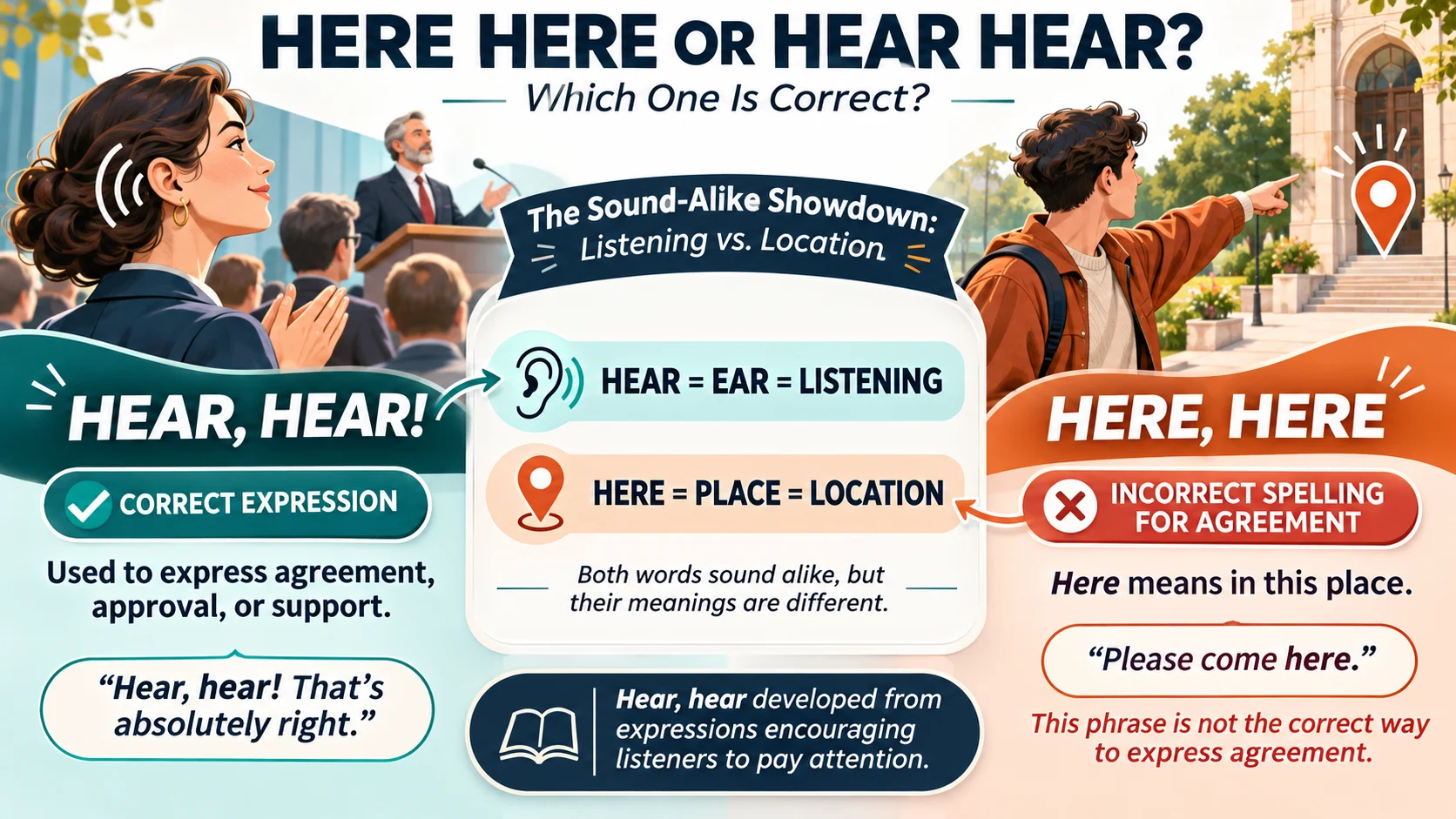
Hear, hear is the correct expression used to show agreement, approval, or support for something someone has said. Although it sounds like “here here,” the correct spelling uses hear because it comes from the verb hear. The phrase essentially means “I agree” or “I support what you just said.” Meanwhile, “here here” is generally an incorrect spelling when used in this context.
Have you ever heard someone say “hear, hear” during a speech, meeting, or lively conversation? This familiar expression often appears when someone wants to show strong agreement with another person’s statement. However, its spelling can confuse many English speakers because here here or hear hear sound exactly alike when spoken. As a result, people sometimes write the wrong version, even when they understand the expression perfectly.
The correct spelling is hear, hear, not “here, here.” The phrase has historical roots in parliamentary discussions and has gradually become a common way to express approval in everyday English. Moreover, people sometimes use it in online conversations, social media comments, and friendly discussions to show that they strongly support an opinion.
In this guide, you’ll learn the difference between here here and hear hear, discover the expression’s meaning and origin, and explore practical examples. Additionally, you’ll find helpful grammar tips, common mistakes, related expressions, and exercises to help you remember the correct spelling.
What Is the Difference Between Here Here and Hear Hear?
The main difference between these expressions is their spelling and meaning. Hear, hear is an established English expression used to communicate agreement or approval. On the other hand, “here, here” generally represents a spelling mistake when someone intends to use this expression.
Both versions sound identical because here and hear are homophones. However, they have different meanings and grammatical functions.
| Expression | Meaning | Correct Usage | Example |
|---|---|---|---|
| Hear, hear | Shows agreement or approval | Correct expression | “Hear, hear! That’s absolutely right.” |
| Here, here | Refers to a location or presence, if used literally | Not correct for expressing agreement | “Come here, here is your book.” |
| Hear | To listen or perceive sound | Correct verb | “I can hear the music.” |
| Here | In this place or location | Correct adverb | “Please come here.” |
Therefore, if you want to agree with someone’s statement, always write hear, hear.
Hear Hear Meaning
Hear, hear is an expression used to show enthusiastic agreement, approval, or support for something another person has said.
People commonly use it when someone makes a statement they strongly agree with. The expression can communicate that the speaker believes the statement is correct, important, or worth supporting.
For example:
“Everyone deserves an equal opportunity.”
“Hear, hear!”
In this conversation, the second person uses hear, hear to express agreement with the statement.
The expression is particularly common in formal discussions, public speeches, political debates, meetings, and humorous conversations. Nevertheless, it also works in casual situations.
In simple words, hear, hear means “I agree with you,” “That’s right,” or “Well said.”
Why Is It Hear Hear Instead of Here Here?
The correct spelling comes from the verb hear, which means to listen or receive sound.
Historically, the expression developed from the longer phrase “hear him, hear him” or “hear her, hear her.” People used these words to encourage others to listen to a speaker whose statement deserved attention or approval.
Over time, the longer expression became shortened to “hear, hear.”
Consequently, the spelling reflects the idea of listening to and acknowledging someone’s words rather than referring to a physical location.
Although here and hear have identical pronunciations, their meanings are different. Therefore, writing “here, here” changes the intended expression and makes it incorrect in this context.
Origin and History of Hear, Hear
The expression hear, hear has a long history in British English and is strongly associated with parliamentary traditions.
Its origins are connected to the phrase “hear him” or “hear her,” which people used to encourage an audience to listen to a speaker. During parliamentary discussions, listeners would use this expression to show support for a statement or draw attention to an important argument.
Eventually, the shorter form “hear, hear” became an established expression of approval.
The phrase also spread beyond parliamentary settings. Today, people use it during public speeches, formal meetings, debates, ceremonies, and ordinary conversations.
Although its historical association remains strong, the expression is not limited to politics or formal occasions. It can also add humor or enthusiasm to an informal discussion.
Here vs. Hear: Understanding the Difference
Since the confusion comes from two homophones, understanding their individual meanings makes the correct spelling easier to remember.
What Does Here Mean?
Here is an adverb that refers to a particular place or location. It tells someone where a person or object is situated.
Examples:
- “Please sit here beside me.”
- “Your package is here.”
- “I have lived here for five years.”
- “Come here when you finish your work.”
- “The keys are right here.”
A simple memory trick is to associate here with a place. Both words in the phrase “come here” point toward a location.
What Does Hear Mean?
Hear is a verb that means to perceive sound through your ears. It can also mean receiving information or listening to someone’s words.
Examples:
- “Can you hear the birds singing?”
- “I didn’t hear the announcement.”
- “We need to hear both sides of the story.”
- “Did you hear the latest news?”
- “I love hearing your ideas.”
Remember that hear relates to listening and sound.
Here vs. Hear Comparison Table
| Feature | Here | Hear |
|---|---|---|
| Part of speech | Adverb | Verb |
| Meaning | In this place | To perceive sound |
| Refers to | Location | Listening or sound |
| Pronunciation | /hɪr/ | /hɪr/ |
| Example | Come here. | I can hear you. |
| Memory trick | Here = Place | Hear = Ear |
The easiest way to remember the difference is to notice the word ear inside hear. Your ears help you hear sounds, while here tells you where something is.
Examples of Hear Hear in Everyday Conversations
Understanding examples can help you use the expression naturally. Here are several situations where hear, hear communicates agreement.
In Everyday Conversations
Example 1
Person A: “Everyone should have time to relax after work.”
Person B: “Hear, hear! We all need a break.”
Example 2
Person A: “Honesty is always the best policy.”
Person B: “Hear, hear. I completely agree.”
Example 3
Person A: “Good friends make difficult times easier.”
Person B: “Hear, hear! That’s so true.”
In Workplace Discussions
Example 4
Manager: “A successful team needs communication and trust.”
Employee: “Hear, hear! Those qualities make a real difference.”
Example 5
Colleague: “We should recognize everyone’s contribution to this project.”
Another colleague: “Hear, hear. Everyone worked hard.”
In Public Speeches
Example 6
Speaker: “Education should be accessible to everyone.”
Audience member: “Hear, hear!”
Example 7
Speaker: “We must protect our environment for future generations.”
Listener: “Hear, hear! That’s an important message.”
On Social Media
People also use the expression in comments and online discussions.
- “Everyone deserves kindness. Hear, hear!”
- “Self-respect should always come first. Hear, hear!”
- “Less negativity and more positivity. Hear, hear!”
- “We need more honest conversations. Hear, hear!”
These examples show that the expression works in different situations whenever someone wants to express agreement.
How to Use Hear, Hear Correctly
Using hear, hear is simple once you understand its purpose. However, the situation and tone can influence how natural it sounds.
Use it to express strong agreement.
When someone makes a statement you support, you can respond with “Hear, hear!”
Example: “We should always treat others with respect.”
Response: “Hear, hear!”
Use it to praise a meaningful statement.
The expression can also acknowledge an insightful or thoughtful comment.
Example: “Success means nothing if you lose your integrity.”
Response: “Hear, hear. Well said!”
Use it during speeches or discussions.
In formal settings, people may use the expression to show public approval.
Example: “Every student deserves a fair chance.”
Response: “Hear, hear!”
Use it humorously in casual conversations.
You can also use it playfully when someone says something relatable.
Example: “Weekends should definitely be three days long.”
Response: “Hear, hear!”
However, avoid using it when you simply want someone to listen to a sound. In that situation, use the verb hear in its ordinary grammatical sense.
Is Hear Hear Formal or Informal?
Hear, hear is suitable for both formal and informal situations.
Its traditional association with parliamentary discussions gives it a somewhat formal or old-fashioned feel. Nevertheless, people frequently use it in casual conversations to express enthusiastic agreement.
| Context | Example | Tone |
|---|---|---|
| Business meeting | “Hear, hear! Excellent suggestion.” | Professional |
| Political speech | “Hear, hear!” | Formal |
| Friendly conversation | “Hear, hear! That’s true.” | Casual |
| Social media | “Hear, hear! Couldn’t agree more.” | Supportive |
| Humorous discussion | “Hear, hear! More holidays, please.” | Playful |
| Public debate | “Hear, hear!” | Enthusiastic |
Therefore, you can use the expression in almost any setting where showing agreement feels appropriate.
Common Mistakes When Using Here and Hear
Even experienced English speakers sometimes confuse these words because they sound identical. Fortunately, a few simple rules can help you avoid common spelling mistakes.
Writing Here Here Instead of Hear Hear
This is the most common mistake when expressing agreement.
Incorrect: “Here, here! I completely agree.”
Correct: “Hear, hear! I completely agree.”
The correct expression uses hear because it comes from the idea of listening to and supporting someone’s statement.
Using Hear Instead of Here for a Location
Incorrect: “Come hear and sit beside me.”
Correct: “Come here and sit beside me.”
In this sentence, the speaker is referring to a physical location, so here is the correct word.
Using Here Instead of Hear for Sound
Incorrect: “I can here the music.”
Correct: “I can hear the music.”
Since the sentence describes perceiving sound, it requires the verb hear.
Forgetting the Comma
The traditional expression is written as hear, hear, with a comma separating the repeated words.
For example:
“Hear, hear! That’s exactly what I think.”
In informal digital communication, some people omit the comma, but the traditional punctuation is preferred in standard writing.
Synonyms and Alternatives to Hear, Hear
If you want to express agreement without repeating hear, hear, several alternatives can communicate the same idea.
| Alternative | Meaning | Example |
|---|---|---|
| I agree | You share someone’s opinion | “I agree with your point.” |
| Well said | Someone expressed an idea effectively | “Well said! That’s important.” |
| Absolutely | Strong agreement | “Absolutely! You’re right.” |
| Exactly | Complete agreement | “Exactly! That’s what I mean.” |
| So true | You believe something is correct | “So true! We need more kindness.” |
| Right on | Enthusiastic approval | “Right on! Great idea.” |
| Couldn’t agree more | Very strong agreement | “I couldn’t agree more.” |
| Amen | Strong agreement or approval | “Amen! That’s a powerful message.” |
Although these alternatives share a similar purpose, their tones are slightly different. For instance, well said praises someone’s wording, while absolutely expresses direct agreement.
Hear Hear vs. Here Here: Which One Should You Use?
The answer depends on what you want to communicate.
If you want to show agreement, use hear, hear. If you want to refer to a place, use here.
Consider these examples:
- “Hear, hear! We need more honesty.” (Agreement)
- “Please come here.” (Location)
- “I can hear the announcement.” (Listening)
- “Your phone is here.” (Location)
The important thing is to understand the meaning rather than rely only on pronunciation.
Since both words sound the same, checking the sentence’s context is the easiest way to select the correct spelling.
Memory Tricks to Remember Hear Hear
If you frequently confuse these expressions, try these simple memory techniques.
Connect Hear with Ear
The word hear contains the word ear. Since ears help you listen, remember that hear relates to listening and agreement.
Connect Here with Place
Think of the phrase “Put it here.” The word here identifies a location.
Remember the Full Expression
Think of “Hear, hear!” as another way of saying “Listen to that! I agree!”
Practice with Short Sentences
- Come here.
- I can hear you.
- Hear, hear! That’s correct.
- Your book is here.
With regular practice, you can recognize the correct word without hesitation.
Advantages and Disadvantages of Using Hear, Hear
Like other expressions of agreement, hear, hear has useful qualities, although it may not suit every conversation.
Advantages
- Expresses agreement quickly: It communicates support without requiring a long response.
- Shows enthusiasm: The expression can make your agreement sound more energetic.
- Works in different settings: You can use it in meetings, speeches, conversations, and online discussions.
- Adds personality: It can make a response sound friendly, humorous, or engaging.
- Recognizes good ideas: It acknowledges statements that deserve appreciation.
Disadvantages
- Can sound old-fashioned: Some people may consider it a traditional or formal expression.
- May confuse readers: People unfamiliar with the phrase might misunderstand its meaning.
- Can sound sarcastic: Depending on delivery, it may communicate irony rather than genuine support.
- Not suitable for every situation: A serious or sensitive conversation may require a more thoughtful response.
Nevertheless, when used naturally, hear, hear is an effective way to communicate agreement.
Related Grammar Comparisons
Here are some other commonly confused English words that sound alike or have different meanings.
| Word Pair | Difference |
|---|---|
| There vs. Their | Location vs. possession |
| Your vs. You’re | Possession vs. you are |
| To vs. Too | Direction vs. also or excessively |
| Its vs. It’s | Possession vs. it is |
| Then vs. Than | Time or sequence vs. comparison |
| Weather vs. Whether | Atmospheric conditions vs. alternatives |
| Allowed vs. Aloud | Permitted vs. spoken audibly |
| See vs. Sea | Perceive with eyes vs. large body of salt water |
Learning these differences can improve your spelling, writing, and everyday communication.
Practice Exercises: Here Here or Hear Hear
Test your understanding with these quick exercises. Choose the correct word for each sentence.
Fill in the blanks:
- “________! That’s exactly what I believe.”
- Please come ________ and sit with us.
- Can you ________ the birds outside?
- “________! Everyone deserves equal treatment.”
- Your bag is over ________.
- I couldn’t ________ what the teacher said.
- “________! That’s a wonderful suggestion.”
- Put the keys right ________ on the table.
Multiple-Choice Questions:
- Which expression shows agreement?A. Here, here
B. Hear, hear
C. Hear, here - What does here mean?
A. To listen
B. To agree
C. In this place
- Which sentence is correct?
A. I can here the music.
B. I can hear the music.
C. I can hear here music.
- Which spelling is traditionally used to express approval?
A. Here here
B. Hear hear
C. Here hear
Exercise Answers
- Hear, hear
- Here
- Hear
- Hear, hear
- Here
- Hear
- Hear, hear
- Here
- B. Hear, hear
- C. In this place
- B. I can hear the music.
- B. Hear hear (traditionally written with a comma: hear, hear).
Frequently Asked Questions
Is it here here or hear hear?
Hear, hear is the correct expression when showing agreement or approval. Although both versions sound identical, the traditional spelling uses hear because it relates to listening to and supporting someone’s statement.
What does hear hear mean?
Hear, hear means “I agree,” “That’s right,” or “Well said.” People use it to show enthusiasm or support for another person’s opinion or statement.
Why do people say hear hear?
People say hear, hear to express agreement and encourage others to recognize a statement. The expression developed from longer phrases such as “hear him” and became associated with public approval and parliamentary discussions.
Is here here ever correct?
The words here here can appear together in a sentence when they refer to a place, but they are not the correct spelling of the expression used to show agreement.
Is hear hear one word or two?
Hear, hear is written as two separate words, traditionally separated by a comma. It is a repeated expression rather than a single word.
Is hear hear sarcastic?
Not necessarily. The expression usually communicates genuine agreement or approval. However, someone can use it sarcastically depending on their tone, context, and intention.
Can I use hear hear in a text message?
Yes. You can use hear, hear in text messages, social media comments, and online conversations to show agreement.
Example: “Everyone deserves a little happiness. Hear, hear!”
Is hear hear British or American English?
The expression has strong historical roots in British English, particularly parliamentary traditions. However, American English speakers also understand and use it.
What is another way to say hear hear?
Common alternatives include “I agree,” “absolutely,” “well said,” “exactly,” “so true,” and “couldn’t agree more.”
Do you put a comma between hear hear?
Yes. The traditional spelling is hear, hear! The comma separates the repeated words and reflects the established written form.
What is the difference between hear and here?
Hear is a verb meaning to perceive sound, while here is an adverb referring to a location. Both words sound alike, but their meanings and grammatical uses are different.
Key Takeaways
The difference between here here and hear hear becomes simple once you understand their meanings.
- Hear, hear is the correct expression for showing agreement or approval.
- Here refers to a place or location.
- Hear relates to listening and perceiving sound.
- Both words are homophones because they share the same pronunciation.
- The traditional expression comes from historical phrases used to encourage people to listen.
- You can use hear, hear in formal discussions, casual conversations, and social media comments.
Most importantly, remember this simple rule: If you agree with someone, write “hear, hear!” If you’re talking about a place, use “here.”
Conclusion
Choosing between here here or hear hear becomes easy when you understand the difference between these two homophones. Although they sound exactly alike, only hear, hear is the established expression for showing agreement, approval, or support. The phrase has historical connections to parliamentary discussions, but today it also appears in everyday conversations, workplace meetings, public speeches, and social media comments.
On the other hand, here refers to a location, while hear means to perceive sound. Therefore, remembering the connection between hear and ear can help you avoid this common spelling mistake.
Ultimately, whenever someone makes a statement you strongly support, you can confidently respond with “Hear, hear!”