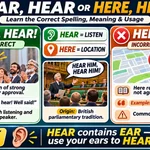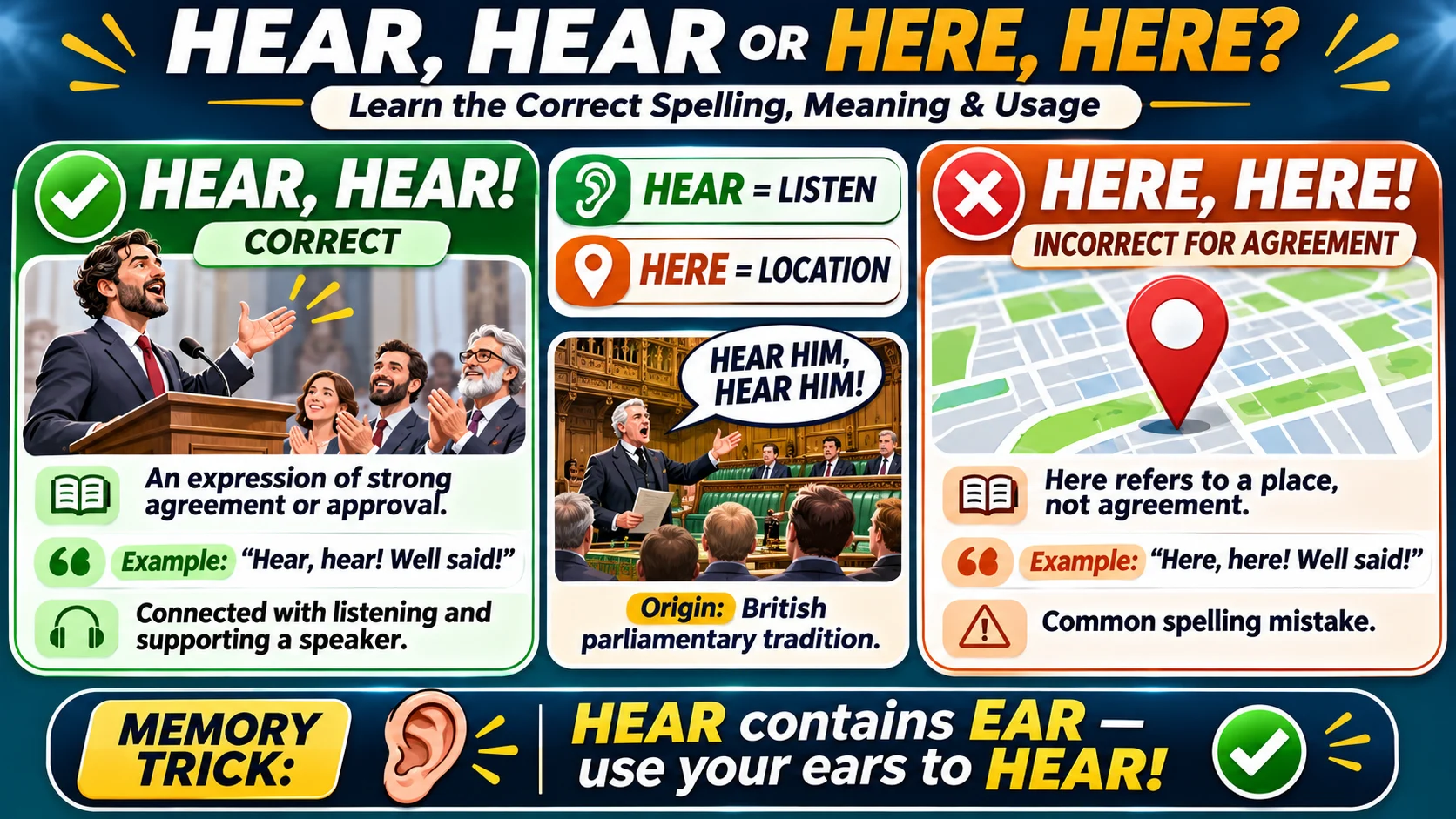
Hear, hear is the correct expression used to show strong agreement, support, or approval of someone’s statement. The phrase originated from the older parliamentary expression “Hear him, hear him,” which encouraged people to listen to a speaker. In contrast, here, here is a common misspelling because hear and here sound identical but have different meanings.
Have you ever heard someone enthusiastically shout “hear, hear!” during a speech, meeting, or celebration and wondered whether the correct spelling is hear hear or here here? Although both versions sound exactly the same, only one is correct when expressing agreement or approval. This commonly confused expression often appears in public discussions, formal gatherings, and even casual online conversations.
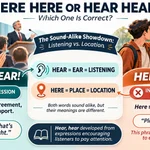
The confusion happens because hear and here are homophones, meaning they have identical pronunciations but different spellings and meanings. While hear refers to listening or perceiving sounds, here refers to a particular place or location. Therefore, understanding the relationship between these words makes the correct spelling easier to remember.
Moreover, the expression has an interesting historical connection to British parliamentary traditions. Originally, people used it to encourage others to listen to an important speaker. Over time, however, the phrase developed into a familiar way of showing enthusiastic support for someone’s opinion.
In this guide, you’ll discover the correct spelling, meaning, pronunciation, historical origin, and practical examples of this expression. Additionally, we’ll explore common mistakes, related phrases, and helpful memory tricks so you can use it confidently in everyday English.
Is It Hear Hear or Here Here?
The correct expression is “hear, hear!”
It is used to express enthusiastic agreement, approval, or support for something another person has said.
For example:
Correct: “Hear, hear! I completely agree with your suggestion.”
Incorrect: “Here, here! I completely agree with your suggestion.”
Although the second version is commonly seen in informal writing, it is considered a spelling mistake when the intended meaning is agreement.
The correct expression uses hear because it originally encouraged listeners to pay attention to a speaker’s words.
Meanwhile, here refers to a location and does not communicate that meaning.
Therefore, whenever you want to express strong agreement, choose “hear, hear!”
Hear, Hear vs. Here, Here
| Feature | Hear, Hear | Here, Here |
|---|---|---|
| Correct expression | Yes | No, when expressing agreement |
| Meaning | Strong agreement or approval | No established agreement meaning |
| Main word | Hear | Here |
| Word meaning | Listen or perceive sound | A particular location |
| Origin | Parliamentary expression | Common spelling confusion |
| Typical usage | Speeches, debates, discussions | Usually a mistaken spelling |
| Example | “Hear, hear! Well said!” | “Here, here! Well said!” |
| Recommended usage | Use this spelling | Avoid for expressing approval |
The main distinction is straightforward. One expression encourages listening and communicates support, whereas the other mistakenly substitutes a word referring to location.
What Does Hear, Hear Mean?
The phrase “hear, hear!” is an exclamation used to express strong approval of something someone has just said.
In simple words, it means:
- I completely agree.
- Well said!
- That’s absolutely right.
- I strongly support that statement.
- You’ve made an excellent point.
- I agree with what the speaker is saying.
For example, imagine someone at a meeting says:
“We should recognize employees for their hard work.”
Another person responds:
“Hear, hear!”
The response communicates enthusiastic agreement with the speaker’s suggestion.
Similarly, people may use the expression after a toast, public speech, or thoughtful statement.
Although the phrase is particularly associated with formal settings, it can also appear humorously or enthusiastically in informal conversations.
What Does Here, Here Mean?
The words “here, here” do not form a standard English expression for agreement.
Individually, here means “in this place” or “at this location.”
For example:
- “Come here.”
- “Your bag is here.”
- “We should meet here.”
- “Put the chair here.”
However, repeating the word does not turn it into an expression of approval.
Someone might literally repeat here while identifying locations or calling attention to a place, but that usage is unrelated to the established exclamation.
Consequently, writing “here, here!” after a speech is generally considered incorrect.
The mistake occurs because both words sound identical when spoken aloud.
Why Is Hear, Hear the Correct Spelling?
The expression uses the verb hear, which means to perceive sound or listen to someone.
Historically, the words encouraged an audience to pay attention to a speaker.
In other words, the original idea was similar to saying:
“Listen to what this person is saying!”
Over time, encouraging people to hear a statement became associated with approving or supporting it.
Therefore, the phrase developed its modern meaning of enthusiastic agreement.
On the other hand, the word here identifies a location.
Since the expression concerns listening and approval rather than physical position, the spelling with hear is correct.
Origin and History of Hear, Hear
The expression has a long history connected with British parliamentary traditions.
Its development can be traced to earlier forms such as “hear him, hear him!”, which encouraged members of an assembly to pay attention to a speaker.
Historical examples of related expressions date back to the seventeenth century.
According to discussions of the Oxford English Dictionary’s historical evidence, early recorded versions include calls directing attention to a person who was speaking.
As the expression became more established, the longer wording was gradually shortened.
Eventually, “hear, hear!” became a recognizable parliamentary exclamation.
The Connection to British Parliament
During parliamentary debates, members have traditionally used verbal expressions to show agreement or respond to speakers.
The phrase became particularly associated with the British House of Commons.
Instead of simply applauding, members could call out their approval while another person spoke.
For example, a member might support a proposal about public policy, prompting approving responses from colleagues.
Consequently, the expression developed a strong association with political debate, public speaking, and formal discussion.
How the Meaning Changed
Originally, the phrase encouraged attention.
Its early purpose was essentially:
“Listen to the speaker!”
However, its meaning gradually expanded.
Today, it is more commonly understood as:
“I agree with that statement!”
Thus, the modern expression emphasizes approval rather than merely requesting that someone listen.
For additional historical information, see Dictionary.com’s entry on hear, hear.
How to Use Hear, Hear in a Sentence
The expression is usually spoken or written as a separate exclamation.
It frequently appears after someone makes a statement that receives strong support.
Examples in Formal Settings
- “Hear, hear! The committee has made an excellent decision.”
- “The audience responded with cries of ‘Hear, hear!'”
- “Hear, hear! Every employee deserves fair treatment.”
- “Several members shouted ‘Hear, hear!’ during the debate.”
- “Hear, hear! The speaker has raised an important issue.”
These examples demonstrate the phrase’s connection with public speaking and formal approval.
Examples in Everyday Conversations
- “Hear, hear! We all deserve a relaxing weekend.”
- “Hear, hear! That restaurant really is amazing.”
- “I think everyone should get an extra holiday.” “Hear, hear!”
- “Hear, hear! Spending more time with family is important.”
- “We should order dessert first.” “Hear, hear!”
Although the wording may sound slightly old-fashioned, it can add humor and enthusiasm to casual discussions.
Examples in Workplace Conversations
- “Hear, hear! Better communication would help the entire team.”
- “We should celebrate everyone’s achievements.” “Hear, hear!”
- “Hear, hear! Flexible working arrangements can benefit employees.”
- “The team deserves recognition for its dedication.” “Hear, hear!”
- “Hear, hear! That is a practical solution.”
In professional settings, the expression may sound playful or traditional depending on the audience.
Hear, Hear in British English
The expression is especially familiar in British English because of its parliamentary history.
It is commonly associated with political debates, speeches, ceremonies, and formal gatherings.
For example:
“The members responded with enthusiastic cries of ‘Hear, hear!'”
Furthermore, the phrase appears in British literature, historical dramas, and discussions about parliamentary procedure.
However, it is not restricted to politics.
British speakers may also use it informally to express enthusiastic agreement with a friend’s opinion or a humorous observation.
Therefore, its meaning remains recognizable across both formal and casual situations.
Hear, Hear in American English
American English also recognizes the expression, although it is generally less common in everyday conversation.
Many American speakers prefer alternatives such as:
- Absolutely!
- Exactly!
- Well said!
- I agree!
- That’s right!
Nevertheless, “hear, hear!” appears in American writing, public discussions, speeches, and humorous conversations.
For example:
“Everyone deserves a fair opportunity.” “Hear, hear!”
The expression can sound traditional, dramatic, or playfully formal in an American context.
Consequently, writers should consider their audience and tone before choosing it.
How Do You Pronounce Hear, Hear?
The phrase is pronounced:
“HEER, HEER!”
Both words sound exactly like the English word here.
This identical pronunciation explains why spelling mistakes are so common.
The words are examples of homophones.
Homophones are words that sound alike but have different meanings or spellings.
Other examples include:
| Word Pair | Meaning |
|---|---|
| Hear / Here | Listen / Location |
| Their / There | Possession / Place |
| To / Too | Direction / Also |
| Right / Write | Correct / Form letters |
| Peace / Piece | Harmony / Portion |
| Sea / See | Ocean / Look |
| Flour / Flower | Baking ingredient / Plant bloom |
Because pronunciation cannot distinguish the two words, writers must rely on meaning and context.
Why Do People Confuse Hear and Here?
The confusion comes primarily from their identical pronunciation.
When someone hears the expression aloud, they may assume it contains the word here.
Additionally, both spellings are common English words, so ordinary spell-checking tools may not always identify the mistake.
Identical Pronunciation
The two words sound the same.
For example:
“I can hear the music.”
“Please come here.”
Although their meanings differ, the pronunciation does not.
Therefore, someone unfamiliar with the expression’s history might select the wrong spelling.
Similar Appearance
Both words begin with “he” and end with “r” and “e” or similar letter patterns.
This visual similarity can make them easy to confuse.
However, their grammatical meanings are different.
Limited Knowledge of the Origin
Many people recognize the expression from movies, television programs, or speeches without knowing its historical background.
Consequently, the phrase may be remembered by sound rather than meaning.
Learning about its connection to listening makes the correct spelling much easier to recognize.
Hear vs. Here: Understanding the Individual Words
To avoid confusion, it helps to understand how each word functions independently.
Hear Meaning
Hear is a verb referring to perceiving sound through the ears.
Examples:
- “Can you hear me?”
- “I heard a strange noise.”
- “She likes to hear stories.”
- “We could hear the audience cheering.”
- “Did you hear the announcement?”
The word is directly connected with listening and sound.
Here Meaning
Here generally functions as an adverb indicating a location or position.
Examples:
- “Please sit here.”
- “My phone is here.”
- “We arrived here yesterday.”
- “Come here for a moment.”
- “The meeting will take place here.”
Unlike hear, this word refers to where something or someone is located.
Quick Grammar Comparison
| Word | Part of Speech | Meaning | Example |
|---|---|---|---|
| Hear | Verb | Perceive sound | I hear the music. |
| Here | Adverb | In this location | The book is here. |
| Hear, hear! | Interjection | Express agreement | Hear, hear! Well said! |
Understanding these differences makes the correct expression easier to remember.
Hear, Hear in Formal Speeches and Debates
Formal speeches provide one of the most recognizable settings for the expression.
For example, a speaker might argue that education should be accessible to everyone.
An audience member could respond:
“Hear, hear!”
This response indicates approval and support.
Similarly, the expression may appear during a debate when participants want to acknowledge a convincing argument.
However, its appropriateness depends on the event’s customs.
In some formal meetings, interrupting a speaker could be considered inappropriate even when the interruption expresses agreement.
Therefore, participants should follow the communication practices of their particular setting.
Can You Say Hear, Hear in Casual Conversation?
Yes. The expression can be used in everyday conversation, especially when someone makes a statement you strongly support.
For example:
Friend A: “I think weekends should be three days long.”
Friend B: “Hear, hear!”
Here, the response adds a humorous sense of enthusiastic approval.
Similarly, someone might use it when agreeing with an opinion about food, entertainment, or daily life.
Nevertheless, the expression is less common than simple responses such as “Exactly!” or “I agree!”
As a result, it may sound theatrical or playful in informal conversation.
Is Hear, Hear Formal or Informal?
The expression is historically associated with formal speech, but its modern usage can be either formal or informal.
Its tone depends largely on context.
| Situation | Typical Tone | Appropriate? |
|---|---|---|
| Parliamentary debate | Traditional and formal | Yes |
| Public speech | Supportive | Yes |
| Celebration toast | Enthusiastic | Yes |
| Workplace meeting | Slightly formal or playful | Usually |
| Casual conversation | Humorous | Yes |
| Social media comment | Playful agreement | Yes |
| Academic essay | Usually unnecessary | Depends on context |
Although the phrase is flexible, it is best used when expressing strong approval of a specific statement.
Hear, Hear on Social Media
The expression also appears in online discussions.
People sometimes use it in comments to show that they strongly support another person’s opinion.
For example:
Post: “Everyone should have time to rest and recharge.”
Comment: “Hear, hear!”
Similarly, a user might write:
“Great point. Hear, hear!”
In these situations, the phrase works as a concise expression of agreement.
However, some people mistakenly write “here, here” because they are unfamiliar with the established spelling.
Therefore, using the correct version improves clarity and demonstrates an understanding of the expression.
Hear, Hear vs. Other Expressions of Agreement
Several English expressions communicate meanings similar to “hear, hear!”
However, their tone and level of formality can differ.
| Expression | Meaning | Tone |
|---|---|---|
| Hear, hear! | Strong approval | Traditional or enthusiastic |
| Well said! | Praise for a statement | Positive |
| Absolutely! | Complete agreement | Conversational |
| Exactly! | Strong agreement | Informal |
| I couldn’t agree more. | Full agreement | Neutral |
| That’s right! | Confirmation | Casual |
| Indeed! | Agreement or emphasis | Formal or neutral |
| Amen to that! | Enthusiastic approval | Informal or emphatic |
For example, “Well said!” works naturally after a thoughtful speech.
Meanwhile, “Exactly!” may be more suitable during an informal conversation.
Therefore, selecting the appropriate expression depends on the situation and your intended tone.
Is Hear, Hear the Same as Hear Ye, Hear Ye?
No. Although the expressions both contain the word hear, they serve different purposes.
Hear, hear! expresses agreement or approval of something that has already been said.
In contrast, hear ye, hear ye! is a traditional announcement calling for public attention.
For example:
“Hear ye, hear ye! The court is now in session.”
The second phrase is associated with ceremonial proclamations and historical public announcements.
Comparison Table
| Phrase | Meaning | Typical Usage |
|---|---|---|
| Hear, hear! | I strongly agree | Debates, speeches, discussions |
| Hear ye, hear ye! | Listen to this announcement | Ceremonies and proclamations |
| Listen up! | Pay attention | Informal instructions |
| Well said! | I approve of that statement | Speeches and conversations |
Although the phrases share a connection with listening, they should not be used interchangeably.
Common Mistakes to Avoid
Several errors frequently occur when people write or use this expression.
Writing Here, Here Instead of Hear, Hear
This is the most common mistake.
Incorrect: “Here, here! That’s an excellent idea.”
Correct: “Hear, hear! That’s an excellent idea.”
The correct expression refers to listening and approval, not a location.
Confusing the Phrase With Hear Ye, Hear Ye
Some writers assume that both expressions mean the same thing.
However, one communicates agreement while the other calls for attention.
Therefore, choose the phrase based on the intended meaning.
Using the Expression Without Context
Saying “hear, hear!” without a preceding statement can confuse listeners.
The phrase normally responds to something another person has said.
For example:
“We should support our local schools.”
“Hear, hear!”
This exchange provides a clear reason for the expression.
Overusing the Phrase
Although the expression can sound enthusiastic, repeating it too frequently may seem unnatural.
Instead, alternate it with simple responses such as “I agree,” “Well said,” or “Absolutely.”
Assuming It Is Only British English
The expression has strong British historical associations.
Nevertheless, American and other English-speaking audiences may also understand and use it.
Consequently, it should not be treated as exclusively British vocabulary.
Easy Trick to Remember Hear, Hear
One simple memory trick is:
HEAR contains EAR.
You use your EAR to HEAR someone’s words.
Therefore, when you strongly agree with a speaker, you say:
“Hear, hear!”
Another helpful reminder is:
Hear = Listen
Here = Location
Since the expression originally encouraged people to listen, it uses the word connected with hearing.
For example:
Correct: “Hear, hear! I support that proposal.”
Incorrect: “Here, here! I support that proposal.”
This connection makes the correct spelling easy to recall.
Practice Exercises: Choose the Correct Expression
Test your understanding with the following examples.
Practice Questions
Sentence A:
The audience shouted, “______!” after the inspiring speech.
Options: Hear, hear / Here, here
Sentence B:
“Everyone deserves equal opportunities.” “______!”
Options: Hear, hear / Here, here
Sentence C:
The committee members expressed approval by calling, “______!”
Options: Hear, hear / Here, here
Sentence D:
“Let’s give our volunteers more recognition.” “______!”
Options: Hear, hear / Here, here
Sentence E:
The enthusiastic response from the crowd was “______!”
Options: Hear, hear / Here, here
Answers and Explanations
Sentence A: Hear, hear!
The audience is expressing approval of the speech.
Sentence B: Hear, hear!
The response communicates strong agreement.
Sentence C: Hear, hear!
The members are verbally supporting the speaker.
Sentence D: Hear, hear!
The phrase shows enthusiastic approval of the proposal.
Sentence E: Hear, hear!
The crowd is responding positively to what was said.
All five examples require the same spelling because each involves agreement rather than location.
Why Correct Spelling Matters
Using familiar expressions accurately helps readers understand your intended meaning.
Moreover, correct spelling is particularly important in professional, educational, and published writing.
Improves Written Communication
Readers are less likely to become distracted by incorrect wording.
For example, “Hear, hear!” clearly communicates a recognized expression of approval.
Demonstrates Language Knowledge
Correct idiomatic usage shows that you understand the meaning behind the words.
Additionally, recognizing common homophones can improve your overall writing accuracy.
Supports Professional Writing
Editors and professional writers generally follow established spelling conventions.
Therefore, using the recognized expression prevents unnecessary corrections.
Helps English Learners
Understanding why the phrase uses hear rather than here helps learners distinguish between sound and location vocabulary.
Consequently, the lesson can also improve accuracy in unrelated sentences containing these words.
Frequently Asked Questions
Is it hear, hear or here, here?
The correct expression is “hear, hear!” It communicates strong agreement, approval, or support for a statement. Meanwhile, “here, here” is a common spelling mistake when used with that meaning.
What does hear, hear mean?
The expression means “I strongly agree,” “Well said,” or “I support that statement.” It is often used after speeches, debates, or comments that receive enthusiastic approval.
Why do people say hear, hear?
People use the phrase to express agreement or encourage support for a speaker. Historically, it developed from expressions urging an audience to listen to someone’s words.
Where did hear, hear originate?
The expression is closely associated with British parliamentary traditions. Earlier forms, including “hear him, hear him,” were used to direct attention toward a speaker before the shortened phrase became established.
Is hear, hear British English?
It is especially associated with British English and parliamentary debates. However, the expression is also recognized in American English and other English-speaking communities.
Is here, here ever correct?
The words here, here may appear together in unusual literal contexts involving locations. However, they do not form the standard expression of agreement. For that meaning, always use “hear, hear!”
Do you put a comma between hear and hear?
Yes, “Hear, hear!” is a common written form. However, dictionaries and historical writing may also show “Hear! Hear!” with separate exclamation marks.
Can you say hear, hear in a text message?
Yes. You can use “hear, hear!” in text messages, social media comments, and online conversations to express enthusiastic agreement. Nevertheless, it may sound slightly formal or playful.
What is another way to say hear, hear?
Similar expressions include “Well said!”, “Absolutely!”, “Exactly!”, “I couldn’t agree more,” and “That’s right!” Each communicates agreement, although the tone varies.
Is hear, hear the same as amen?
Both can express enthusiastic agreement in certain contexts. However, “amen” also has an important religious meaning, whereas “hear, hear!” is historically associated with listening to and supporting a speaker.
Can hear, hear be sarcastic?
Yes. Like many expressions, it can be used sarcastically depending on the speaker’s tone and context. However, its ordinary meaning is sincere agreement or approval.
Conclusion
Understanding the difference between hear hear or here here is simple once you know the expression’s meaning and historical background. “Hear, hear!” is the correct spelling when you want to express enthusiastic agreement, approval, or support for someone’s statement. In contrast, “here, here” is a common mistake caused by the identical pronunciation of hear and here.
Furthermore, the phrase originated from traditional calls encouraging listeners to pay attention to a speaker, particularly in British parliamentary settings. Over time, it became a familiar expression of agreement that continues to appear in speeches, discussions, celebrations, and casual conversations.
Most importantly, remember that hear relates to listening, while here refers to location. Whether you’re writing an article, responding to an inspiring speech, or agreeing with a friend’s opinion, choosing “hear, hear!” will help you communicate clearly and confidently.
References and Further Reading
For additional information about the expression, its meaning, and historical usage, explore these authoritative language resources:
- Cambridge Dictionary — Hear, Hear! — Standard definition and English usage.
- Collins English Dictionary — Hear, Hear! — Meaning and examples of the expression.
- Dictionary.com — Hear, Hear — Definition and historical background.
- Grammarly — Here, Here vs. Hear, Hear — Explanation of the correct spelling and common confusion.